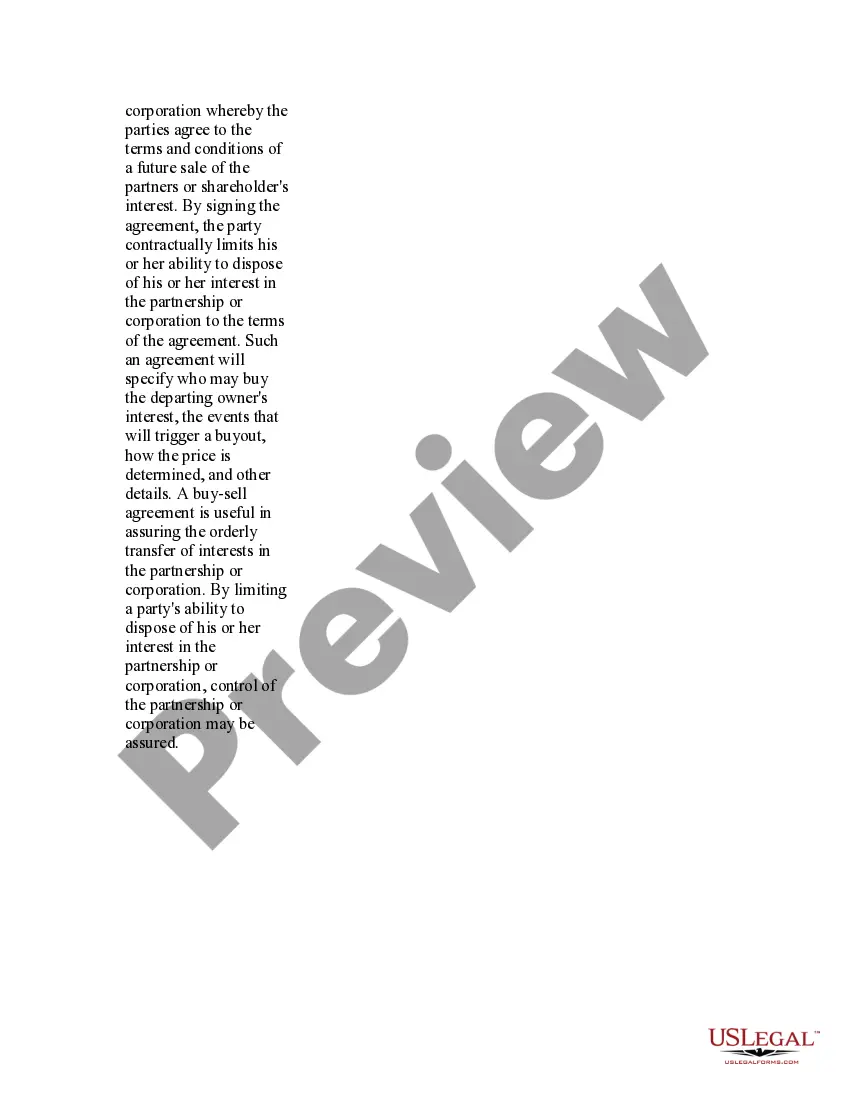
This pamphlet provides an overview of silent partners. Topics covered include what a silent partner is, steps to take before becoming a silent partner, and how buy-sell agreements are used.
District of Columbia USLegal Pamphlet on Silent Partners
Category:
State:
Multi-State
Control #:
US-PMPH-17
Format:
Word;
Rich Text
Instant download
Description
Free preview
How to fill out USLegal Pamphlet On Silent Partners?
You can allocate time online attempting to locate the legal document template that meets the state and federal requirements you require.
US Legal Forms provides a vast selection of legal forms that have been reviewed by experts.
You can easily download or print the District of Columbia USLegal Pamphlet on Silent Partners from my service.
If available, utilize the Preview button to browse the document template as well. If you wish to find another version of the form, use the Search field to locate the template that meets your needs and requirements. Once you have identified the template you need, click Buy now to proceed. Select the pricing plan you want, enter your details, and register for an account on US Legal Forms. Complete the transaction. You can use your Visa or Mastercard or PayPal account to pay for the legal document. Choose the format of the document and download it to your device. Make modifications to your document if possible. You can complete, alter, sign, and print the District of Columbia USLegal Pamphlet on Silent Partners. Obtain and print a multitude of document templates using the US Legal Forms website, which offers the largest collection of legal forms. Utilize professional and state-specific templates to address your business or personal needs.
- If you have a US Legal Forms account, you can Log In and then click the Acquire button.
- After that, you can complete, modify, print, or sign the District of Columbia USLegal Pamphlet on Silent Partners.
- Each legal document template you obtain is yours permanently.
- To get another copy of any purchased form, visit the My documents section and click the corresponding button.
- If you're using the US Legal Forms website for the first time, follow the simple instructions below.
- First, ensure you have selected the correct document template for the area/city of your choice.
- Review the form description to confirm you have selected the appropriate document.
Form popularity
FAQ
The percentage of ownership that silent partners receive can vary significantly based on the terms outlined in the partnership agreement. Typically, silent partners invest capital in the business but do not participate in daily operations. Therefore, their ownership percentage reflects their financial contribution rather than operational involvement. For more precise guidance on structuring these partnerships, refer to the District of Columbia USLegal Pamphlet on Silent Partners, which provides valuable insights.
Yes, a silent partner can be sued under certain circumstances. If the silent partner's actions lead to legal issues for the business, or if they violate the terms of the partnership agreement, they might face legal consequences. The District of Columbia USLegal Pamphlet on Silent Partners outlines the liabilities of silent partners, making it easier to navigate these situations. Utilizing this pamphlet can help clarify the legal responsibilities involved in your partnership.
The percentage a silent partner receives often depends on the terms set in the partnership agreement. Typically, this can range from 10% to 50% of profits, depending on their initial investment and involvement in the business. It’s crucial to refer to the District of Columbia USLegal Pamphlet on Silent Partners for guidance on structuring these agreements effectively. This resource can help ensure that all parties understand their rights and obligations.
Silent partners typically have limited liability, meaning they are not personally responsible for the debts of the business beyond their investment. However, it's essential to outline these terms clearly in the partnership agreement to avoid misunderstandings. The District of Columbia USLegal Pamphlet on Silent Partners can provide further insights on this important topic.
The ownership percentage for a silent partner varies based on the initial investment and the terms of the partnership agreement. Generally, their share reflects their capital contribution relative to the total investment in the business. For a comprehensive breakdown, check out the District of Columbia USLegal Pamphlet on Silent Partners.
A 51% to 49% partnership indicates that one partner holds a controlling interest in the business, while the other has a minority stake. This structure allows the majority partner to make key decisions and manage the company effectively. To understand how this affects silent partners, consult the District of Columbia USLegal Pamphlet on Silent Partners.
The percentage a silent partner receives often depends on the agreement made between the partners. Typically, a silent partner may receive a share of the profits proportional to their investment. For more detailed guidance on this topic, refer to the District of Columbia USLegal Pamphlet on Silent Partners.
The silent partner rule refers to the arrangement in which a partner contributes capital to a business but does not participate in its daily operations. This type of partner typically remains anonymous and is not involved in decision-making processes. You can learn more about this arrangement in the District of Columbia USLegal Pamphlet on Silent Partners.