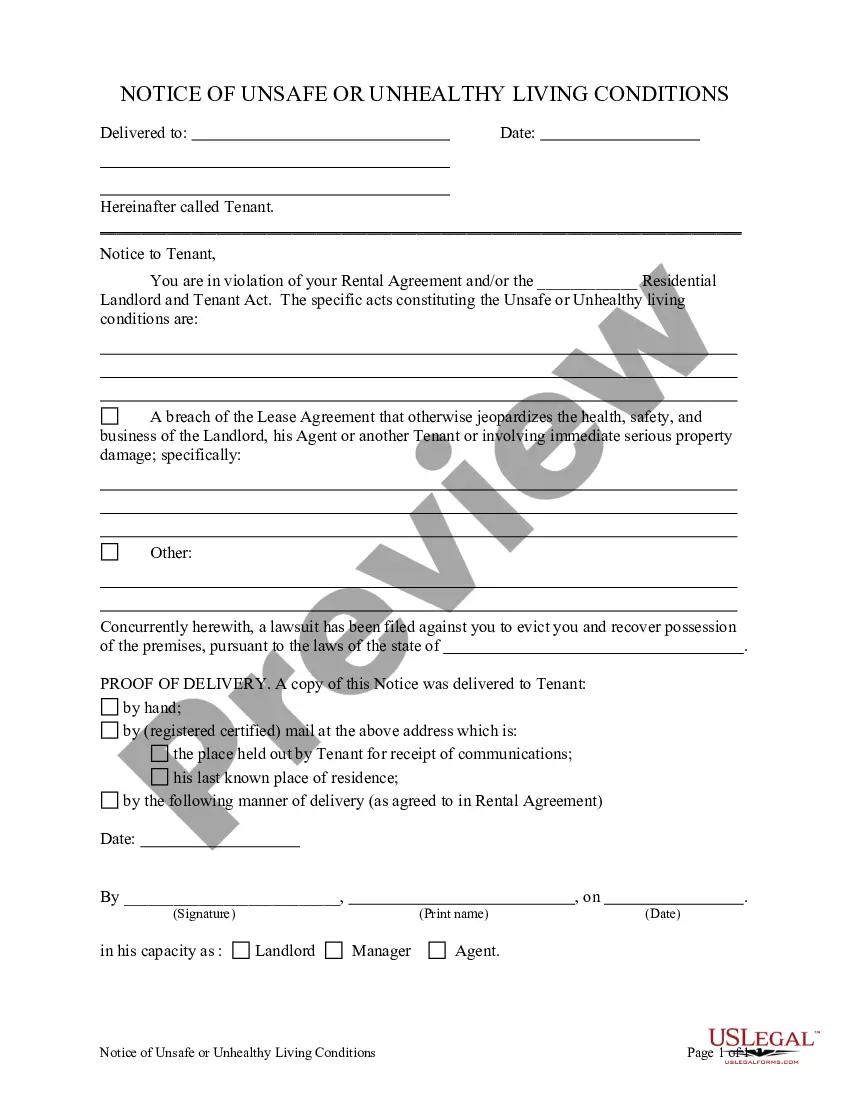
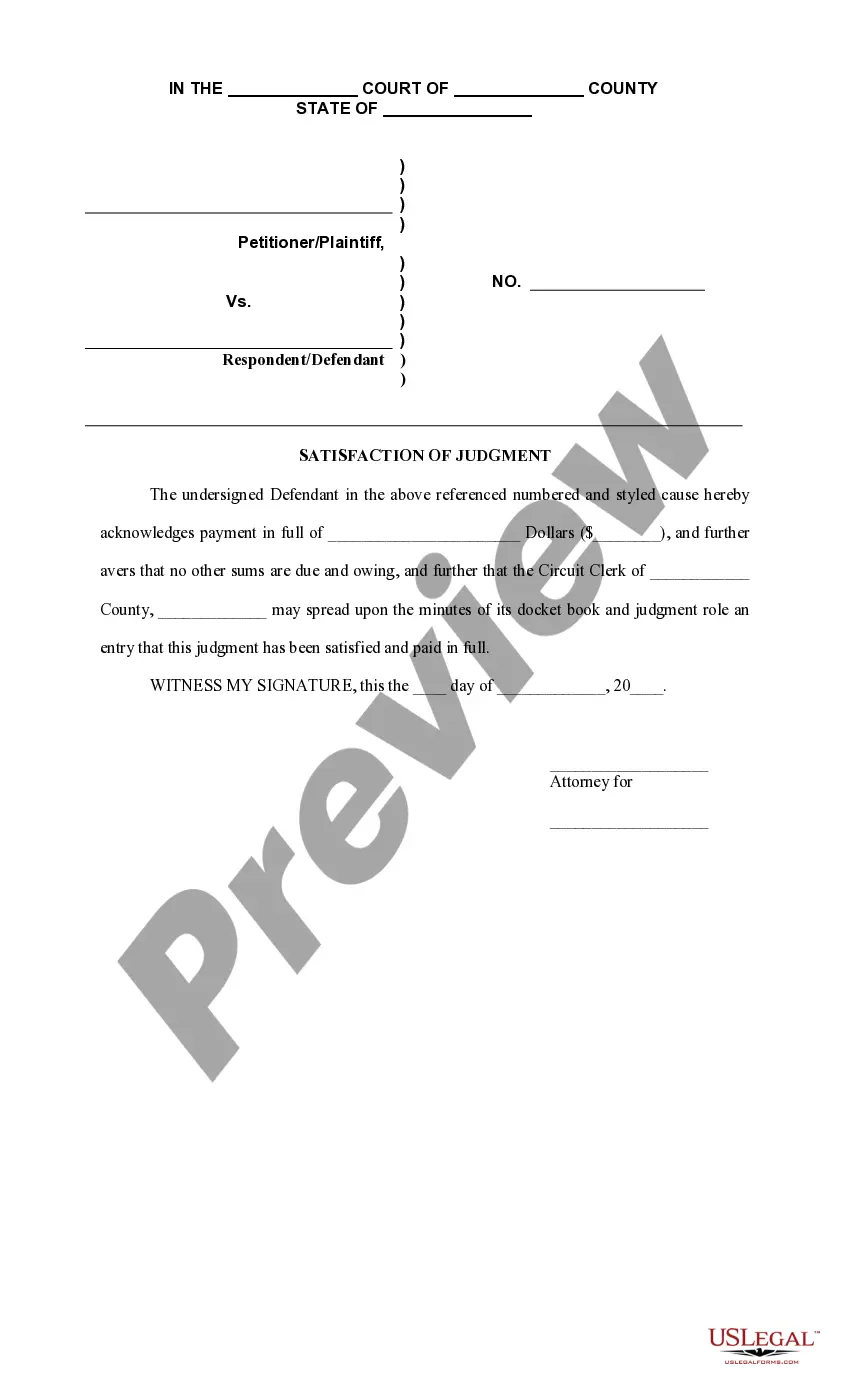
This form is a sample acknowledgment by the defendant that the plaintiff has satisfied a ruling in favor of the defendant.
District of Columbia Satisfaction of Judgment for Civil Trial
State:
Multi-State
Control #:
US-PI-0065
Format:
Word;
Rich Text
104 downloads
Description
Get your form ready online
Our built-in tools help you complete, sign, share, and store your documents in one place.
Built-in online Word editor
Make edits, fill in missing information, and update formatting in US Legal Forms—just like you would in MS Word.
Export easily
Download a copy, print it, send it by email, or mail it via USPS—whatever works best for your next step.
E-sign your document
Sign and collect signatures with our SignNow integration. Send to multiple recipients, set reminders, and more. Go Premium to unlock E-Sign.
Notarize online 24/7
If this form requires notarization, complete it online through a secure video call—no need to meet a notary in person or wait for an appointment.
Store your document securely
We protect your documents and personal data by following strict security and privacy standards.

Make edits, fill in missing information, and update formatting in US Legal Forms—just like you would in MS Word.

Download a copy, print it, send it by email, or mail it via USPS—whatever works best for your next step.

Sign and collect signatures with our SignNow integration. Send to multiple recipients, set reminders, and more. Go Premium to unlock E-Sign.

If this form requires notarization, complete it online through a secure video call—no need to meet a notary in person or wait for an appointment.

We protect your documents and personal data by following strict security and privacy standards.
Looking for another form?


How to fill out Satisfaction Of Judgment For Civil Trial?
It is possible to commit time online trying to find the legitimate papers template that suits the state and federal requirements you want. US Legal Forms gives a huge number of legitimate types that happen to be evaluated by professionals. It is possible to down load or printing the District of Columbia Satisfaction of Judgment for Civil Trial from the assistance.
If you already possess a US Legal Forms profile, you can log in and click the Down load button. Next, you can full, modify, printing, or indicator the District of Columbia Satisfaction of Judgment for Civil Trial. Every legitimate papers template you buy is the one you have eternally. To have yet another copy of the purchased kind, proceed to the My Forms tab and click the related button.
Should you use the US Legal Forms site for the first time, follow the easy instructions listed below:
- First, ensure that you have selected the correct papers template for that state/town of your choice. See the kind information to ensure you have chosen the appropriate kind. If accessible, take advantage of the Review button to look throughout the papers template as well.
- In order to find yet another variation of the kind, take advantage of the Search discipline to find the template that meets your requirements and requirements.
- Once you have identified the template you want, just click Purchase now to move forward.
- Choose the costs program you want, type your accreditations, and register for an account on US Legal Forms.
- Full the financial transaction. You may use your bank card or PayPal profile to purchase the legitimate kind.
- Choose the formatting of the papers and down load it to your device.
- Make alterations to your papers if required. It is possible to full, modify and indicator and printing District of Columbia Satisfaction of Judgment for Civil Trial.
Down load and printing a huge number of papers web templates utilizing the US Legal Forms Internet site, which provides the biggest assortment of legitimate types. Use professional and state-particular web templates to tackle your business or person requirements.
Form popularity
FAQ
(a) Except as provided in subsection (b), the Superior Court has jurisdiction of any civil action or other matter (at law or in equity) brought in the District of Columbia.
Rule 12-I(a) provides that a moving party must seek consent of other affected parties prior to the filing of a motion, except with respect to Rule 11 motions for imposition of sanctions. In these instances, a good faith effort to resolve the disputed issues is required.
(A) In General. A party must disclose to the other parties the identity of any witness it may use at trial to present expert testimony.
The court shall grant summary judgment if the movant shows that there is no genuine dispute as to any material fact and the movant is entitled to judgment as a matter of law. The court should state on the record the reasons for granting or denying the motion.
(A) A defendant must serve an answer within 21 days after being served with the summons and complaint. (B) A party must serve an answer to a counterclaim or crossclaim within 21 days after being served with the pleading that states the counterclaim or crossclaim.
Any party may file a motion, but when represented by counsel, an individual party may not file a motion or pleading except for a motion to discharge or vacate the appointment of counsel. The Clerk will transmit that motion to counsel of record for that party.
All appeals are governed by the District of Columbia Court of Appeals Rules. (b) STAY OF ORDER PENDING APPEAL. On motion of a party and on appropriate terms for the opposing party, the court may stay the execution or enforcement of an order pending appeal. Formerly Rule 13, this rule was renumbered as Rule 15.
Each interrogatory must, to the extent it is not objected to, be answered separately and fully in writing under oath. Answers and objections to interrogatories must identify and quote each interrogatory in full immediately preceding the answer or objection.