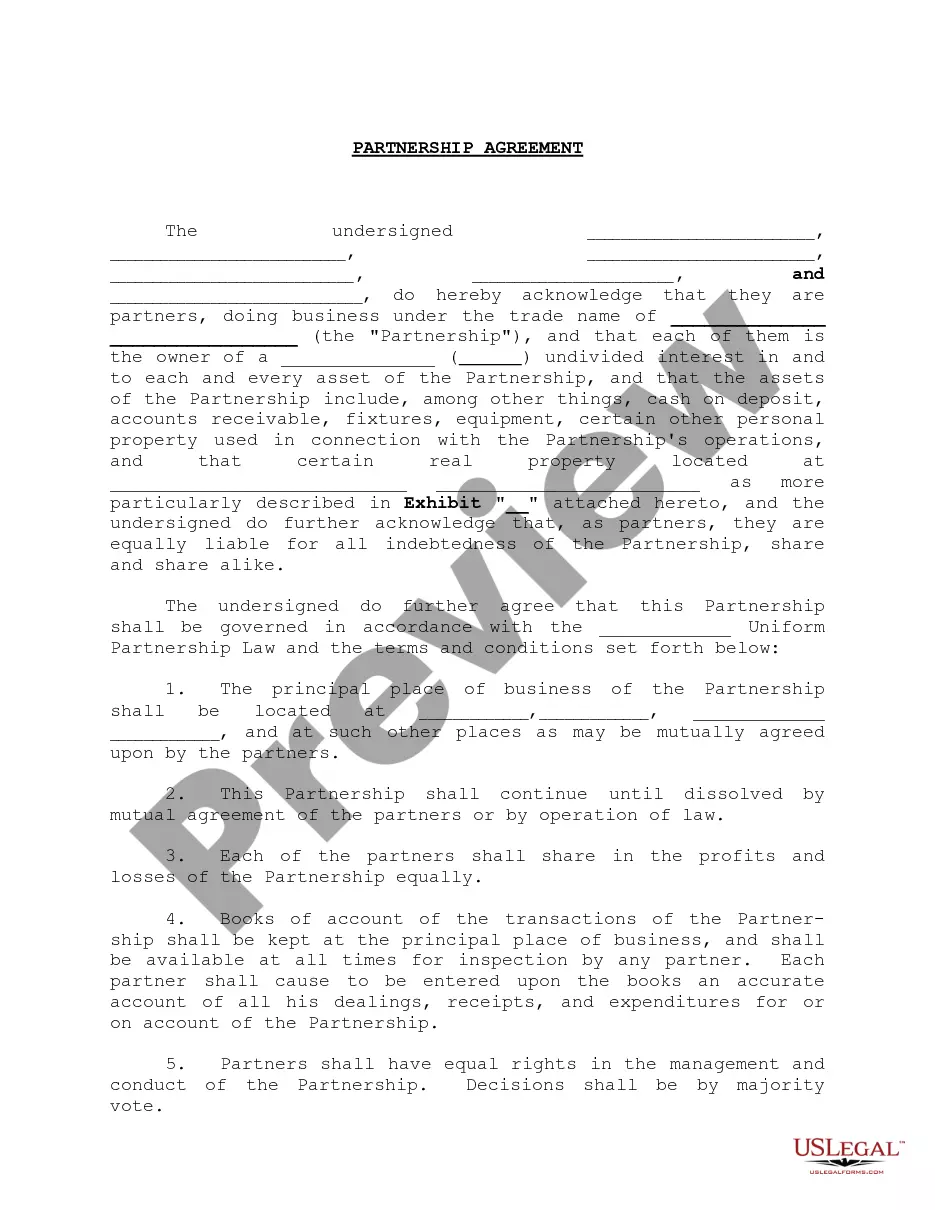
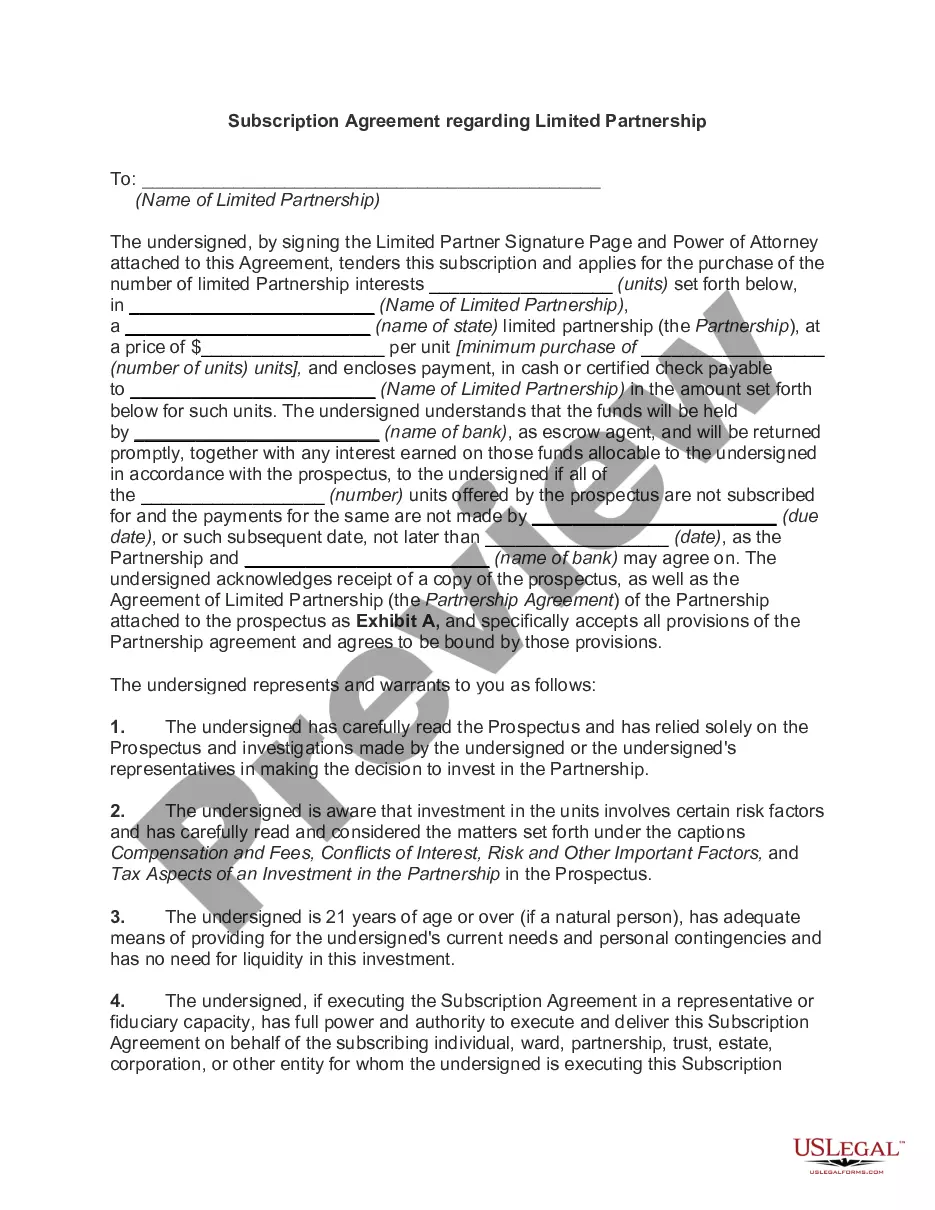
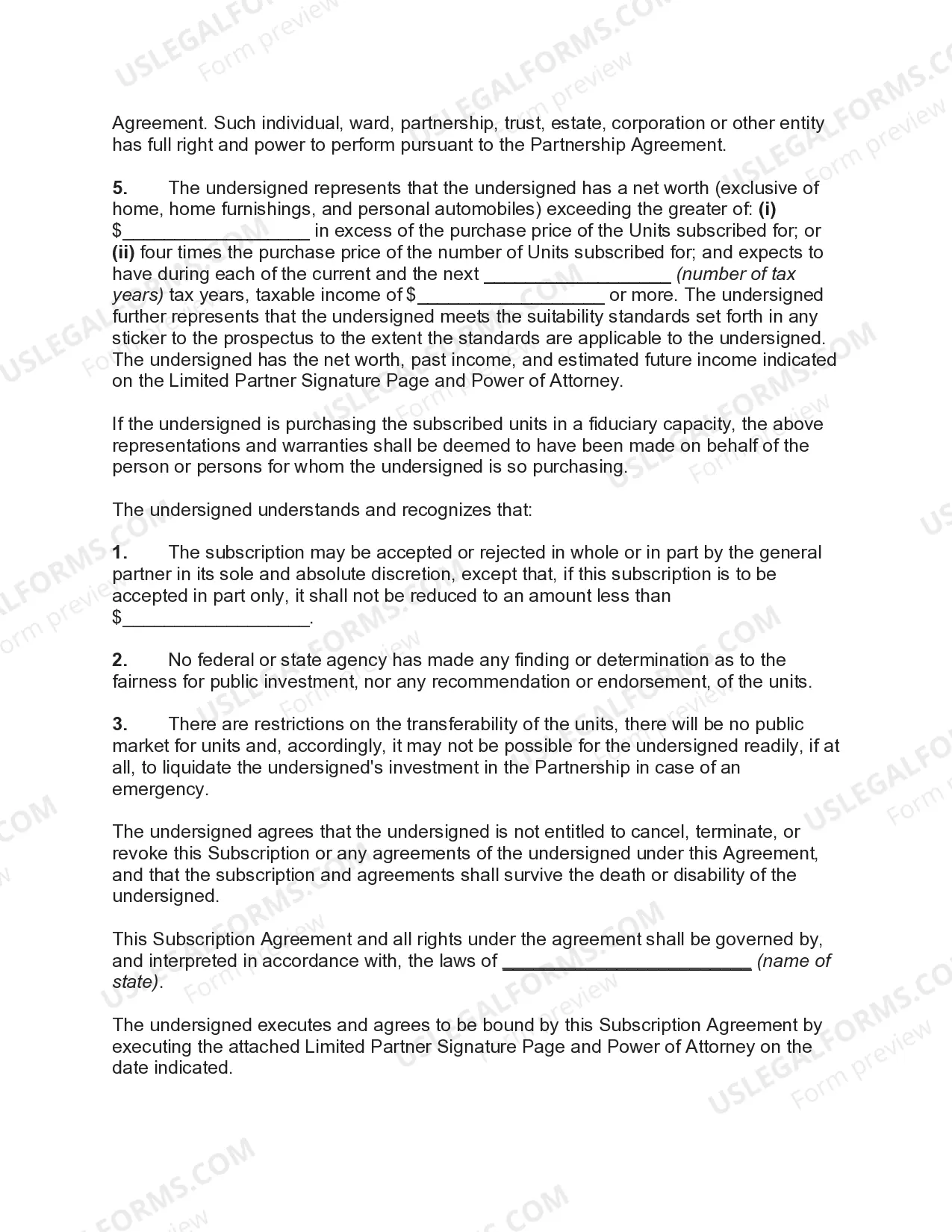
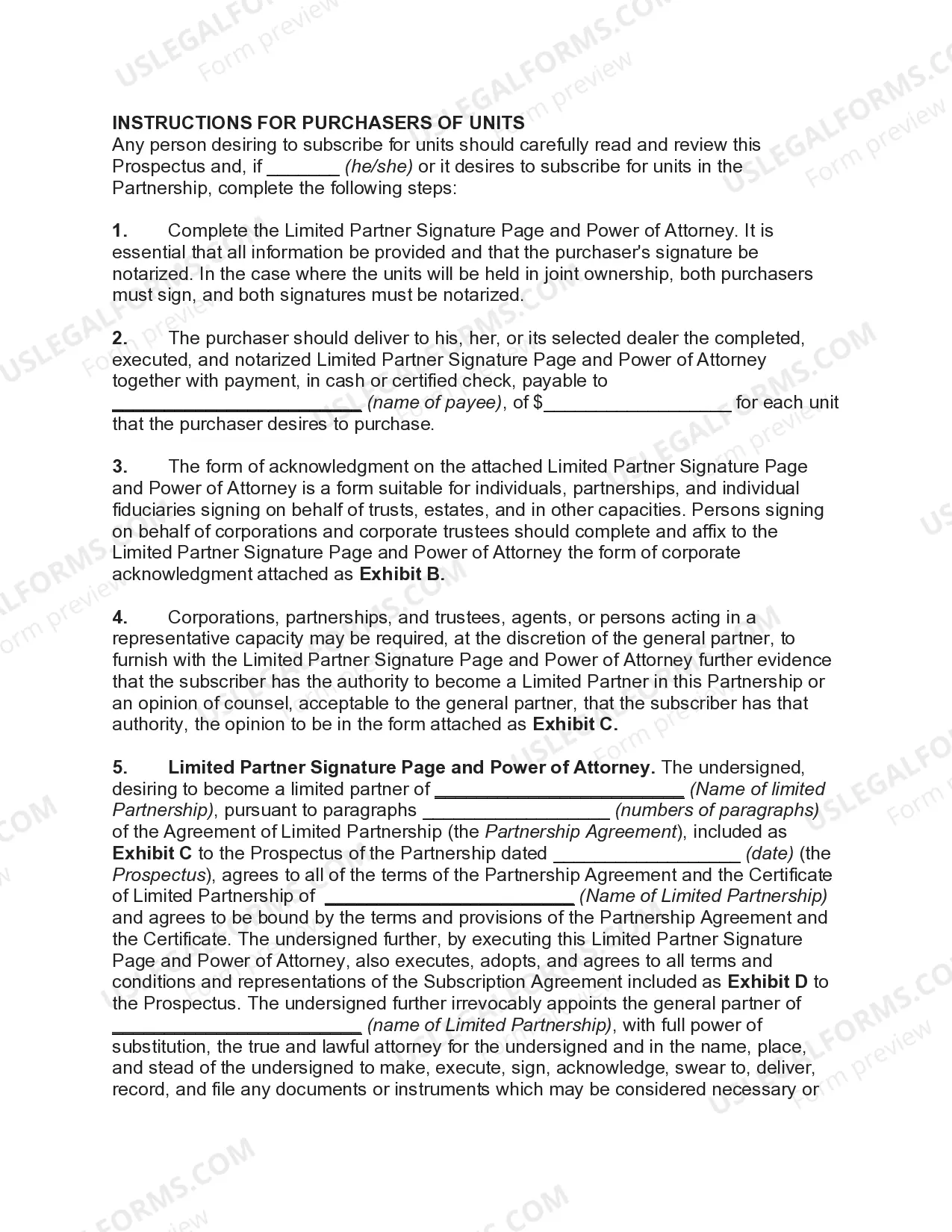
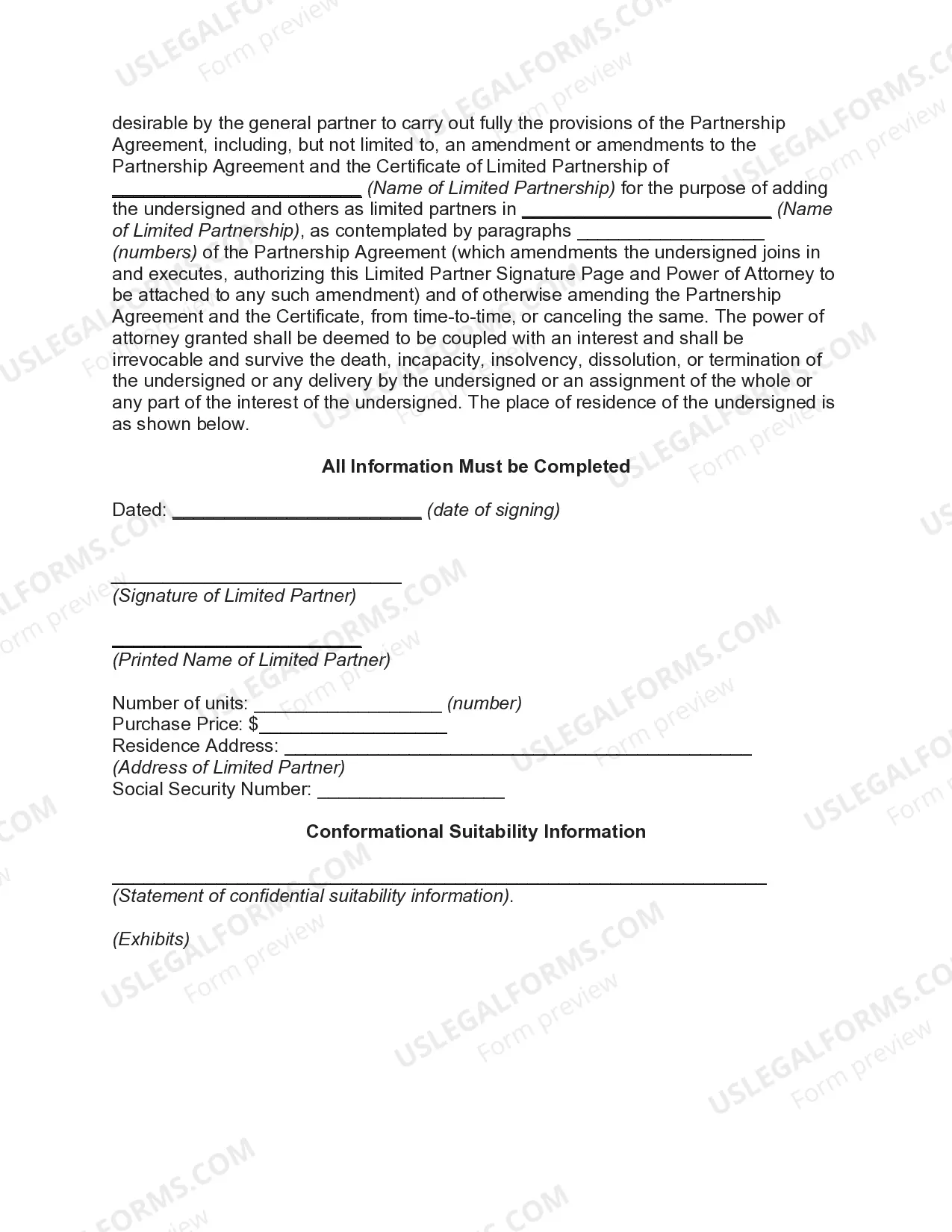
District of Columbia Subscription Agreement regarding Limited Partnership
Description
Get your form ready online
Our built-in tools help you complete, sign, share, and store your documents in one place.
Make edits, fill in missing information, and update formatting in US Legal Forms—just like you would in MS Word.
Download a copy, print it, send it by email, or mail it via USPS—whatever works best for your next step.
Sign and collect signatures with our SignNow integration. Send to multiple recipients, set reminders, and more. Go Premium to unlock E-Sign.
If this form requires notarization, complete it online through a secure video call—no need to meet a notary in person or wait for an appointment.
We protect your documents and personal data by following strict security and privacy standards.

Make edits, fill in missing information, and update formatting in US Legal Forms—just like you would in MS Word.

Download a copy, print it, send it by email, or mail it via USPS—whatever works best for your next step.

Sign and collect signatures with our SignNow integration. Send to multiple recipients, set reminders, and more. Go Premium to unlock E-Sign.

If this form requires notarization, complete it online through a secure video call—no need to meet a notary in person or wait for an appointment.

We protect your documents and personal data by following strict security and privacy standards.
Looking for another form?
How to fill out Subscription Agreement Regarding Limited Partnership?
If you're looking to obtain, download, or print legal form templates, utilize US Legal Forms, the premier repository of legal documents available online.
Take advantage of the site's straightforward and user-friendly search to discover the documents you require.
Various templates for both business and personal purposes are categorized by type and subject, or by keywords.
Step 4. Once you’ve found the form you need, click the Buy now button. Choose your preferred payment plan and enter your details to create an account.
Step 5. Complete the transaction. You can use your credit card or PayPal account to finalize the purchase. Step 6. Select the format of the legal document and download it to your device. Step 7. Complete, modify, and print or sign the District of Columbia Subscription Agreement related to Limited Partnerships.
Every legal document template you obtain is yours permanently. You will have access to every form you downloaded in your account. Visit the My documents section and choose a form to print or download again.
Fill out, download, and print the District of Columbia Subscription Agreement related to Limited Partnerships with US Legal Forms. There are many professional and state-specific forms available for your business or personal needs.
- Utilize US Legal Forms to acquire the District of Columbia Subscription Agreement pertaining to Limited Partnerships with just a few clicks.
- If you are already a customer of US Legal Forms, Log In to your account and select the Download option to find the District of Columbia Subscription Agreement regarding Limited Partnerships.
- You can also access forms you previously downloaded in the My documents section of your account.
- If you are using US Legal Forms for the first time, follow the instructions below.
- Step 1. Ensure you have selected the form for the correct city/state.
- Step 2. Use the Review option to inspect the contents of the form. Don’t forget to read the description.
- Step 3. If you are dissatisfied with the document, use the Search field at the top of the screen to find alternative templates from the legal form category.
Form popularity
FAQ
Real estate investors, for example, might use a limited partnership. Another common use of a limited partnership is in a family business, called a family limited partnership. Members of a family may pool their money, designate a general partner, and watch their investments grow.
A key advantage of forming a limited liability company is the limited personal liability it grants to every single one of its owners. This is in contrast to limited partnerships wherein only the limited partner has their personal liability shielded by the limited partnership business structure.
A key advantage of forming a limited liability company is the limited personal liability it grants to every single one of its owners. This is in contrast to limited partnerships wherein only the limited partner has their personal liability shielded by the limited partnership business structure.
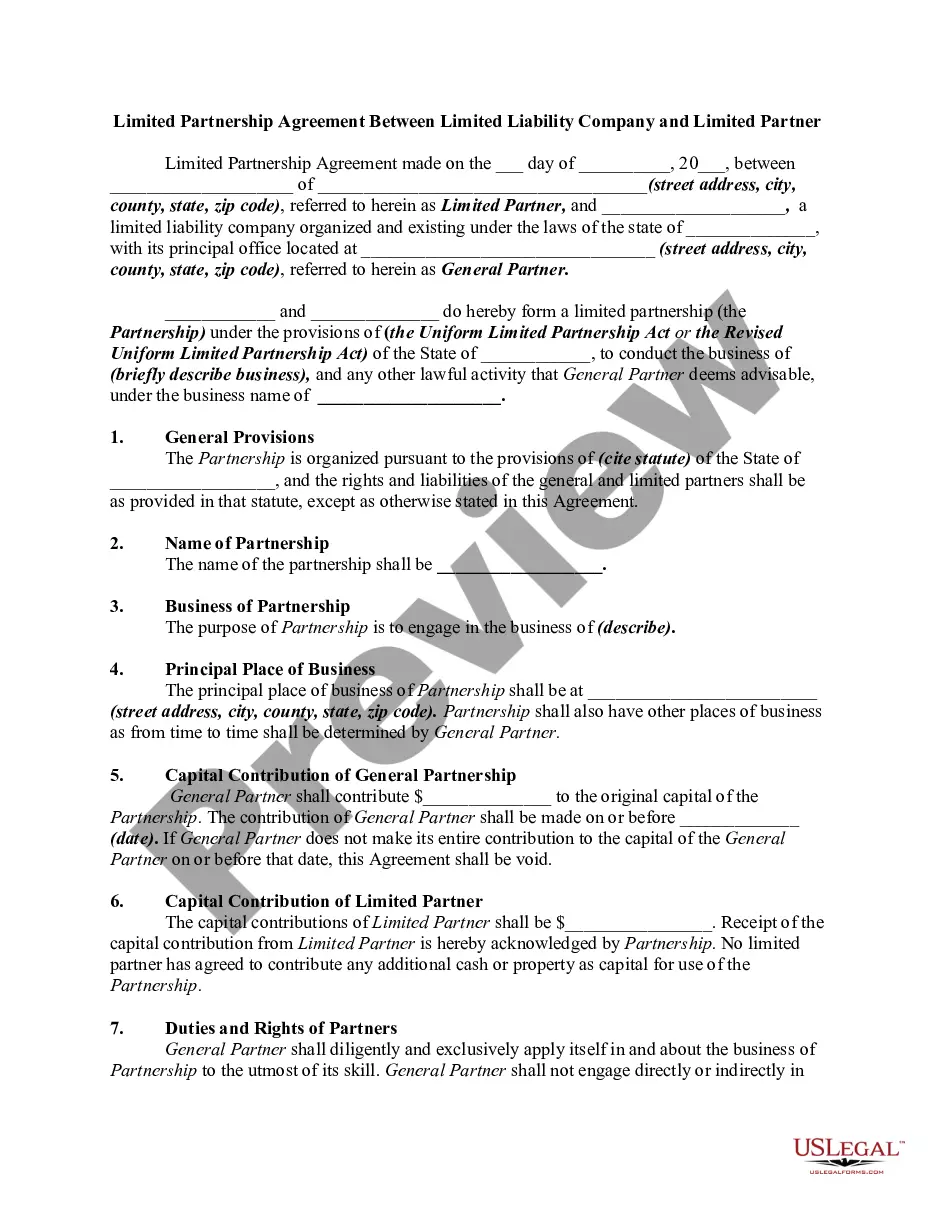
A limited partnership agreement establishes the final type of partnership from the above list. A limited partnership is a partnership between a general partner and a limited partner. The general partner oversees and runs the business, and has unlimited liability for any business debts.
LLCs and LPs both use internal documents to outline the business. In an LLC, this document is called an Operating Agreement, and limited partnerships use partnership agreements. Pass-through taxation is available for both of these entities. This means that the entity itself will not be taxed at the federal level.
A partnership operating agreement is a document that outlines the roles, responsibilities, and rights of the owners and managers of a partnership. It states the rules and regulations governing many aspects of the organization, ranging from voting powers to profit and loss distribution.
Operating agreement is important if you want to form a partnership. Limited liability companies, also commonly referred to as LLCs, implement an operating agreement to provide details on how a partnership will work.
Disadvantages of a Limited PartnershipExtensive Documentation Required.Lack of Legal Distinction for General Partners.General Partners' Personal Assets Unprotected.General Partners Liable for Each Others' Actions.Less Protection from Excessive Taxation.More items...
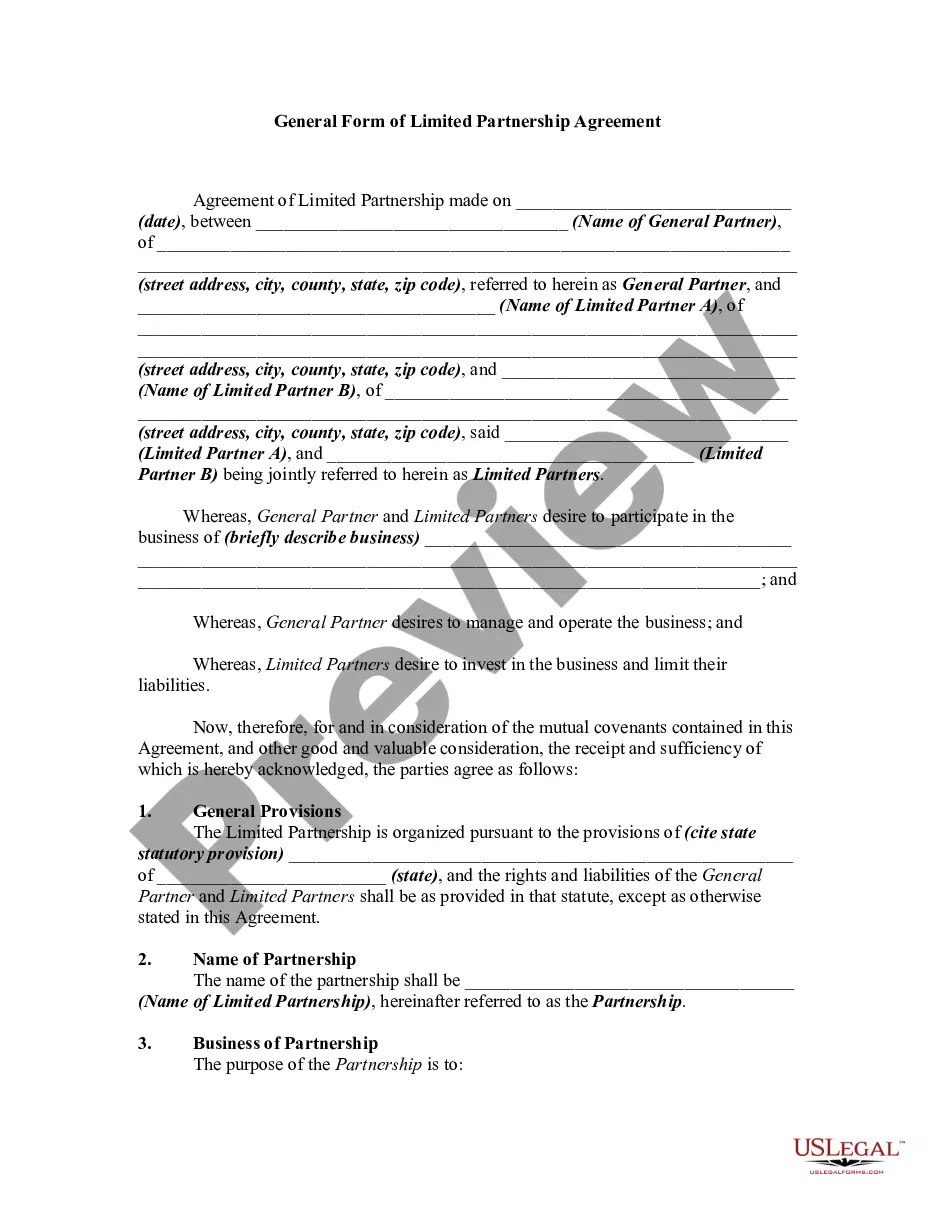
Your Limited Partnership Agreement can include details like: the name, address, and purpose of forming the partnership; whether limited partners have any voting rights regarding the day-to-day business decisions; how decisions will be made (by unanimous vote, majority vote, or majority vote based on percent ownership);
The limited partnership is a specialized form of partnership. The purpose of the limited partnership is to allow individuals to organize into an entity form that allows the flexibility of a general partnership while allowing for special rights, duties, and protections for limited partners.