District of Columbia Beneficiary Deed

State:
Multi-State
Control #:
US-03279BG
Format:
Word; 
Rich Text
Instant download

Description

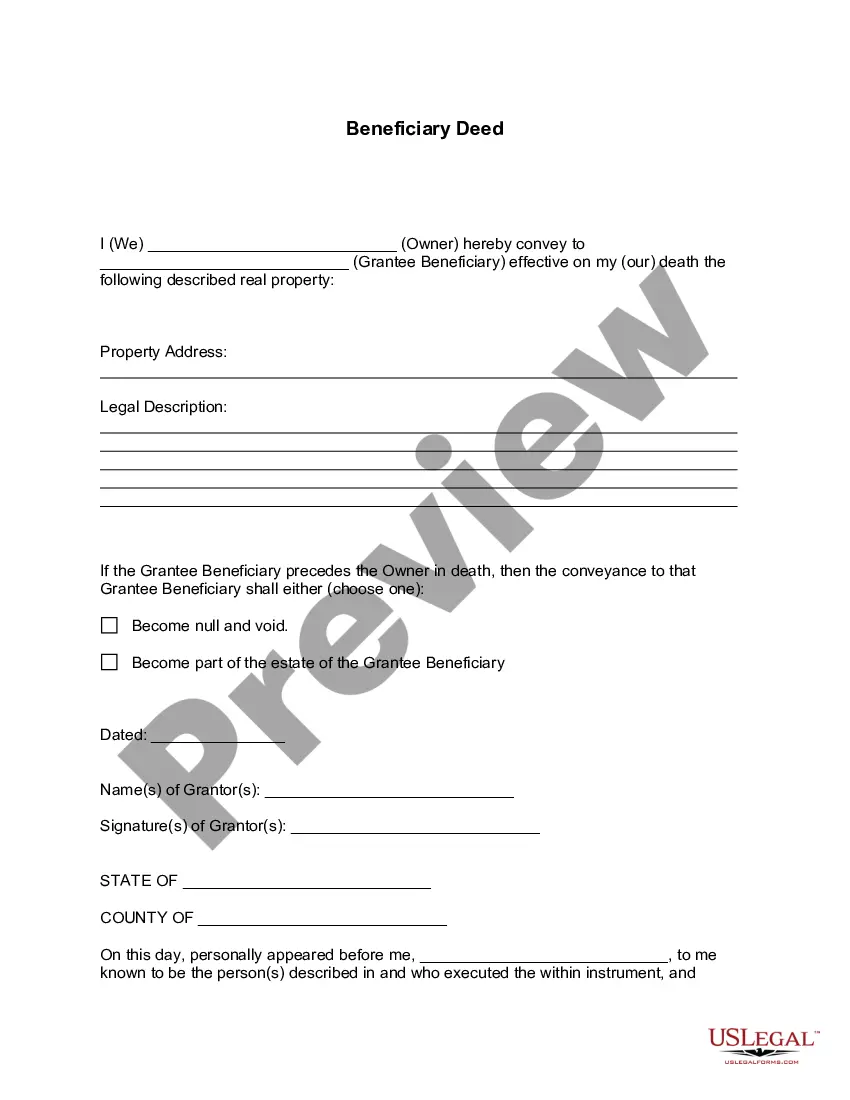
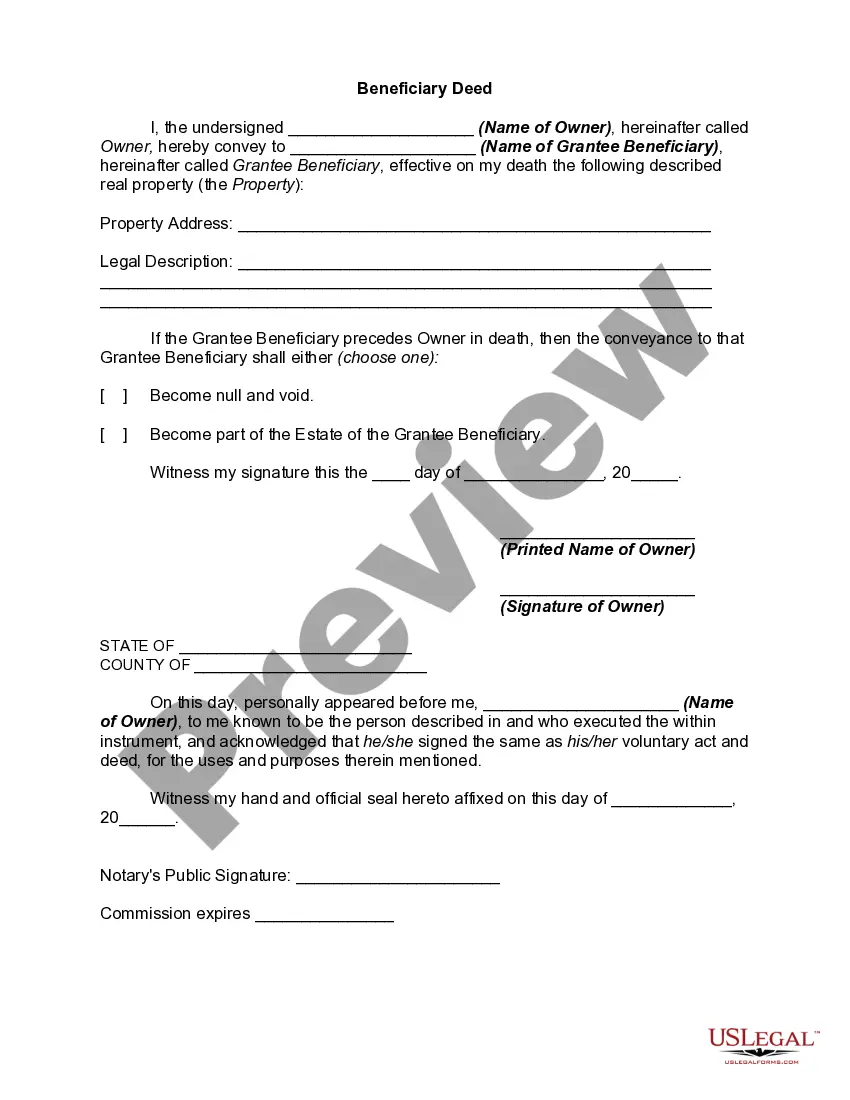
A beneficiary deed is a another type of real property deed used to transfer property. By signing and recording a beneficiary deed, an owner of an interest in real property may cause the owner's interest in the real property to be conveyed to people or entities upon the owner's death. The interest in real property conveyed by a beneficiary deed does not take effect until the death of the owner, at which time that interest transfers automatically by law to the designated grantee named in the beneficiary deed.


This form is a generic example that may be referred to when preparing such a form for your particular state. It is for illustrative purposes only. Local laws should be consulted to determine any specific requirements for such a form in a particular jurisdiction.


How to fill out Beneficiary Deed?

US Legal Forms - one of many largest libraries of legal varieties in the USA - delivers an array of legal document themes you can down load or produce. Utilizing the website, you can find a huge number of varieties for enterprise and specific reasons, sorted by groups, says, or search phrases.You can get the newest types of varieties such as the District of Columbia Beneficiary Deed in seconds.

If you have a subscription, log in and down load District of Columbia Beneficiary Deed from the US Legal Forms library. The Download button will show up on every single develop you look at. You have access to all in the past downloaded varieties within the My Forms tab of your own profile.

In order to use US Legal Forms the very first time, allow me to share easy directions to help you started out:

  • Ensure you have picked the correct develop for the metropolis/area. Click on the Review button to review the form`s information. Read the develop information to actually have chosen the proper develop.
  • In the event the develop doesn`t satisfy your needs, make use of the Lookup area near the top of the screen to discover the the one that does.
  • Should you be satisfied with the form, affirm your selection by clicking on the Get now button. Then, choose the prices strategy you favor and provide your credentials to register on an profile.
  • Approach the purchase. Make use of credit card or PayPal profile to finish the purchase.
  • Pick the file format and down load the form on your own product.
  • Make alterations. Fill up, revise and produce and indicator the downloaded District of Columbia Beneficiary Deed.

Every template you included in your money does not have an expiry day and is also the one you have for a long time. So, if you want to down load or produce another copy, just proceed to the My Forms area and then click on the develop you want.

Gain access to the District of Columbia Beneficiary Deed with US Legal Forms, probably the most comprehensive library of legal document themes. Use a huge number of specialist and status-particular themes that meet your company or specific needs and needs.

Form popularity

FAQ

A District of Columbia quitclaim deed, by definition, provides no warranty of title. The new owner receives whatever rights or interests the current owner can lawfully transfer. The current owner does not guarantee that he or she actually has a clear title or any interest to transfer at all.

The ?Revocable Transfer on Death Deed,? also called ?TOD Deed? or ?beneficiary deed,? is a simple way to leave a residence to your beneficiaries without the need for probate.

An individual may transfer property to one or more beneficiaries effective at the transferor's death by a transfer on death deed. (Mar. 19, 2013, D.C. Law 19-230, § 2(b), 59 DCR 13606.)

You may research this information at: Office of the Recorder of Deeds or Real Property Tax Database Search. The cost to purchase a copy is $2.25 per page plus ($2.25) per document for certification of a copied document. Your copies will be mailed promptly to you.

The beneficiary acquires ownership on the current owner's date of death. If the beneficiary later sells the property, any capital gain will be based upon the value of the property at the original owner's date of death, not the value when the original owner acquired the property.

The main difference between a beneficiary designation and a will is that assets with designated beneficiaries can avoid probate, while assets included in a will don't. Like assets in a living trust, assets with beneficiary attached to them operate separately from a will.

Cons To Using Beneficiary Deed Estate taxes. Property transferred may be taxed. No asset protection. The beneficiary receives the property without protection from creditors, divorces, and lawsuits. Medicaid eligibility. ... No automatic transfer. ... Incapacity not addressed. ... Problems with beneficiaries.

The key purpose of a beneficiary deed is to transfer real estate to your heir in the future, and not in the present moment. The secondary (and also key) purpose is to keep your property outside of probate. If you simply leave your property to your heir in a Will, then that property will be subject to probate.

Trusted and secure by over 3 million people of the world’s leading companies

District of Columbia Beneficiary Deed