District of Columbia Motion By Petitioner Spouse to Increase Alimony Payments due to Changed Financial Circumstances of Respondent Spouse

State:
Multi-State
Control #:
US-01899BG
Format:
Word; 
Rich Text
Instant download

Description

A decree for alimony is res judicata only as long as the circumstances remain the same as when the court rendered the decree. The doctrine of res judicata is based on the concept that parties should not call upon a court to adjudicate twice the same set of facts. Therefore, a party generally cannot base a motion to modify an order for alimony on the same set of facts that existed when the original order was made.


To justify a modification of an alimony order, a court must find that there has been a change in the material circumstances of the parties since the time of the original order. The burden of proving a change of circumstances is on the party seeking the modification.


This form is a generic example that may be referred to when preparing such a form for your particular state. It is for illustrative purposes only. Local laws should be consulted to determine any specific requirements for such a form in a particular jurisdiction.
Free preview
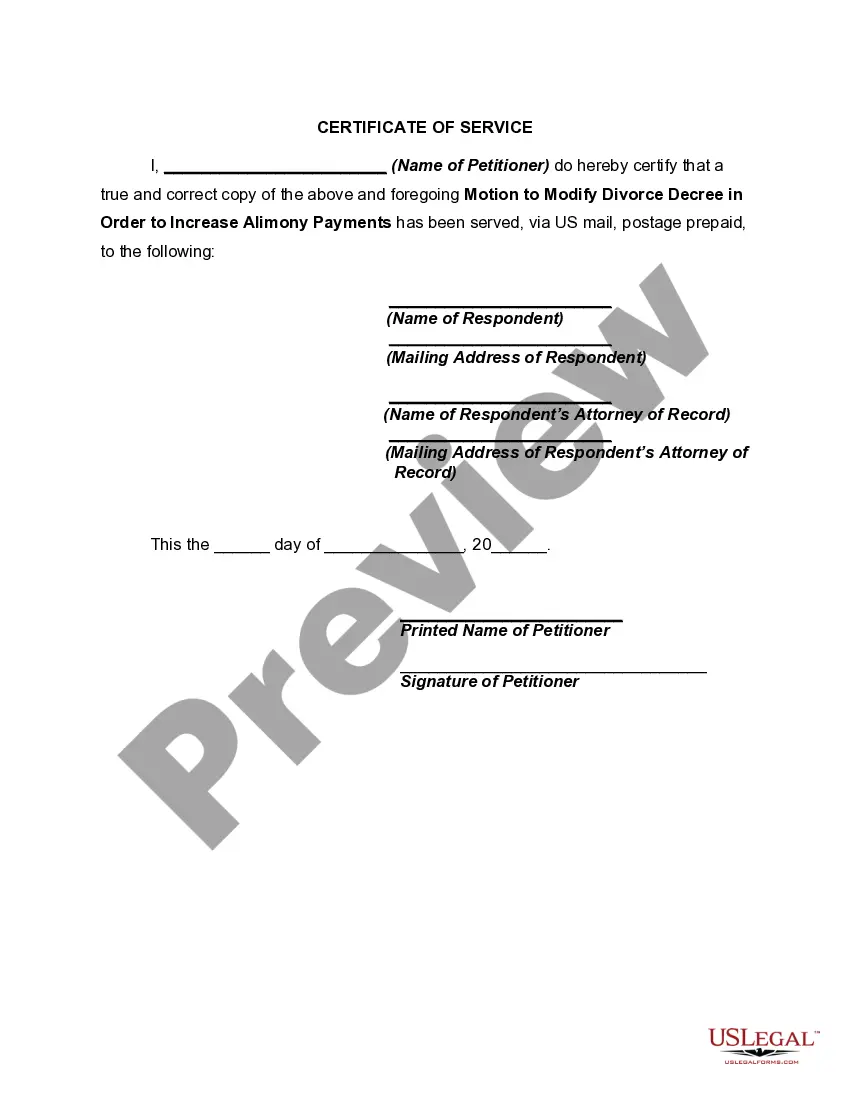
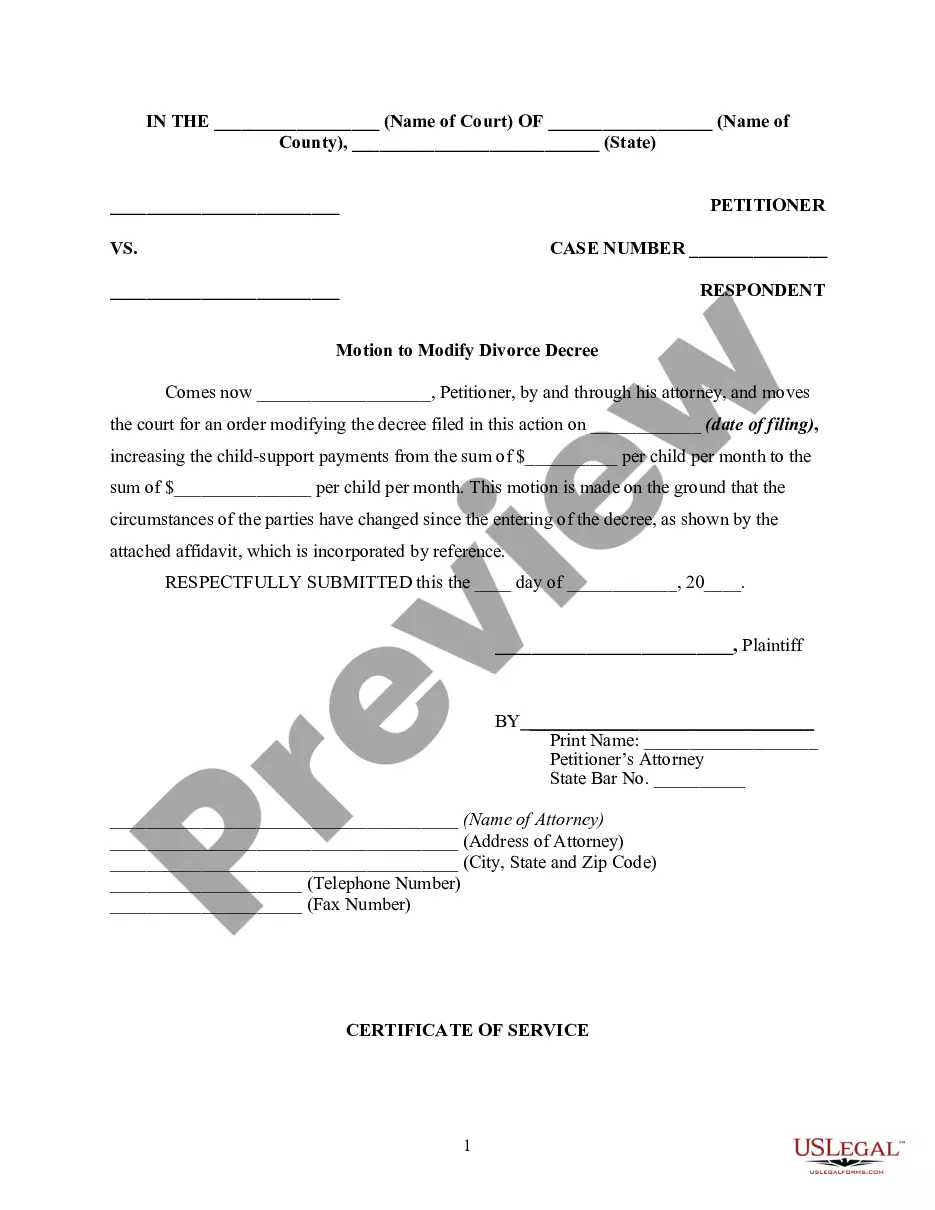
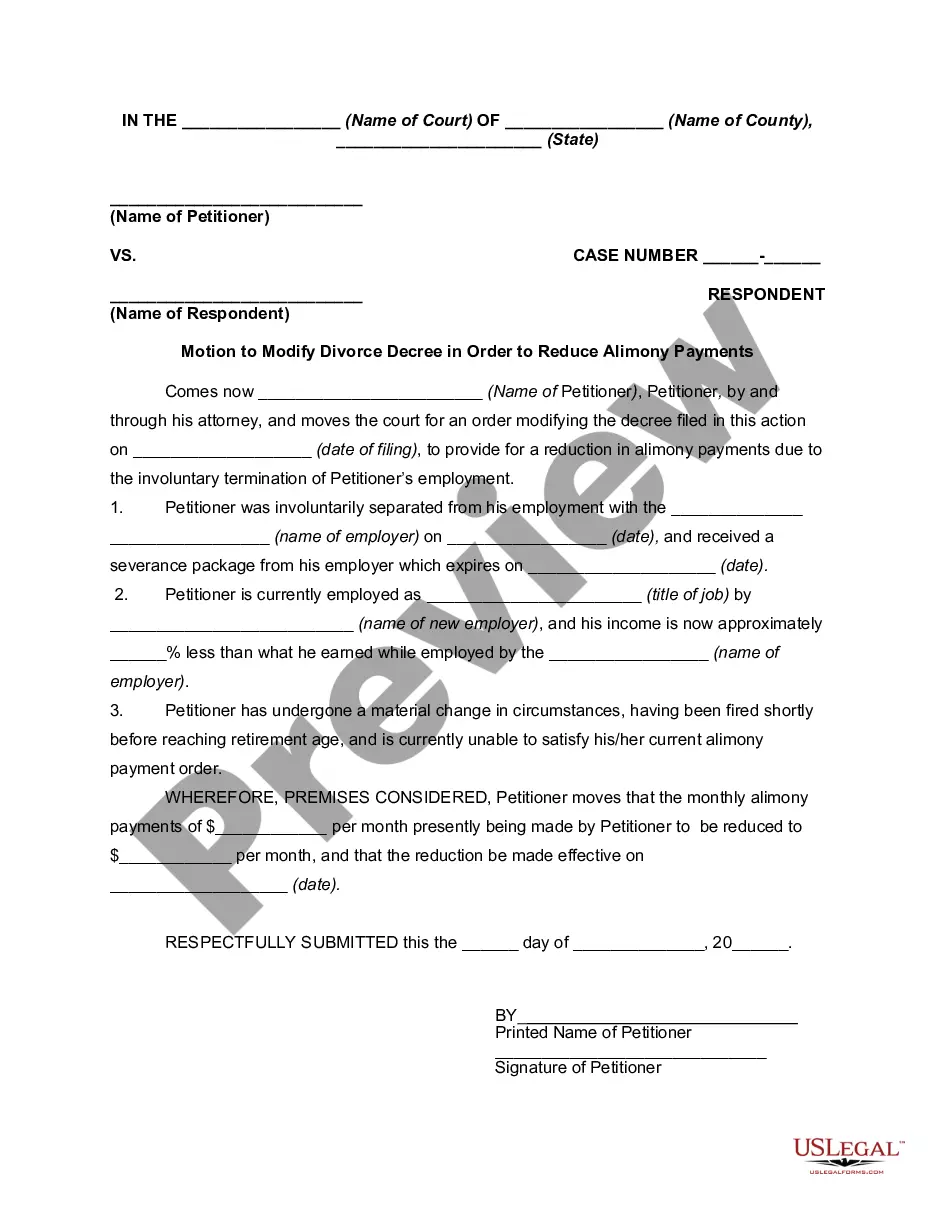
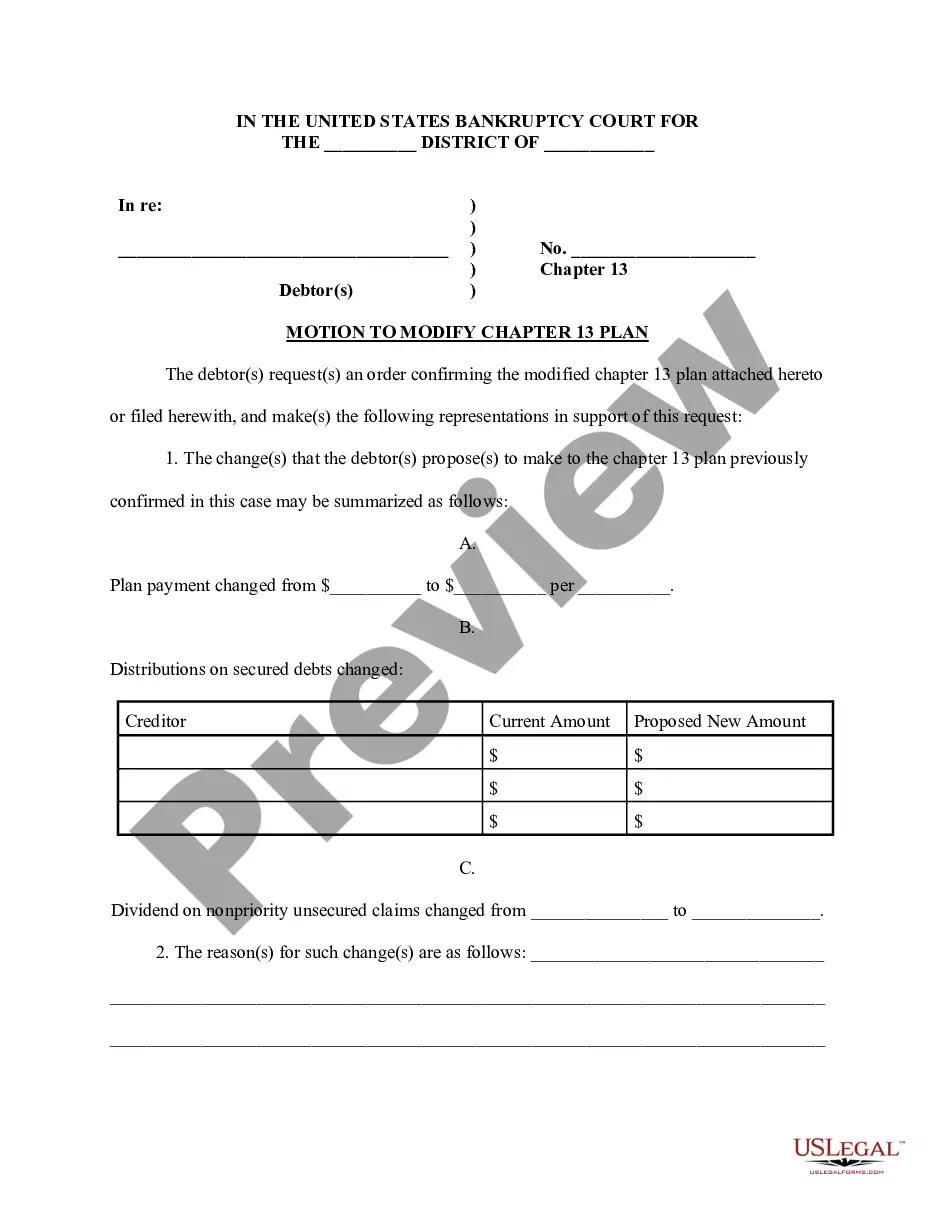
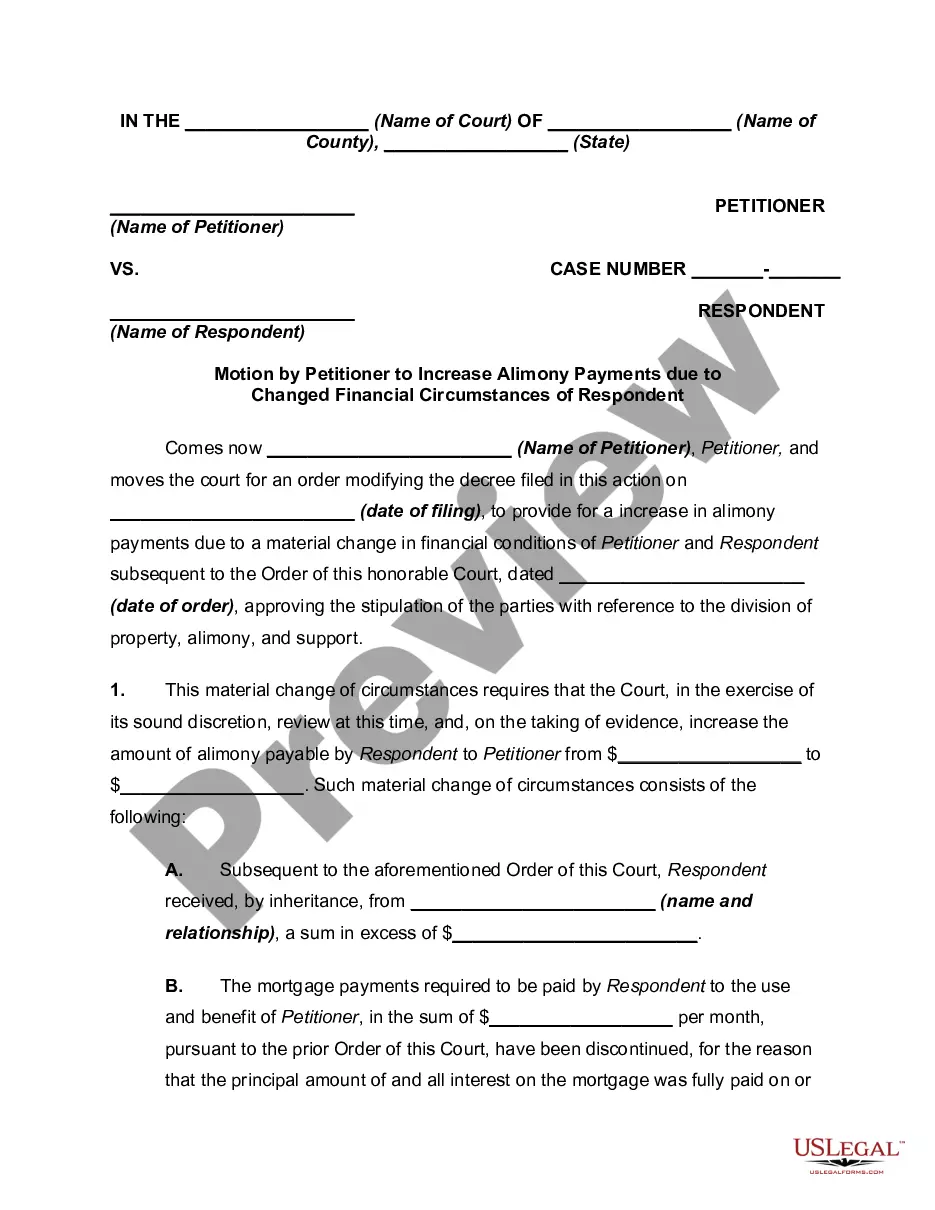
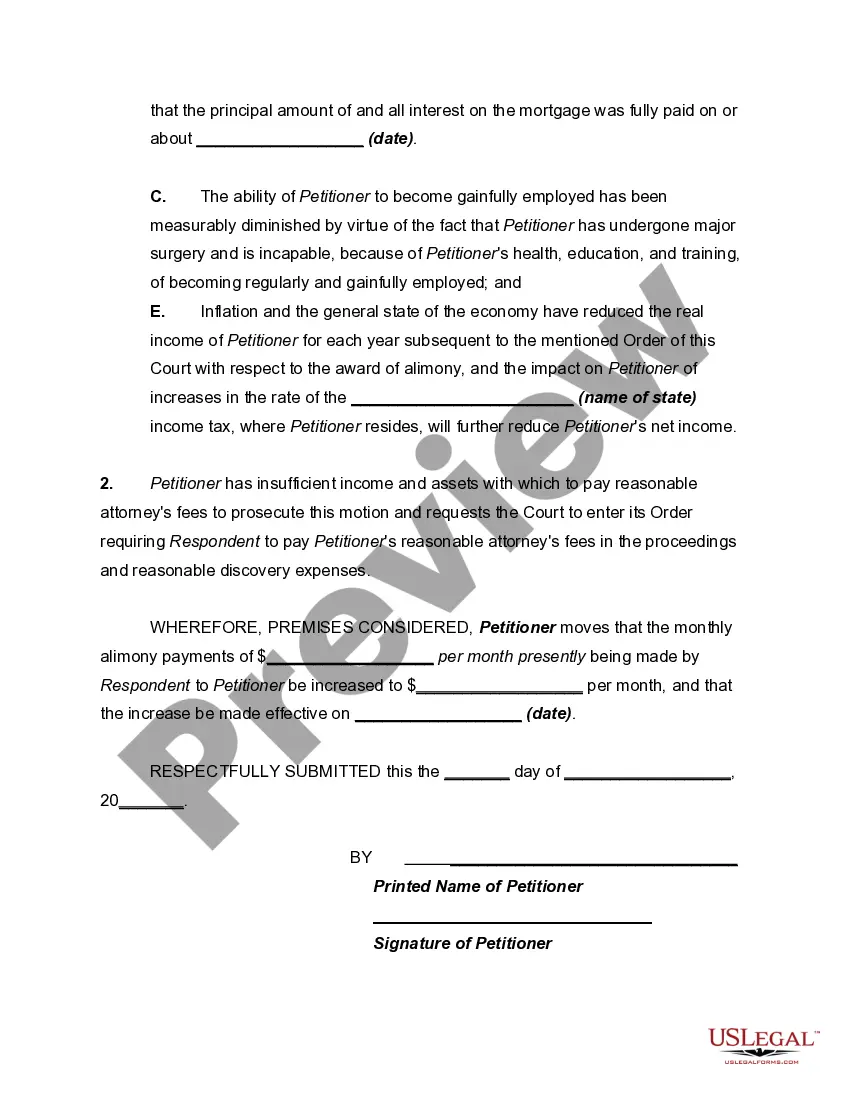
  • Preview Motion By Petitioner Spouse to Increase Alimony Payments due to Changed Financial Circumstances of Respondent Spouse
  • Preview Motion By Petitioner Spouse to Increase Alimony Payments due to Changed Financial Circumstances of Respondent Spouse
  • Preview Motion By Petitioner Spouse to Increase Alimony Payments due to Changed Financial Circumstances of Respondent Spouse

How to fill out Motion By Petitioner Spouse To Increase Alimony Payments Due To Changed Financial Circumstances Of Respondent Spouse?

If you need to finish, download, or print sanctioned document templates, utilize US Legal Forms, the largest collection of legal forms available on the web.

Use the site's simple and effective search to locate the documents you require. Numerous templates for business and personal purposes are categorized by types and states, or keywords.

Utilize US Legal Forms to find the District of Columbia Motion By Petitioner Spouse to Increase Alimony Payments due to Altered Financial Conditions of Respondent Spouse with just a few clicks.

Step 5. Complete the transaction. You can use your credit card or PayPal account to finalize the payment.

Step 6. Choose the format of the legal form and download it to your device. Step 7. Fill out, modify and print or sign the District of Columbia Motion By Petitioner Spouse to Increase Alimony Payments due to Altered Financial Conditions of Respondent Spouse. Each legal document template you acquire is your property indefinitely. You have access to every form you downloaded in your account. Visit the My documents section and select a form to print or download again. Be proactive and download, and print the District of Columbia Motion By Petitioner Spouse to Increase Alimony Payments due to Altered Financial Conditions of Respondent Spouse with US Legal Forms. There are numerous professional and state-specific forms you can utilize for your business or personal needs.

  1. If you are already a US Legal Forms customer, Log In to your account and click on the Download option to access the District of Columbia Motion By Petitioner Spouse to Increase Alimony Payments due to Altered Financial Conditions of Respondent Spouse.
  2. You can also access forms you previously submitted electronically in the My documents section of your account.
  3. If you are using US Legal Forms for the first time, follow the steps below.
  4. Step 1. Ensure you have selected the form for the correct city/state.
  5. Step 2. Use the Review option to examine the form's content. Remember to read the summary.
  6. Step 3. If you are dissatisfied with the form, utilize the Search box at the top of the screen to find other versions of the legal form template.
  7. Step 4. Once you have found the form you need, click the Purchase now button. Select the payment plan you prefer and enter your details to register for the account.

Form popularity

FAQ

The statute in Washington DC that concerns alimony is the Code of the District of Columbia §16-913. Under this statute, the family court has the ability to order the payment of spousal support at the conclusion of any divorce or domestic separation case.

In California, if the supported spouse?the one who receives alimony?gets remarried, then the paying spouse's obligation to provide spousal support automatically ends, unless both parties agreed to waive Family Code Section 4337. Filing a motion to terminate alimony or any type of court action is not necessary.

The key factors analyzed in an alimony decision are each spouse's income, ability to earn and standards of living established during the marriage. If there is a history of violence, abuse or certain criminal convictions, however, this could bar a spouse from receiving alimony payments under California law.

In order to receive termination of alimony, you should obtain necessary evidence of life changes, such as your spouse remarrying, becoming deceased, or cohabitation. A judge may not grant termination in other changed circumstances.

A last point to consider is that while you cannot quit your job to avoid spousal support, there is no obligation to labor 80 hours per week to support your ex-spouse's lavish, unemployed lifestyle. The California Supreme Court in Marriage of Simpson (1992) 4 Cal.

Although some states still allow you to file for divorce based on adultery, California is a no-fault divorce state. Cheating does not reduce or eliminate your spouse's eligibility to receive alimony.

The paying spouse can petition the court seeking alimony termination if circumstances arise that make payment nearly impossible. Some circumstances the courts will look for before allowing the petition include unemployment, an illness that prohibits work, and whether payment would cause severe financial hardship.

Trusted and secure by over 3 million people of the world’s leading companies

District of Columbia Motion By Petitioner Spouse to Increase Alimony Payments due to Changed Financial Circumstances of Respondent Spouse