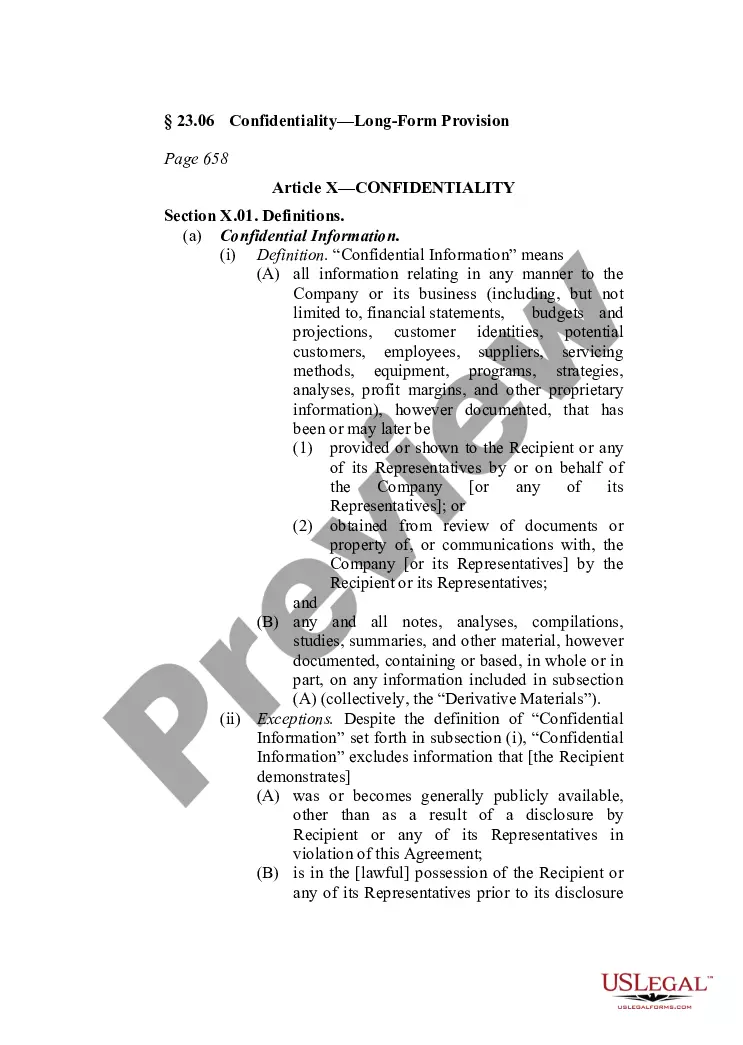
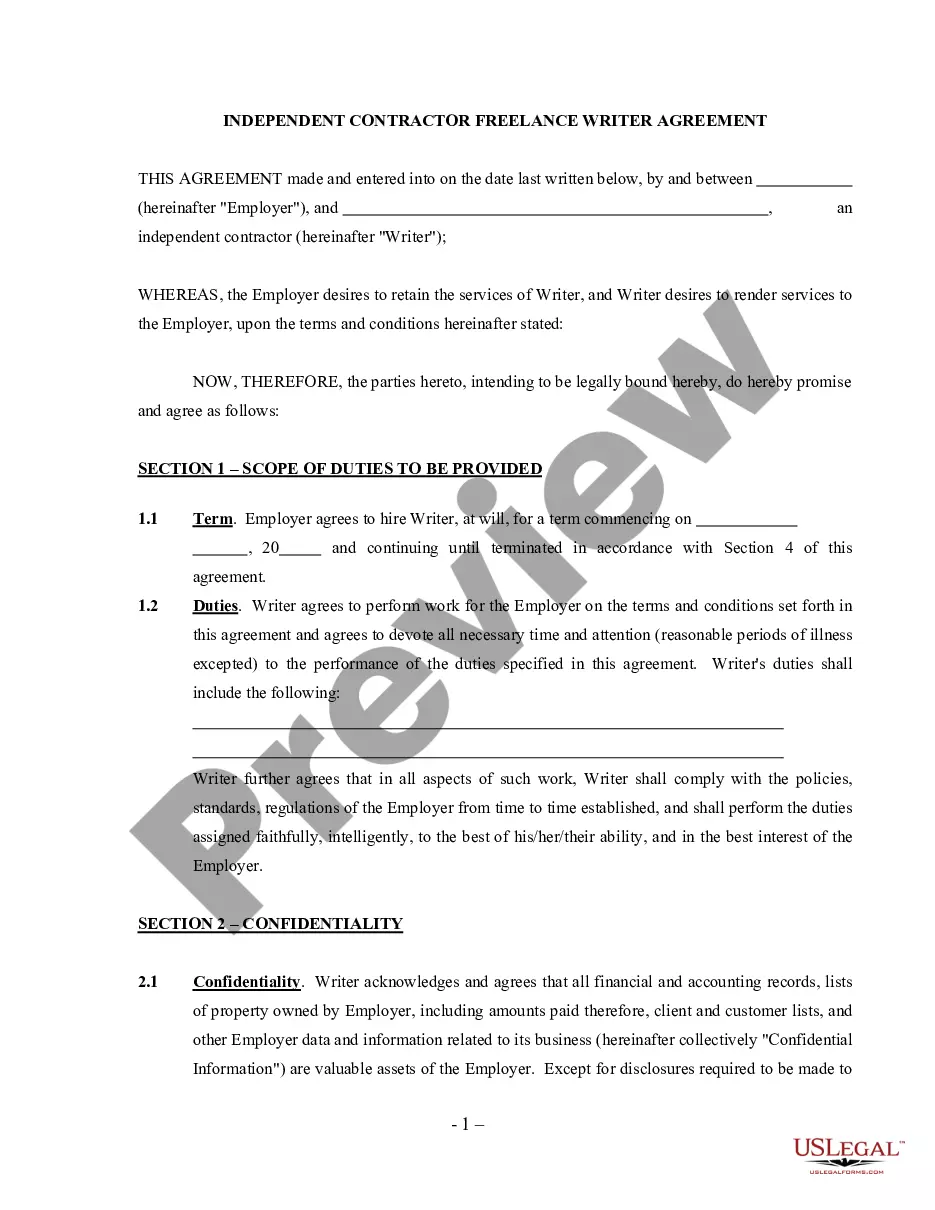
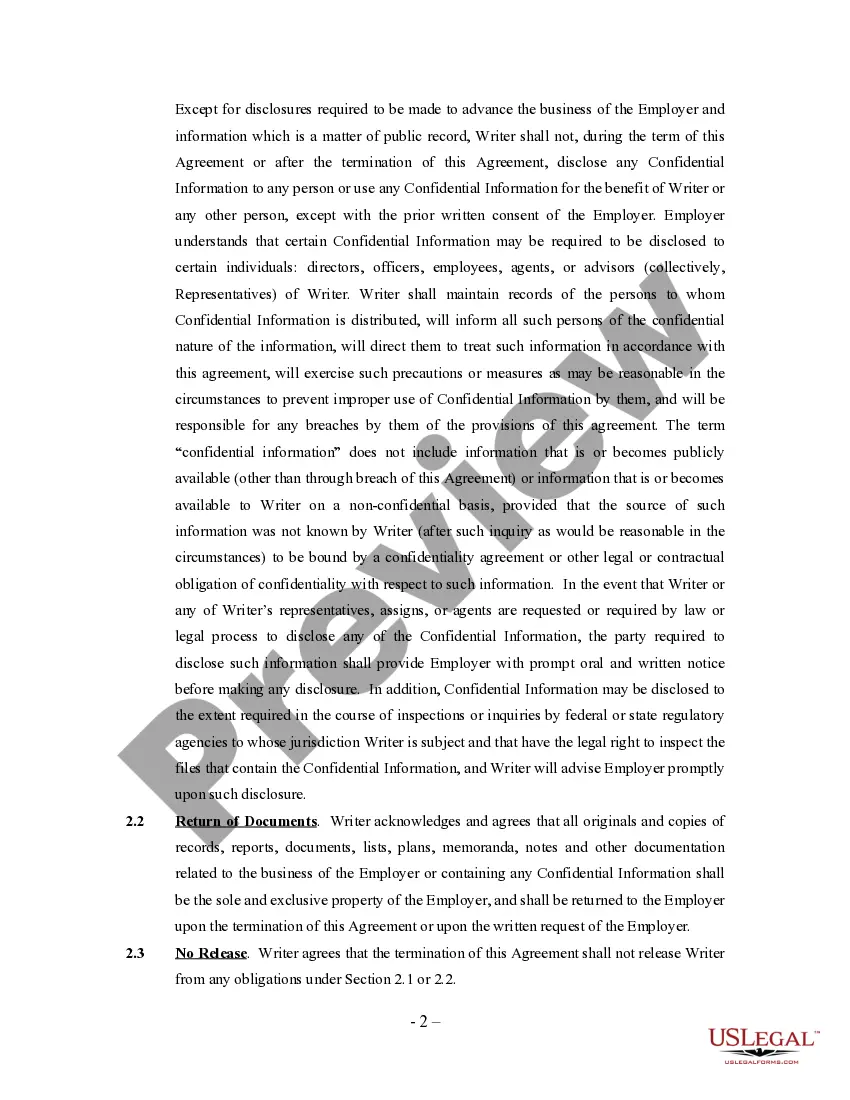
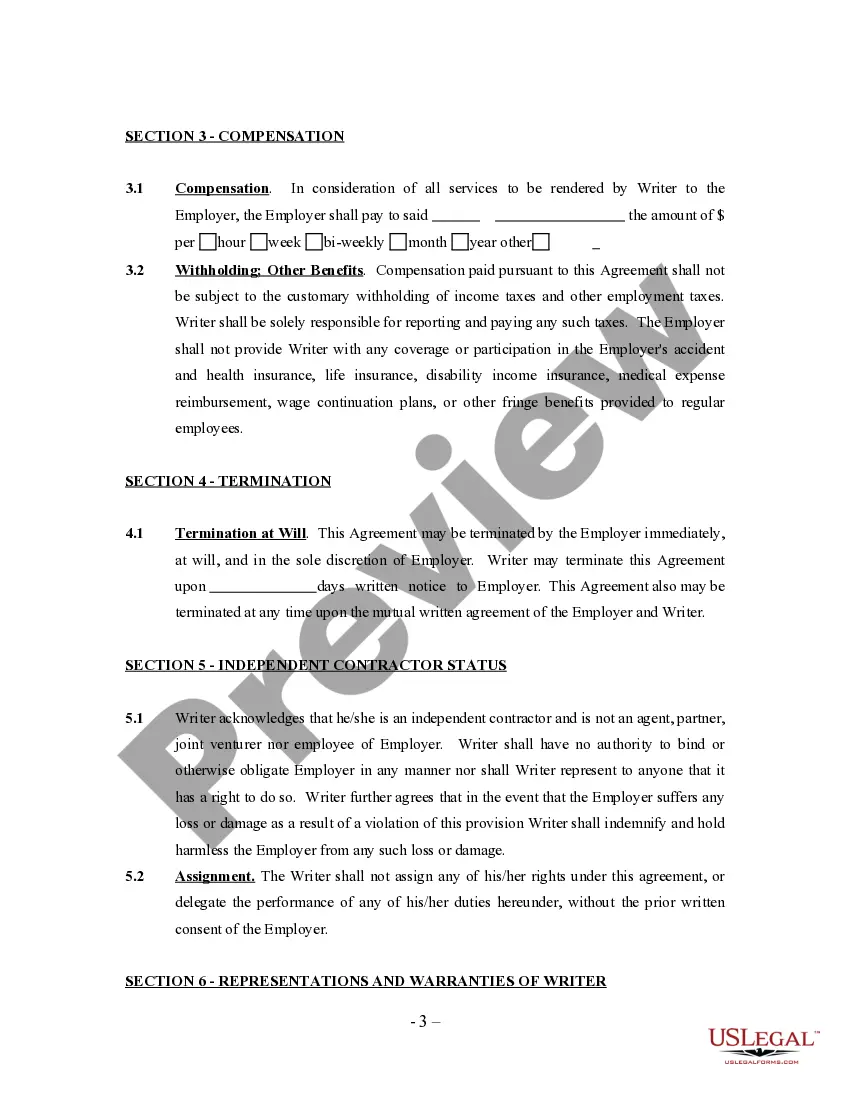
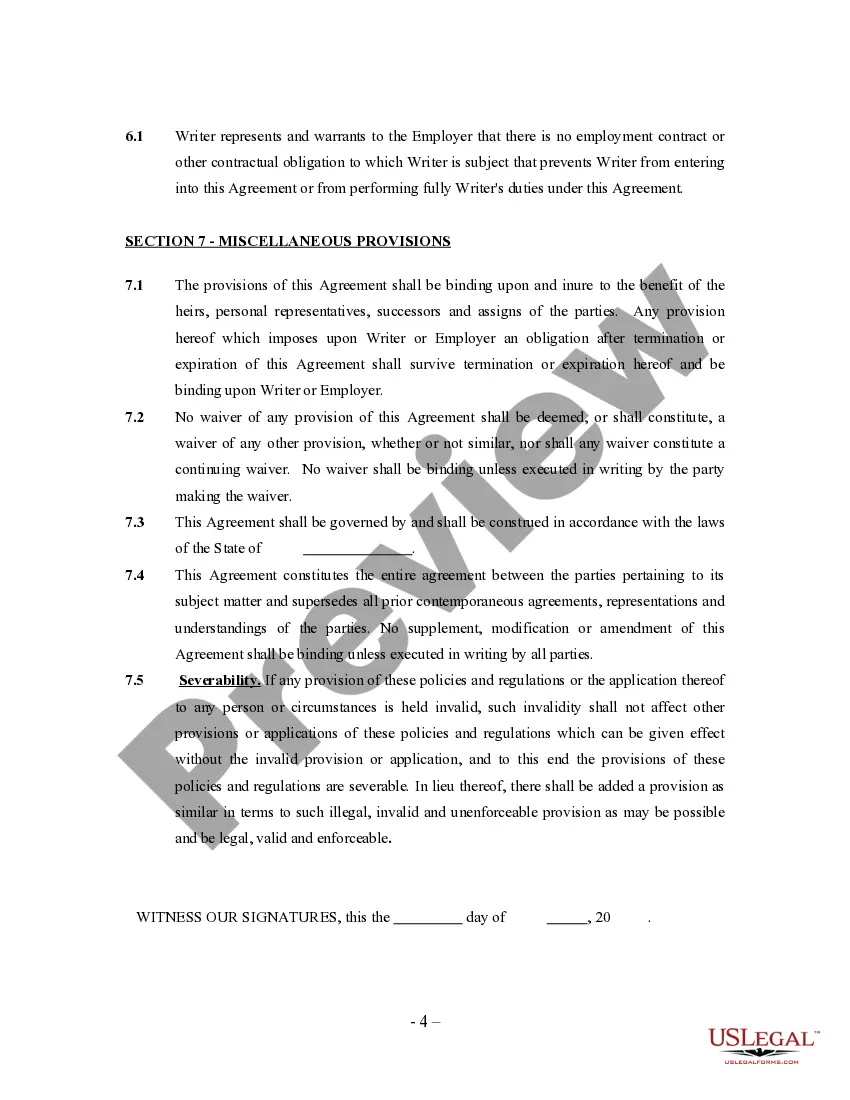
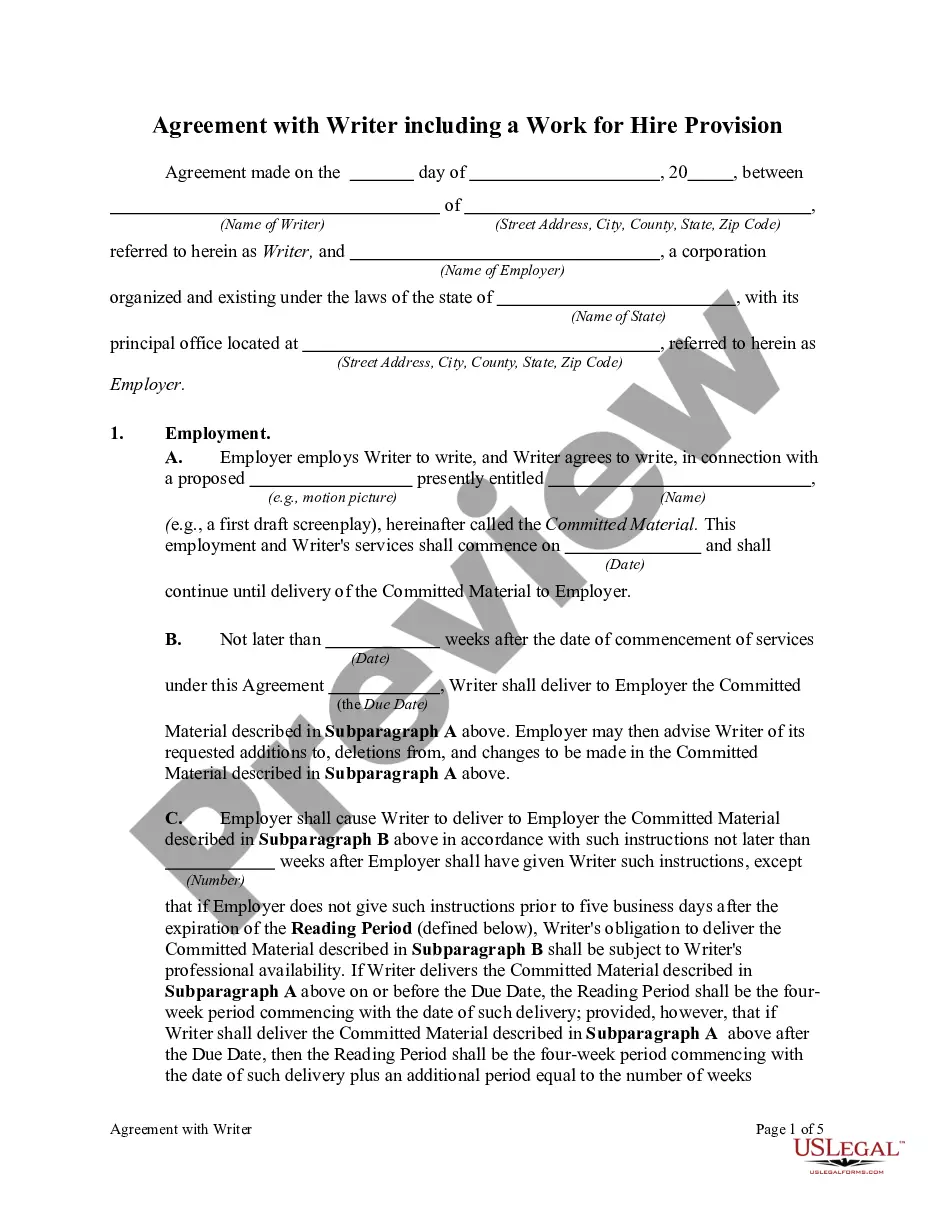
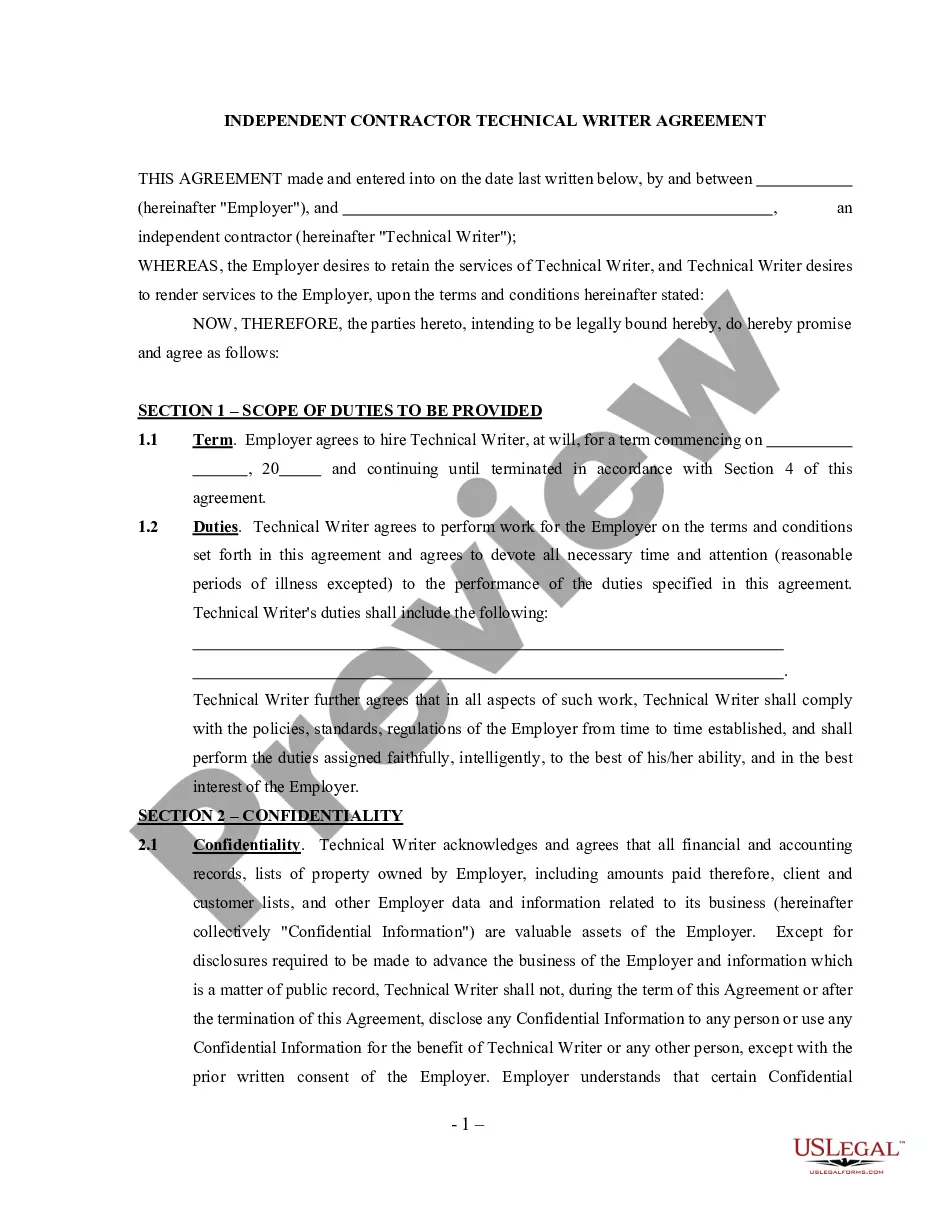
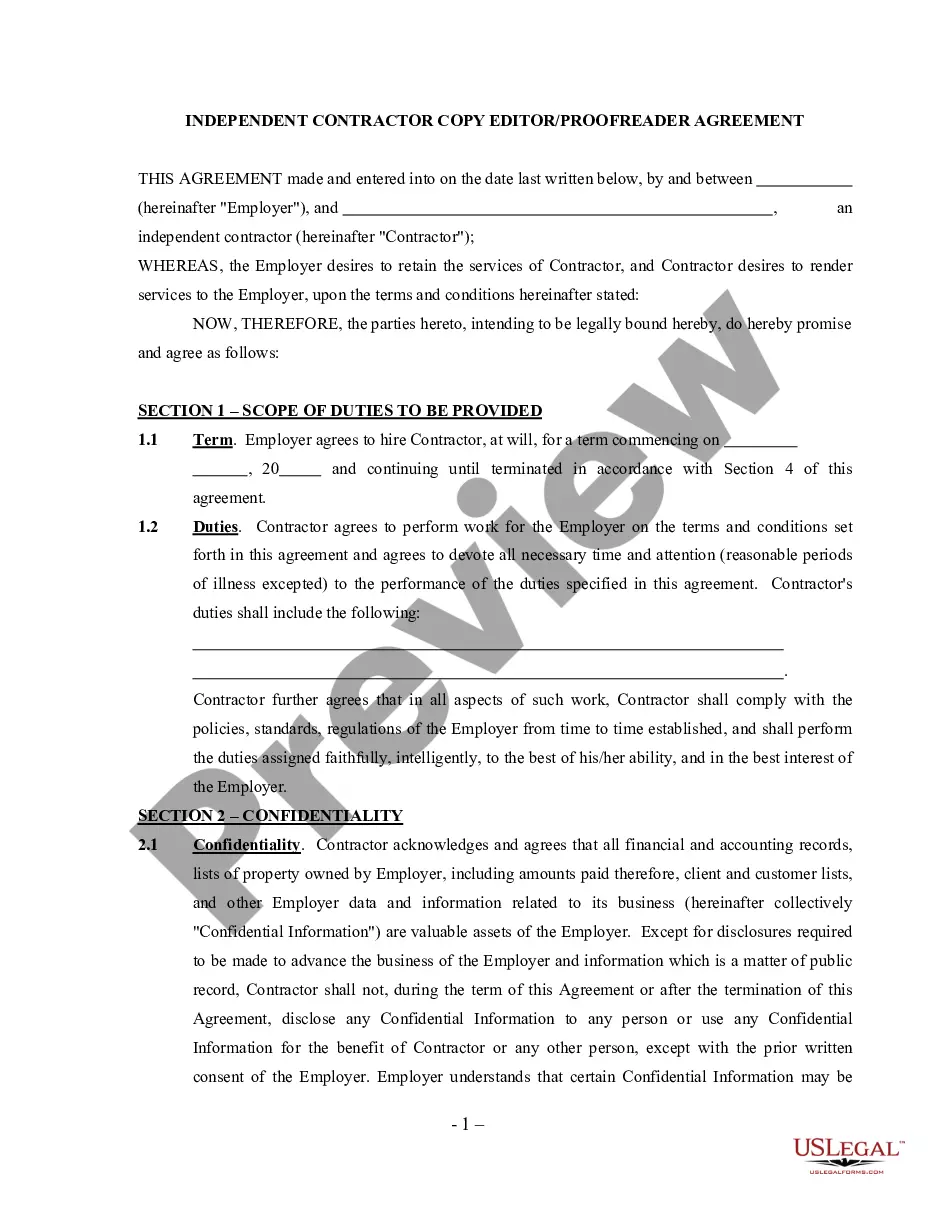
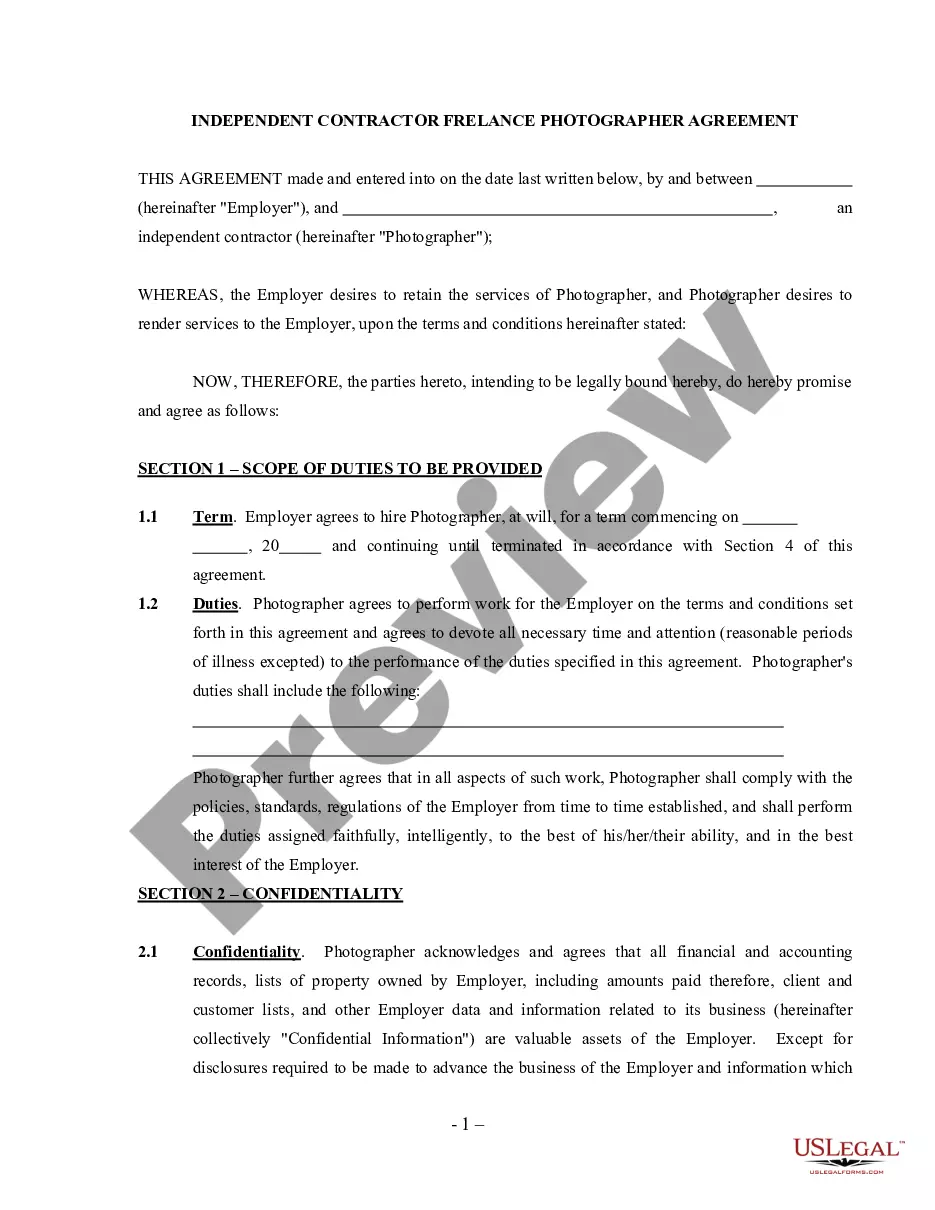
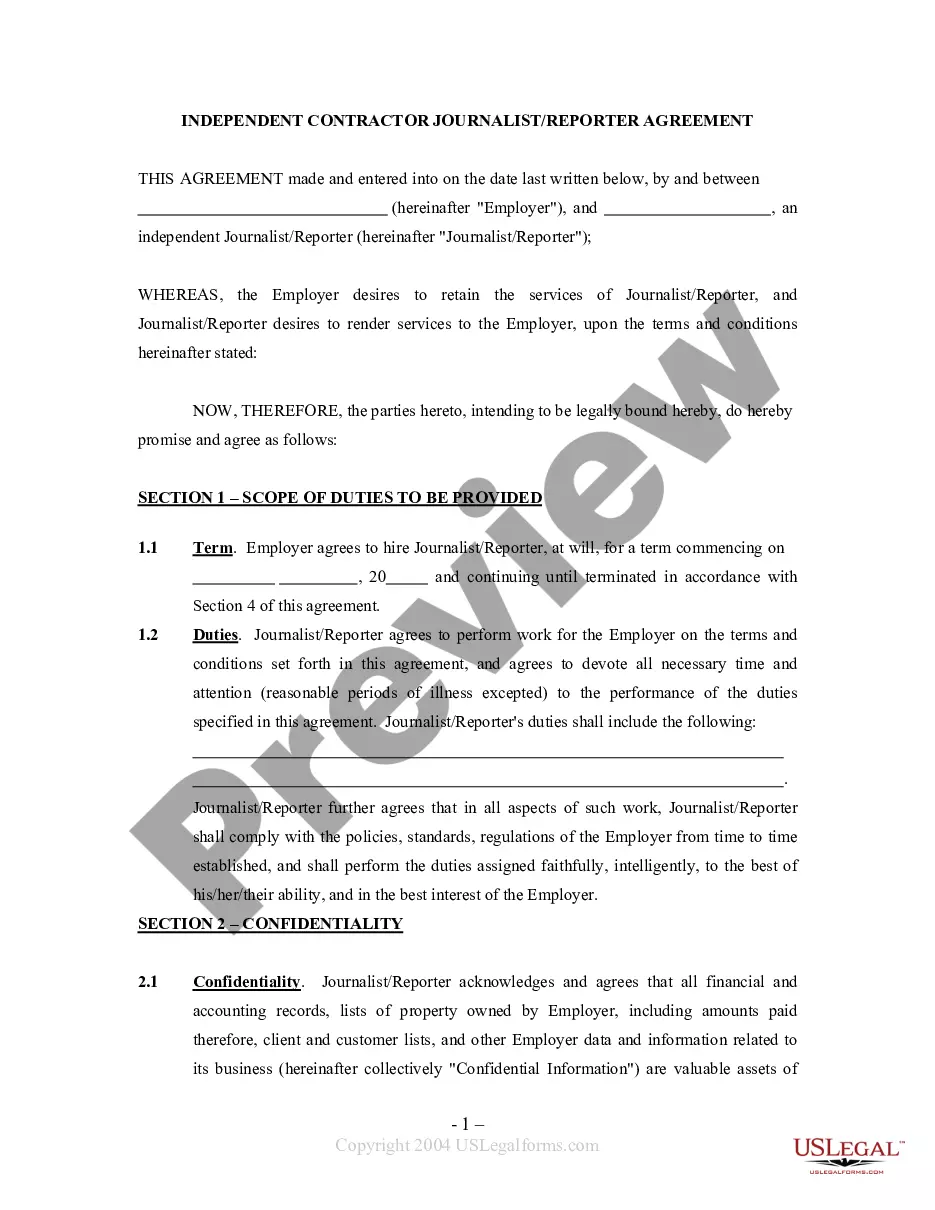
This is an agreement between an employer and a freelance writer to provide writing or journalistic services for employer as an independent contractor. Many times the employer may be a newspaper or magazine.
Connecticut Freelance Writer Agreement - Self-Employed Independent Contractor
State:
Multi-State
Control #:
US-INDC-30
Format:
Word;
Rich Text
Instant download
Description
Free preview

Get your form ready online
Our built-in tools help you complete, sign, share, and store your documents in one place.
Built-in online Word editor
Make edits, fill in missing information, and update formatting in US Legal Forms—just like you would in MS Word.
Export easily
Download a copy, print it, send it by email, or mail it via USPS—whatever works best for your next step.
E-sign your document
Sign and collect signatures with our SignNow integration. Send to multiple recipients, set reminders, and more. Go Premium to unlock E-Sign.
Notarize online 24/7
If this form requires notarization, complete it online through a secure video call—no need to meet a notary in person or wait for an appointment.
Store your document securely
We protect your documents and personal data by following strict security and privacy standards.

Make edits, fill in missing information, and update formatting in US Legal Forms—just like you would in MS Word.

Download a copy, print it, send it by email, or mail it via USPS—whatever works best for your next step.

Sign and collect signatures with our SignNow integration. Send to multiple recipients, set reminders, and more. Go Premium to unlock E-Sign.

If this form requires notarization, complete it online through a secure video call—no need to meet a notary in person or wait for an appointment.

We protect your documents and personal data by following strict security and privacy standards.
Looking for another form?




How to fill out Freelance Writer Agreement - Self-Employed Independent Contractor?
Have you ever found yourself in a situation where you need documents for either organizational or personal purposes nearly every working day.
There are numerous legitimate document templates accessible online, but locating reliable versions can be challenging.
US Legal Forms offers a vast array of form templates, such as the Connecticut Freelance Writer Agreement - Self-Employed Independent Contractor, designed to meet federal and state regulations.
Utilize US Legal Forms, one of the most extensive collections of legal forms, to save time and avoid mistakes.
The service provides professionally crafted legal document templates that you can use for various purposes. Create your account on US Legal Forms and start simplifying your life.
- If you are already familiar with the US Legal Forms website and have an account, simply Log In.
- Afterward, you can download the Connecticut Freelance Writer Agreement - Self-Employed Independent Contractor template.
- If you do not have an account and wish to begin using US Legal Forms, follow these steps.
- Obtain the form you need and ensure it is for the correct city/region.
- Use the Review button to examine the document.
- Read the description to ensure you have selected the right form.
- If the form is not what you are looking for, utilize the Search field to find the form that fits your needs.
- Once you have the correct form, click Get now.
- Choose the pricing plan you desire, enter the necessary information to create your account, and pay for your order using PayPal or credit card.
- Select a convenient document format and download your copy.
- Access all the document templates you have purchased in the My documents section. You can retrieve an additional copy of the Connecticut Freelance Writer Agreement - Self-Employed Independent Contractor anytime, if needed. Just click on the required form to download or print the document template.
Form popularity
FAQ
To fill out a Connecticut Freelance Writer Agreement - Self-Employed Independent Contractor, you need to provide specific details about the project and the parties involved. Ensure you include terms regarding compensation, duration of the contract, and any relevant clauses. It’s beneficial to review this agreement with the contractor to ensure mutual understanding. Utilizing USLegalForms can help you navigate this process effectively.
Filling out an independent contractor form requires attention to detail. Begin by entering the contractor's name, address, and contact information. Next, outline the work to be performed and the payment terms. For a comprehensive Connecticut Freelance Writer Agreement - Self-Employed Independent Contractor, consider using USLegalForms to streamline the process.
To write a Connecticut Freelance Writer Agreement - Self-Employed Independent Contractor, start by clearly defining the scope of work. Include terms regarding payment, deadlines, and confidentiality. It's essential to specify the relationship between you and the contractor to avoid any confusion. Using a template from USLegalForms can ensure you include all necessary elements.
To create an independent contractor agreement, begin by outlining the responsibilities and expectations of both parties involved. Include important details such as payment schedules, project timelines, and confidentiality clauses. A well-structured Connecticut Freelance Writer Agreement - Self-Employed Independent Contractor will help protect both you and the freelancer. Consider using US Legal Forms to access reliable templates that can guide you in crafting a thorough agreement.
Creating a contract agreement for a freelancer involves several key steps. Start by defining the scope of work, including specific tasks, deadlines, and payment terms. It is essential to ensure that the agreement complies with Connecticut freelance writer laws, especially when considering the Connecticut Freelance Writer Agreement - Self-Employed Independent Contractor. Using platforms like US Legal Forms can simplify this process, providing you with templates tailored to your needs.
Yes, independent contractors are often considered freelancers, but not all freelancers fit the independent contractor model. Freelancers work independently and may take on various projects for different clients. Independent contractors generally have a contractual agreement that outlines specific terms for their services. To formalize this relationship, you might consider using a Connecticut Freelance Writer Agreement - Self-Employed Independent Contractor to ensure clarity and professionalism.
Yes, a freelance writer is typically classified as an independent contractor. This means they operate their own business and are responsible for their taxes and work schedule. As an independent contractor, a freelance writer can choose their clients and set their rates. A well-structured Connecticut Freelance Writer Agreement - Self-Employed Independent Contractor can help protect both the writer and the client by setting clear expectations.
Creating an LLC is not a requirement for freelance writers, but it can offer benefits. An LLC can provide personal liability protection and may also offer tax advantages. However, whether you need one depends on your individual circumstances, including your income and risk factors. Consider using a Connecticut Freelance Writer Agreement - Self-Employed Independent Contractor to outline your business arrangements, even if you choose not to form an LLC.
Freelance work and independent contracting often overlap, but they are not exactly the same. Freelancers typically work on a project basis, offering their services to multiple clients without long-term commitments. An independent contractor, however, may have a more formal agreement with a client, which could include specific terms. For those looking to establish clear relationships, a Connecticut Freelance Writer Agreement - Self-Employed Independent Contractor can clarify roles and responsibilities.