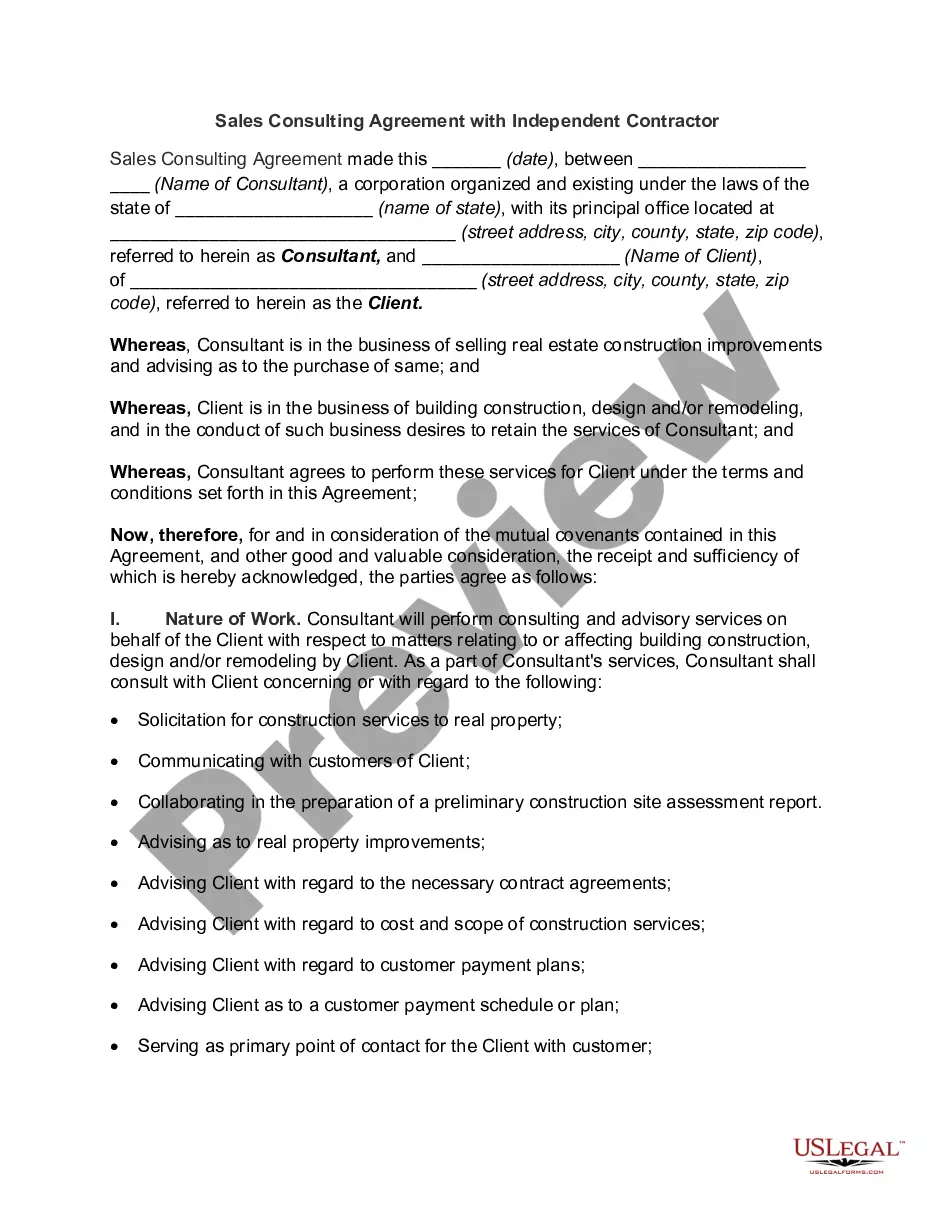
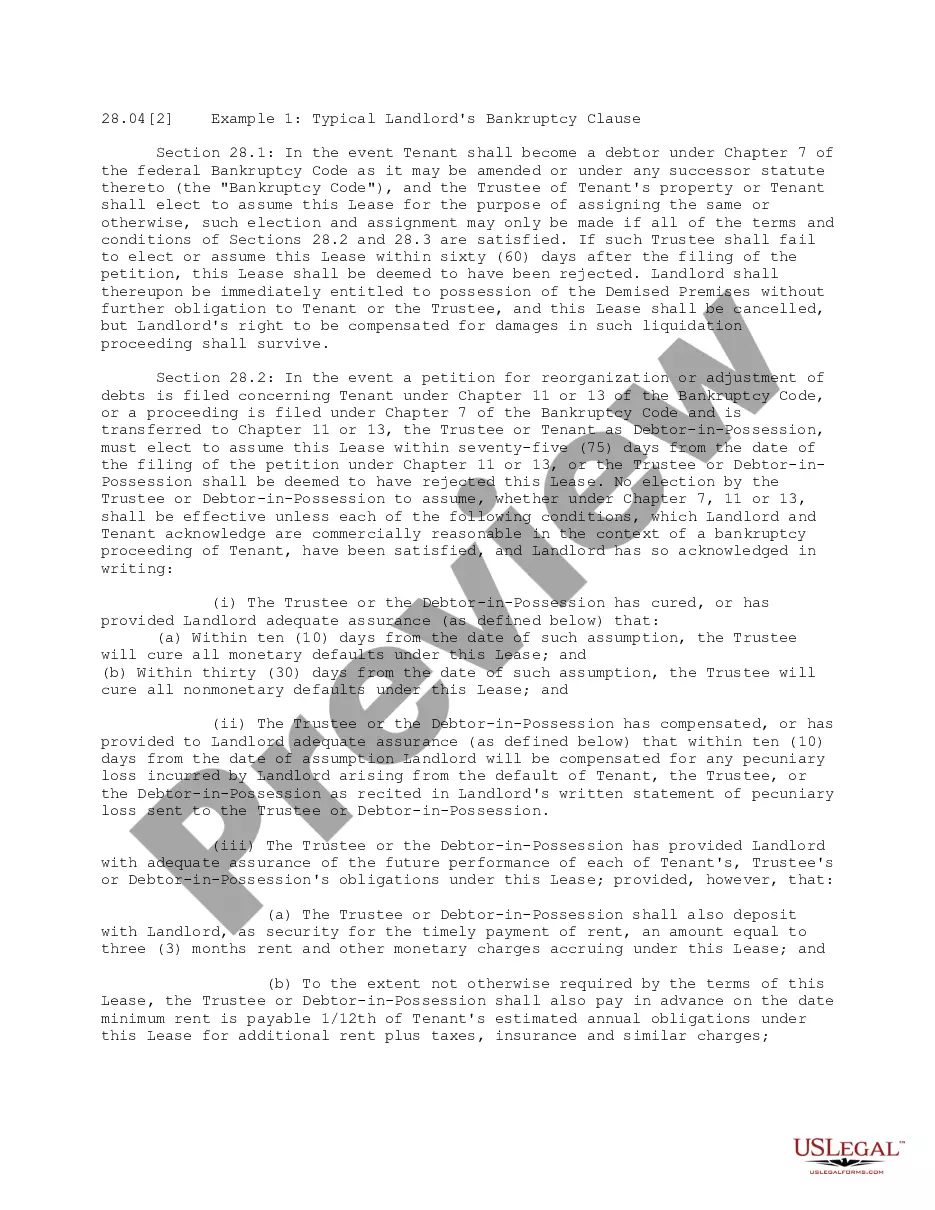
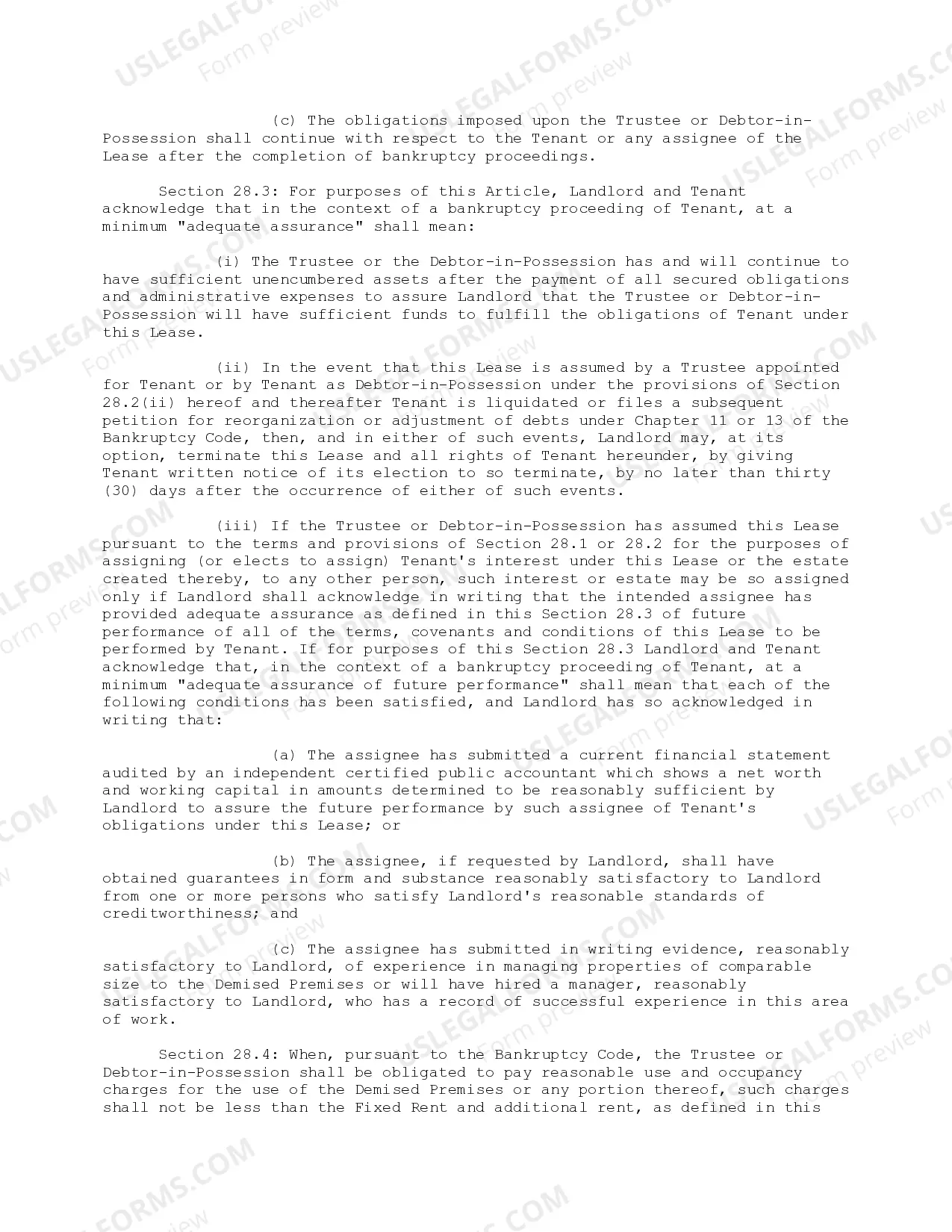
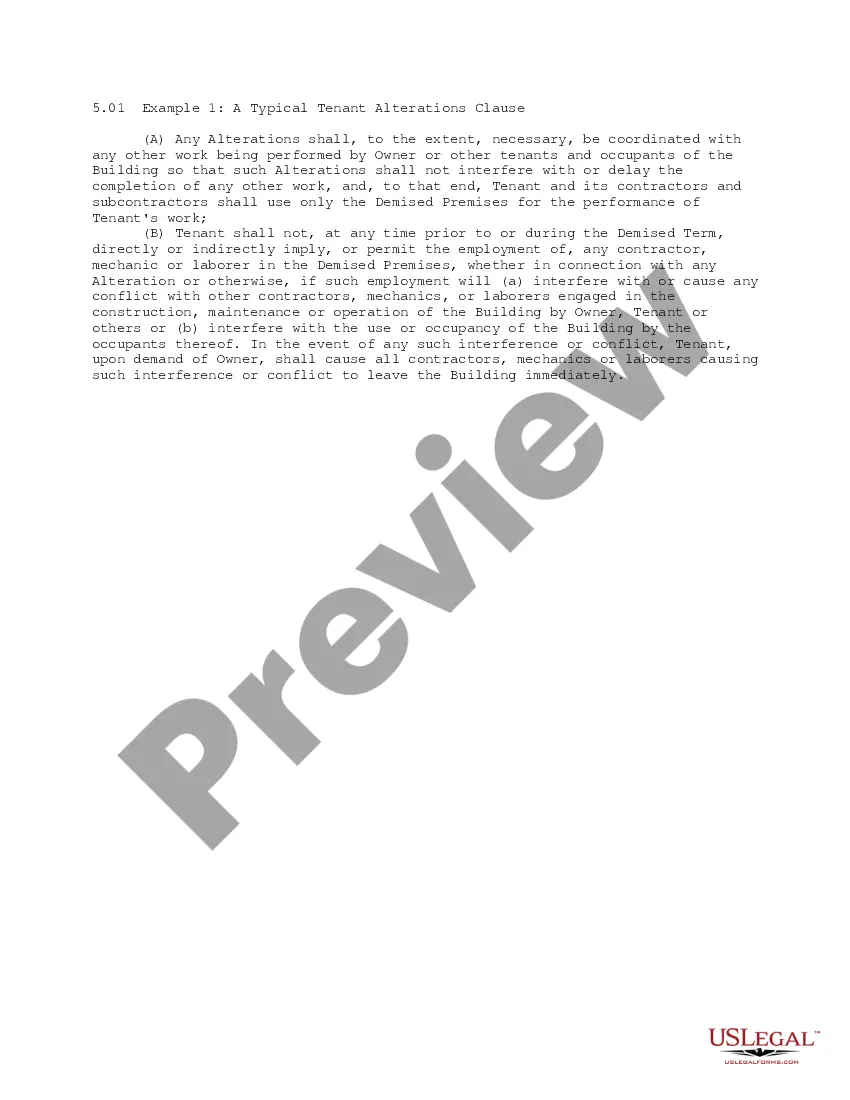
This office lease clause states that in the event the tenant becomes a debtor under Chapter 7 of the federal Bankruptcy Code and the Trustee of the tenant's property or the tenant elects to assume the lease for the purpose of assigning the same or otherwise, such election and assignment may only be made if all of the terms and conditions are satisfied. If such Trustee shall fail to elect or assume the lease within sixty (60) days after the filing of the petition, the lease shall be deemed to have been rejected.
Connecticut Landlord Bankruptcy Clause
Category:
State:
Multi-State
Control #:
US-OL28042
Format:
Word;
PDF
Instant download
Description
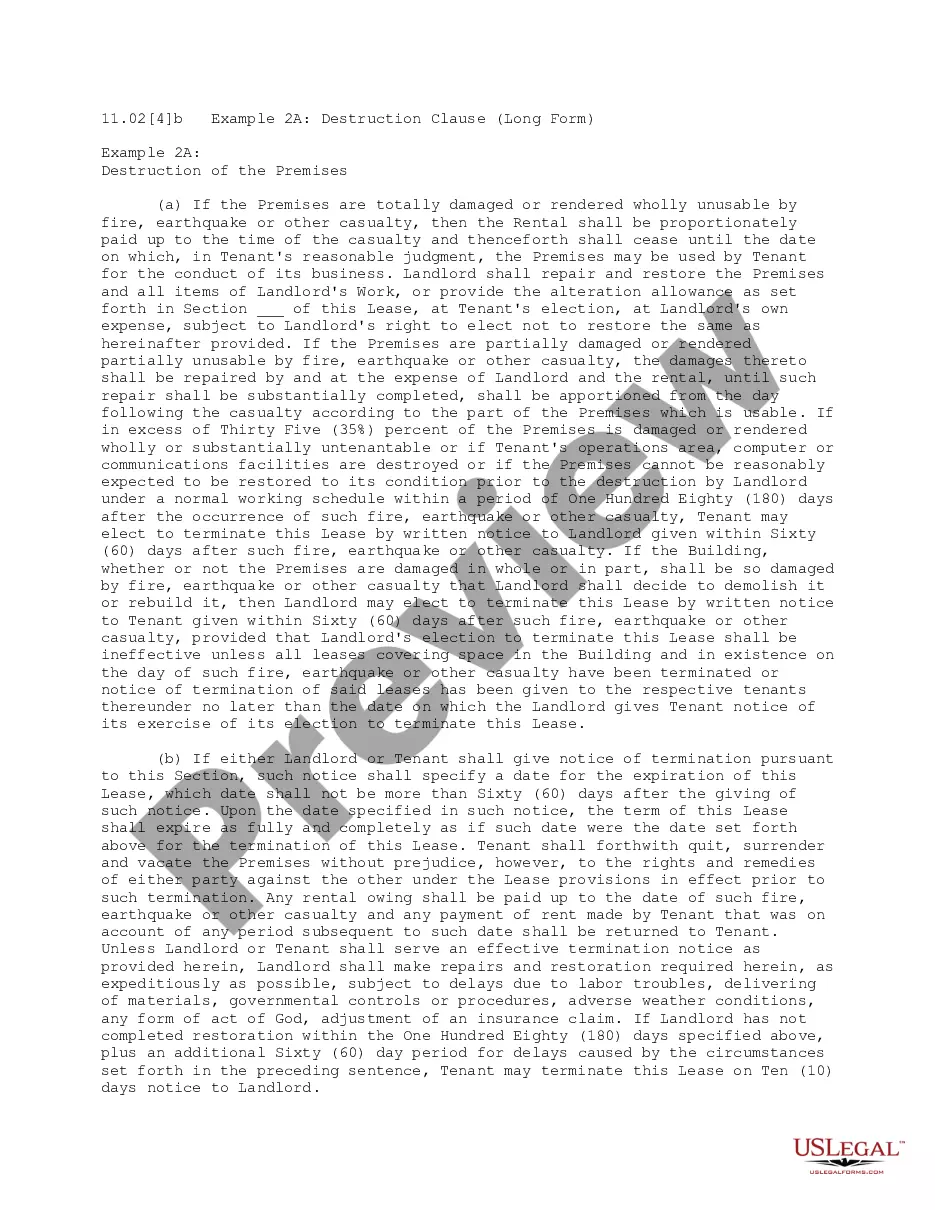
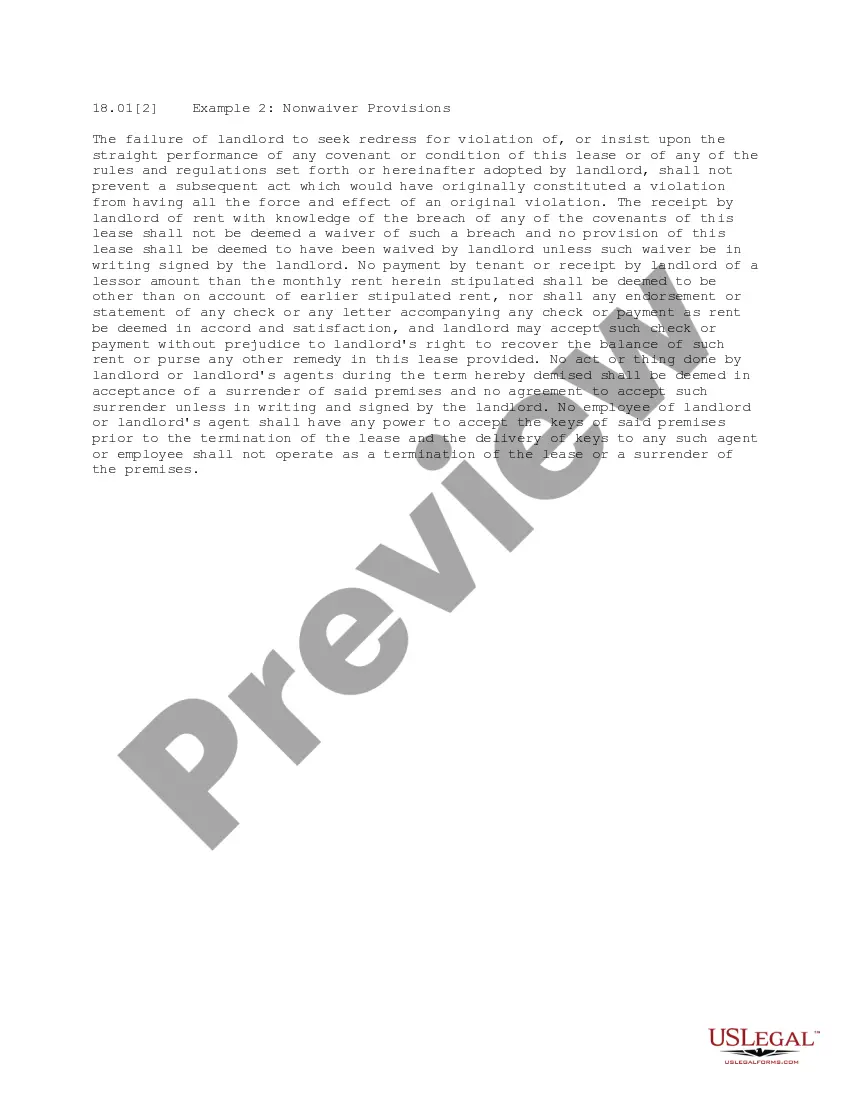
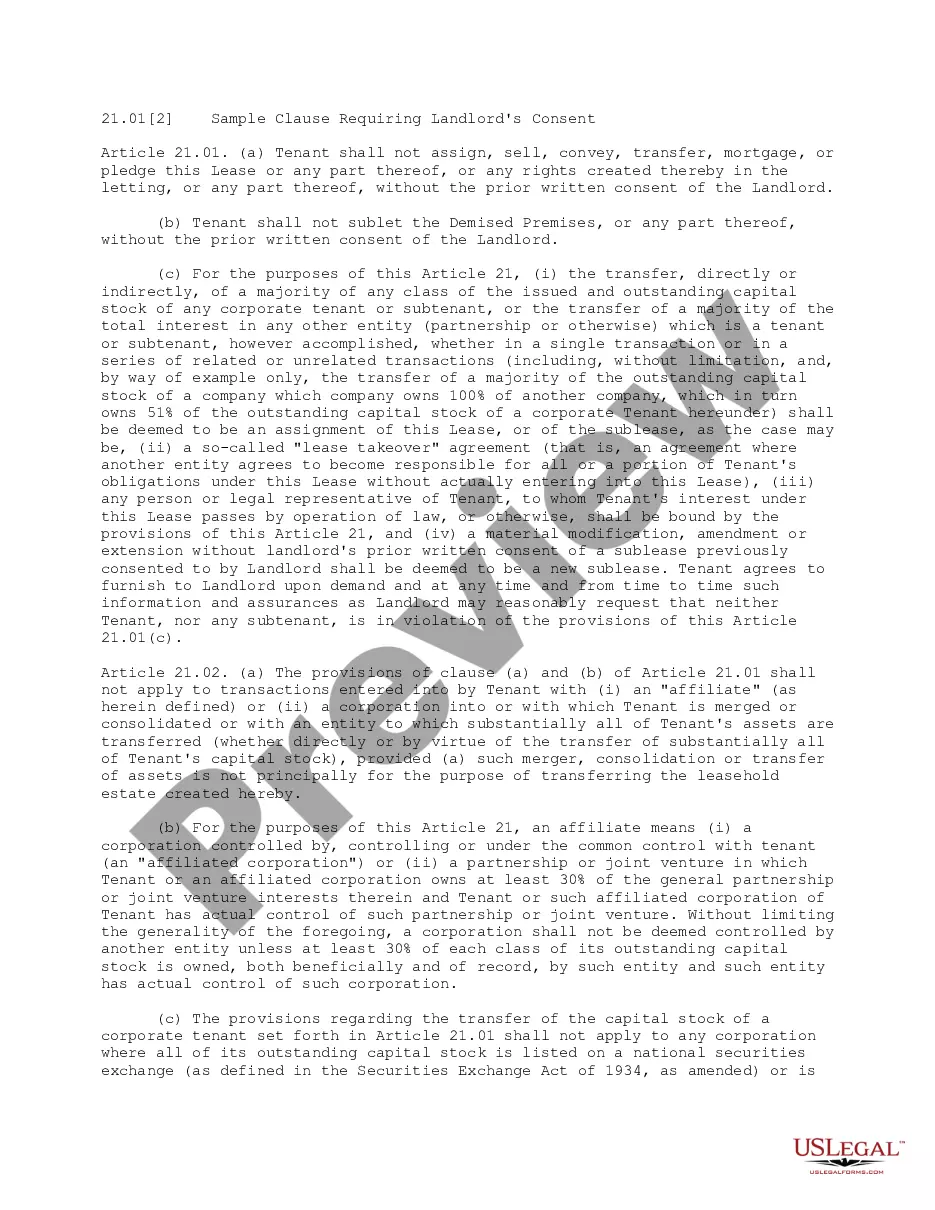
Free preview




How to fill out Landlord Bankruptcy Clause?
Discovering the right legitimate document template could be a have a problem. Naturally, there are tons of templates accessible on the Internet, but how would you discover the legitimate form you want? Make use of the US Legal Forms site. The support gives 1000s of templates, like the Connecticut Landlord Bankruptcy Clause, that you can use for company and private requirements. Every one of the types are inspected by experts and fulfill federal and state requirements.
When you are presently listed, log in to your profile and then click the Download switch to have the Connecticut Landlord Bankruptcy Clause. Utilize your profile to look from the legitimate types you might have acquired previously. Proceed to the My Forms tab of your respective profile and obtain another version of the document you want.
When you are a new customer of US Legal Forms, listed here are easy instructions that you should comply with:
- First, make sure you have chosen the appropriate form for your personal area/county. You can check out the shape making use of the Review switch and look at the shape outline to make certain this is basically the right one for you.
- When the form is not going to fulfill your expectations, make use of the Seach field to discover the correct form.
- Once you are positive that the shape is proper, go through the Buy now switch to have the form.
- Opt for the prices program you need and enter the essential info. Make your profile and buy your order using your PayPal profile or Visa or Mastercard.
- Select the file file format and down load the legitimate document template to your product.
- Comprehensive, modify and print and sign the acquired Connecticut Landlord Bankruptcy Clause.
US Legal Forms is the largest catalogue of legitimate types for which you can see a variety of document templates. Make use of the company to down load skillfully-produced paperwork that comply with condition requirements.
Form popularity
FAQ
Answer. In most circumstances, you can keep your house, car and most ? if not all ? of your property after filing for bankruptcy in Connecticut. The majority of people who file for Chapter 7 bankruptcy don't give up any property. This surprises many people, but the idea behind bankruptcy is hope, not despair.
Surviving Chapter 13 Bankruptcy: Helpful Tips Stay in Touch With Your Attorney and Creditors. ... Keep Up With All Payments. ... Keep Track Of Financial Documents. ... Take a Credit Counseling Course. ... Stay on Top of Notifications.
Chapter 12 and Chapter 13 are basically the same filing, except that Chapter 12 is for family farmers and Chapter 13 is for other individuals. As long as you have a steady, reliable income, less than $269,250 in unsecured debt and less than $807,750 in secured debt, you can file Chapter 13.
A: Yes, you may file as a married individual. Q: If I am married and I file individually, will my spouse's credit be affected? A: No, your spouse's credit will not be affected if he or she does not file.
If your total monthly income over the course of the next 60 months is less than $7,475 then you pass the means test and you may file a Chapter 7 bankruptcy. If it is over $12,475 then you fail the means test and don't have the option of filing Chapter 7.
The filing of a Chapter 13 bankruptcy creates an immediate stop ? known as an ?automatic stay? ? of the foreclosure process, halting a pending foreclosure and allowing for repayment of the past-due mortgage installments, and other debt obligations, over a three- to five-year time period.
The biggest difference between Chapter 7 and Chapter 13 is that Chapter 7 focuses on discharging (getting rid of) unsecured debt such as credit cards, personal loans and medical bills while Chapter 13 allows you to catch up on secured debts like your home or your car while also discharging unsecured debt.
If you want to pay off your plan early, you must notify your creditors and get court approval. Creditors and the bankruptcy trustee will have the opportunity to object to your early payoff?and you should expect them to do so.