This is an official form from the Connecticut Court System, which complies with all applicable laws and statutes. USLF amends and updates forms as is required by Connecticut statutes and law.
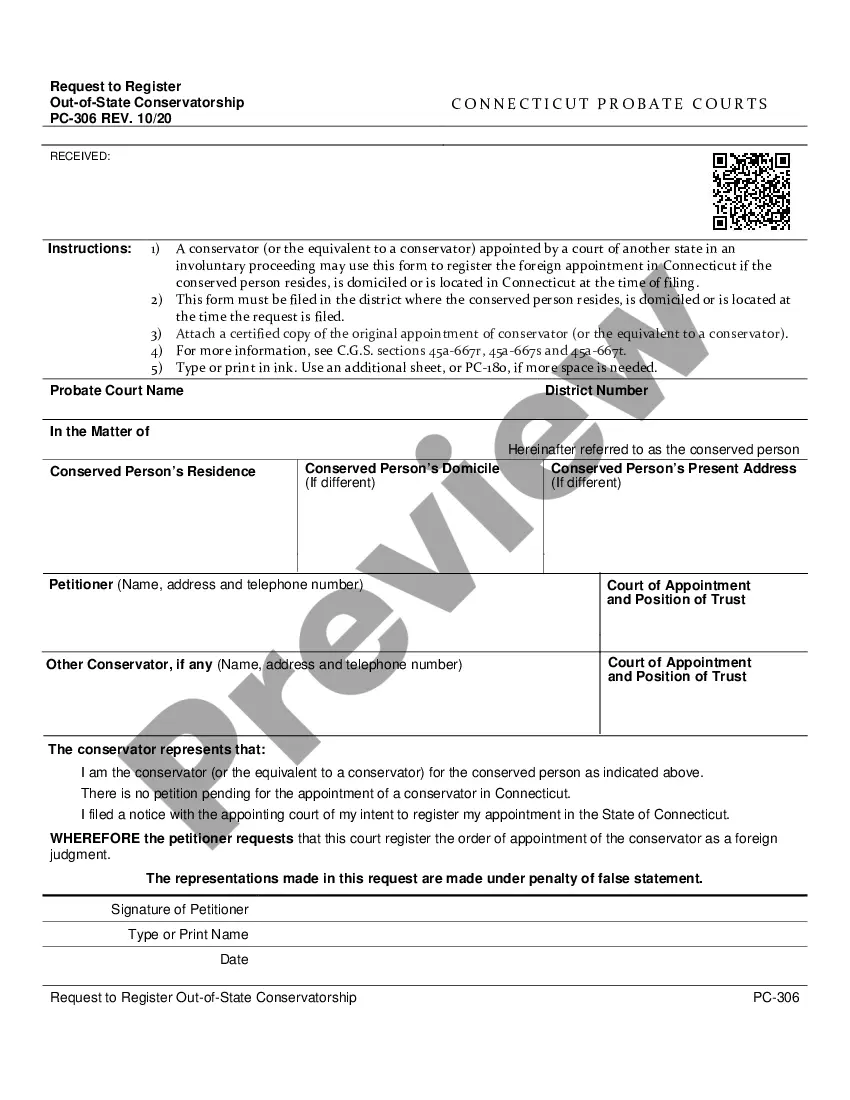
Connecticut Request to Register Out-of-State Conservatorship
State:
Connecticut
Control #:
CT-JD-PC-306
Format:
PDF
Instant download
This website is not affiliated with any governmental entity
Public form
Description
Get your form ready online
Our built-in tools help you complete, sign, share, and store your documents in one place.
Built-in online Word editor
Make edits, fill in missing information, and update formatting in US Legal Forms—just like you would in MS Word.
Export easily
Download a copy, print it, send it by email, or mail it via USPS—whatever works best for your next step.
E-sign your document
Sign and collect signatures with our SignNow integration. Send to multiple recipients, set reminders, and more. Go Premium to unlock E-Sign.
Notarize online 24/7
If this form requires notarization, complete it online through a secure video call—no need to meet a notary in person or wait for an appointment.
Store your document securely
We protect your documents and personal data by following strict security and privacy standards.

Make edits, fill in missing information, and update formatting in US Legal Forms—just like you would in MS Word.

Download a copy, print it, send it by email, or mail it via USPS—whatever works best for your next step.

Sign and collect signatures with our SignNow integration. Send to multiple recipients, set reminders, and more. Go Premium to unlock E-Sign.

If this form requires notarization, complete it online through a secure video call—no need to meet a notary in person or wait for an appointment.

We protect your documents and personal data by following strict security and privacy standards.
Looking for another form?
How to fill out Connecticut Request To Register Out-of-State Conservatorship?
The larger quantity of documents you ought to produce - the more anxious you become.
You can find a vast array of Connecticut Request to Register Out-of-State Conservatorship templates online, but you may be uncertain which ones to trust.
Remove the stress to make locating samples much easier with US Legal Forms. Obtain expertly prepared forms that are designed to fulfill state requirements.
Input the required information to create your account and process your order using PayPal or a credit card. Choose a preferred file format and retrieve your template. Locate every template you acquire in the My documents section. Simply navigate there to create a new version of the Connecticut Request to Register Out-of-State Conservatorship. Even with professionally drafted forms, it's still important to consider consulting your local attorney to verify that your document is accurately completed. Achieve more for less with US Legal Forms!
- If you already possess a US Legal Forms subscription, Log In to your account, and you'll find the Download button on the Connecticut Request to Register Out-of-State Conservatorship’s page.
- If you haven't attempted our site before, complete the registration process by following these guidelines.
- Ensure the Connecticut Request to Register Out-of-State Conservatorship is applicable in your state.
- Double-check your selection by reviewing the description or utilizing the Preview option if available for the selected document.
- Click on Buy Now to initiate the registration process and choose a pricing plan that meets your needs.
Form popularity
FAQ
In Connecticut, there are two main types of conservatorship: conservatorship of the person and conservatorship of the estate. The former is responsible for looking after someone's personal and medical needs, while the latter handles financial matters. When managing an out-of-state conservatorship, knowing the differences can help you effectively navigate the Connecticut Request to Register Out-of-State Conservatorship.
Filing for conservatorship in Connecticut requires completing specific forms and submitting them to the appropriate court. You'll need to provide evidence that the person requires a conservator and show your willingness to take on the role. The Connecticut Request to Register Out-of-State Conservatorship process can be initiated through platforms like USLegalForms, simplifying necessary paperwork and ensuring compliance with state regulations.
Conservatorship in Connecticut involves appointing an individual to look after the personal and financial matters of someone unable to do so themselves. The court oversees the process, ensuring that the conservator fulfills their duties responsibly. If you need to manage an out-of-state conservatorship, utilizing the Connecticut Request to Register Out-of-State Conservatorship can make the transition smoother.
Statute 52-584 in Connecticut deals with the statute of limitations for certain civil actions. It serves as a guideline on how long individuals have to bring forth a legal claim related to conservatorships. While it may not directly relate to the Connecticut Request to Register Out-of-State Conservatorship, it is important for conservators to be aware of as they manage legal responsibilities.
In Connecticut, conservatorship statutes outline the legal framework governing the responsibilities and authority of conservators. These laws ensure that conservators act in the best interest of the person they are appointed to support. Understanding these statutes is essential, especially when navigating a Connecticut Request to Register Out-of-State Conservatorship.
The PC 450 probate form in Connecticut is used for registering a conservatorship from out of state. This form enables a conservator appointed in another state to operate legally within Connecticut. By completing the Connecticut Request to Register Out-of-State Conservatorship, the process becomes streamlined and allows for effective management of the conservatee's affairs.
Not all wills in Connecticut must go through probate. Small estates, typically valued under $40,000, may qualify for a simplified process. However, if your estate includes out-of-state assets or a Connecticut Request to Register Out-of-State Conservatorship is involved, probate becomes necessary to authenticate the will and manage the estate effectively. Always review your situation with a qualified professional to explore your options.
In Connecticut, you generally need to file for probate within six months of the deceased's passing. However, it's best to begin the process as soon as possible to manage the estate effectively. If you encounter complexities, such as needing to handle a Connecticut Request to Register Out-of-State Conservatorship, consider using the uslegalforms platform for assistance in filing the necessary documents efficiently.
A guardian in Connecticut primarily oversees an individual's personal health, safety, and welfare, while a conservator mainly deals with financial responsibility and asset management. Guardians make decisions about living arrangements and healthcare, whereas conservators handle budgeting and property management. This differentiation is essential when seeking to understand your role or responsibilities under a Connecticut Request to Register Out-of-State Conservatorship.
In Connecticut, guardianship typically pertains to decisions regarding a person's personal welfare and care, while conservatorship focuses more on financial matters. Guardianship is often established for minors or individuals unable to care for themselves, whereas conservatorship is generally for adults managing their affairs. Understanding these distinctions is crucial when exploring a Connecticut Request to Register Out-of-State Conservatorship, as it determines the right legal approach.