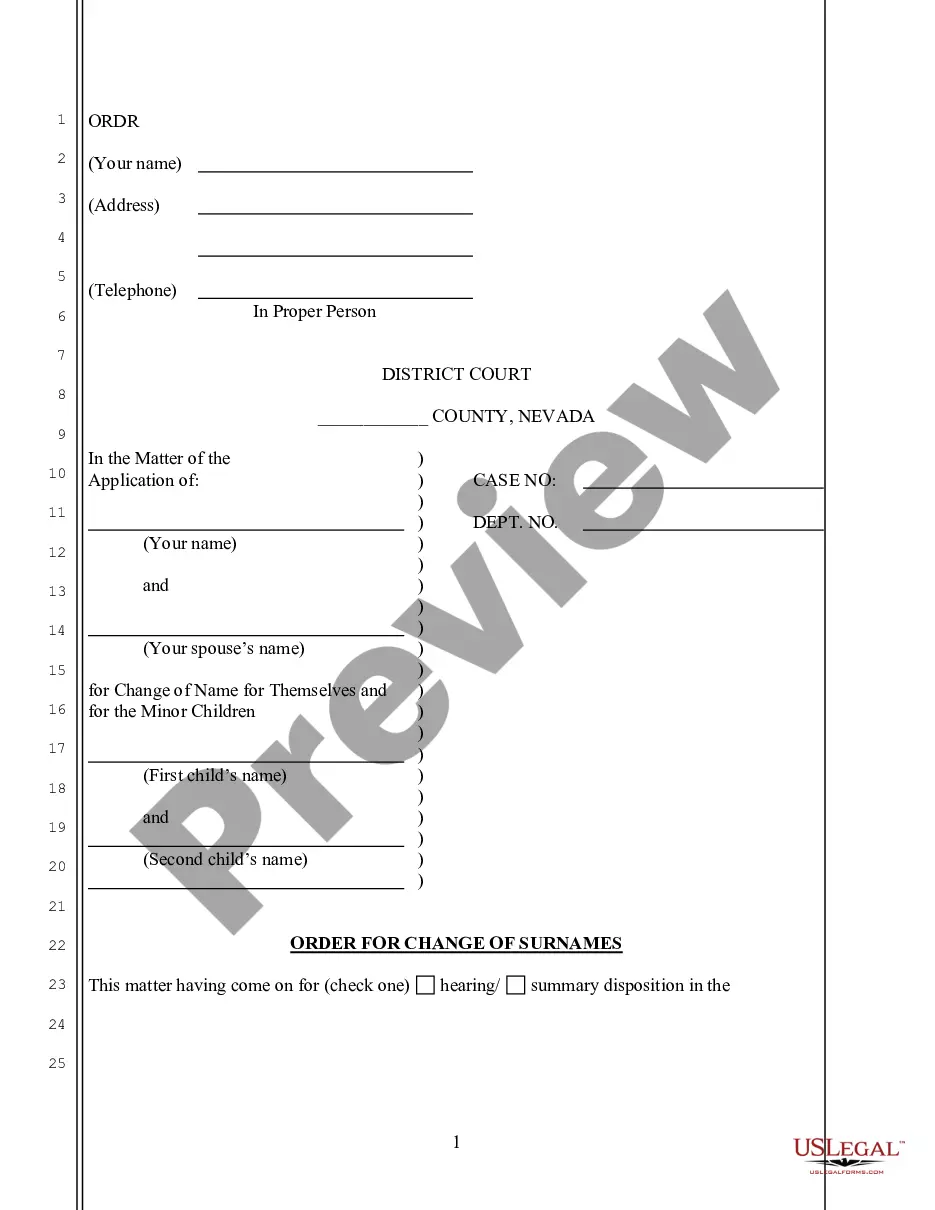
Colorado General Motion
What this document covers
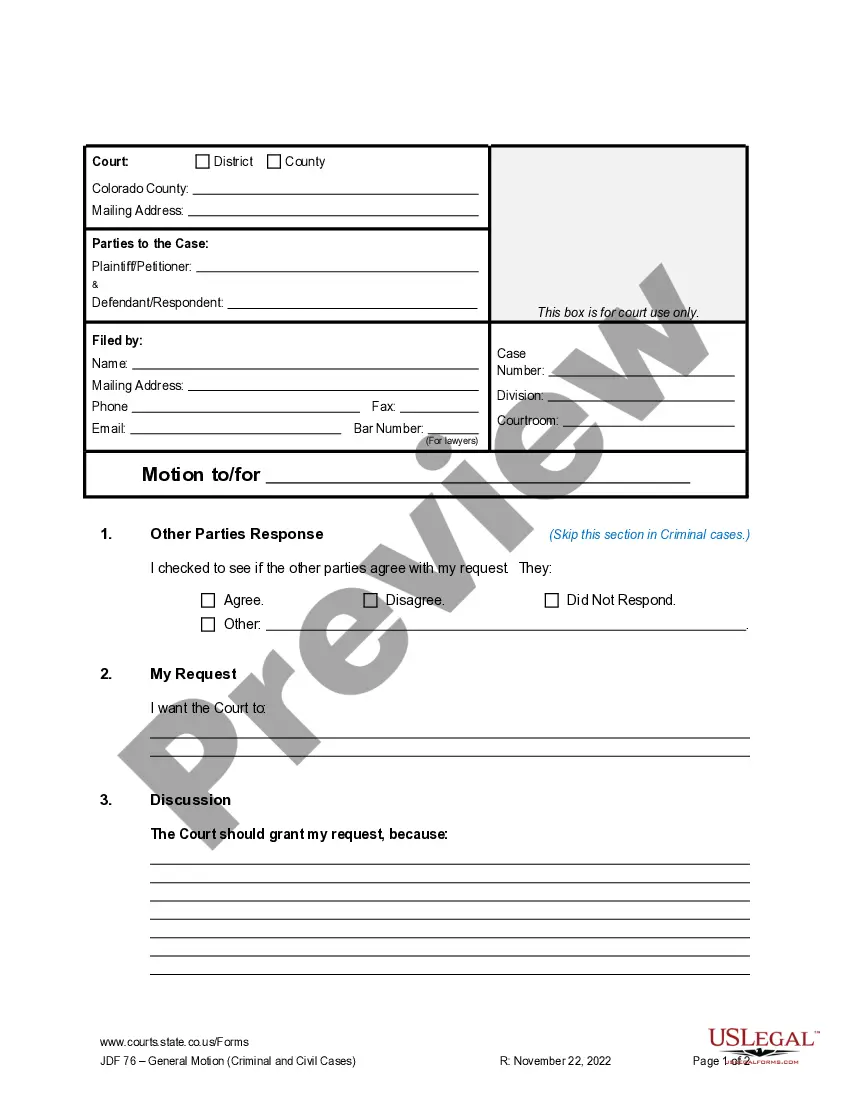
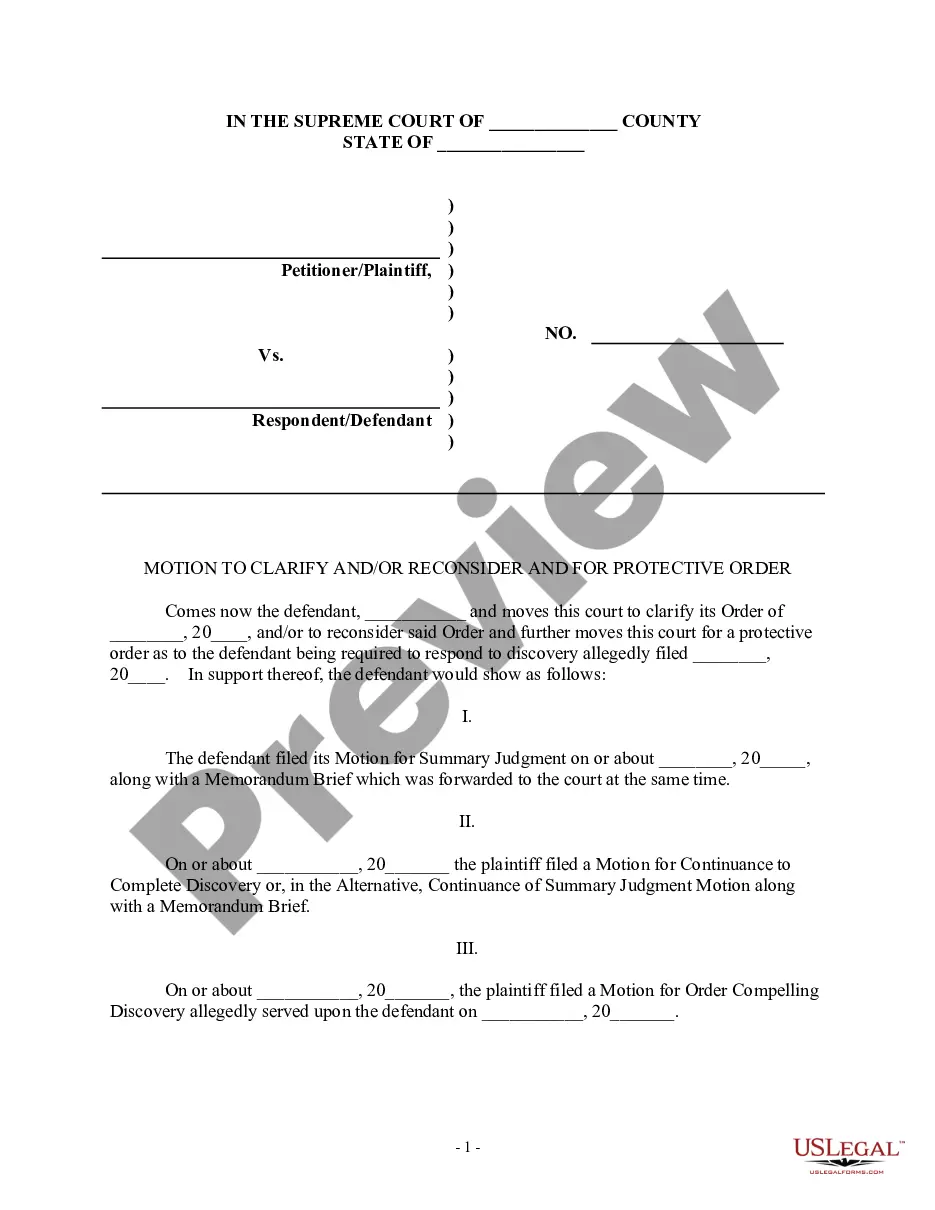
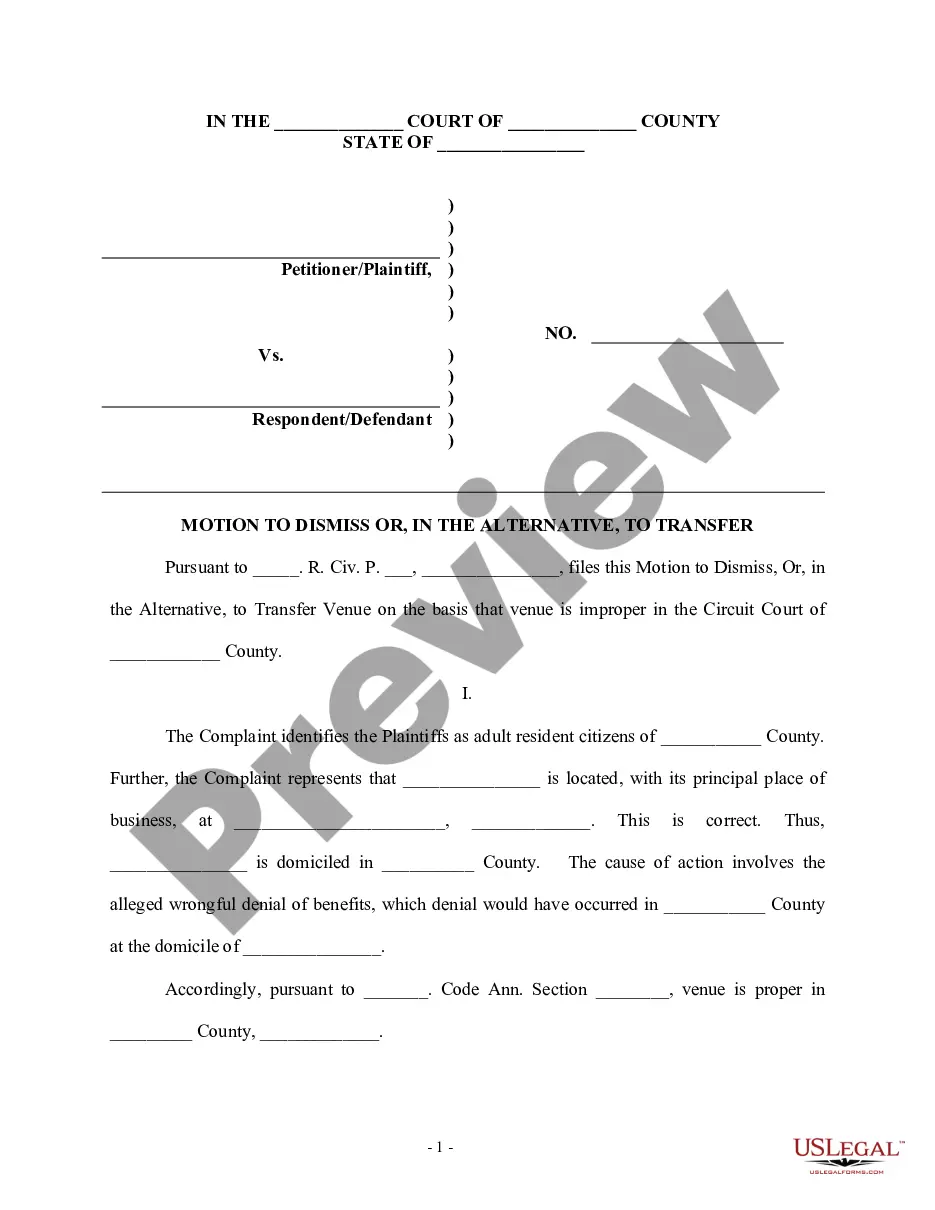
The General Motion form is an official Colorado Judicial Court document designed to request a specific action from the court. It differs from other legal forms by focusing on presenting a motion for a particular relief or request, as determined by Colorado state laws. This form can be tailored for various situations where a legal ruling or decision is sought, making it an essential document in managing legal proceedings.
Key parts of this document
- Fax number and attorney registration details
- Case number for identifying the specific legal matter
- Division and courtroom information
- Section to specify the nature of the motion
- Space to outline reasons for the request, citing applicable laws
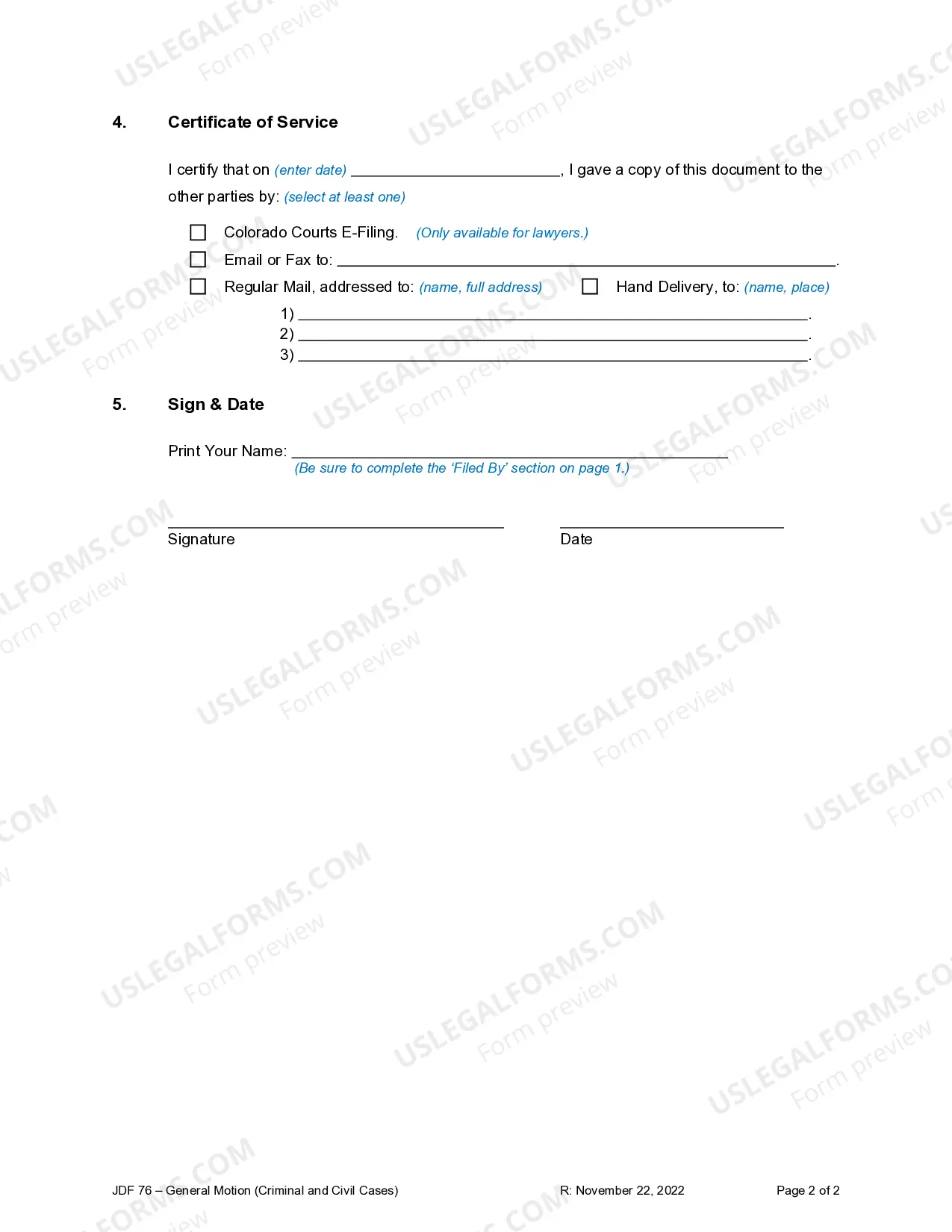
- Signature line for the requesting party


When to use this form
This form is used when you need to formally request an order or ruling from the court on a specific issue within your case. Situations may include seeking a modification of existing orders, requesting court intervention in a dispute, or asking the court to clarify legal issues. Essentially, if you need the court to make a decision on a particular matter, this General Motion form is appropriate.
Who can use this document
This form is intended for the following individuals:
- Parties involved in ongoing litigation in Colorado
- Attorneys representing clients in court
- Individuals representing themselves (pro se litigants)
- Any person seeking to formally address the court on specific legal matters
How to complete this form
- Enter your contact information, including the fax number.
- Provide the relevant attorney registration and case number.
- Specify the court division and courtroom associated with your case.
- Clearly state the motion's purpose in the designated space.
- Cite any applicable laws that support your request in the reasons section.
- Sign and date the form to finalize your request.
Does this document require notarization?
This form does not typically require notarization unless specified by local law. However, if you want to ensure its acceptance, you may consider notarizing it.
Get your form ready online
Our built-in tools help you complete, sign, share, and store your documents in one place.
Make edits, fill in missing information, and update formatting in US Legal Forms—just like you would in MS Word.
Download a copy, print it, send it by email, or mail it via USPS—whatever works best for your next step.
Sign and collect signatures with our SignNow integration. Send to multiple recipients, set reminders, and more. Go Premium to unlock E-Sign.
If this form requires notarization, complete it online through a secure video call—no need to meet a notary in person or wait for an appointment.
We protect your documents and personal data by following strict security and privacy standards.

Make edits, fill in missing information, and update formatting in US Legal Forms—just like you would in MS Word.

Download a copy, print it, send it by email, or mail it via USPS—whatever works best for your next step.

Sign and collect signatures with our SignNow integration. Send to multiple recipients, set reminders, and more. Go Premium to unlock E-Sign.

If this form requires notarization, complete it online through a secure video call—no need to meet a notary in person or wait for an appointment.

We protect your documents and personal data by following strict security and privacy standards.
Mistakes to watch out for
- Failing to provide all required case numbers and court information.
- Omitting specific legal citations to support the motion.
- Ineffectively stating the reasons for the motion, which can lead to rejection.
- Not signing the form before submission.
Why complete this form online
- Convenience of accessing the form anytime, anywhere.
- Editability allows you to customize the form to your particular needs.
- Reliability since the form is regularly updated to comply with legal standards.
- The General Motion must be submitted in accordance with Colorado court rules.
- Ensure that the motion is served to all other parties involved in the case.
- Incomplete motions may be rejected by the court, so careful attention to detail is critical.
- The General Motion is a vital tool for requesting judicial relief in Colorado courts.
- Complete all sections carefully to avoid submission issues.
- Understanding procedural requirements can enhance the likelihood of a favorable outcome.
Looking for another form?

Form popularity
FAQ
In Colorado, the maximum claim amount in small claims court is generally $7,500. This limit allows individuals to resolve disputes without the complexities of a full civil trial. For assistance with understanding the claims process, you may find resources related to Colorado General Motion helpful as part of your preparation.
Rule 35 in Colorado permits a party to request a mental or physical examination of another party when their condition is in controversy. This motion plays an important role in personal injury and medical cases, helping you gather relevant information. When considering how to present your case, knowing about Colorado General Motion can provide valuable insights.
A Rule 70 motion in Colorado allows a party to ask the court to order the transfer of property or rights when the opposing party refuses to comply with a prior judgment. This is a crucial mechanism to ensure your rights are upheld. Familiarizing yourself with Colorado General Motion can empower you to take necessary steps in these situations.
Rule 69 in Colorado outlines the procedures for enforcing a judgment through various means, including writs of execution and garnishment. Essentially, this rule provides a framework for collecting what’s owed after winning a case. Utilizing your knowledge of Colorado General Motion can help you respond effectively when dealing with enforcement actions.
A Rule 59 motion in Colorado is a request for a court to alter or amend a judgment. This motion allows a party to address issues such as newly discovered evidence or errors that could have influenced the outcome. If you're navigating a complex case, understanding how to file a Colorado General Motion could be essential to your strategy.
Filing a civil lawsuit without a lawyer is possible, but it requires careful attention to detail. Start by researching court procedures and relevant forms, such as the JDF 76, which may be necessary for your Colorado General Motion. You can find support and resources through uslegalforms, which can help you navigate the entire filing process efficiently. Remember to keep copies of all documents you submit.
In Colorado, the timeframe to file a civil lawsuit typically varies based on the type of claim you have. Most actions must be filed within three years from the date of the incident. Understanding these timelines is crucial, especially when dealing with Colorado General Motion matters. If you're unsure, it may be helpful to seek assistance from uslegalforms to navigate your specific situation.
Filling out a JDF 76 form requires you to provide specific information related to your case. Start by entering the case number, parties involved, and a brief description of the motion you are addressing. Ensure that you complete all sections accurately, as this form relates to Colorado General Motion procedures. You can always use resources from uslegalforms to guide you through this process.
In Colorado, you generally have 21 days to respond to a motion. It's essential to adhere to this timeline to ensure your right to present your side of the case remains intact. Failure to respond within this period may result in a default judgment against you. If you're facing a Colorado General Motion, consider consulting with a legal professional for tailored advice.
Filing a general motion involves a few key steps to ensure proper submission to the court. First, prepare the motion document, making sure to include clear arguments and any supporting evidence. Next, file the motion with your local court, following any specific procedures outlined for Colorado General Motion submissions. Finally, serve a copy to the opposing party, as this step ensures transparency and adherence to court rules.