A joint venture is very similar to a partnership. In fact, some States treat joint ventures the same as partnerships with regard to partnership statutes such as the Uniform Partnership Act. The main difference between a partnership and a joint venture is that a joint venture usually relates to the pursuit of a single transaction or enterprise even though this may require several years to accomplish. A partnership is generally a continuing or ongoing business or activity. While a partnership may be expressly created for a single transaction, this is very unusual. Most Courts hold that joint ventures are subject to the same principles of law as partnerships. The duties owed by joint venturers to each are the same as those that partners owe to each other. For example, partners have a duty of loyalty to one another, and joint venturers would also have the same duty. If a joint venture is entered into to acquire and develop a certain tract of land, but some of the venturers secretly purchase and develop land in their own names to compete with the joint venture, the other joint venturers may be liable for damages for the breach of this duty of loyalty.
A joint venture will last generally as long as stated in the joint venture agreement. If the joint venture agreement is silent on this, it can be terminated by any participant unless it clearly relates to a particular transaction. For example, if a joint venture is created to construct a particular bridge, it will last until the project is completed or becomes impossible to complete because of bankruptcy or some other type situation.
With regard to liability to third persons, generally, joint venturers have the same liability as partners in a general partnership.
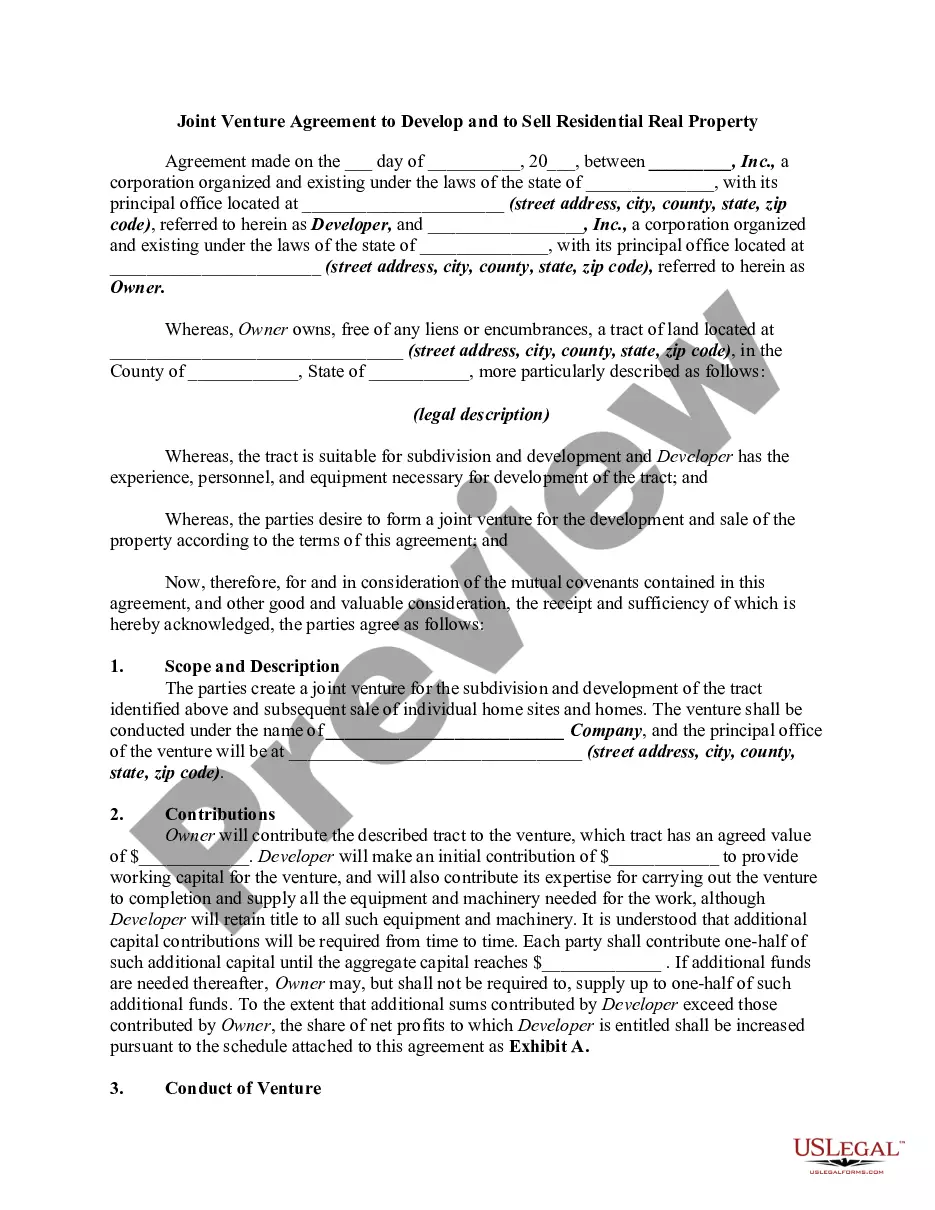
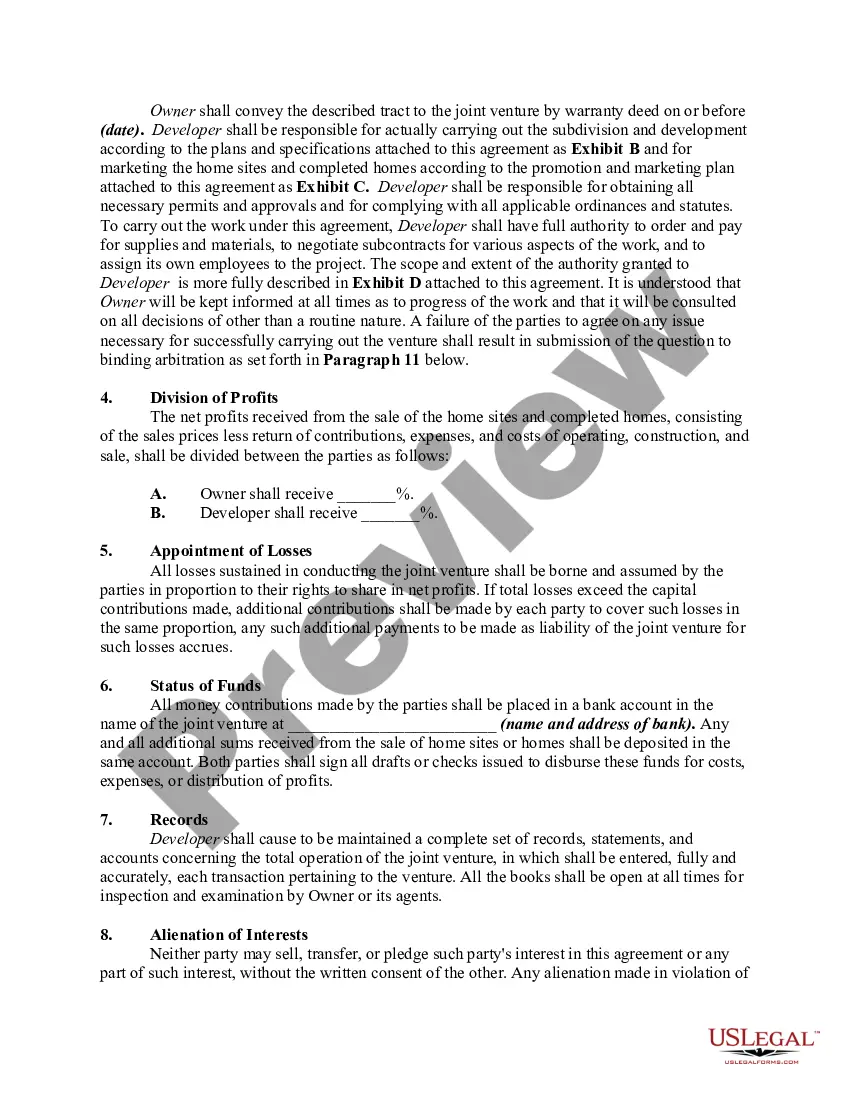
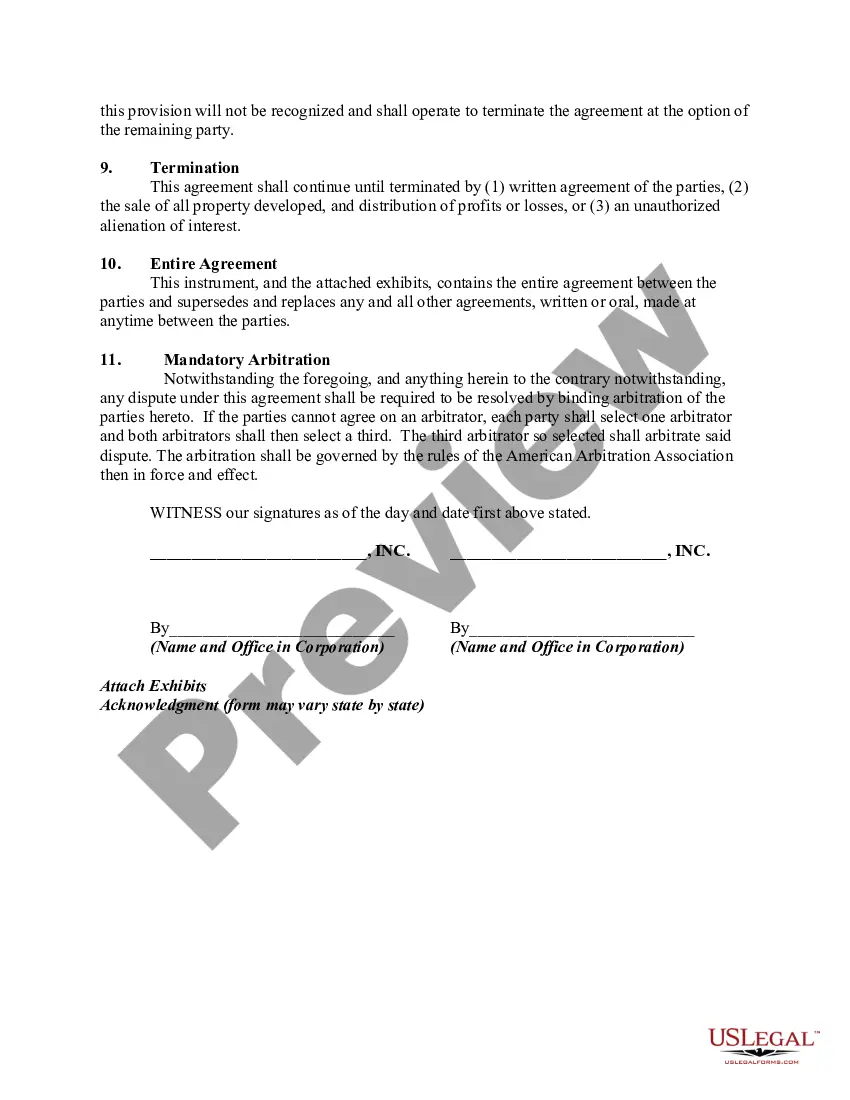
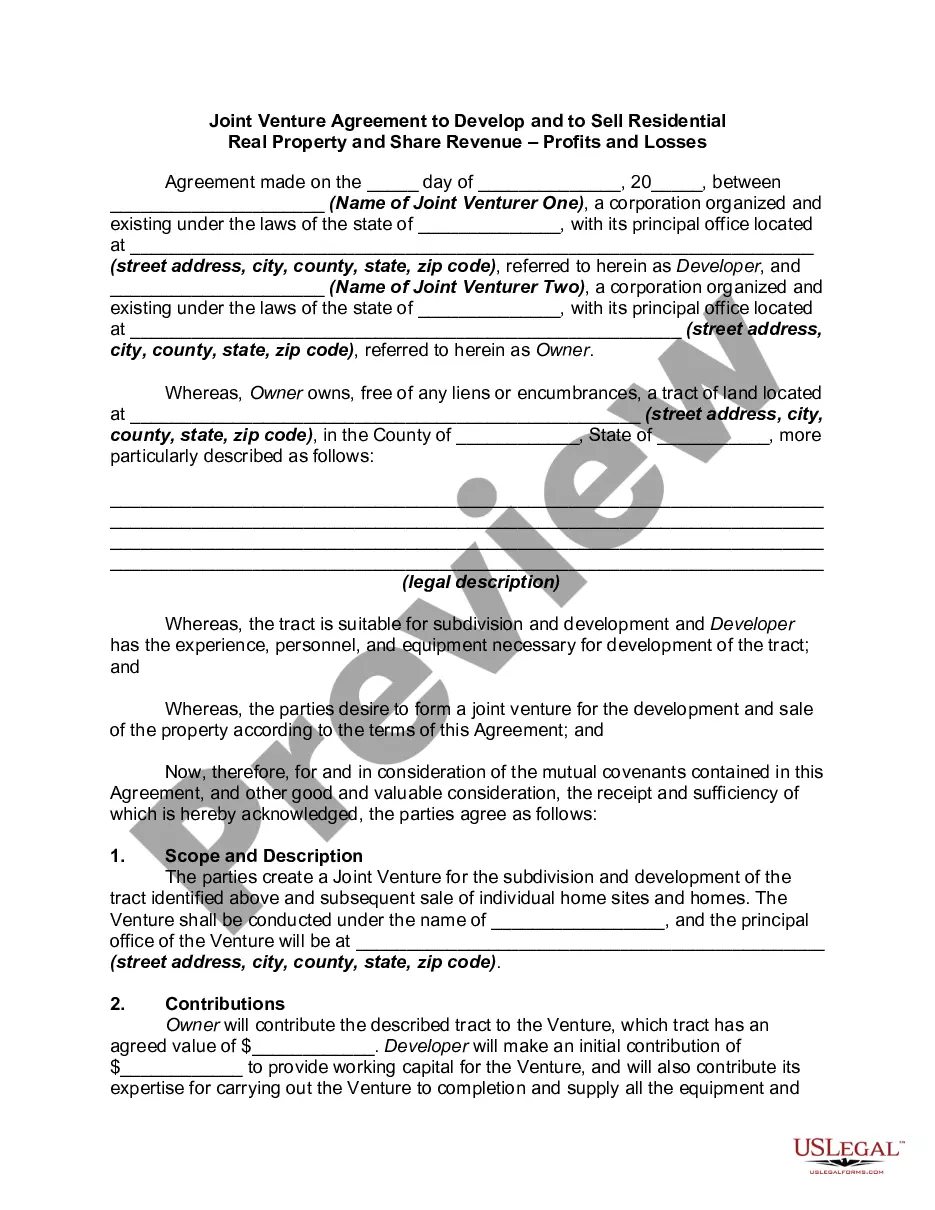
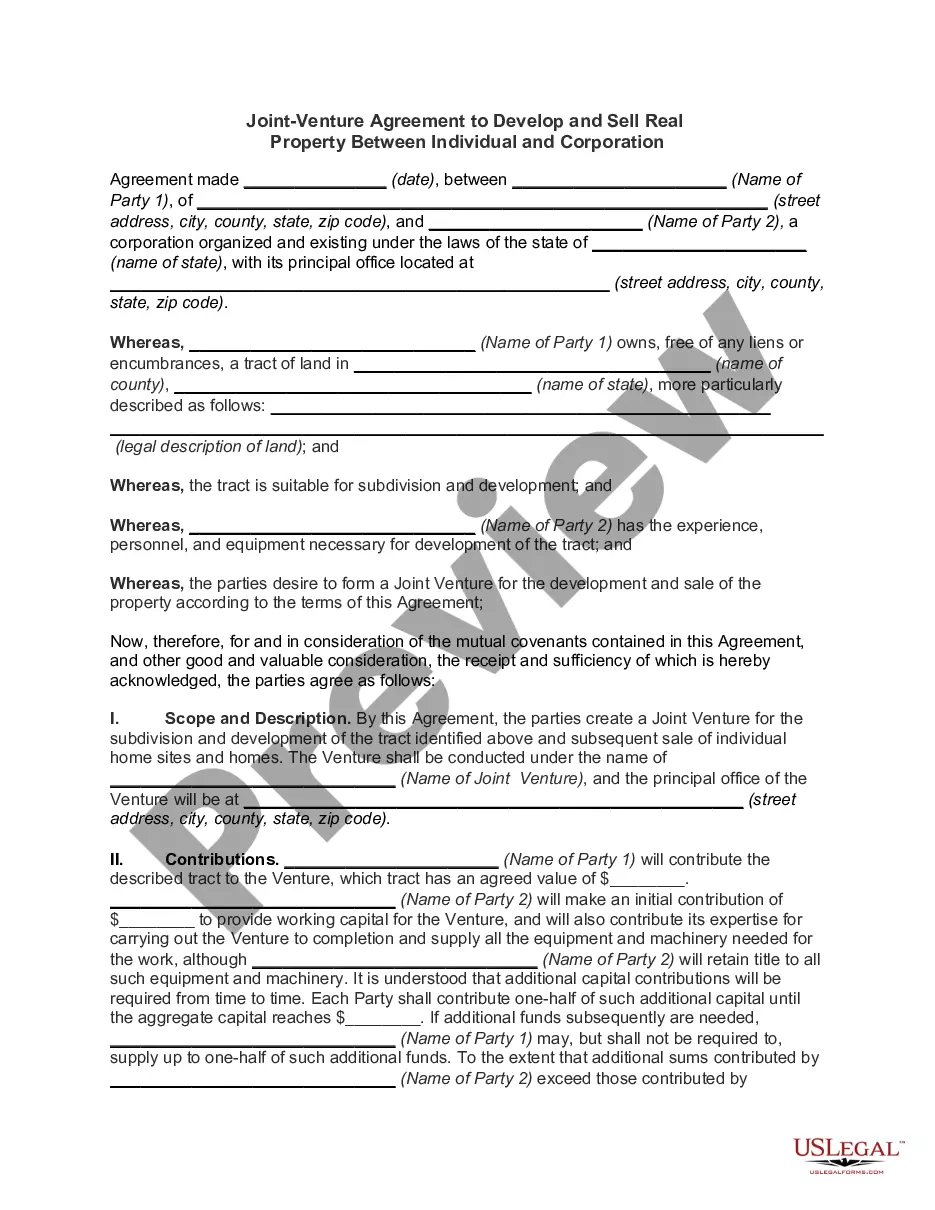
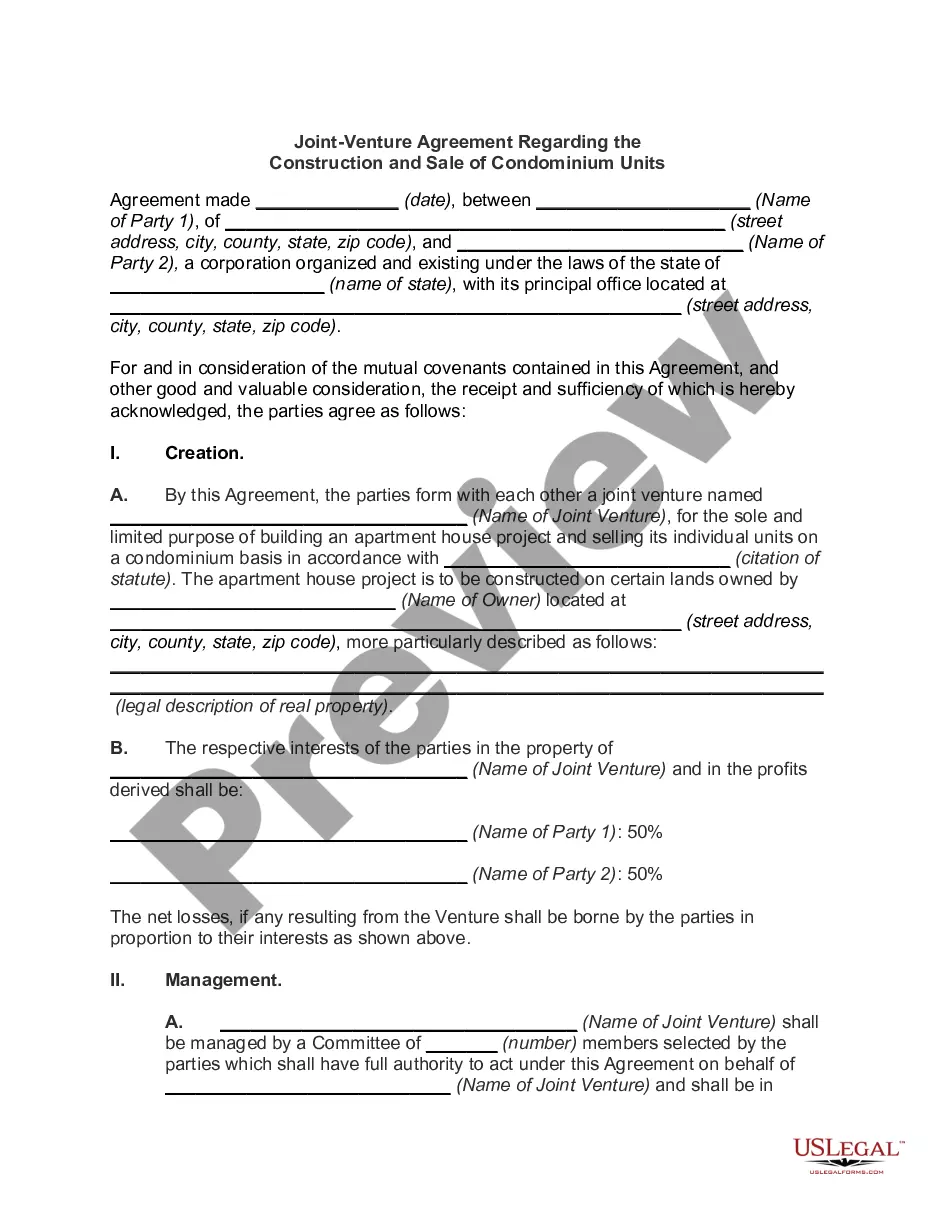
California Joint Venture Agreement to Develop and to Sell Residential Real Property
State:
Multi-State
Category:
Control #:
US-00798BG
Format:
Word;
Rich Text
195 downloads
Description
Free preview
Get your form ready online
Our built-in tools help you complete, sign, share, and store your documents in one place.
Built-in online Word editor
Make edits, fill in missing information, and update formatting in US Legal Forms—just like you would in MS Word.
Export easily
Download a copy, print it, send it by email, or mail it via USPS—whatever works best for your next step.
E-sign your document
Sign and collect signatures with our SignNow integration. Send to multiple recipients, set reminders, and more. Go Premium to unlock E-Sign.
Notarize online 24/7
If this form requires notarization, complete it online through a secure video call—no need to meet a notary in person or wait for an appointment.
Store your document securely
We protect your documents and personal data by following strict security and privacy standards.

Make edits, fill in missing information, and update formatting in US Legal Forms—just like you would in MS Word.

Download a copy, print it, send it by email, or mail it via USPS—whatever works best for your next step.

Sign and collect signatures with our SignNow integration. Send to multiple recipients, set reminders, and more. Go Premium to unlock E-Sign.

If this form requires notarization, complete it online through a secure video call—no need to meet a notary in person or wait for an appointment.

We protect your documents and personal data by following strict security and privacy standards.
Looking for another form?
How to fill out Joint Venture Agreement To Develop And To Sell Residential Real Property?
You can spend multiple hours online searching for the valid document template that meets the state and federal requirements you need.
US Legal Forms offers thousands of valid forms reviewed by professionals.
You can easily acquire or create the California Joint Venture Agreement to Develop and to Sell Residential Real Property through my service.
First, make sure you have selected the correct document template for your area/city of choice. Review the form description to ensure you have selected the appropriate form. If available, utilize the Preview button to browse through the document template as well.
- If you already possess a US Legal Forms account, you can Log In and click the Acquire button.
- Next, you can complete, edit, create, or sign the California Joint Venture Agreement to Develop and to Sell Residential Real Property.
- Every valid document template you purchase is yours permanently.
- To obtain an additional copy of any acquired form, navigate to the My documents section and click the appropriate button.
- If you are utilizing the US Legal Forms website for the first time, follow the simple instructions below.
Form popularity
FAQ
An equity joint venture involves shared ownership and investment among partners, which is crucial in a California Joint Venture Agreement to Develop and to Sell Residential Real Property. Alternatively, a contractual joint venture establishes a partnership through a mutual agreement without forming a separate legal entity, typically focusing on specific project outcomes. Understanding these differences helps you choose the right structure for your project based on your goals and resources.
The most typical joint venture is an equity joint venture, commonly used in real estate, such as a California Joint Venture Agreement to Develop and to Sell Residential Real Property. In this arrangement, two or more parties combine their resources, expertise, and capital to pursue a specific project. By sharing both the risks and rewards, participants can leverage their strengths to achieve greater success in the competitive real estate market.
There are various methods for establishing a joint venture, especially in a California Joint Venture Agreement to Develop and to Sell Residential Real Property. The most common methods include equity joint ventures, where both parties contribute capital and share ownership, and contractual joint ventures, which formalize the terms of collaboration without creating a separate legal entity. Each method suits different business needs, so it's crucial to evaluate which fits your goals best.
Successful joint ventures, such as a California Joint Venture Agreement to Develop and to Sell Residential Real Property, rely on four key factors. First, effective communication between partners promotes transparency and trust. Second, aligning goals ensures that everyone is committed to the same vision. Third, the complementary strengths of each partner enhance the venture's capabilities. Lastly, a clearly defined legal framework protects everyone's interests.
Writing a California Joint Venture Agreement to Develop and to Sell Residential Real Property involves several essential steps. Start by clearly defining the purpose of the joint venture, including the specific real estate development goals. Next, outline the contributions each party will make, such as property, capital, or expertise. Finally, ensure you include the terms for profit sharing, governance, and dispute resolution, which will provide a solid foundation for the partnership.
The four types of joint ventures include contractual joint ventures, equity joint ventures, cooperative joint ventures, and project-specific joint ventures. Each type has its nuances but generally serves to pool resources for a specific objective, such as a California Joint Venture Agreement to Develop and to Sell Residential Real Property. Understanding these types helps partners choose the best structure for their collaboration, aligning with their goals and project requirements.
To set up a joint venture agreement, gather potential partners and identify the common objective. Next, draft an agreement that clearly states each partner's responsibilities, profits distribution, and duration of the venture. For a California Joint Venture Agreement to Develop and to Sell Residential Real Property, you may consider using resources from US Legal Forms to ensure an effective structure that meets legal standards and aligns with your project goals.
Creating a joint venture agreement involves several steps, starting with discussing goals and expectations among partners. Once aligned, draft a formal document that includes essential details, like financial contributions and distribution of profits. Utilizing platforms like US Legal Forms can streamline this process, providing templates specifically designed for California Joint Venture Agreements to Develop and to Sell Residential Real Property, ensuring compliance and clarity throughout.
A joint venture agreement typically needs to outline the terms, contributions, profit distribution, and management roles of each partner. In the case of a California Joint Venture Agreement to Develop and to Sell Residential Real Property, inclusion of specific project details and timelines is crucial. This ensures that all parties understand their responsibilities, helping to facilitate effective teamwork and successful project completion.
In California, joint ventures do not require formal registration. However, creating a California Joint Venture Agreement to Develop and to Sell Residential Real Property is advisable for protecting each partner's interests and outlining responsibilities. By drafting a comprehensive agreement, partners can avoid potential disputes and clarify obligations, ensuring a smoother collaboration.