See Preview
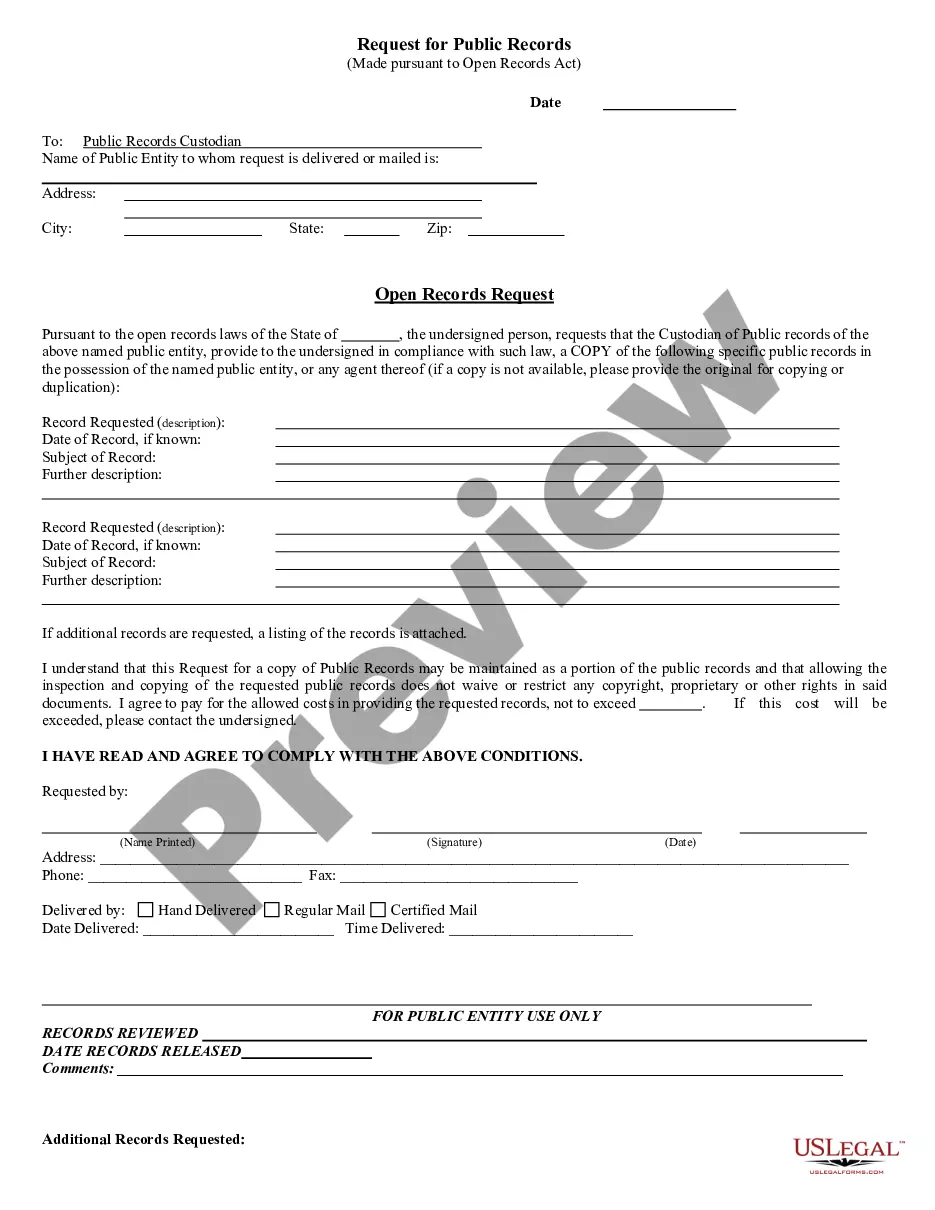
California Public Records Request - Open Public Records Act
State:
Multi-State
Category:
Control #:
US-004-PR
Format:
Word;
Rich Text
124 downloads
Description
Free preview
Get your form ready online
Our built-in tools help you complete, sign, share, and store your documents in one place.
Built-in online Word editor
Make edits, fill in missing information, and update formatting in US Legal Forms—just like you would in MS Word.
Export easily
Download a copy, print it, send it by email, or mail it via USPS—whatever works best for your next step.
E-sign your document
Sign and collect signatures with our SignNow integration. Send to multiple recipients, set reminders, and more. Go Premium to unlock E-Sign.
Notarize online 24/7
If this form requires notarization, complete it online through a secure video call—no need to meet a notary in person or wait for an appointment.
Store your document securely
We protect your documents and personal data by following strict security and privacy standards.

Make edits, fill in missing information, and update formatting in US Legal Forms—just like you would in MS Word.

Download a copy, print it, send it by email, or mail it via USPS—whatever works best for your next step.

Sign and collect signatures with our SignNow integration. Send to multiple recipients, set reminders, and more. Go Premium to unlock E-Sign.

If this form requires notarization, complete it online through a secure video call—no need to meet a notary in person or wait for an appointment.

We protect your documents and personal data by following strict security and privacy standards.
Looking for another form?






How to fill out Public Records Request - Open Public Records Act?
Selecting the appropriate legal document format can be quite a challenge. Naturally, there are numerous templates accessible online, but how do you locate the legal form you need? Utilize the US Legal Forms website. The service offers thousands of templates, including the California Public Records Request - Open Public Records Act, which can be utilized for both business and personal purposes. All forms are verified by experts and comply with state and federal regulations.
If you are already registered, Log In to your account and click the Download button to obtain the California Public Records Request - Open Public Records Act. Use your account to search for the legal forms you have previously purchased. Navigate to the My documents section of your account and retrieve another copy of the documents you need.
If you are a new user of US Legal Forms, here are some simple instructions for you to follow: First, ensure you have selected the correct form for your city/state. You can browse the form using the Review option and read the form description to confirm it is suitable for you. If the form does not meet your requirements, use the Search field to find the appropriate form. Once you are confident that the form is correct, click the Purchase now button to obtain the form. Choose the pricing plan you desire and enter the required information. Create your account and complete your purchase using your PayPal account or credit card. Select the file format and download the legal document format to your device. Fill out, modify, print, and sign the acquired California Public Records Request - Open Public Records Act.
Leverage US Legal Forms to access the documents you require efficiently and effectively.
- US Legal Forms is the largest collection of legal forms where you can discover various document templates.
- Utilize the service to download properly crafted paperwork that adhere to state regulations.
- The platform offers an extensive range of forms for diverse needs.
- All documents are crafted to ensure compliance with legal standards.
- Users can easily retrieve and manage their purchased forms.
- The website provides a user-friendly experience for both new and existing customers.
Form popularity
FAQ
Yes, you can access California public records online through various platforms, including the US Legal Forms website. The California Public Records Request - Open Public Records Act allows you to request access to numerous documents, such as court records, property records, and vital records. By utilizing online services, you can streamline your request process, saving time and effort. Additionally, US Legal Forms provides resources and templates to help you navigate the request process efficiently.
When making a public records request in California, you must specify the records you seek to ensure clarity. Requests should be directed to the appropriate government agency that holds the records. The California Public Records Request - Open Public Records Act mandates a response within ten days, although additional time may be necessary in some cases. Utilizing platforms like US Legal Forms can simplify this process, providing templates and guidance to help you navigate your request efficiently.
The California Public Records Act aims to promote transparency and accountability in government by allowing the public to access government records. This law empowers citizens to stay informed about government actions and decisions. By submitting a California Public Records Request - Open Public Records Act, individuals can gain insight into public affairs, fostering an informed community. Ultimately, this promotes trust between the government and the people it serves.
Certain records are exempt from the California Public Records Act, including those that contain sensitive personal information, attorney-client communications, and documents related to ongoing investigations. These exemptions exist to protect privacy and ensure effective law enforcement. However, you can still submit a California Public Records Request - Open Public Records Act to seek access to other public documents. Understanding these limits helps you navigate the request process more effectively.
California Public Records Act (CPRA) allows for the inspection or disclosure of government records to the public, upon request, unless exempt by law.
Effective January 1, 2023, the California Public Records Act (CPRA) has a new location within the Government Code, complete with relabeled organizational headings that improve navigating the statute.
A few of the exemptions that are relied on frequently by public agencies are: Attorney Client Privilege and Attorney Work Product. All records protected by privileges under the Evidence Code are exempt from disclosure under the CPRA pursuant to Gov. Code §7927.705.
6250. In enacting this chapter, the Legislature, mindful of the right of individuals to privacy, finds and declares that access to information concerning the conduct of the people's business is a fundamental and necessary right of every person in this state.
Publicly available information is defined to mean ?information that is lawfully made available from federal, state, or local government records, or information that a business has a reasonable basis to believe is lawfully made available to the general public by the consumer or from widely distributed media,; or ...
Prompt access to public records is required by the CPRA (Government Code 6253). However, the agency has 10 days to respond to the request, either providing the information, or may provide a detailed explanation as to what information may be released or what cannot because it is protected by law.