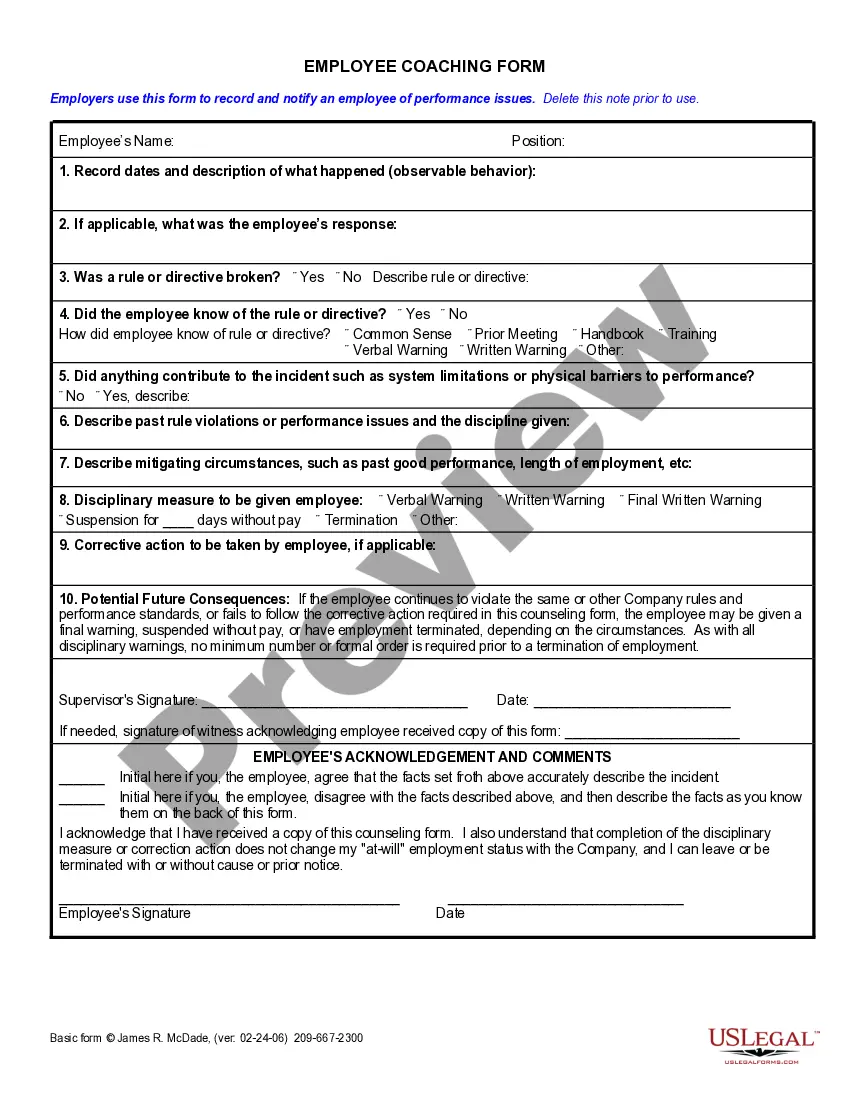
California Employee Coaching Form
Overview of this form
The Employee Coaching Form is a tool used by employers to document and communicate concerns regarding an employee's performance issues. This form serves to provide a clear record of the incidents, the employee's responses, and any disciplinary actions taken. Unlike other forms that might only serve as warnings, this document focuses on coaching and corrective measures in response to specific performance challenges.
Key components of this form
- Employee's name and position
- Detailed documentation of performance issues, including dates and descriptions
- Employeeâs response to the performance issues
- Information regarding rule violations and prior knowledge of rules
- Past disciplinary actions and mitigating circumstances
- Proposed disciplinary measures and corrective actions
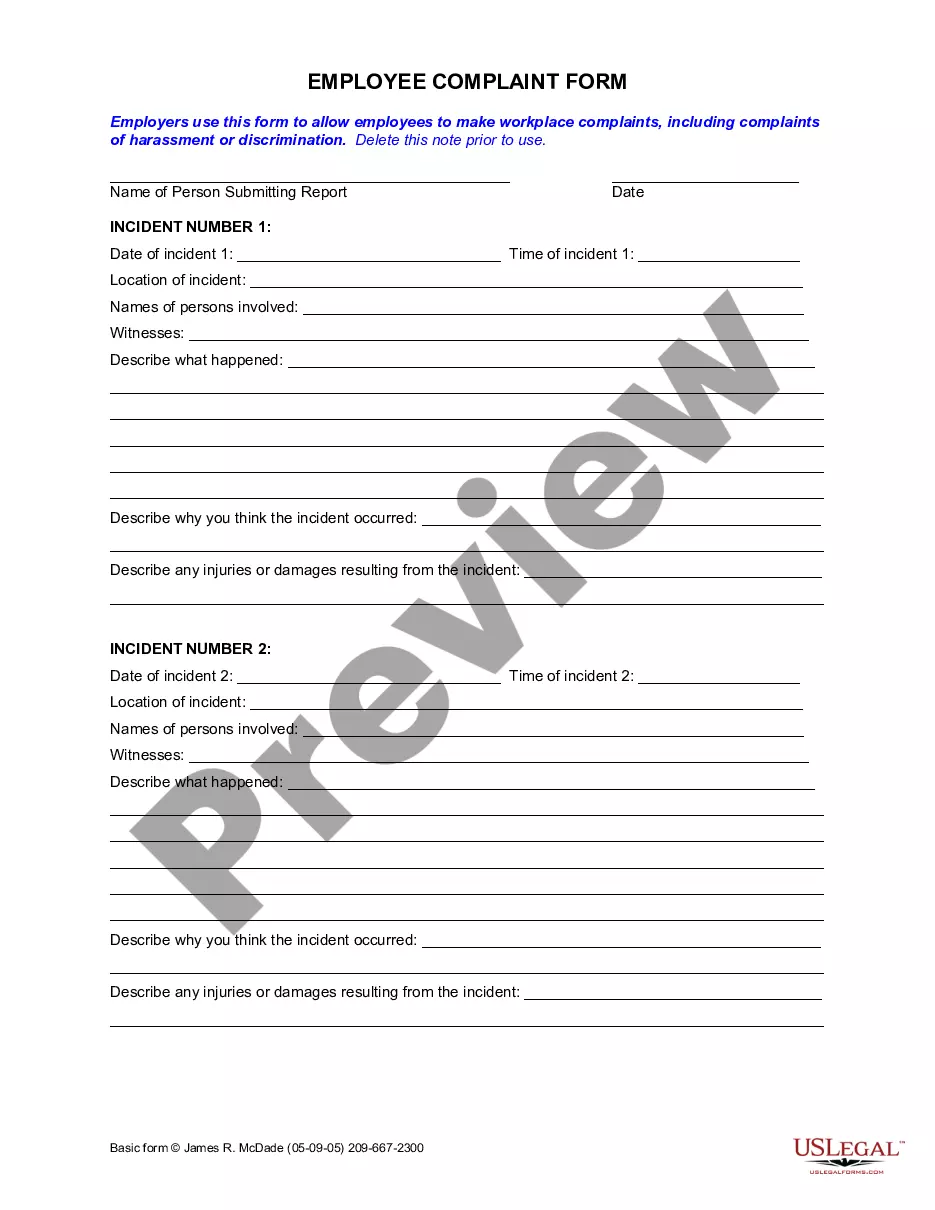
Situations where this form applies
This form should be used when an employer identifies repeated or serious performance issues with an employee. It is applicable in situations where initial informal discussions have occurred but have not resolved the issues. Use the form to create a structured record, ensuring that both management and the employee understand the concerns and the expectations moving forward.
Who this form is for
This form is designed for:
- Employers and supervisors looking to address performance issues with employees
- Human resource professionals managing employee performance records
- Managers in any industry who seek to provide constructive feedback and support improvement efforts
How to complete this form
- Enter the employee's name and job position at the top of the form.
- Document specific dates and descriptions of the observed performance issues.
- Record any responses from the employee regarding the incidents.
- Check whether a rule was broken and if the employee was aware of it.
- Identify any mitigating factors or prior incidents that may influence the current situation.
- Specify the proposed disciplinary measures and required corrective actions.
Does this form need to be notarized?
This form usually doesn’t need to be notarized. However, local laws or specific transactions may require it. Our online notarization service, powered by Notarize, lets you complete it remotely through a secure video session, available 24/7.
Get your form ready online
Our built-in tools help you complete, sign, share, and store your documents in one place.
Make edits, fill in missing information, and update formatting in US Legal Forms—just like you would in MS Word.
Download a copy, print it, send it by email, or mail it via USPS—whatever works best for your next step.
Sign and collect signatures with our SignNow integration. Send to multiple recipients, set reminders, and more. Go Premium to unlock E-Sign.
If this form requires notarization, complete it online through a secure video call—no need to meet a notary in person or wait for an appointment.
We protect your documents and personal data by following strict security and privacy standards.

Make edits, fill in missing information, and update formatting in US Legal Forms—just like you would in MS Word.

Download a copy, print it, send it by email, or mail it via USPS—whatever works best for your next step.

Sign and collect signatures with our SignNow integration. Send to multiple recipients, set reminders, and more. Go Premium to unlock E-Sign.

If this form requires notarization, complete it online through a secure video call—no need to meet a notary in person or wait for an appointment.

We protect your documents and personal data by following strict security and privacy standards.
Mistakes to watch out for
- Failing to provide specific examples of performance issues.
- Not allowing the employee to provide their input or response.
- Missing signatures from both the supervisor and employee.
- Neglecting to follow up on performance improvement after the form is completed.
Benefits of completing this form online
- Convenience of downloading and printing the form from home or office.
- Editability allows for customization based on specific performance issues.
- Reliable templates that ensure compliance with general standards and practices.
- This form serves as a legal record of performance discussions, which can be critical in potential disciplinary proceedings.
- It aids in establishing clear expectations and outcomes, which can prevent legal disputes later on.
- Proper usage of this form can demonstrate the employer's commitment to fair treatment and adherence to company policies.
What to keep in mind
- This form serves to document performance issues and communicate expectations clearly.
- It is important for creating a record that can support future decisions related to employee performance.
- Involving the employee in the process is crucial for their understanding and improvement.
Looking for another form?


Form popularity
FAQ
A coaching document is a written record that summarizes coaching sessions and progress made by an employee. It typically includes feedback, performance evaluations, and agreed-upon actions for growth. The California Employee Coaching Form serves as an effective coaching document, providing a systematic approach to track employee development and align performance with organizational goals.
To apply for coaching in the workplace, employees should first discuss their interest with their manager or HR department. This conversation should include specific goals and areas where coaching is needed. By using the California Employee Coaching Form, employees and managers can document this process and outline the necessary steps for achieving development objectives.
The purpose of a coaching form is to enhance employee performance through clear communication and goal-setting. It serves as a roadmap for both managers and employees to identify strengths and weaknesses. Utilizing the California Employee Coaching Form can lead to improved accountability, increased motivation, and a more engaged workforce.
An employee coaching form is a structured document used to facilitate discussions between managers and employees. It provides a framework for outlining employee performance, areas for improvement, and goals for future development. By using the California Employee Coaching Form, organizations can ensure that coaching sessions are productive and focused on specific outcomes.
The California Labor Code defines an employee as any individual who is engaged to perform services for an employer in exchange for compensation. This includes both full-time and part-time workers under various employment arrangements. When using a California Employee Coaching Form, employers can clearly communicate expectations to employees, ensuring compliance with the labor code.
In the California Labor Code, the term 'person' encompasses individuals, partnerships, corporations, and other organized groups. This wide-ranging definition allows for various entities to be included under labor laws and protections. Understanding these definitions can be crucial, especially when utilizing tools like the California Employee Coaching Form to navigate employee rights and responsibilities.
A classified employee in California refers to an individual employed in a position that falls under specific rules and regulations of the state’s education system. Classified employees typically provide support services to educational institutions, such as administrative and maintenance roles. Utilizing a California Employee Coaching Form can help classified employees understand their duties and performance expectations.
Legally, an employee is an individual who works for another person or entity under a contract of hire, whether express or implied. This relationship grants the employer certain rights and responsibilities toward the employee. A California Employee Coaching Form can aid in clarifying this relationship by serving as documentation of the employer’s and employee’s agreements and expectations.
The progressive discipline process is designed to address employee misconduct or performance issues constructively. This process typically involves a series of steps, including verbal warnings, written warnings, and potential termination. Incorporating a California Employee Coaching Form can be beneficial, as it documents performance discussions and outlines expectations, guiding employees through improvements.
California state employees are generally expected to maintain a professional appearance. Specific dress codes may vary by department, but guidelines often emphasize business casual attire. Using a California Employee Coaching Form can assist in outlining expectations regarding dress and appearance, fostering a consistent image across all departments.