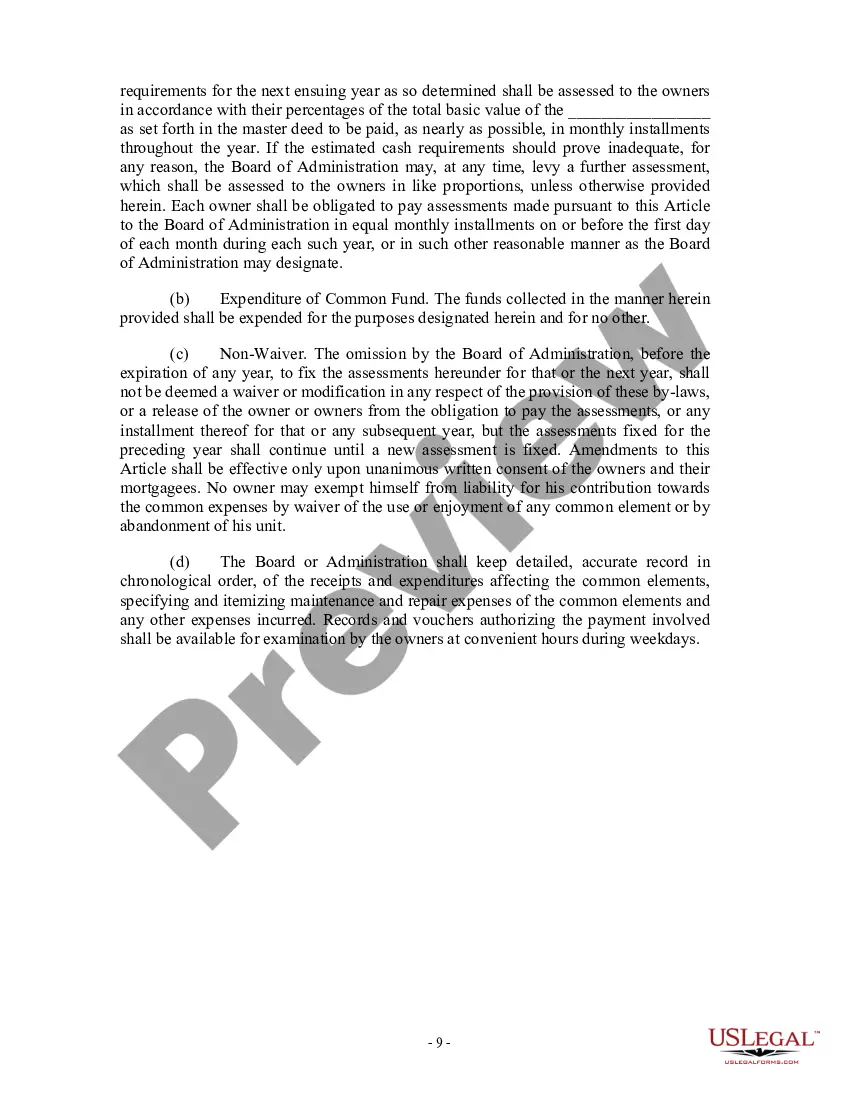
The following By-Laws have been adopted to govern the affairs of the project described in the master deed of the owners. The form also contains defintions of the words and terms used in the document.
Arizona Bylaws of Condominium
State:
Multi-State
Category:
Control #:
US-AR-B1039
Format:
Word;
Rich Text
170 downloads
Description
Free preview


Get your form ready online
Our built-in tools help you complete, sign, share, and store your documents in one place.
Built-in online Word editor
Make edits, fill in missing information, and update formatting in US Legal Forms—just like you would in MS Word.
Export easily
Download a copy, print it, send it by email, or mail it via USPS—whatever works best for your next step.
E-sign your document
Sign and collect signatures with our SignNow integration. Send to multiple recipients, set reminders, and more. Go Premium to unlock E-Sign.
Notarize online 24/7
If this form requires notarization, complete it online through a secure video call—no need to meet a notary in person or wait for an appointment.
Store your document securely
We protect your documents and personal data by following strict security and privacy standards.

Make edits, fill in missing information, and update formatting in US Legal Forms—just like you would in MS Word.

Download a copy, print it, send it by email, or mail it via USPS—whatever works best for your next step.

Sign and collect signatures with our SignNow integration. Send to multiple recipients, set reminders, and more. Go Premium to unlock E-Sign.

If this form requires notarization, complete it online through a secure video call—no need to meet a notary in person or wait for an appointment.

We protect your documents and personal data by following strict security and privacy standards.
Looking for another form?
How to fill out Bylaws Of Condominium?
Locating the appropriate legal document template can be a challenge.
Of course, there are many templates accessible online, but how do you find the legal form you need.
Utilize the US Legal Forms website. The site offers a vast array of templates, including the Arizona Bylaws of Condominium, suitable for both business and personal purposes.
First, ensure you’ve selected the correct form for your city/state. You can preview the form by using the Preview button and review the form details to confirm it meets your needs.
- All templates are vetted by professionals and comply with state and federal regulations.
- If you are already registered, Log In to your account and click the Download button to acquire the Arizona Bylaws of Condominium.
- Utilize your account to find the legal forms you have previously purchased.
- Navigate to the My documents tab in your account to obtain another copy of the document you need.
- If you are a new user of US Legal Forms, here are simple steps for you to follow.
Form popularity
FAQ
In Arizona, an HOA holds substantial power in managing community common areas and enforcing rules based on the Arizona Bylaws of Condominium. This power includes assessing dues, establishing regulations, and levying fines for violations. However, homeowners also have rights and can challenge any actions they believe are unfair or unlawful, leading to a balanced relationship between homeowners and the association.
SUBMITTING A PETITION An owner's Petition (complaint) must be regarding a dispute between the owner and the association. (Do not file against an individual or individual Board member). An association's Petition (complaint) must be regarding a dispute between the association and the owner.
If you have more questions you may contact the Arizona Department of Real Estate's HOA Ombudsman here. You may also call the department at (602) 771 -7799.
Fines for Violation of a Homeowner Association Rule Under Arizona law, an HOA may not issue a fine until it first offers you a hearing before the board of directors. If the HOA fails to provide you an opportunity for a hearing before the fine is imposed, the fine is illegal and not enforceable.
The registration and regulation of a condominium corporation shall be vested with the Housing And Land Use Regulatory Board (HLURB) and the term of the said corporation shall be coterminous with the duration of the subdivision projects, the provision of the corporation law to the contrary notwithstanding. Sec. 12.
The Arizona Department of Real Estate administers the Homeowners Association Dispute Process and has the statutory authority to hear disputes between homeowners and condominium or planned community associations. A.R.S. § 32-2199.01.
A condominium is inside a residential building or community but the unit is privately managed by the individual or landlord of the property. This landlord has no say in the functioning of the larger building or even the plot of land in which his/her property is built upon.
The Philippine Condominium Act allows foreigners to own condo units, as long as 60% of the building is owned by Filipinos. If you want to buy a house, consider a long-term lease agreement with a Filipino landowner.
No. The Arizona open meeting laws found in A.R.S. ? 38-431 through 431.09 require that any meeting of any public body must be open to all interested persons, including the public-at-large.
To sum up, the rights of a condominium unit owner are the following: Right of absolute ownership over his unit. Right of exclusive easement of the space of his unit. Right to repair, paint, decorate the interior of his unit.