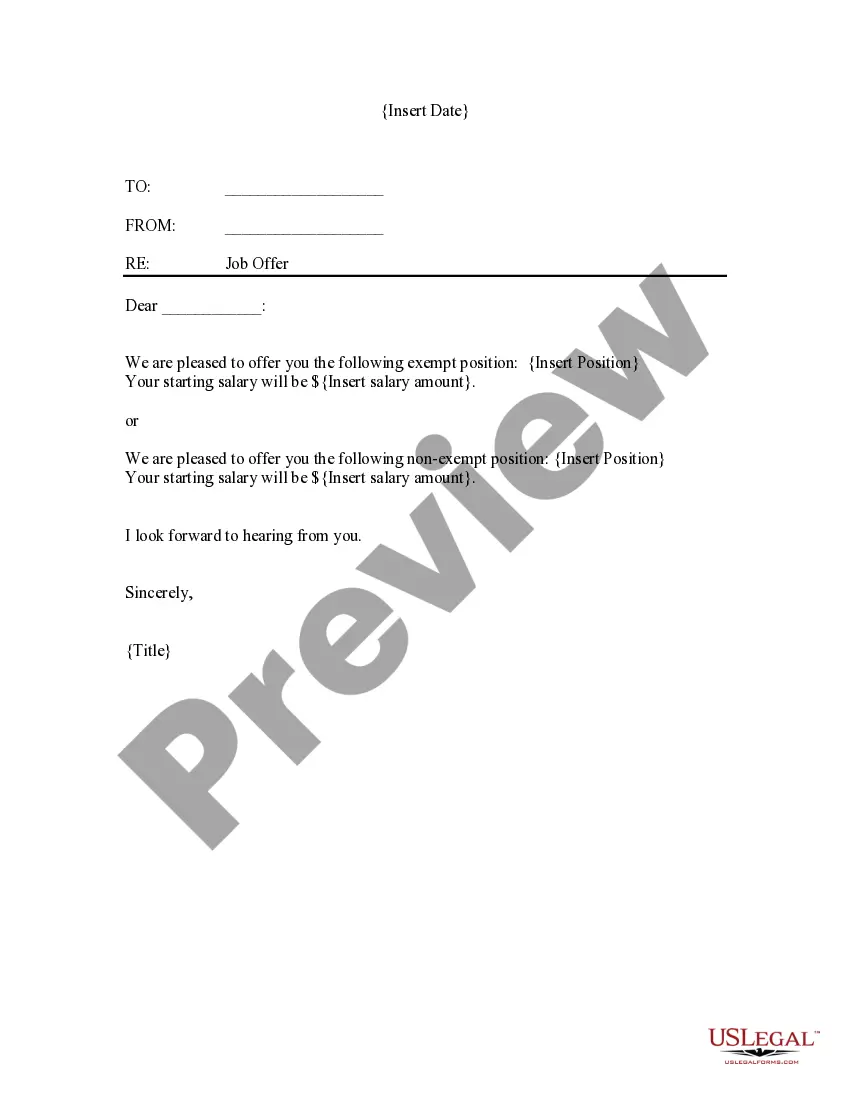
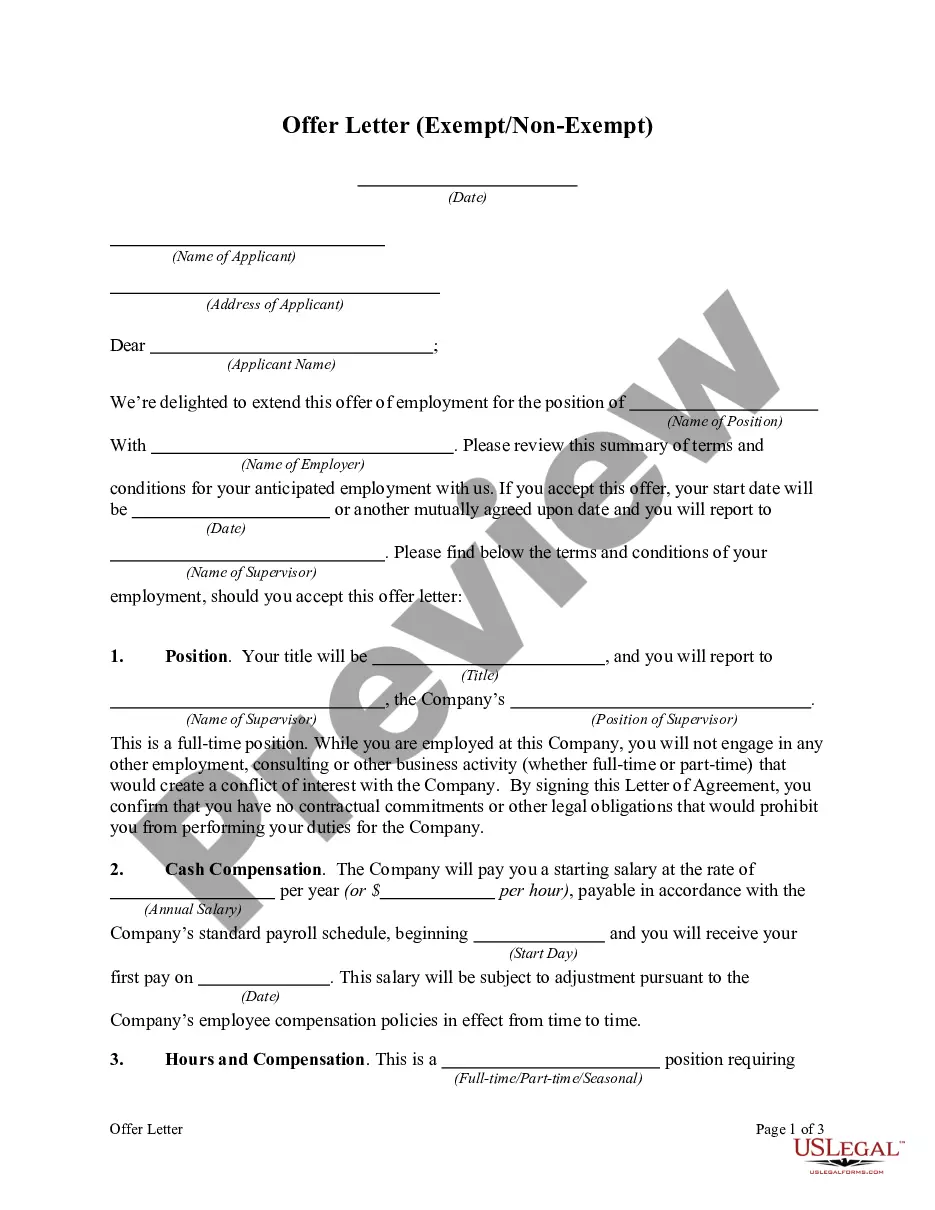
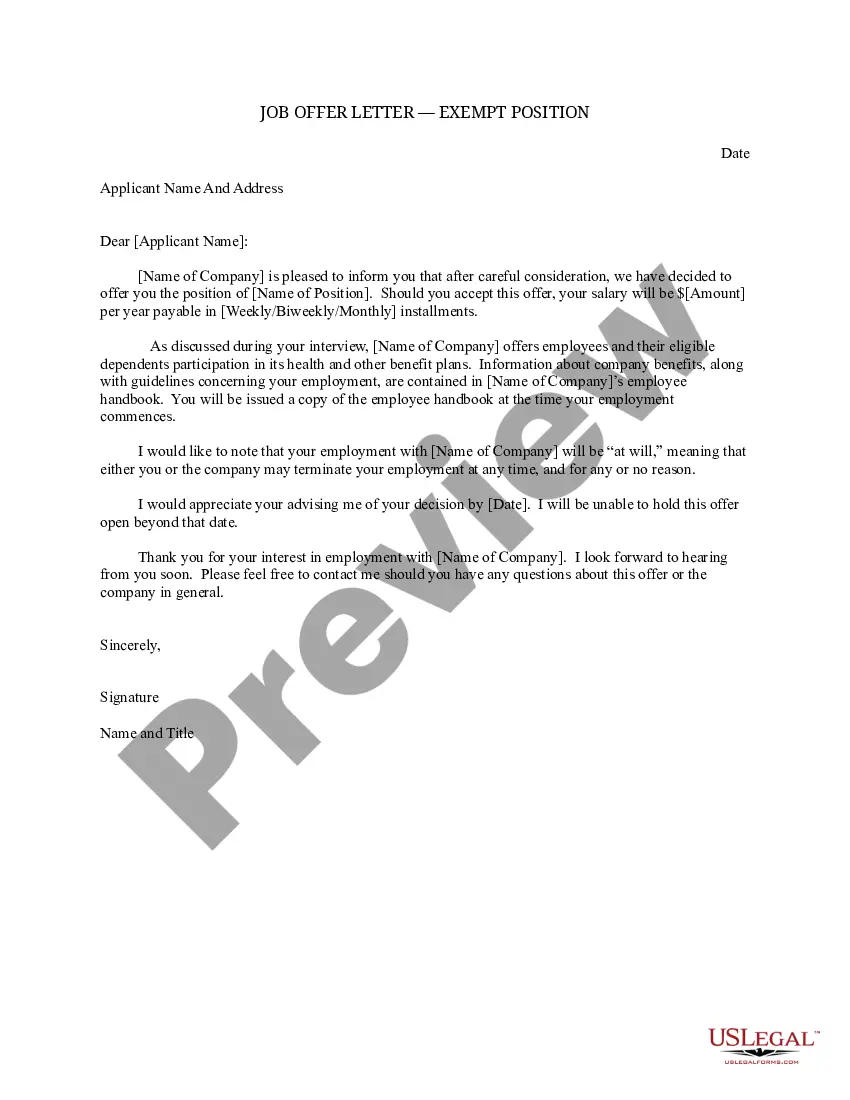
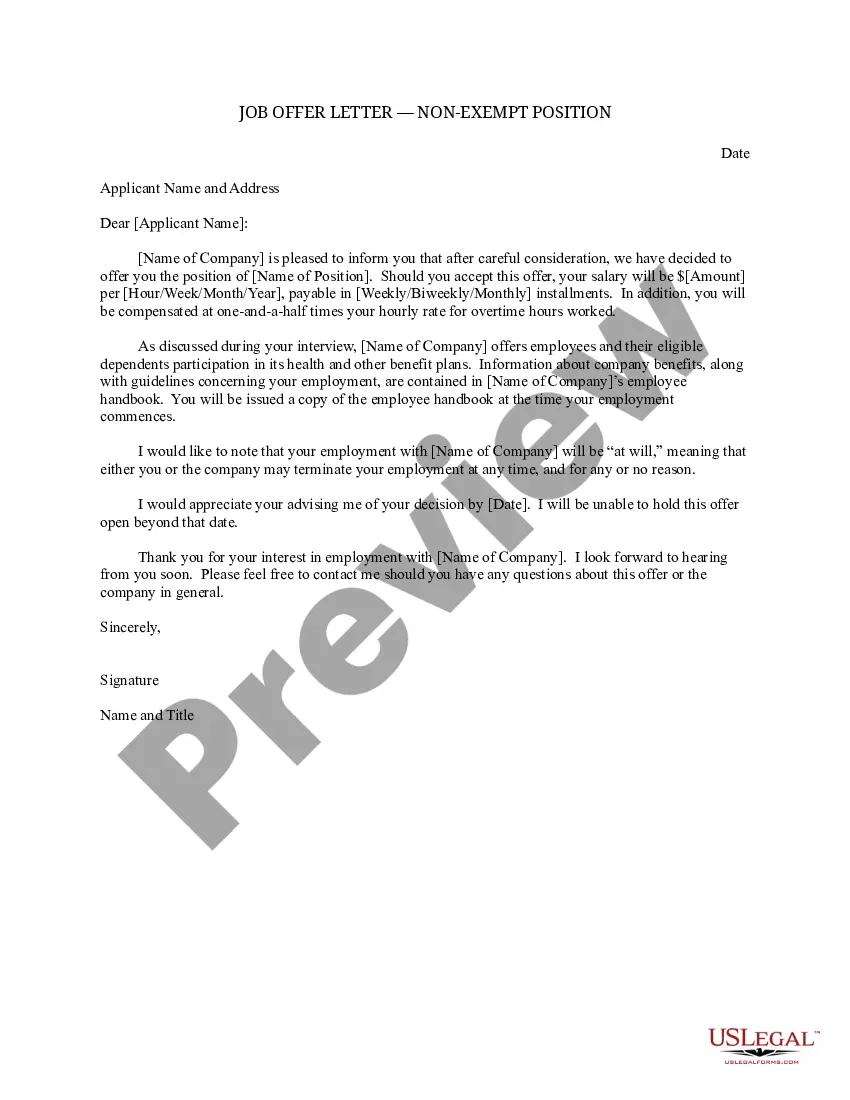
Arizona Job Offer Letter - Exempt or Nonexempt Position
Description
Get your form ready online
Our built-in tools help you complete, sign, share, and store your documents in one place.
Make edits, fill in missing information, and update formatting in US Legal Forms—just like you would in MS Word.
Download a copy, print it, send it by email, or mail it via USPS—whatever works best for your next step.
Sign and collect signatures with our SignNow integration. Send to multiple recipients, set reminders, and more. Go Premium to unlock E-Sign.
If this form requires notarization, complete it online through a secure video call—no need to meet a notary in person or wait for an appointment.
We protect your documents and personal data by following strict security and privacy standards.

Make edits, fill in missing information, and update formatting in US Legal Forms—just like you would in MS Word.

Download a copy, print it, send it by email, or mail it via USPS—whatever works best for your next step.

Sign and collect signatures with our SignNow integration. Send to multiple recipients, set reminders, and more. Go Premium to unlock E-Sign.

If this form requires notarization, complete it online through a secure video call—no need to meet a notary in person or wait for an appointment.

We protect your documents and personal data by following strict security and privacy standards.
Looking for another form?

How to fill out Job Offer Letter - Exempt Or Nonexempt Position?
US Legal Forms - one of the largest collections of legal documents in the United States - offers a vast selection of legal template files that you can download or print.
By using the website, you can access thousands of forms for business and personal purposes, organized by categories, states, or keywords.
You can obtain the most recent forms such as the Arizona Job Offer Letter - Exempt or Nonexempt Position within moments.
Select the Review button to examine the form’s details. Review the form description to confirm that you have selected the right form.
If the form doesn’t meet your requirements, utilize the Search field at the top of the screen to find the one that does.
- If you already have a membership, Log In to download the Arizona Job Offer Letter - Exempt or Nonexempt Position from the US Legal Forms library.
- The Download button will be visible on every form you view.
- You can access all previously downloaded forms in the My documents tab of your account.
- To use US Legal Forms for the first time, here are simple steps to get you started.
- Ensure you have chosen the correct form for your city/state.
Form popularity
FAQ
Exempt or Nonexempt.Employees whose jobs are governed by the FLSA are either "exempt" or "nonexempt." Nonexempt employees are entitled to overtime pay. Exempt employees are not.
Exempt/Nonexempt Classification. Offer letters to nonexempt employees should state that they must record their hours worked and they will be paid overtime (as pre-approved by their supervisor), and describe available meal and rest periods.
Exempt positions are excluded from minimum wage, overtime regulations, and other rights and protections afforded nonexempt workers. Employers must pay a salary rather than an hourly wage for a position for it to be exempt.
The offer was sent from a personal email The biggest giveaway is the email address that the job offer has been sent from. If it's been sent from a free e-mail account like 'google.com or hotmail.com' then you should know that it's fake. Authentic job offers are sent from company registered e-mails.
Some important details about an offer letter are: It is NOT a legally binding contract. It does NOT include promises of future employment or wages. It includes an employment at-will statement.
In general, offer letters are less formal than employment contracts, which typically set terms and conditions of employment that are legally binding. It's also vital for employers to understand that they aren't required by federal law to send an offer letter to new hires.
An exempt employee is not entitled overtime pay by the Fair Labor Standards Act (FLSA). These salaried employees receive the same amount of pay per pay period, even if they put in overtime hours. A nonexempt employee is eligible to be paid overtime for work in excess of 40 hours per week, per federal guidelines.
Whereas an offer letter is unofficial (avoiding statements that promise future wages or employment), an employment contract is exactly the opposite, setting wages and length of employment in legally binding stone.
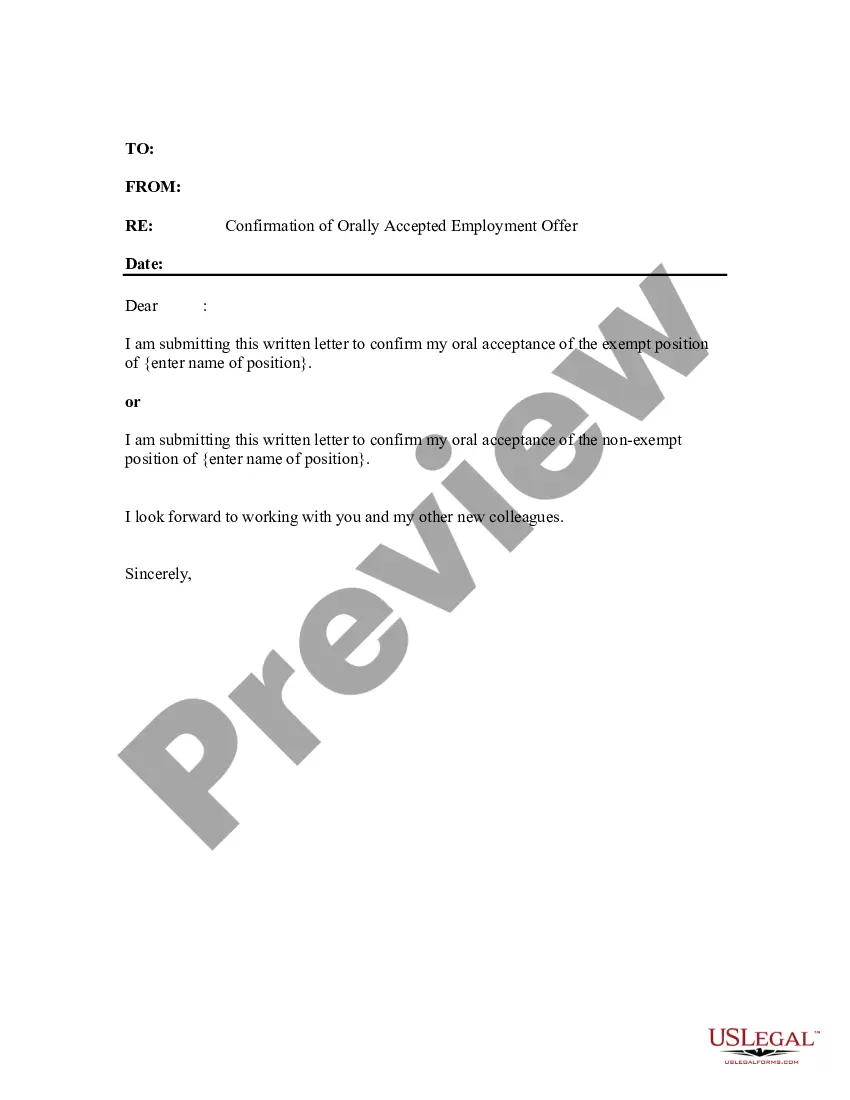
A letter of employment, also known as an employment verification letter, is a document that confirms an individual's working status. Professionals may need to write these on behalf of their team members to provide financial information for third-party organizations, such as mortgage lenders and landlords.
With that, every job offer letter should include the following terms:A job title and description.Important dates.Compensation, benefits, and terms.Company policies and culture.A statement of at-will employment.An employee confidentiality agreement and noncompete clause.A list of contingencies.