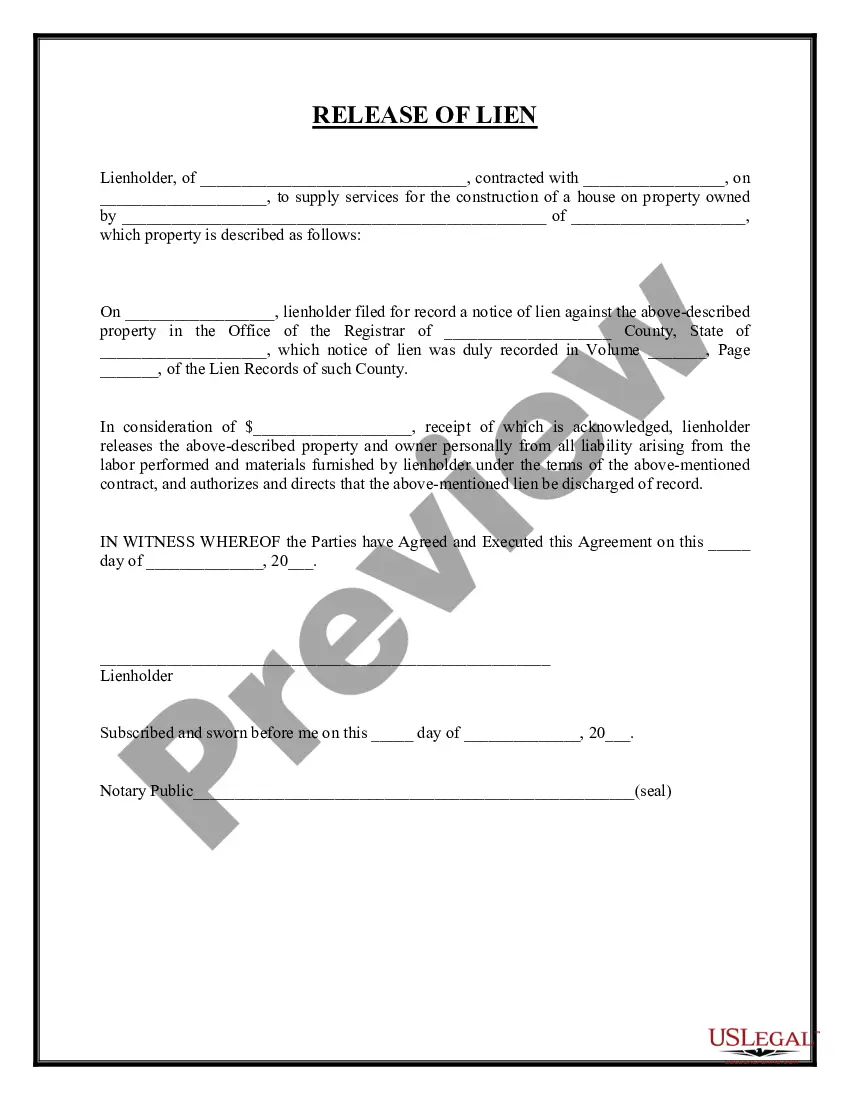
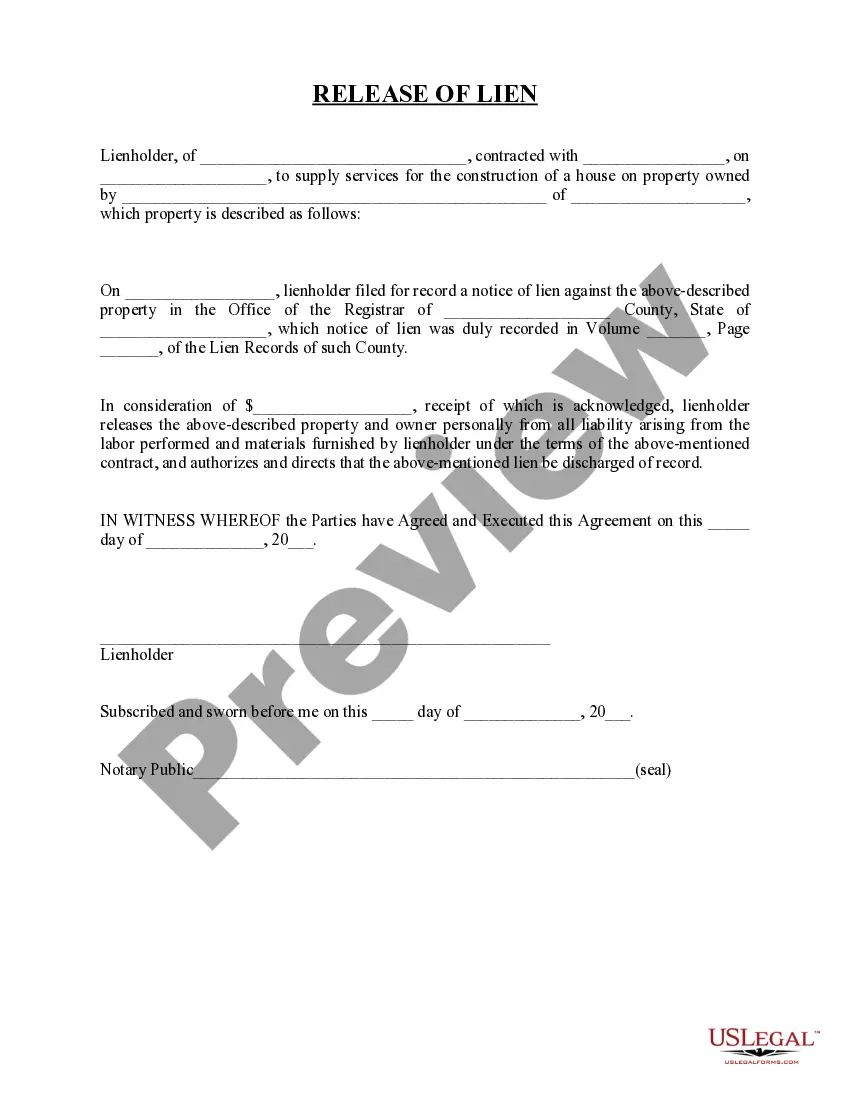
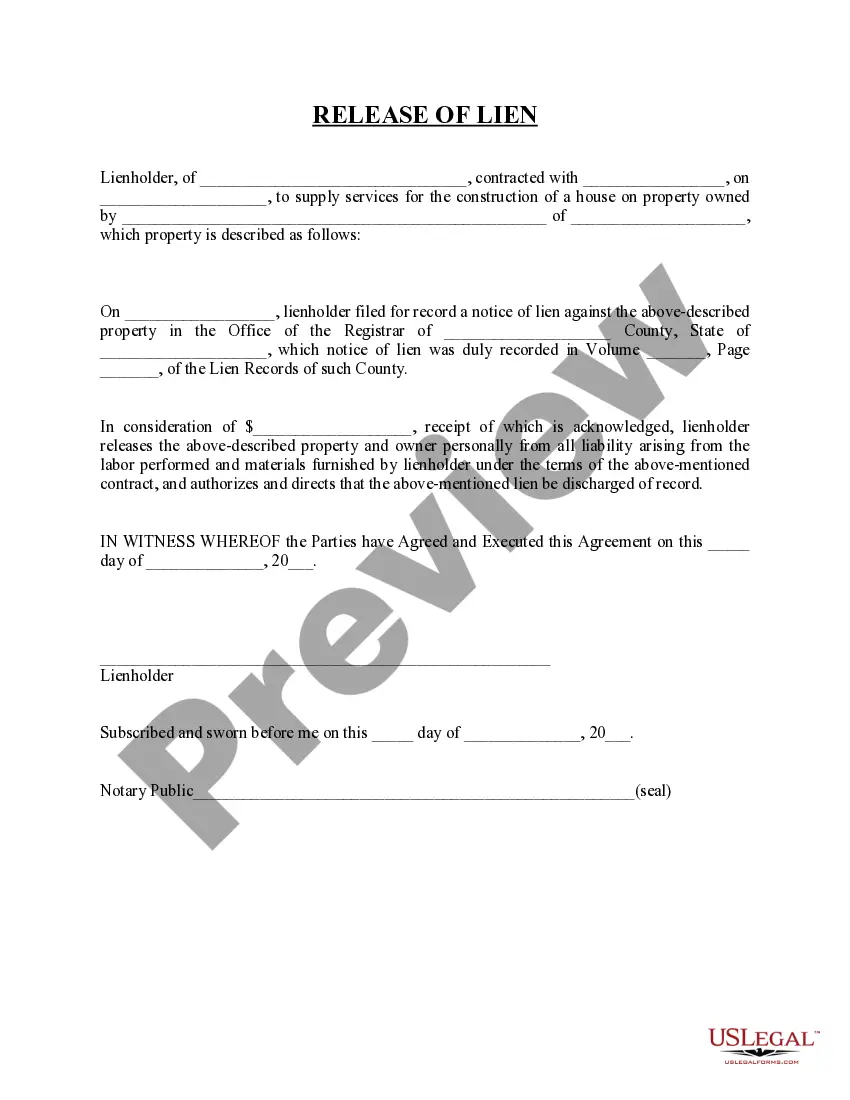
Arizona Release of Lien for Materials
Description
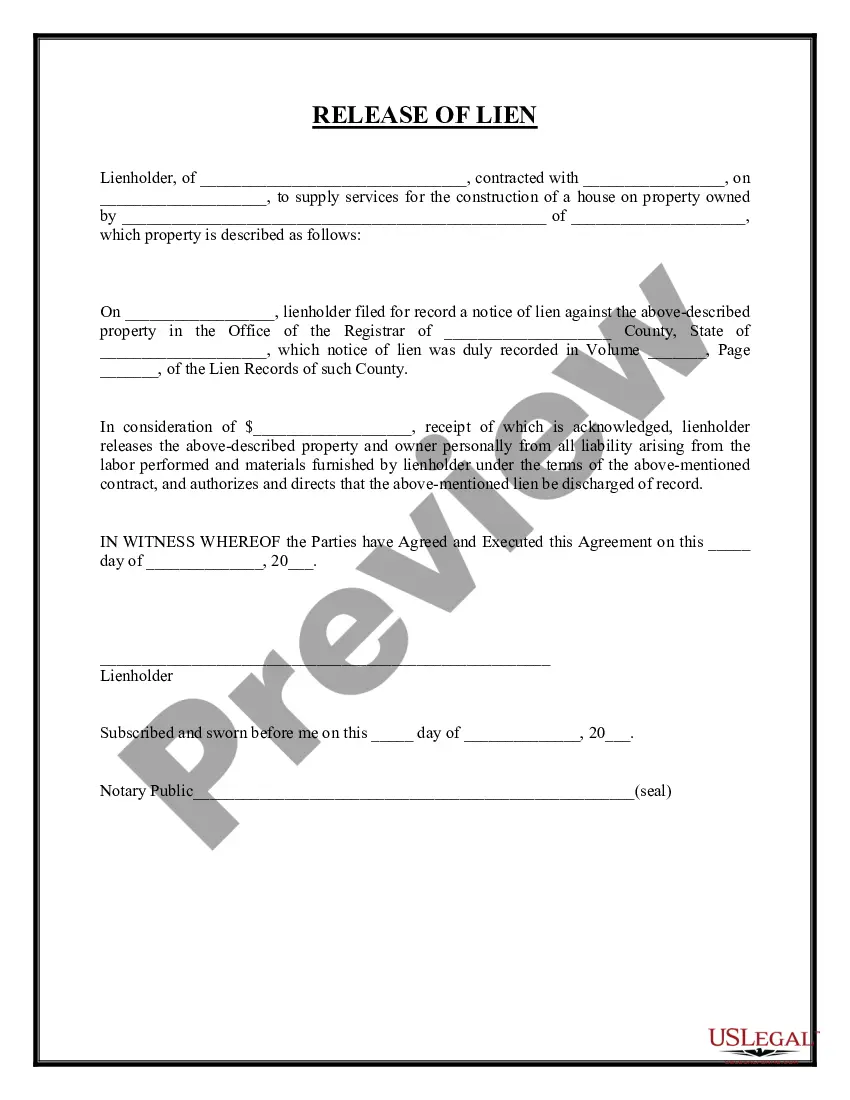
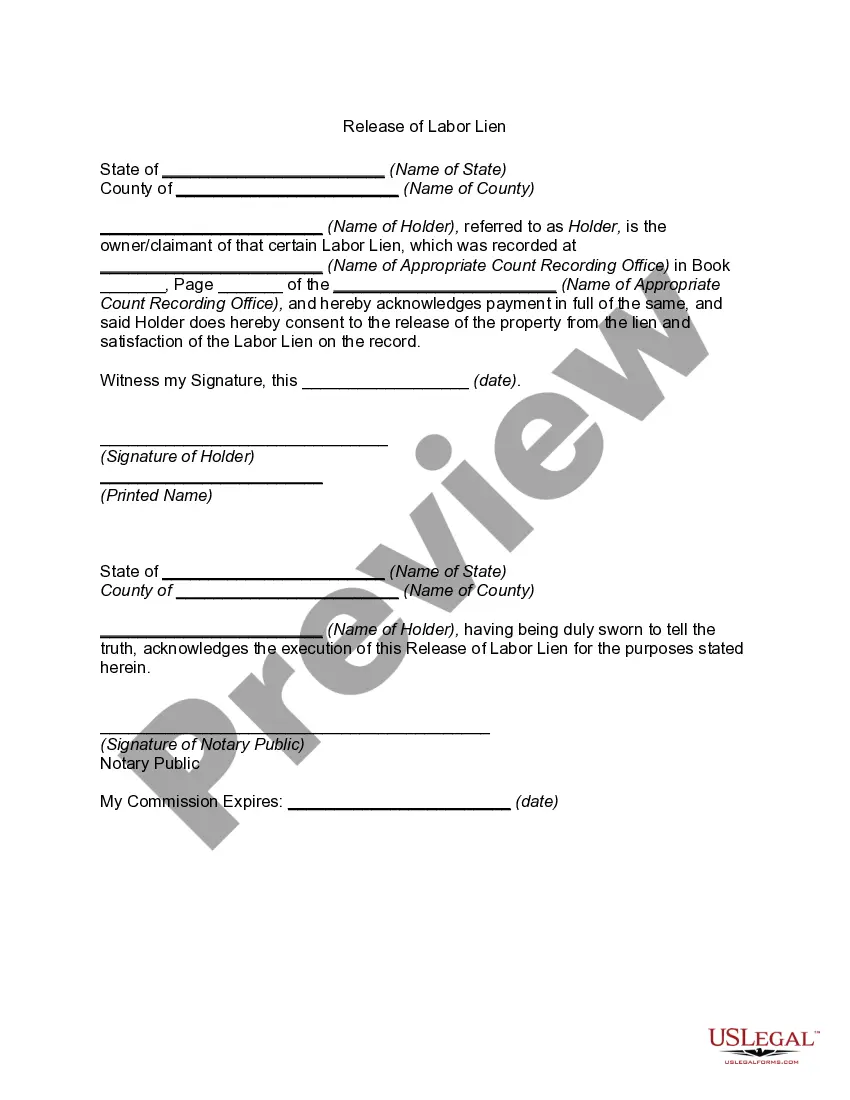
Get your form ready online
Our built-in tools help you complete, sign, share, and store your documents in one place.
Make edits, fill in missing information, and update formatting in US Legal Forms—just like you would in MS Word.
Download a copy, print it, send it by email, or mail it via USPS—whatever works best for your next step.
Sign and collect signatures with our SignNow integration. Send to multiple recipients, set reminders, and more. Go Premium to unlock E-Sign.
If this form requires notarization, complete it online through a secure video call—no need to meet a notary in person or wait for an appointment.
We protect your documents and personal data by following strict security and privacy standards.

Make edits, fill in missing information, and update formatting in US Legal Forms—just like you would in MS Word.

Download a copy, print it, send it by email, or mail it via USPS—whatever works best for your next step.

Sign and collect signatures with our SignNow integration. Send to multiple recipients, set reminders, and more. Go Premium to unlock E-Sign.

If this form requires notarization, complete it online through a secure video call—no need to meet a notary in person or wait for an appointment.

We protect your documents and personal data by following strict security and privacy standards.
Looking for another form?
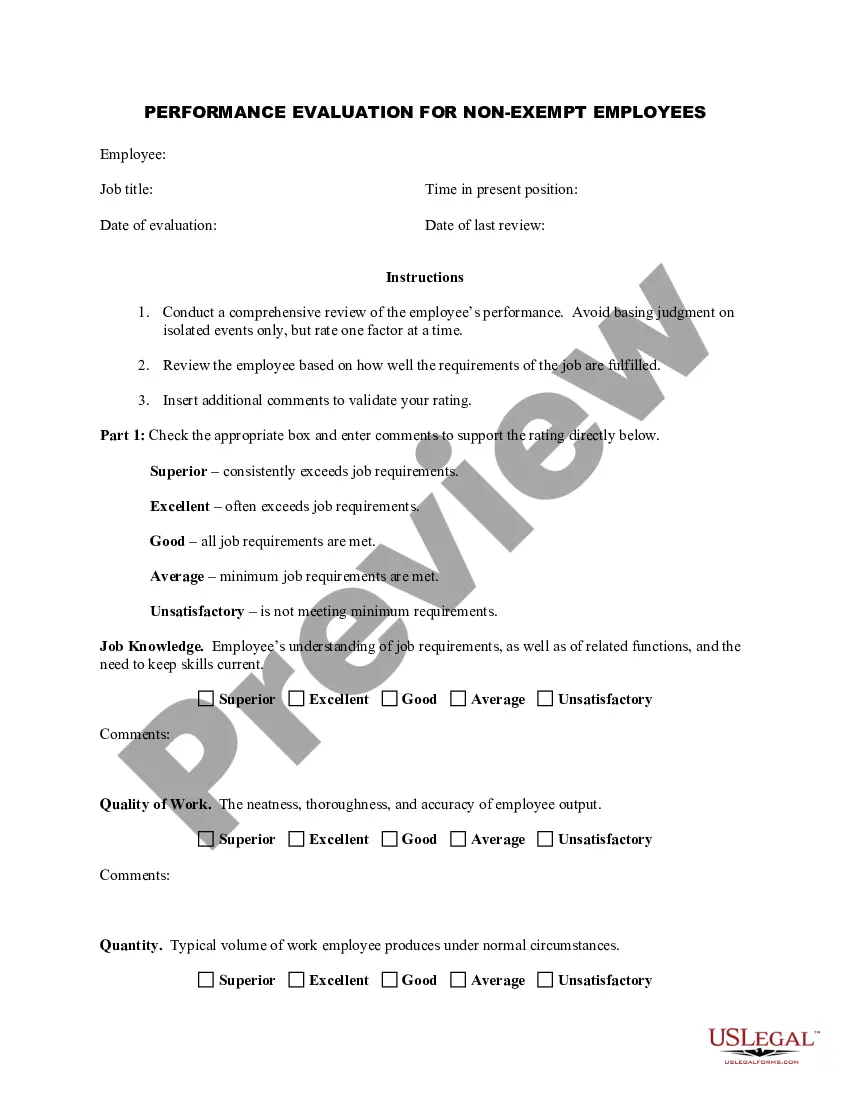

How to fill out Release Of Lien For Materials?
Are you in a situation where you require documents for potential business or personal reasons almost every day.
There is an abundance of legal document templates available online, but finding reliable ones can be challenging.
US Legal Forms provides a vast array of form templates, including the Arizona Release of Lien for Materials, which can be filled out to satisfy federal and state requirements.
- If you are already familiar with the US Legal Forms website and have an account, simply Log In.
- After that, you can download the Arizona Release of Lien for Materials template.
- If you do not have an account and wish to start using US Legal Forms, follow these steps.
- Find the form you need and ensure it is for your specific location/county.
- Utilize the Review button to examine the form.
- Read the description to confirm you have selected the correct form.
- If the form is not what you are searching for, use the Lookup field to locate the form that suits your needs and requirements.
- Once you find the correct form, click Get now.
- Choose the pricing plan you desire, fill in the necessary information to create your account, and complete your order using your PayPal or credit card.
- Select a convenient document format and download your copy.
- Access all the document templates you have purchased in the My documents menu. You can retrieve another copy of the Arizona Release of Lien for Materials at any time, if needed. Click the appropriate form to download or print the document template.
- Utilize US Legal Forms, the most extensive collection of legal forms, to save time and avoid errors. The service provides properly crafted legal document templates that can be used for various purposes. Create your account on US Legal Forms and start making your life a bit easier.
Form popularity
FAQ
It might be possible to waive unconditional lien rights after work has started, but before payment has been made the waiver form will have to meet certain legal requirements. Arizona has no requirement that a lien waiver must be notarized; in fact, this could even invalidate the form.
The state of Arizona also requires the action to enforce a lien must be initiated within 6 months from when the lien was recorded. In Arizona, the lien expires if enforcement is not initiated within that 6 months requirement.
The first step to filing a mechanics lien is to record a Notice and Claim of Lien within 60 days after the property owner has recorded a Notice of Completion. If a notice has not been recorded, however, you will have 120 days after the completion of the project to record the claim.
Professional service providers must have a contract directly with the property owner or an architect, engineer or contractor that has an existing contract with the owner in order to file a valid mechanic's lien against the property.
The 20-day preliminary notice in Arizona is sent to the owner and/or construction lender if a project is financed by a loan, as well as to the original contractor, in the case of subcontractors, to notify them of the contractor, subcontractor, or supplier's right to enforce a lien claim in case of full or partial non- ...
A mechanics lien automatically expires six months after it is recorded. Any lawsuit to foreclose the lien must be filed within that period, and a lis pendens must be recorded within five days of filing. (See our article, "Arizona Mechanics Lien Foreclosure 101.)
A mechanics lien automatically expires six months after it is recorded. Any lawsuit to foreclose the lien must be filed within that period, and a lis pendens must be recorded within five days of filing. (See our article, "Arizona Mechanics Lien Foreclosure 101.)
In Arizona, liens must be filed within 120 days from the completion of the project as a whole. However, if a notice of completion was filed, the deadline is shortened to 60 days from the date such notice was filed.
A materialmen's lien in Arizona is designed to provide a legal process for compensation to contractors and suppliers that have gone unpaid on a project. In most cases, a subcontractor can use a materialmen's lien when they performed work based on a contract with the building owner or the owner's agent.