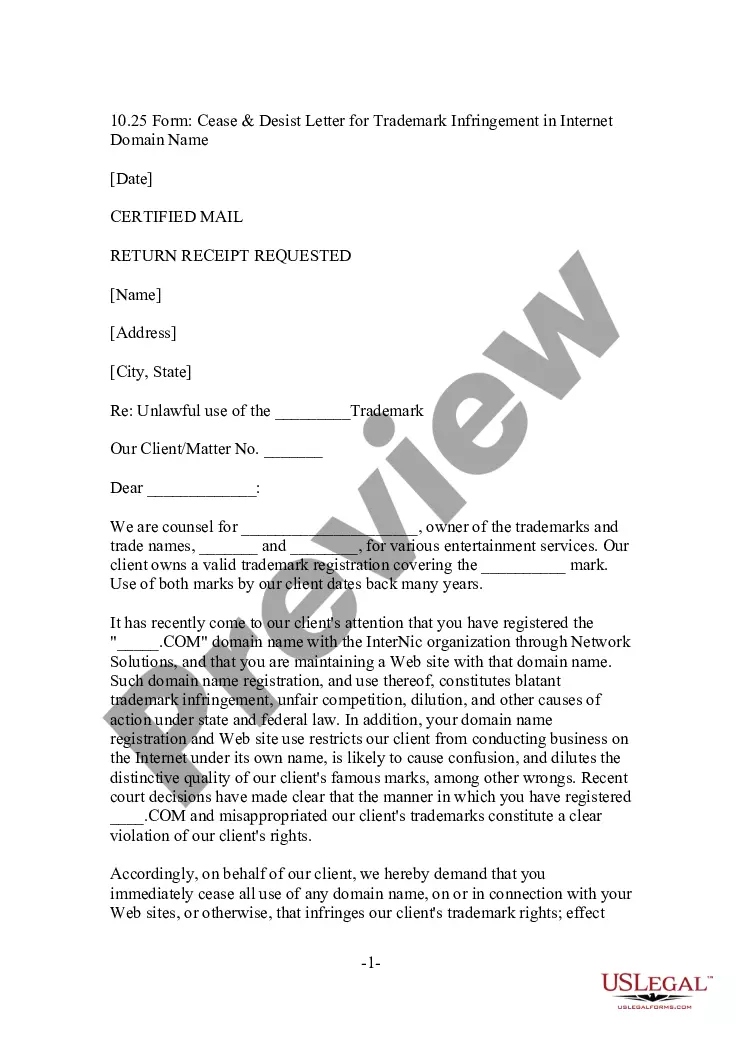
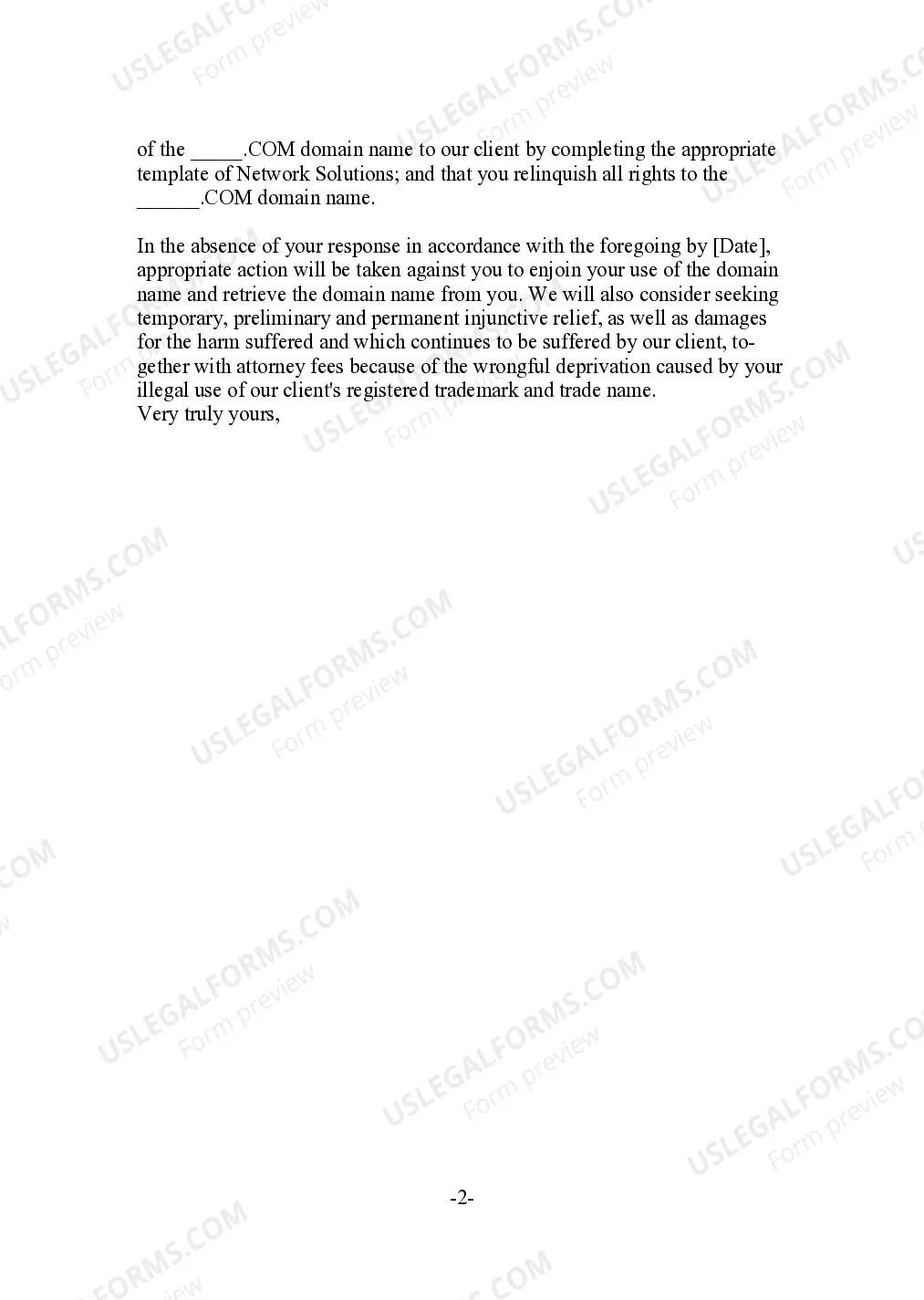
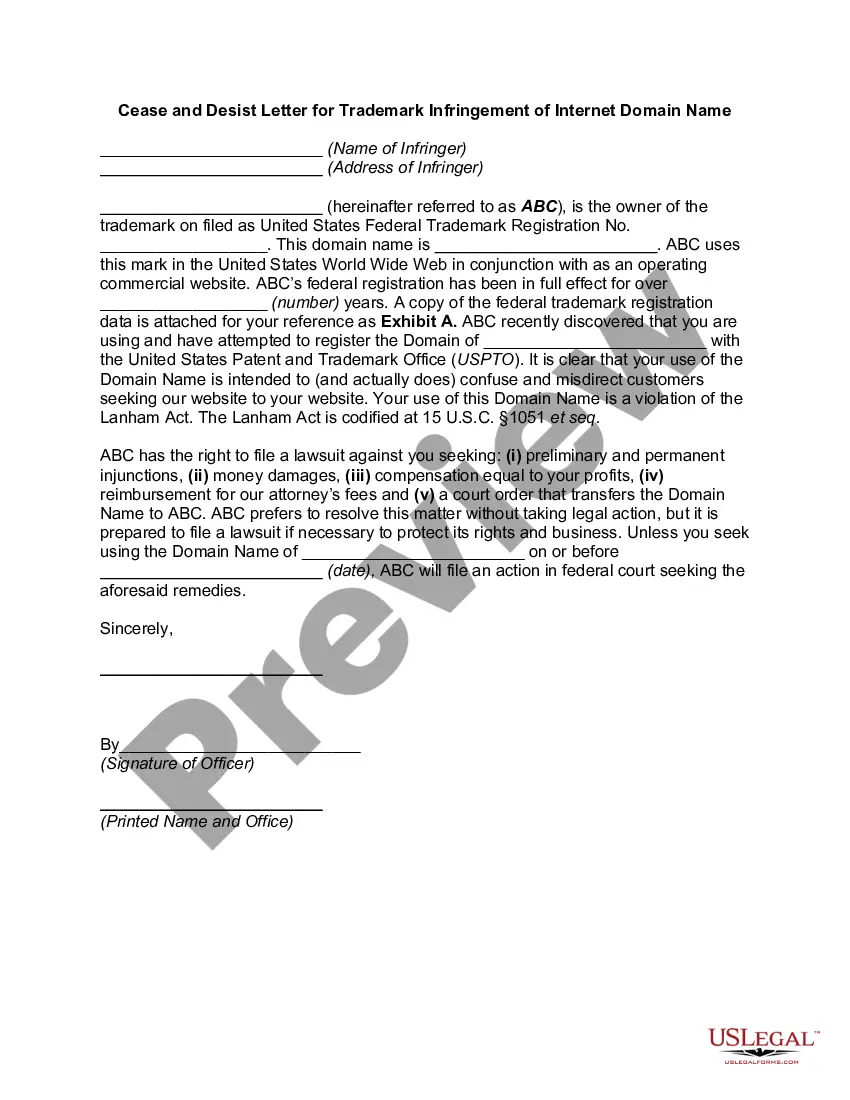
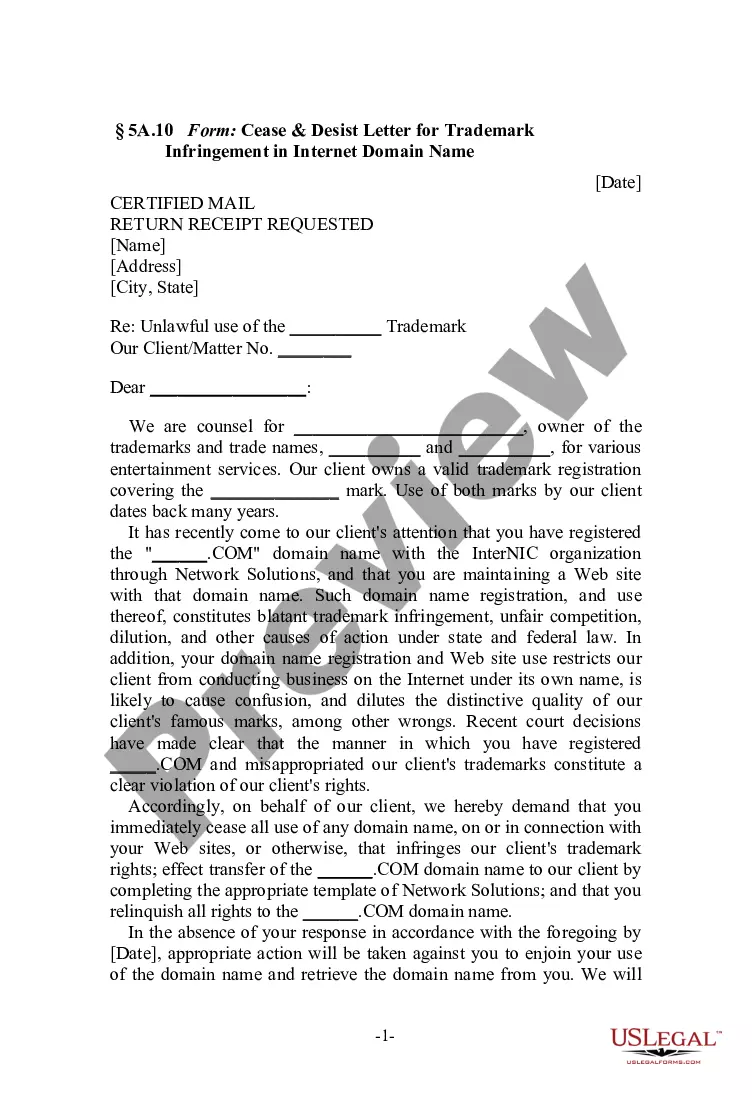
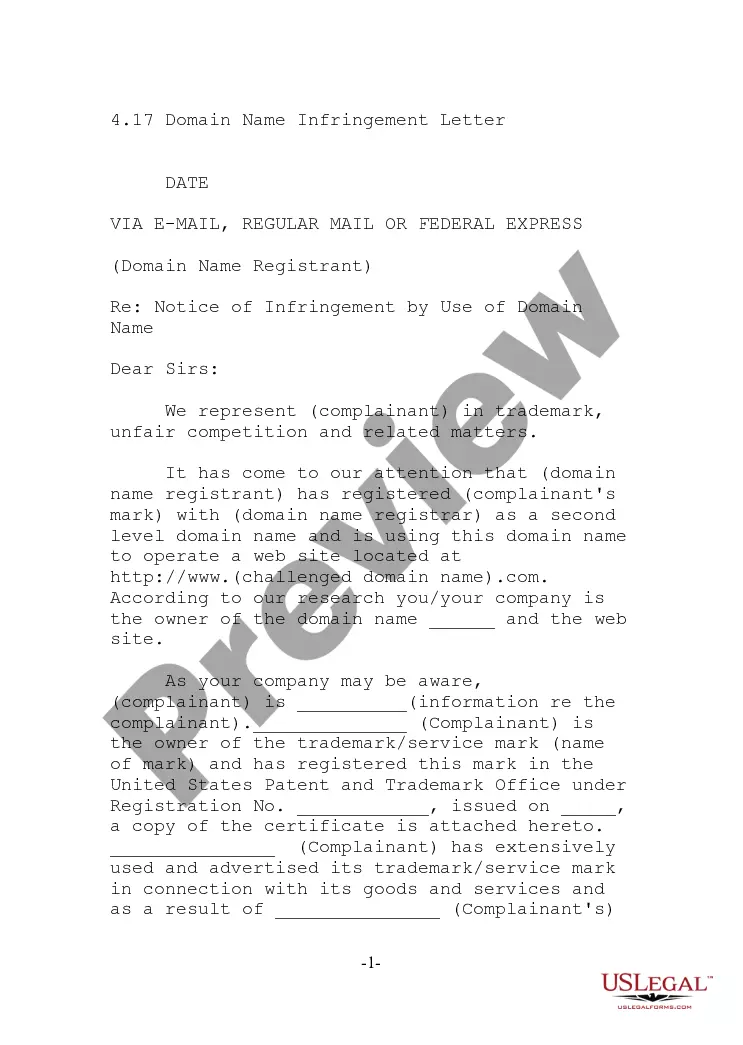
Alabama Form - Cease and Desist Letter For Trademark Infringement Internet Domain Name
Description
Get your form ready online
Our built-in tools help you complete, sign, share, and store your documents in one place.
Make edits, fill in missing information, and update formatting in US Legal Forms—just like you would in MS Word.
Download a copy, print it, send it by email, or mail it via USPS—whatever works best for your next step.
Sign and collect signatures with our SignNow integration. Send to multiple recipients, set reminders, and more. Go Premium to unlock E-Sign.
If this form requires notarization, complete it online through a secure video call—no need to meet a notary in person or wait for an appointment.
We protect your documents and personal data by following strict security and privacy standards.

Make edits, fill in missing information, and update formatting in US Legal Forms—just like you would in MS Word.

Download a copy, print it, send it by email, or mail it via USPS—whatever works best for your next step.

Sign and collect signatures with our SignNow integration. Send to multiple recipients, set reminders, and more. Go Premium to unlock E-Sign.

If this form requires notarization, complete it online through a secure video call—no need to meet a notary in person or wait for an appointment.

We protect your documents and personal data by following strict security and privacy standards.
Looking for another form?
How to fill out Form - Cease And Desist Letter For Trademark Infringement Internet Domain Name?
It is possible to invest several hours on-line attempting to find the lawful file design that meets the state and federal specifications you will need. US Legal Forms gives thousands of lawful kinds that happen to be examined by professionals. You can easily obtain or print out the Alabama Form - Cease and Desist Letter For Trademark Infringement Internet Domain Name from our services.
If you have a US Legal Forms bank account, you may log in and then click the Download switch. After that, you may complete, modify, print out, or sign the Alabama Form - Cease and Desist Letter For Trademark Infringement Internet Domain Name. Each and every lawful file design you get is your own property eternally. To have yet another duplicate associated with a acquired develop, visit the My Forms tab and then click the related switch.
If you use the US Legal Forms site initially, stick to the basic guidelines beneath:
- Initial, ensure that you have selected the correct file design for that state/town of your choosing. Browse the develop explanation to ensure you have selected the right develop. If available, utilize the Review switch to check from the file design too.
- If you would like locate yet another variation in the develop, utilize the Lookup discipline to find the design that fits your needs and specifications.
- Once you have located the design you need, simply click Get now to carry on.
- Find the prices strategy you need, key in your credentials, and sign up for a merchant account on US Legal Forms.
- Complete the financial transaction. You may use your charge card or PayPal bank account to cover the lawful develop.
- Find the file format in the file and obtain it to your gadget.
- Make alterations to your file if necessary. It is possible to complete, modify and sign and print out Alabama Form - Cease and Desist Letter For Trademark Infringement Internet Domain Name.
Download and print out thousands of file web templates while using US Legal Forms website, which offers the most important variety of lawful kinds. Use skilled and condition-distinct web templates to take on your small business or personal needs.
Form popularity
FAQ
This type of domain infringement is similar to cybersquatting but occurs when the domain name holder registers a famous trademark. Competing use. Courts have prohibited such behavior from occurring. But competing claims is a complex field that still gets tangled up in many legal disputes.
Dear [Infringer's Name]: We have recently discovered that your business is using the mark [mark/domain] for your service or product. We believe your use infringes on our ownership of the [registered trademark/domain] mark. We learned of your use of the same or similar [mark/domain] mark on [date].
A domain name cease and desist letter is usually written by an attorney, although sometimes it's written by the trademark owner. The letter is not a court order, so it isn't legally enforceable. The letter contains your opinion, while notifying the offender that they're intruding upon your trademark.
If you're not sure how to send a cease and desist letter, it is actually quite simple. Once written, you can send a C&D via email, mail, or even in person. Sending it by certified mail is a good option because it requires a signature from the recipient, so you'll know when they receive it.
Cease and desist letters can take many forms (here is one example), but there are six essential components. Proper address of infringing party. ... Proof of your trademark rights. ... Details of the infringement. ... Reasonable time frame for infringing party to respond. ... Demand for written assurance of compliance.
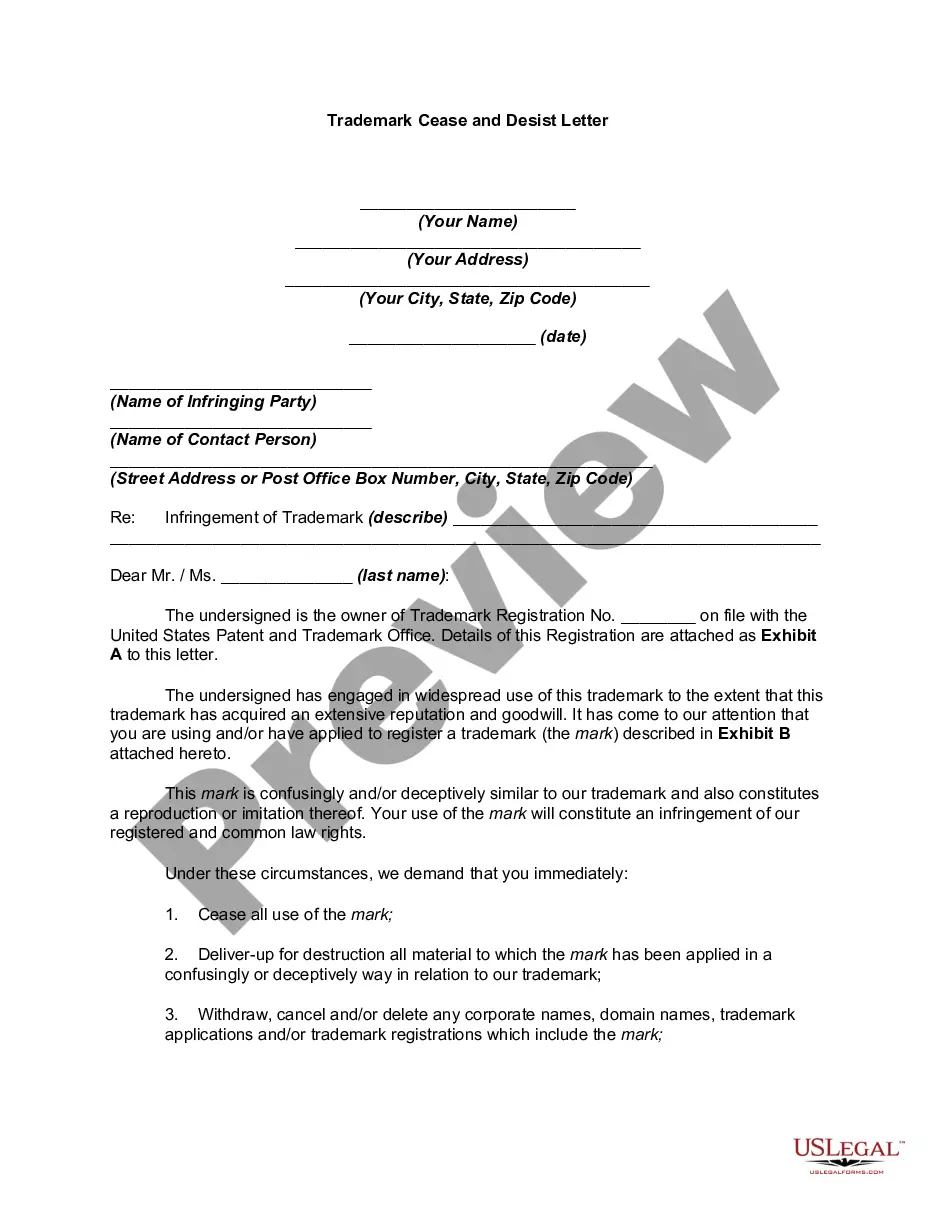
The cease and desist letter should, at a minimum, include the following key provisions: The name of the trademark owner. The trademark and its registration number. A description of the trademark owner's rights. A description of the infringer's activity on the trademark.
For most business owners, lawsuits are rarely the optimal first move. A more efficient first step is to send what intellectual property attorneys call a cease-and-desist letter. This is essentially a demand letter, addressed to the trademark infringer, succinctly and clearly explaining the infringement.
The cease and desist letter should include a clear and concise description of the harassing or offending behavior. The letter should also include the amount of time you are giving the recipient to remedy the issue and possible consequences. Remedying the issue typically means stopping the unlawful action.