Alabama Independent Contractor Agreement Between Licensed Counselor and Therapist and Licensed Counselor and Therapist Practicing as a Solo Practitioner

State:
Multi-State
Control #:
US-02565BG
Format:
Word; 
Rich Text
Instant download

Description

An independent contractor is a person or business who performs services for another person pursuant to an agreement and who is not subject to the other's control, or right to control, the manner and means of performing the services. The exact nature of the independent contractor's relationship with the hiring party is important since an independent contractor pays his/her own Social Security, income taxes without payroll deduction, has no retirement or health plan rights, and often is not entitled to worker's compensation coverage. The traditional tests to determine whether a worker is an employee or independent contractor involve the concept of control. The Internal Revenue Service (IRS) developed 20 factors used to determine whether a worker is an independent contractor under the common law. A "yes" answer to any of these questions would be evidence of an employer-employee relationship.

" Does the principal provide instructions to the worker about when, where, and how he or she is to perform the work?


" Does the principal provide training to the worker?

" Are the services provided by the worker integrated into the principal's business operations?

" Must the services be rendered personally by the worker?

" Does the principal hire, supervise and pay assistants to the worker?

" Is there a continuing relationship between the principal and the worker?

" Does the principal set the work hours and schedule?

" Does the worker devote substantially full time to the business of the principal?

" Is the work performed on the principal's premises?

" Is the worker required to perform the services in an order or sequence set by the principal?

" Is the worker required to submit oral or written reports to the principal?

" Is the worker paid by the hour, week, or month?

" Does the principal have the right to discharge the worker at will?

" Can the worker terminate his or her relationship with the principal any time he or she wishes without incurring liability to the principal?

" Does the principal pay the business or traveling expenses of the worker?

A "yes" answer to any of these questions would be evidence of an independent contractor relationship.


" Does the worker furnish significant tools, materials and equipment?

" Does the worker have a significant investment in facilities?

" Can the worker realize a profit or loss as a result of his or her services?

" Does the worker provide services for more than one firm at a time?

" Does the worker make his or her services available to the general public?
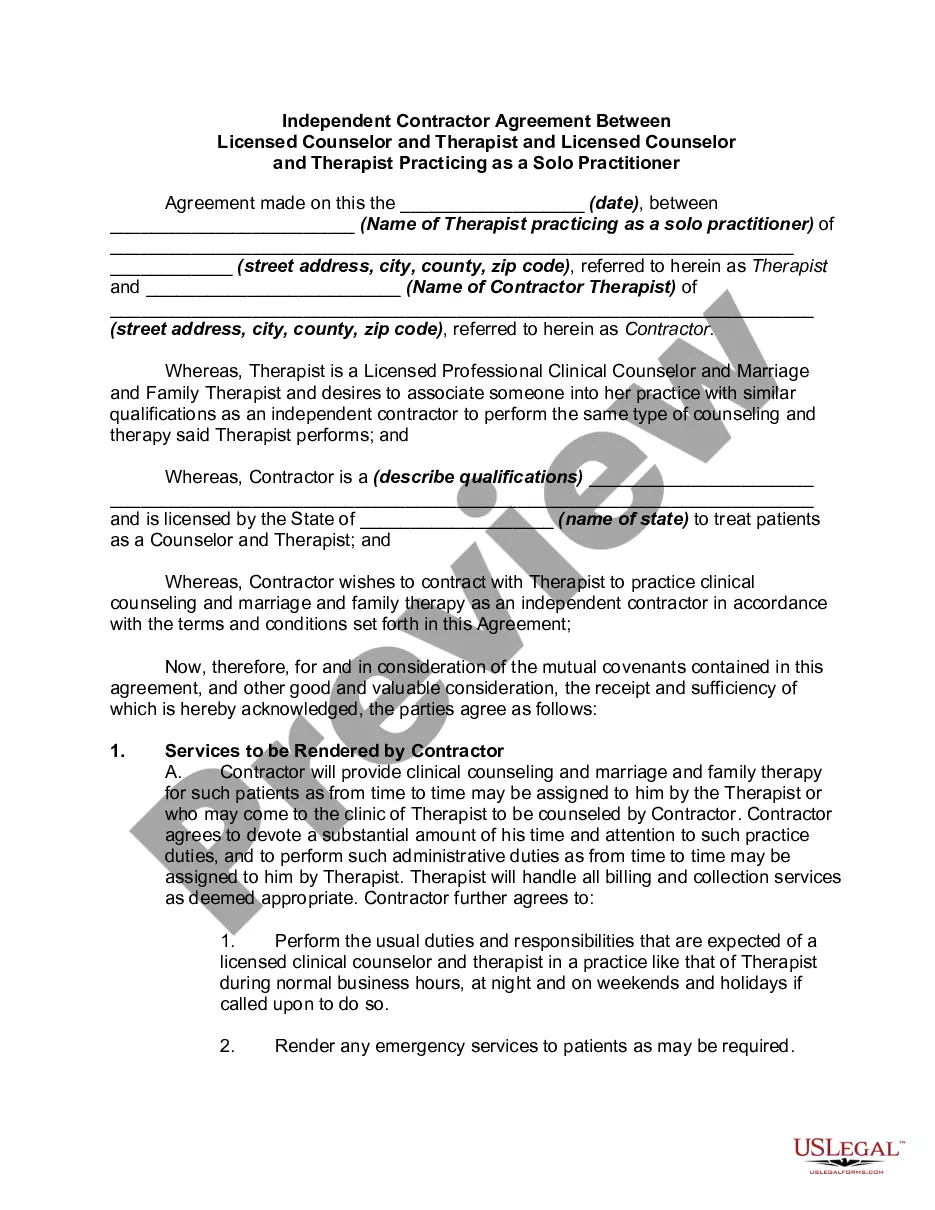
Free preview
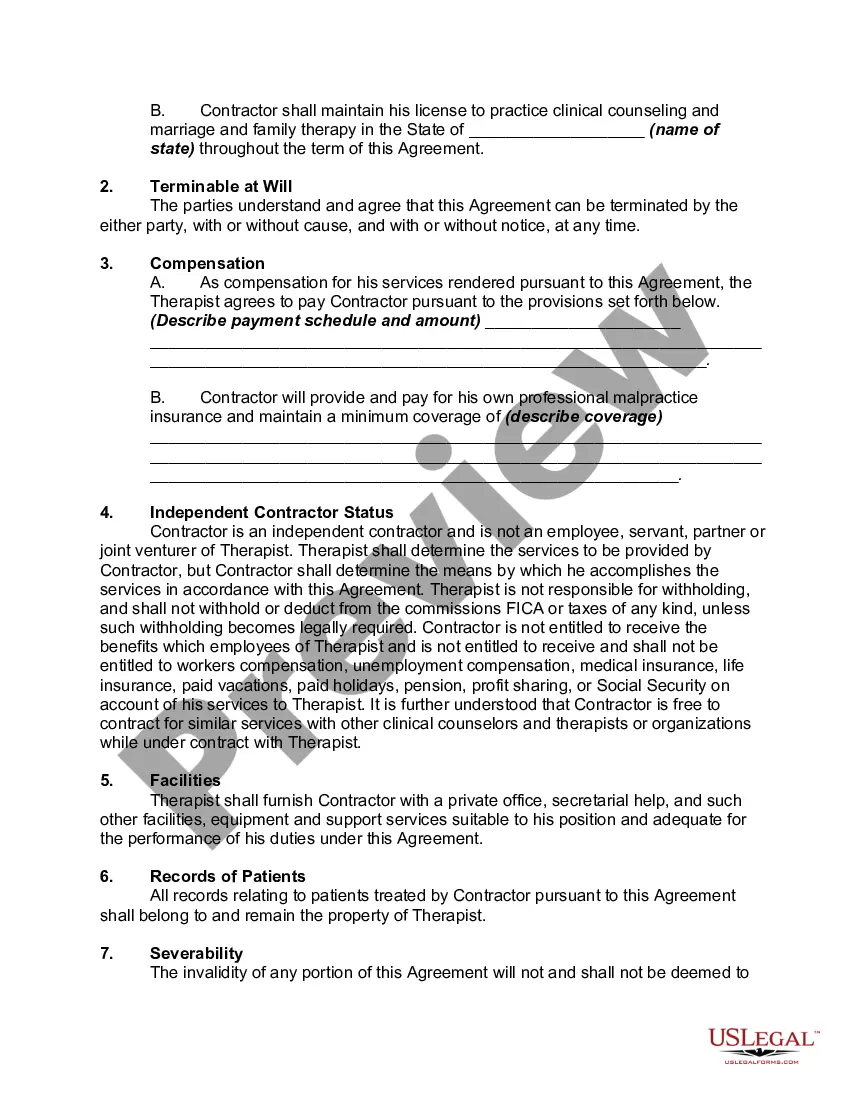
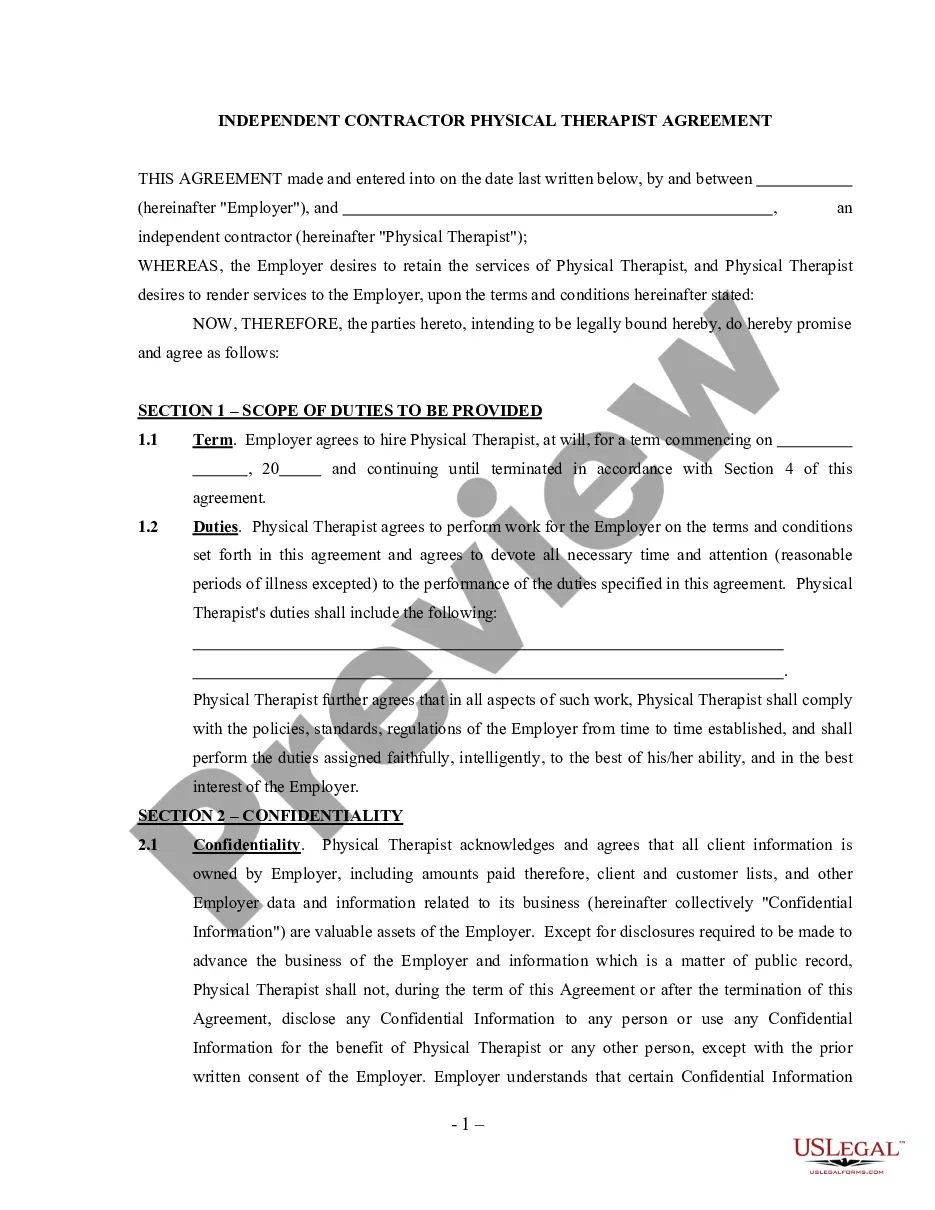
  • Preview Independent Contractor Agreement Between Licensed Counselor and Therapist and Licensed Counselor and Therapist Practicing as a Solo Practitioner
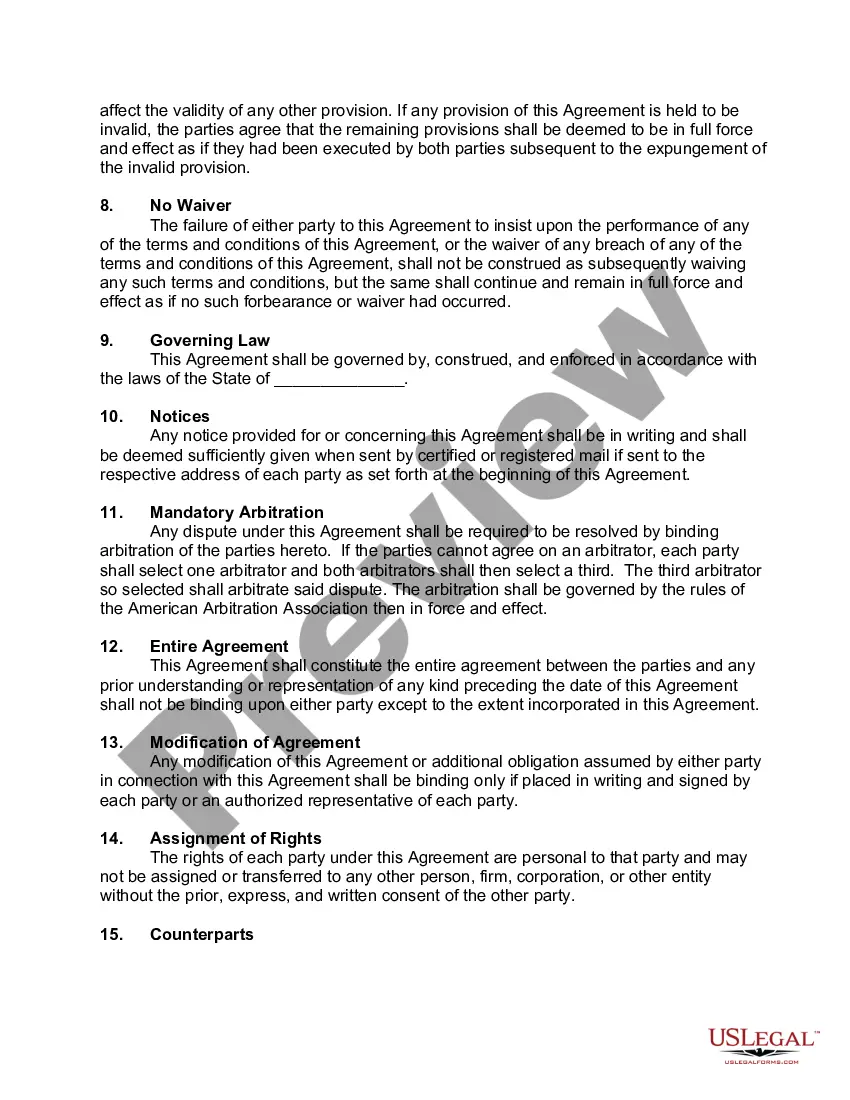
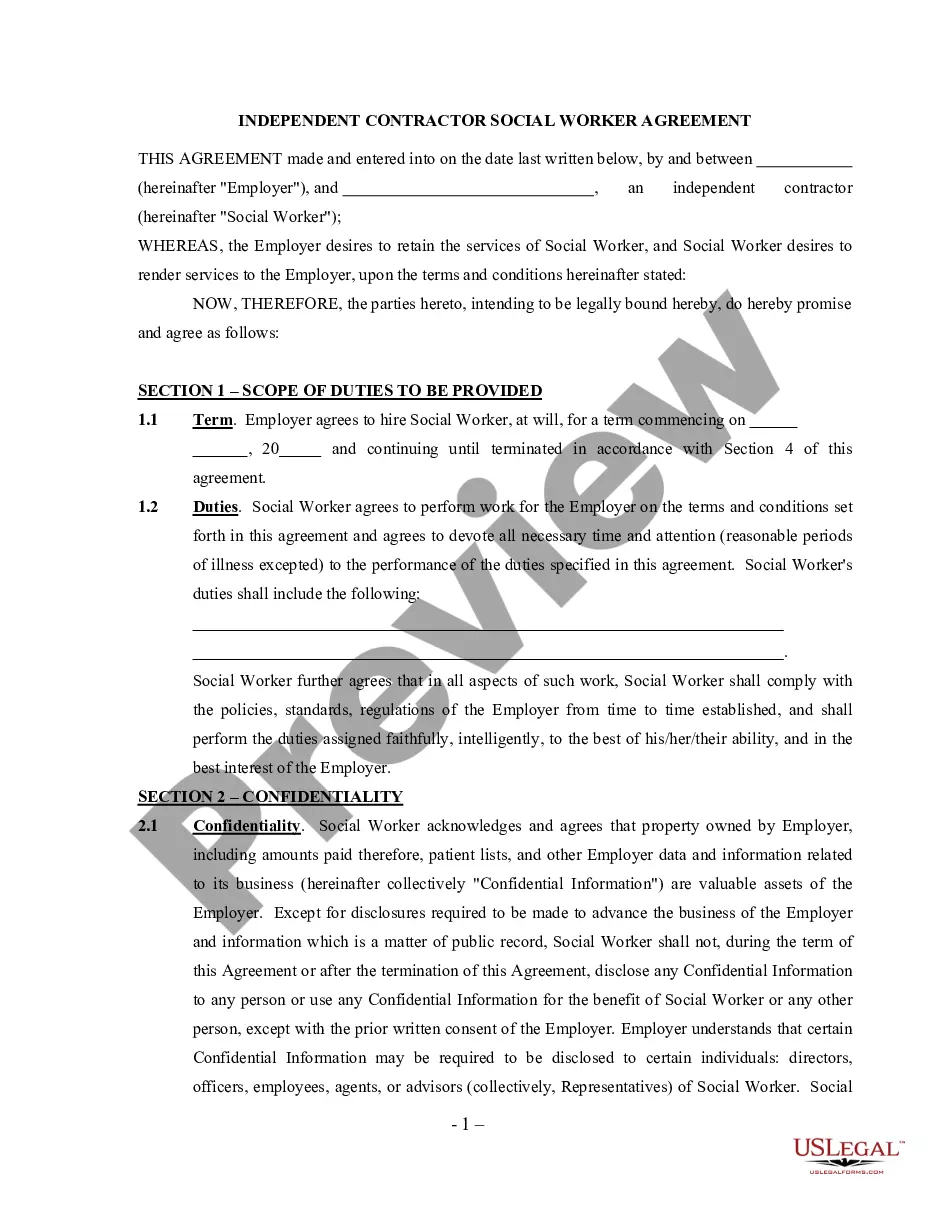
  • Preview Independent Contractor Agreement Between Licensed Counselor and Therapist and Licensed Counselor and Therapist Practicing as a Solo Practitioner
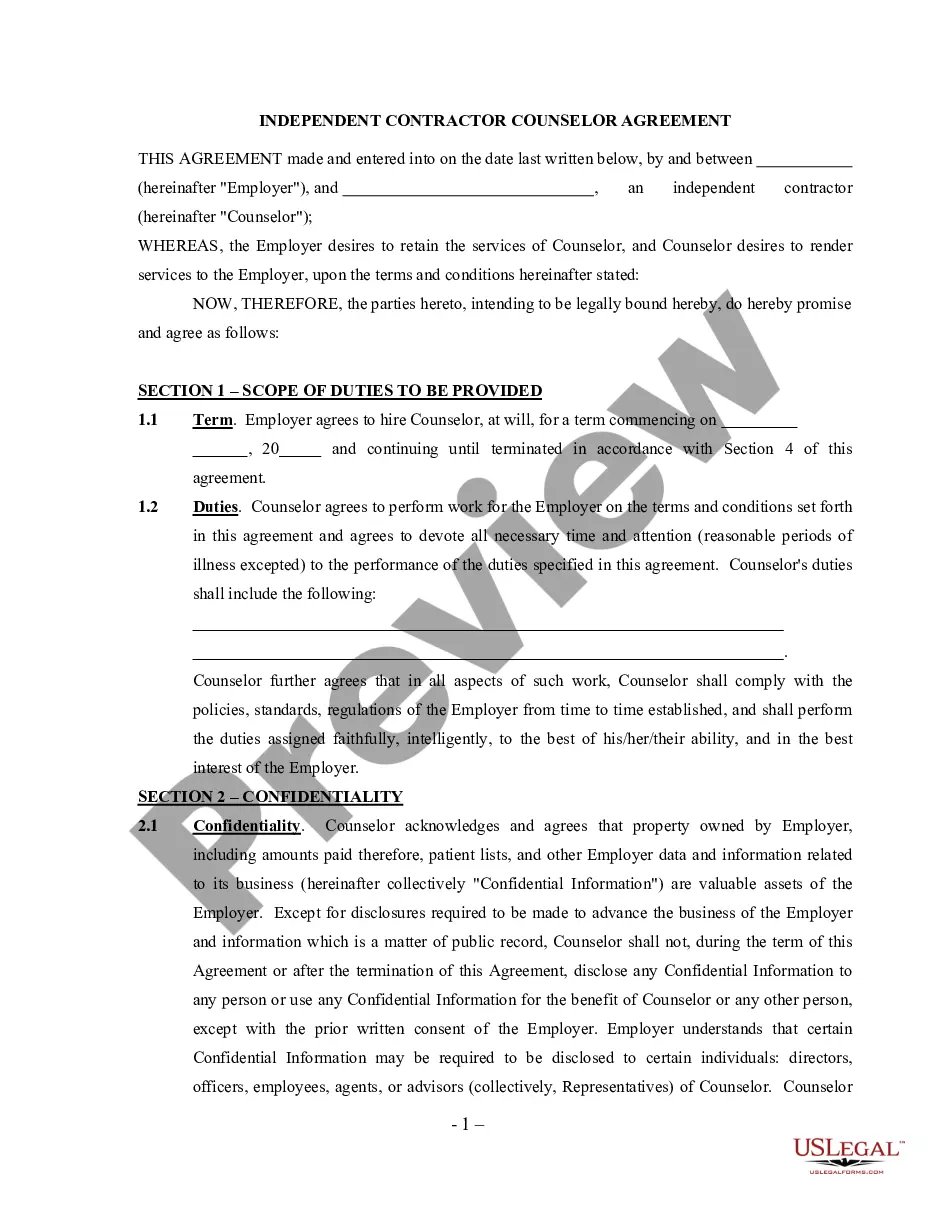
  • Preview Independent Contractor Agreement Between Licensed Counselor and Therapist and Licensed Counselor and Therapist Practicing as a Solo Practitioner
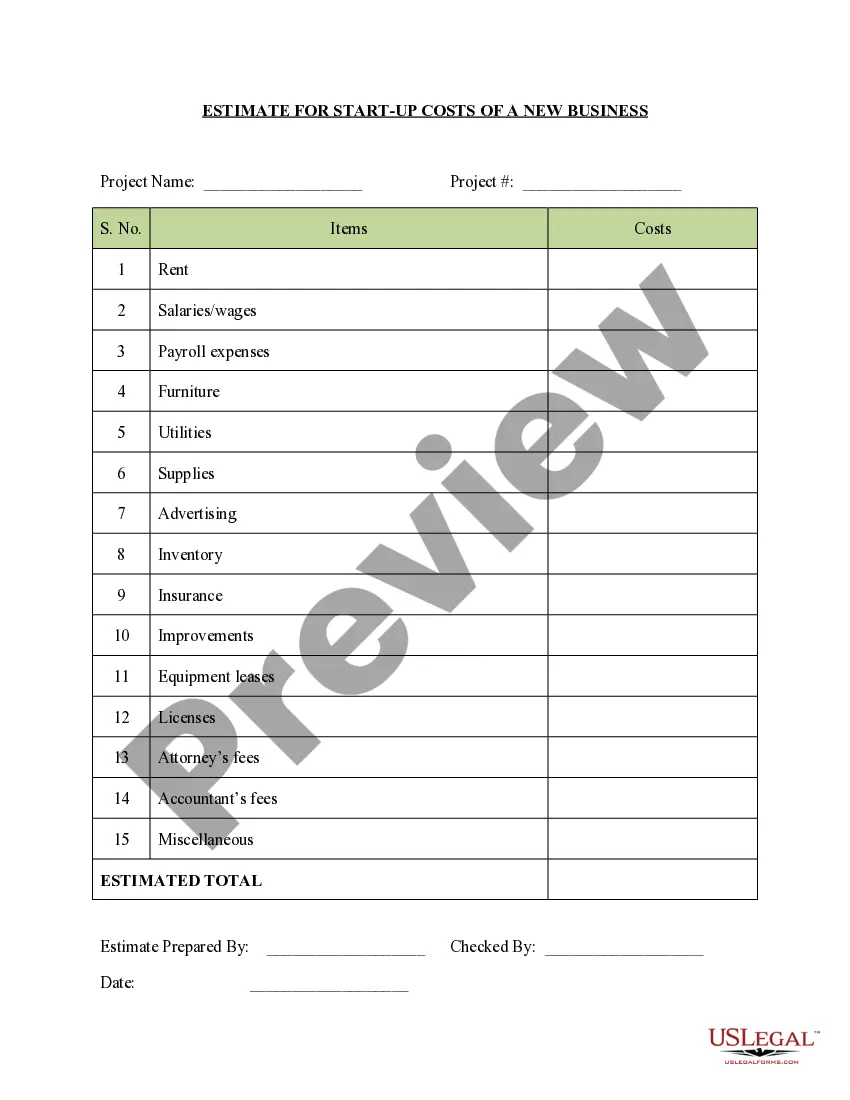
  • Preview Independent Contractor Agreement Between Licensed Counselor and Therapist and Licensed Counselor and Therapist Practicing as a Solo Practitioner

How to fill out Independent Contractor Agreement Between Licensed Counselor And Therapist And Licensed Counselor And Therapist Practicing As A Solo Practitioner?

You may dedicate hours online searching for the valid document template that aligns with the state and federal requirements you need.

US Legal Forms offers thousands of valid templates that are reviewed by professionals.

You can obtain or print the Alabama Independent Contractor Agreement Between Licensed Counselor and Therapist and Licensed Counselor and Therapist Practicing as a Solo Practitioner from the platform.

Firstly, confirm that you have chosen the correct document template for the area/town that you select. Review the document outline to ensure you have chosen the appropriate form.

  1. If you already own a US Legal Forms account, you can Log In and click on the Download button.
  2. After this, you can complete, modify, print, or sign the Alabama Independent Contractor Agreement Between Licensed Counselor and Therapist and Licensed Counselor and Therapist Practicing as a Solo Practitioner.
  3. Every valid document template you obtain is yours indefinitely.
  4. To acquire another copy of any purchased document, visit the My documents section and click on the respective button.
  5. If you are using the US Legal Forms website for the first time, follow the basic instructions below.

Form popularity

FAQ

Yes, a counselor can refer to themselves as a therapist if they provide therapeutic services. However, it is crucial to ensure they have the necessary qualifications and meet state requirements. Including this clarity in an Alabama Independent Contractor Agreement Between Licensed Counselor and Therapist Practicing as a Solo Practitioner can prevent potential misunderstandings for clients seeking therapy.

The choice between saying therapist or counselor often depends on the context and the services provided. If you focus on emotional and psychological treatment, ‘therapist’ may be more appropriate. However, many professionals also use ‘counselor’ in their titles. It is beneficial to clearly define terms in your Alabama Independent Contractor Agreement Between Licensed Counselor and Therapist to ensure clients understand the services you provide.

A licensed professional counselor is a specific type of therapist who has met the state requirements for licensure. While all licensed counselors are therapists, not all therapists are licensed counselors. When creating an Alabama Independent Contractor Agreement Between Licensed Counselor and Therapist, it’s important to specify the qualifications and specializations to ensure clarity in client services.

Yes, Alabama does have LPC reciprocity agreements with several states. This allows licensed professional counselors moving to Alabama to practice without reapplying for licensure, provided they meet certain criteria. Understanding this is essential when drafting an Alabama Independent Contractor Agreement Between Licensed Counselor and Therapist, especially if you plan to work with counselors from other states.

Yes, a licensed professional counselor (LPC) is considered a type of therapist. LPCs have specific training that qualifies them to work with clients on mental health issues. In an Alabama Independent Contractor Agreement Between Licensed Counselor and Therapist and Licensed Counselor and Therapist Practicing as a Solo Practitioner, the roles of LPCs can be highlighted to clarify their therapeutic capabilities.

While therapists and counselors often provide similar services, they are not exactly the same. Counselors usually focus on specific issues and provide guidance, whereas therapists may delve deeper into emotional and psychological challenges. When establishing an Alabama Independent Contractor Agreement Between Licensed Counselor and Therapist, it helps to clearly define the roles to ensure understanding.

The terms 'licensed counselor' and 'licensed therapist' are often used interchangeably but may have distinct meanings based on state laws. Generally, a licensed therapist may hold additional certifications for specific therapy modalities. Regardless of title, having an Alabama Independent Contractor Agreement Between Licensed Counselor and Therapist and Licensed Counselor and Therapist Practicing as a Solo Practitioner prepares you for effective practice management.

Yes, a Licensed Professional Counselor (LPC) can own their own practice. Establishing an independent practice allows LPCs to operate under their terms and contribute to their communities. It's advisable to establish an Alabama Independent Contractor Agreement Between Licensed Counselor and Therapist and Licensed Counselor and Therapist Practicing as a Solo Practitioner to clarify the relationship and responsibilities with any contracted employees.

Yes, you typically need a business license if you operate as a 1099 employee. Licensing requirements vary by state and locality, so it's essential to check with your local authority. In conjunction with an Alabama Independent Contractor Agreement Between Licensed Counselor and Therapist and Licensed Counselor and Therapist Practicing as a Solo Practitioner, obtaining the necessary licenses will ensure compliance with local laws.

As a 1099 therapist, having an LLC is not mandatory, but it is highly advisable. An LLC shields your personal assets from any business-related issues. By utilizing an Alabama Independent Contractor Agreement Between Licensed Counselor and Therapist and Licensed Counselor and Therapist Practicing as a Solo Practitioner, you can streamline your business operations while maintaining your practice more effectively.

Trusted and secure by over 3 million people of the world’s leading companies

Alabama Independent Contractor Agreement Between Licensed Counselor and Therapist and Licensed Counselor and Therapist Practicing as a Solo Practitioner