Alabama General Release by Executor of Employment Claim for Estate of Deceased - Pending Litigation
What is this form?
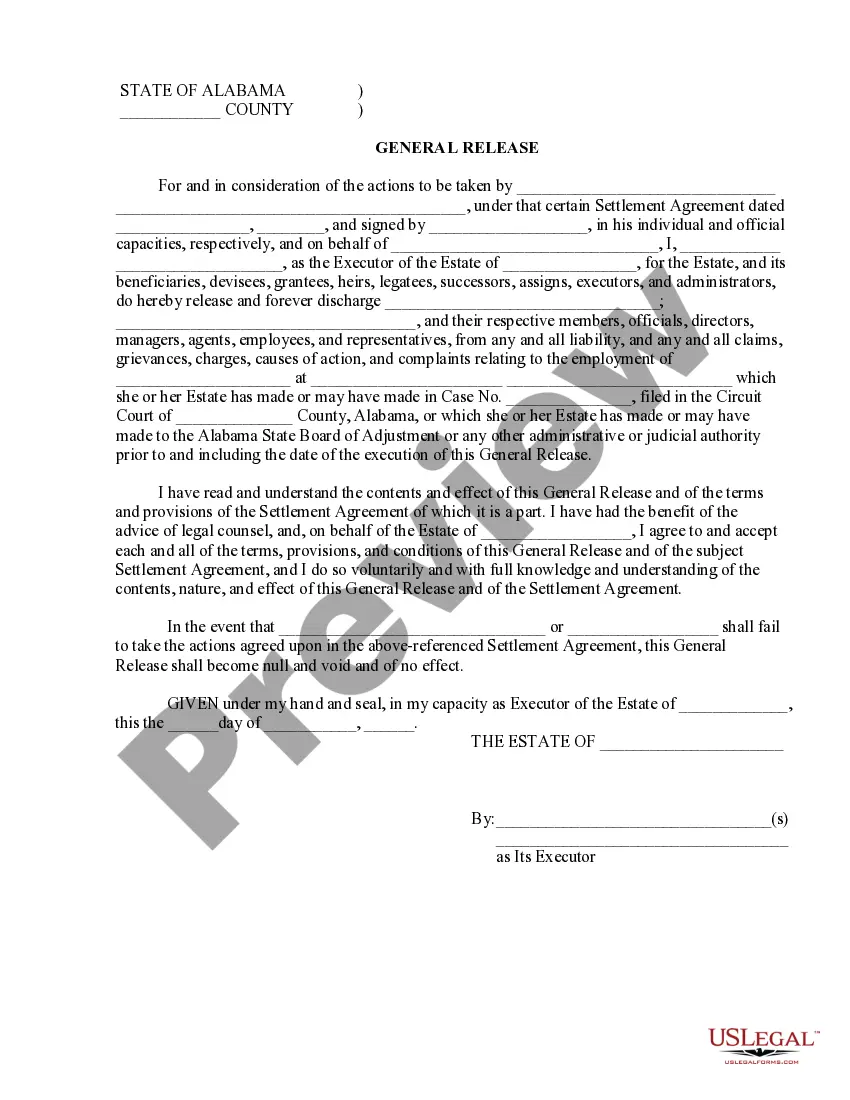
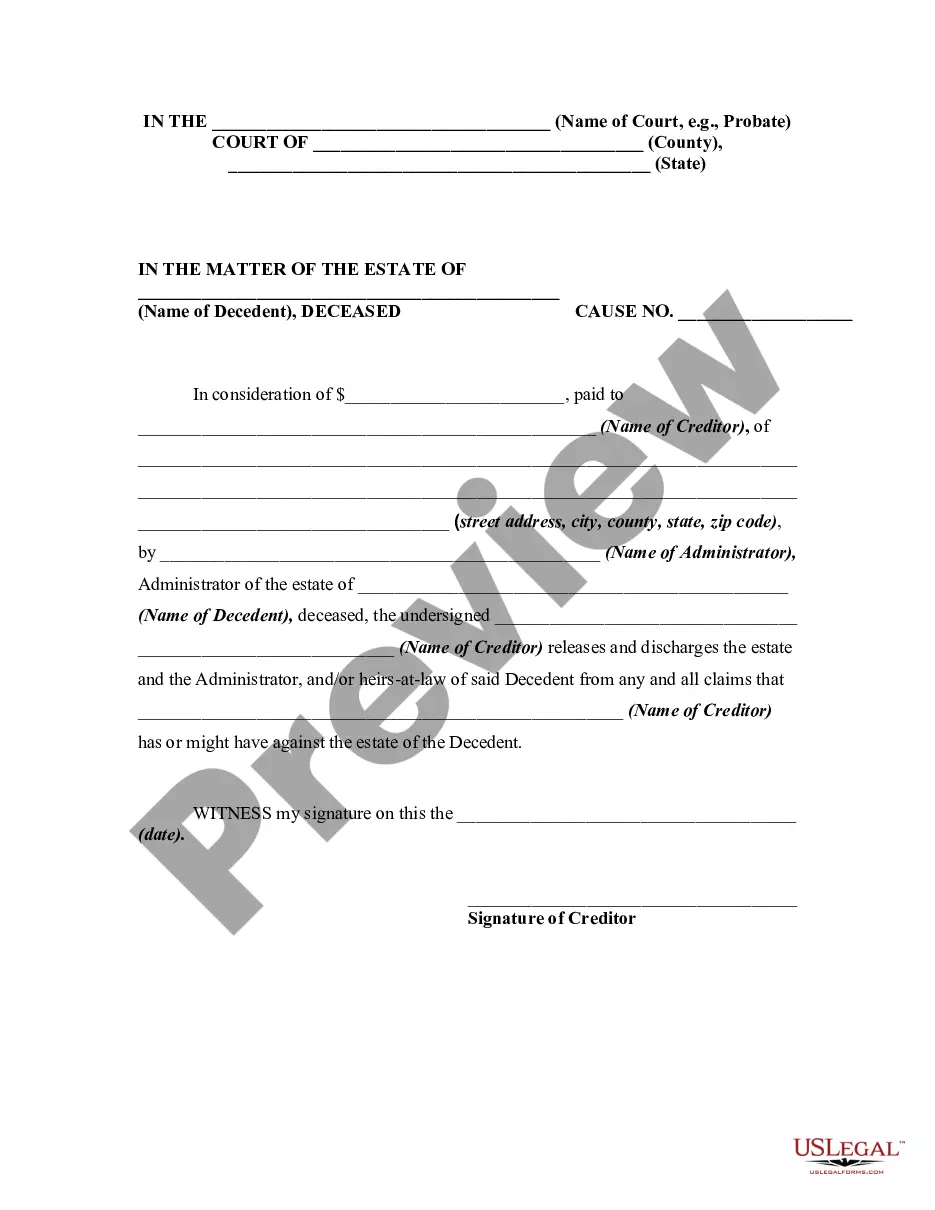
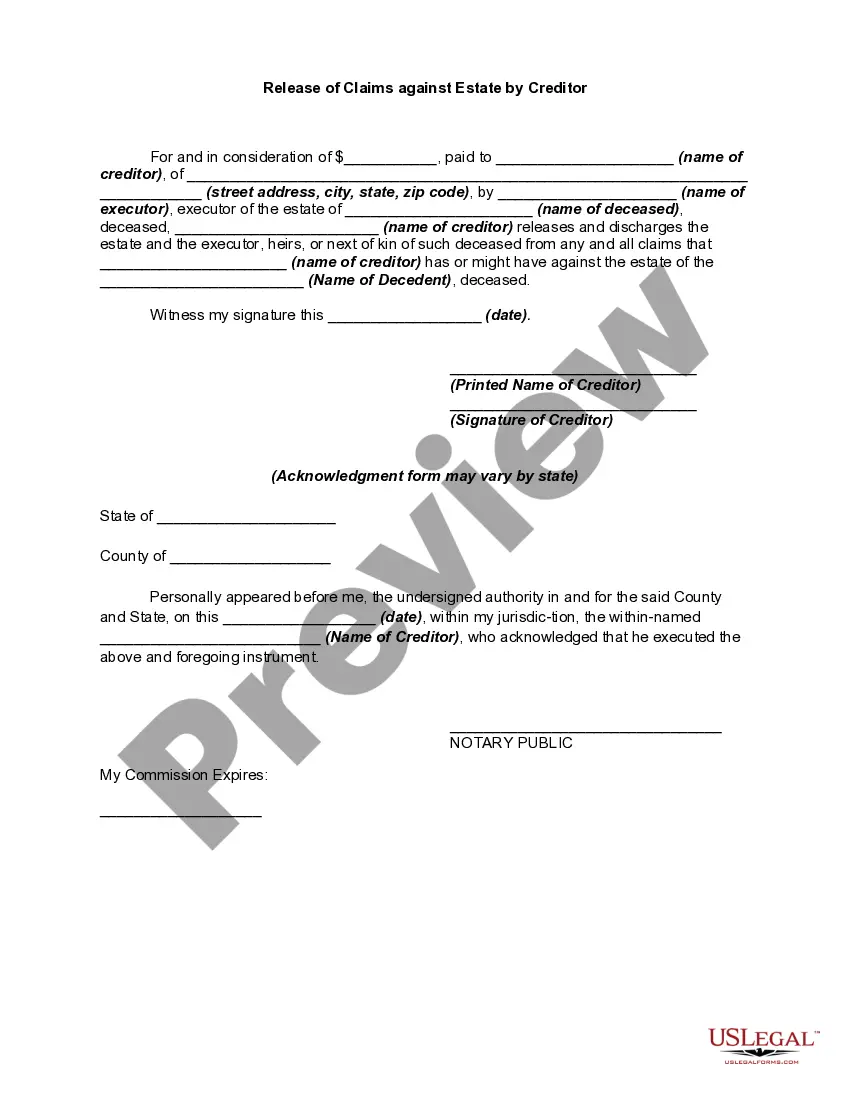
The General Release by Executor of Employment Claim for Estate of Deceased is a legal document that allows the executor of an estate to release a company from liability related to employment issues concerning a deceased individual. This form is typically used when a settlement agreement has been reached and helps prevent future claims from being made by the estate against the employer. It serves a crucial role in the legal settlement process, ensuring that all parties involved acknowledge and agree to the terms set forth.
What’s included in this form
- Identification of the parties involved, including the executor and the company being released.
- Details of the settlement agreement, including the date and parties that signed it.
- A comprehensive release of claims related to the decedent's employment.
- Provisions addressing the conditions under which the release may become null and void.
- Signature line for the executor of the estate to affirm understanding and agreement.
When to use this document
This form should be used when an estate has settled an employment-related claim involving a deceased individual. It can be necessary during the probate process or when negotiating settlements where the estate is seeking justice on behalf of the decedent. Using this form ensures that the executor acts within the legal framework to finalize agreements and releases the employer from any future liability concerning the decedent's employment.
Who should use this form
- Executors or administrators of an estate managing claims related to a deceased person's employment.
- Beneficiaries of the estate who are involved in the settlement process.
- Legal representatives who are advising clients on estate matters involving employment claims.
Instructions for completing this form
- Identify the executor and the estate being represented.
- Specify the name of the deceased and the company being released from liability.
- Complete the details of the settlement agreement, including dates and parties involved.
- Read through and acknowledge all terms outlined in the release and settlement agreement.
- Sign and date the form, ensuring it is completed in the presence of any required witnesses or notary if applicable.
Does this document require notarization?
This form does not typically require notarization unless specified by local law. Be sure to verify any additional requirements that may apply in your jurisdiction to ensure the document is legally valid.
Get your form ready online
Our built-in tools help you complete, sign, share, and store your documents in one place.
Make edits, fill in missing information, and update formatting in US Legal Forms—just like you would in MS Word.
Download a copy, print it, send it by email, or mail it via USPS—whatever works best for your next step.
Sign and collect signatures with our SignNow integration. Send to multiple recipients, set reminders, and more. Go Premium to unlock E-Sign.
If this form requires notarization, complete it online through a secure video call—no need to meet a notary in person or wait for an appointment.
We protect your documents and personal data by following strict security and privacy standards.

Make edits, fill in missing information, and update formatting in US Legal Forms—just like you would in MS Word.

Download a copy, print it, send it by email, or mail it via USPS—whatever works best for your next step.

Sign and collect signatures with our SignNow integration. Send to multiple recipients, set reminders, and more. Go Premium to unlock E-Sign.

If this form requires notarization, complete it online through a secure video call—no need to meet a notary in person or wait for an appointment.

We protect your documents and personal data by following strict security and privacy standards.
Typical mistakes to avoid
- Failing to provide complete and accurate details about the parties involved.
- Not reading the terms of the settlement agreement thoroughly before signing.
- Missing signatures or dates, which can render the form invalid.
Why use this form online
- Convenience of downloading and filling out the form from home.
- Editability allows for customization to meet specific needs of the estate.
- Accessibility to professionally drafted forms ensures legal reliability.
Looking for another form?


Form popularity
FAQ
Under California Probate Code, the executor typically receives 4% on the first $100,000, 3% on the next $100,000 and 2% on the next $800,000, says William Sweeney, a California-based probate attorney. For an estate worth $600,000 the fee works out at approximately $15,000.
The simple answer is that, either through specific will provisions or applicable state law, an executor is usually entitled to receive compensation. The amount varies depending on the situation, but the executor is always paid out of the probate estate.
By law, the probate of an estate in Alabama will take at least six months. This period gives creditors and others with a claim on the estate time to receive notice that the estate is being probated and to submit a claim.
If a will's executor dies or is unable to serve for other reasons, the court appoints another person.An executor's duties include identifying and protecting your assets, finalizing your taxes, paying outstanding bills, and distributing assets to your beneficiaries.
Both the executor and the attorney for the executor would be entitled to $25,000 each for administration of this estate. These fees are paid from the estate assets, not from your own money. So you as the client should never pay these fees yourself. They are paid from the estate before distribution of the assets.
An executor cannot simply gather assets, pay bills and expenses and then distribute the remaining assets to the beneficiaries.Beneficiaries often have the right to request an accounting of estate property and funds even before the estate is ready to close, in order to make sure everything is on the up-and-up.
There is a strict time limit within which an eligible individual can make a claim on the Estate. This is six months from the date that the Grant of Probate was issued. For this reason, Executors are advised to wait until this period has lapsed before distributing any of the Estate to the beneficiaries.
Can I sue the executor of a will or administrator of the estate? Yes, an executor or administrator can be sued, just like anyone else. However, if what you are looking to do is challenge the distributions of a will or trust, then you will need to contest the will or trust via probate or trust litigation.
State law typically provides for payment of the executor. By Mary Randolph, J.D. Most executors are entitled to payment for their work, either by the terms of the will or under state law.