Alabama Initial Disclosure
What this document covers
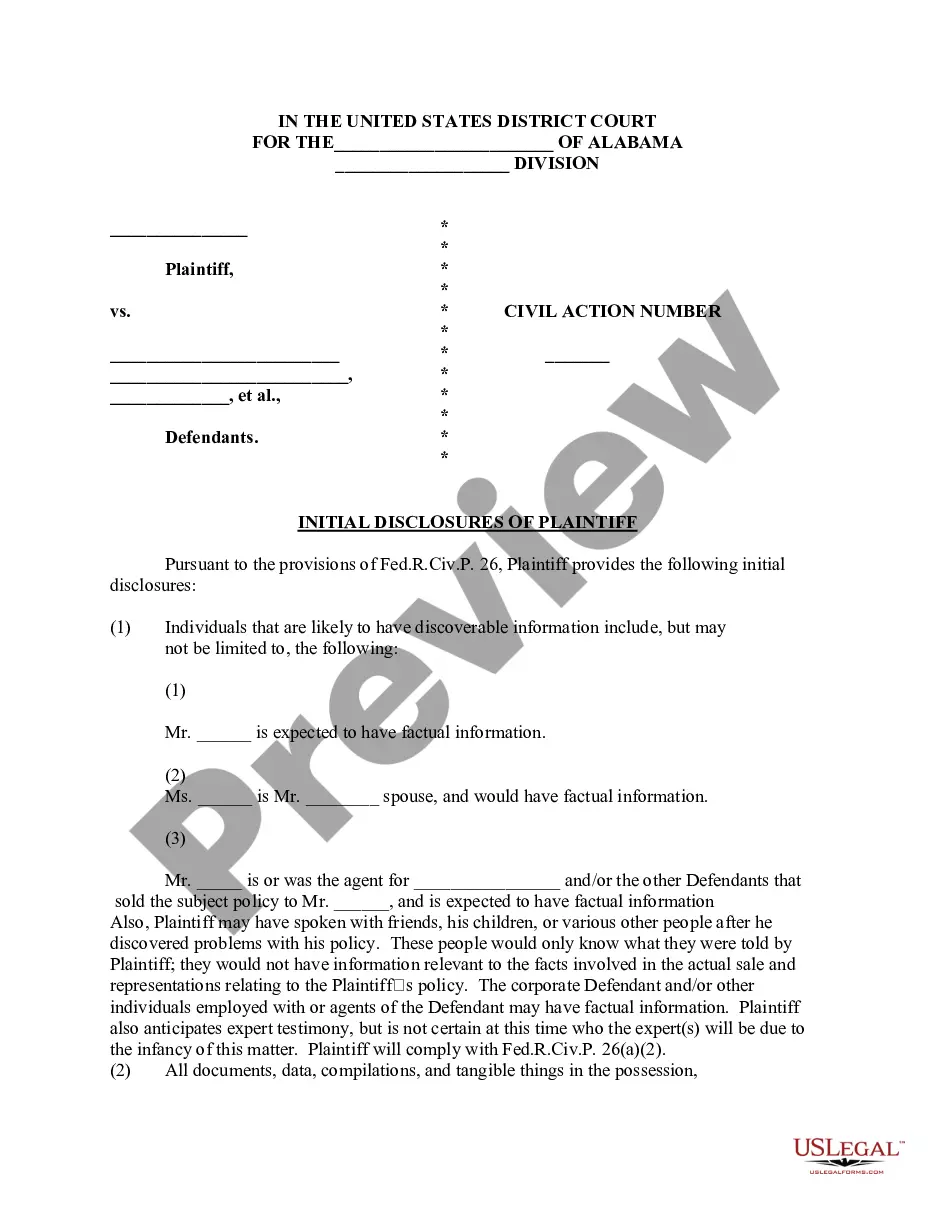
The Initial Disclosure form is a legal document used in federal civil cases, primarily by plaintiffs. This form outlines the witnesses, documents, and other critical information related to the plaintiff's case. It is a vital step within the discovery process, ensuring that both parties are aware of what information will be presented during the litigation. By completing this form, a plaintiff complies with the requirements set forth by federal rules regarding initial disclosures, distinguishing it from other types of legal disclosures that might occur later in a lawsuit.
Key components of this form
- Identification of the parties involved in the case.
- List of individuals with potentially discoverable information.
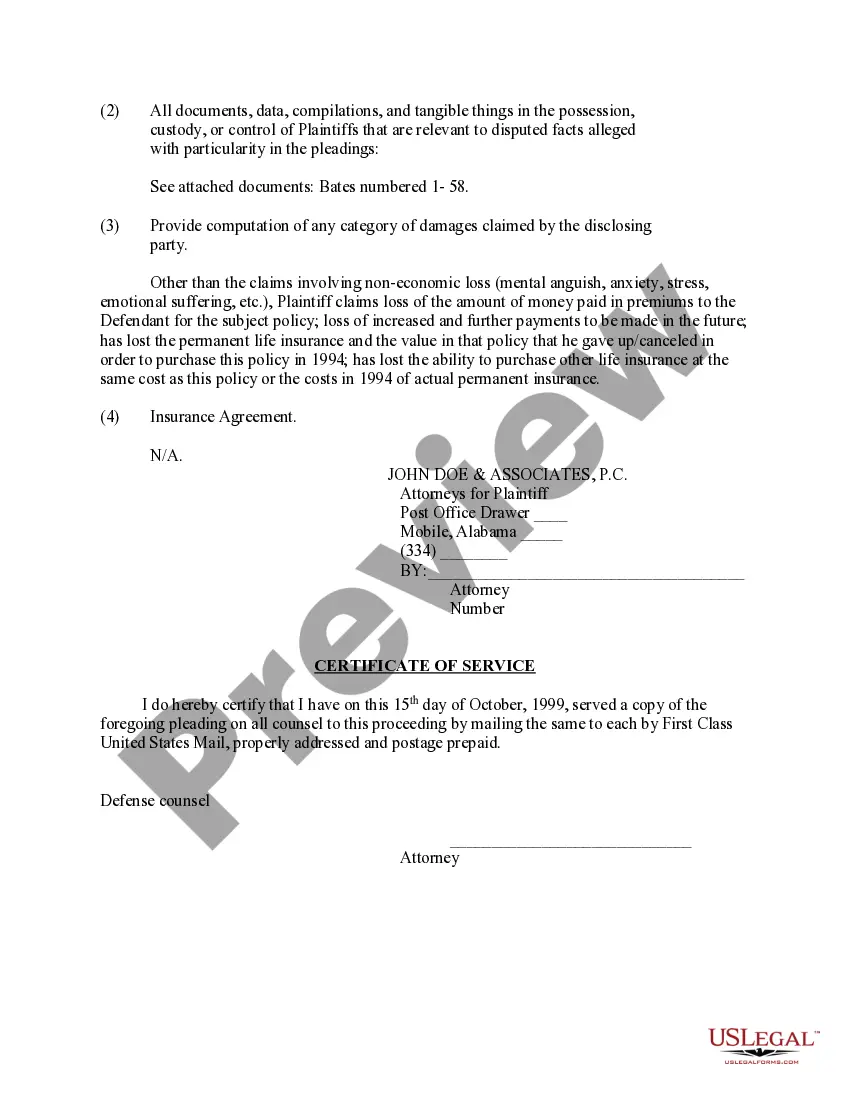
- Details on the documents and tangible items relevant to the dispute.
- Computations of claimed damages.
- Certifications of service to other parties involved in the case.
Situations where this form applies
This form should be used at the beginning of a federal case when the plaintiff is required to disclose certain information to the defendant. It is specifically applicable in cases where pre-trial disclosures are mandated, helping both parties prepare for subsequent stages of litigation. If you are initiating a federal lawsuit, ensure that you file your Initial Disclosure form promptly following the court's timelines.
Who needs this form
- Individuals acting as plaintiffs in federal civil cases.
- Lawyers representing clients in federal lawsuits.
- Litigants seeking to comply with federal rules of civil procedure.
Steps to complete this form
- Identify the full names and roles of the parties involved in the case.
- List all individuals likely to have discoverable information, with a brief description of what they may provide.
- Outline all relevant documents and evidence you possess related to your claims.
- Clearly state any damages you are claiming, including both economic and non-economic losses.
- Sign and date the form to certify its accuracy and completeness.
Does this document require notarization?
This form does not typically require notarization unless specified by local law. However, it is advisable to check the requirements for the specific court where the case is being filed to ensure compliance.
Get your form ready online
Our built-in tools help you complete, sign, share, and store your documents in one place.
Make edits, fill in missing information, and update formatting in US Legal Forms—just like you would in MS Word.
Download a copy, print it, send it by email, or mail it via USPS—whatever works best for your next step.
Sign and collect signatures with our SignNow integration. Send to multiple recipients, set reminders, and more. Go Premium to unlock E-Sign.
If this form requires notarization, complete it online through a secure video call—no need to meet a notary in person or wait for an appointment.
We protect your documents and personal data by following strict security and privacy standards.

Make edits, fill in missing information, and update formatting in US Legal Forms—just like you would in MS Word.

Download a copy, print it, send it by email, or mail it via USPS—whatever works best for your next step.

Sign and collect signatures with our SignNow integration. Send to multiple recipients, set reminders, and more. Go Premium to unlock E-Sign.

If this form requires notarization, complete it online through a secure video call—no need to meet a notary in person or wait for an appointment.

We protect your documents and personal data by following strict security and privacy standards.
Common mistakes to avoid
- Failing to disclose all relevant witnesses or documentation.
- Providing vague descriptions of the damages claimed.
- Missing deadlines for submissions as required by the court.
Advantages of online completion
- Convenience of filling out the form from anywhere at any time.
- Ease of making edits and ensuring accuracy before submission.
- Access to reliable templates drafted by licensed attorneys.
Main things to remember
- The Initial Disclosure form is essential for plaintiffs in federal civil cases.
- It helps facilitate a fair trial by ensuring that both parties have access to key information early in the process.
- Accurate and timely submission of this form is crucial to avoid potential legal complications.
Looking for another form?

Form popularity
FAQ
Initial disclosures are a requirement under the federal legislation and must include: (1) the names, addresses, and phone numbers of individuals who contributed to the discovery, (2) a duplicate description of all related paperwork, compilation of all information pertaining to the invention, and publicly owned tangible
(d) Filing.But disclosures under Rule 26(a)(1) or (2) and the following discovery requests and responses must not be filed until they are used in the proceeding or the court orders filing: depositions, interrogatories, requests for documents or tangible things or to permit entry onto land, and requests for admission.
Initial disclosures are the preliminary disclosures that must be acknowledged and signed in order to move forward with your loan application.When you apply for a mortgage loan, the lender is required to provide you with initial disclosures within three business days of application.
Discovery is a major part of civil litigation, the process through which the parties gather evidence before trial.The very first step in discovery is the exchange of initial disclosures. Through initial disclosures, the parties are required to provide information they may use to support their cases at trial.
Produce these documents during initial disclosures. You will have to produce them at some point, and there is rarely, if ever, a benefit to delaying production. You should do more than just dump doc- uments on the plaintiff's counsel, however.
The Rule 26(a)(1) initial disclosures generally must be made within 14 days after the parties conduct a Rule 26(f ) conference, at which they are to discuss a discovery plan and other matters. The initial disclosures are typically made within 60 to 90 days after the complaint has been filed.
Initial disclosures are a requirement under the federal legislation and must include: (1) the names, addresses, and phone numbers of individuals who contributed to the discovery, (2) a duplicate description of all related paperwork, compilation of all information pertaining to the invention, and publicly owned tangible
Initial disclosure is a requirement under the federal law that parties make available to each other the following information without first receiving a discovery request: (1) the names, addresses, and telephone numbers of persons likely to have relevant, discoverable information, (2) a copy or description of all