Alabama Notice of Hearing
What this document covers
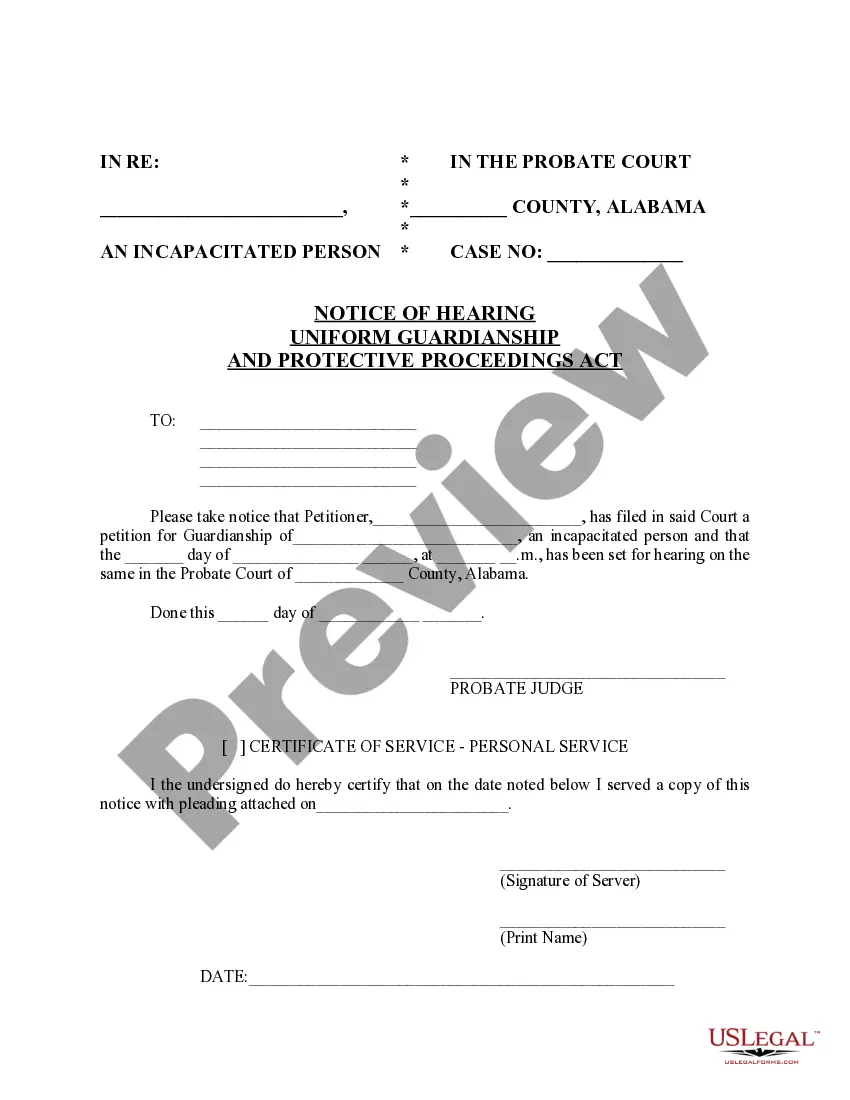
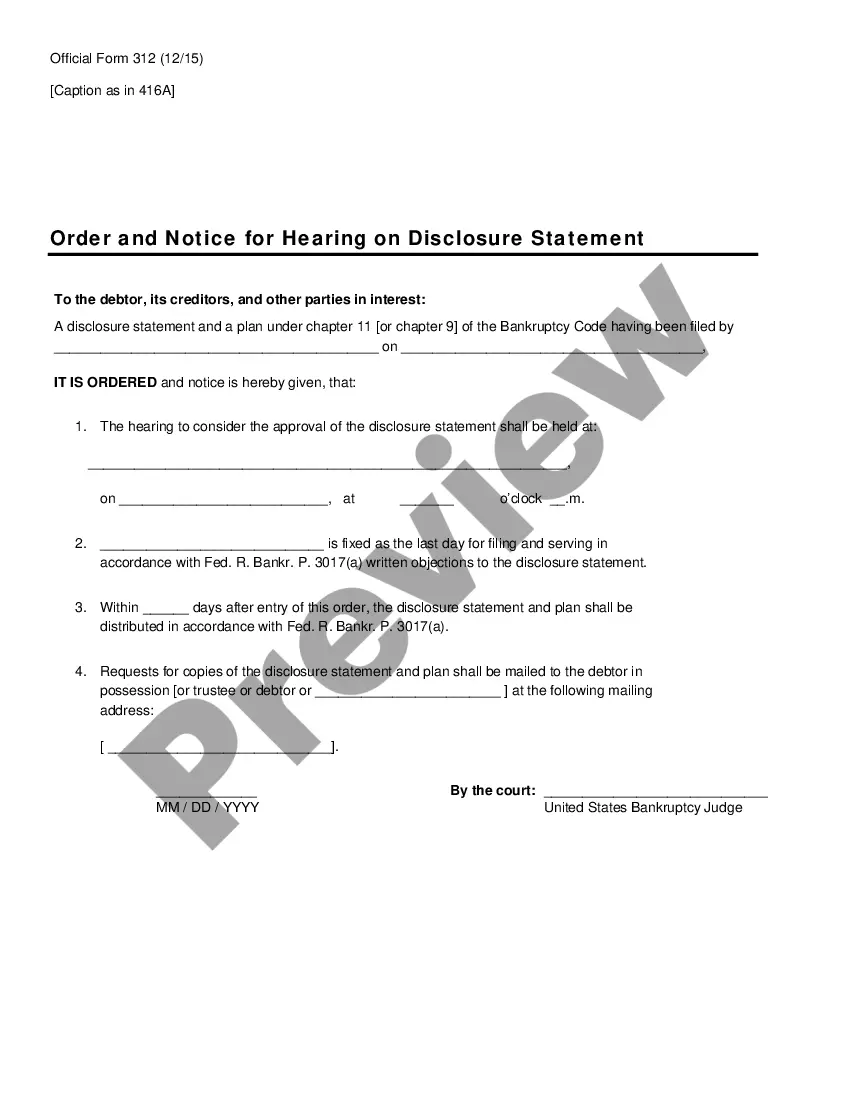
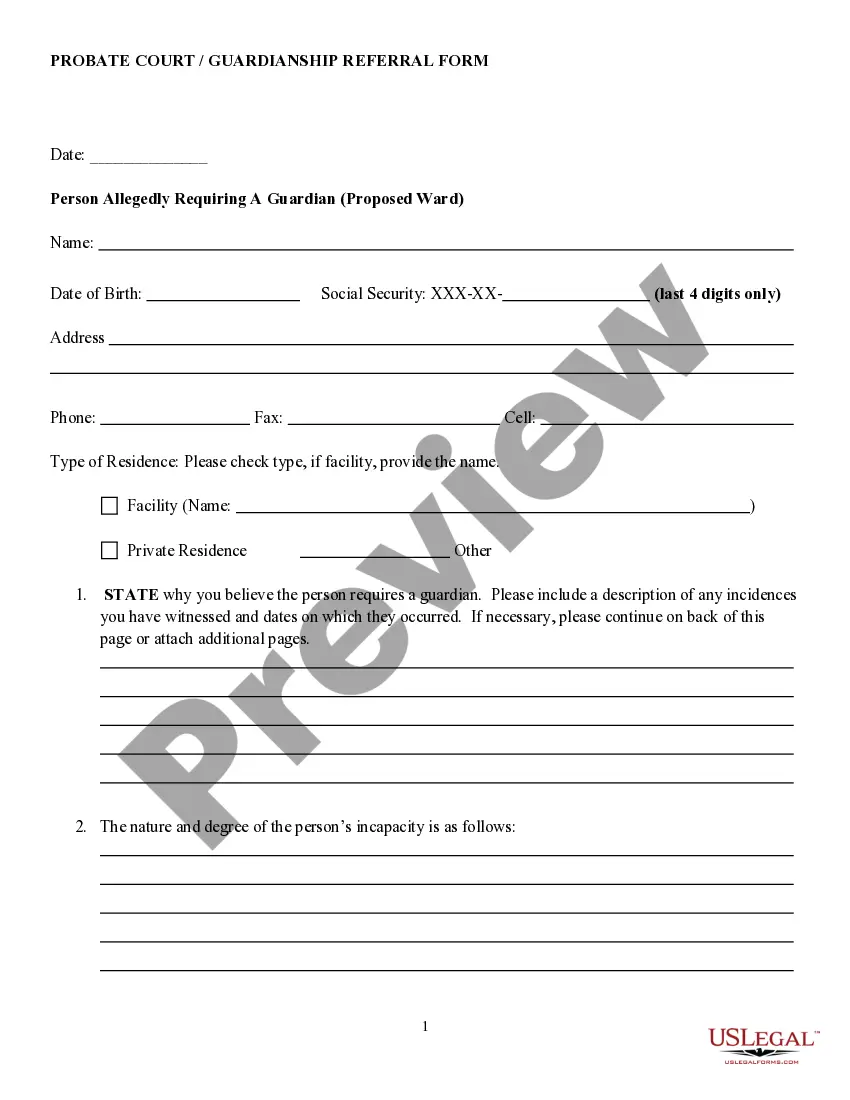
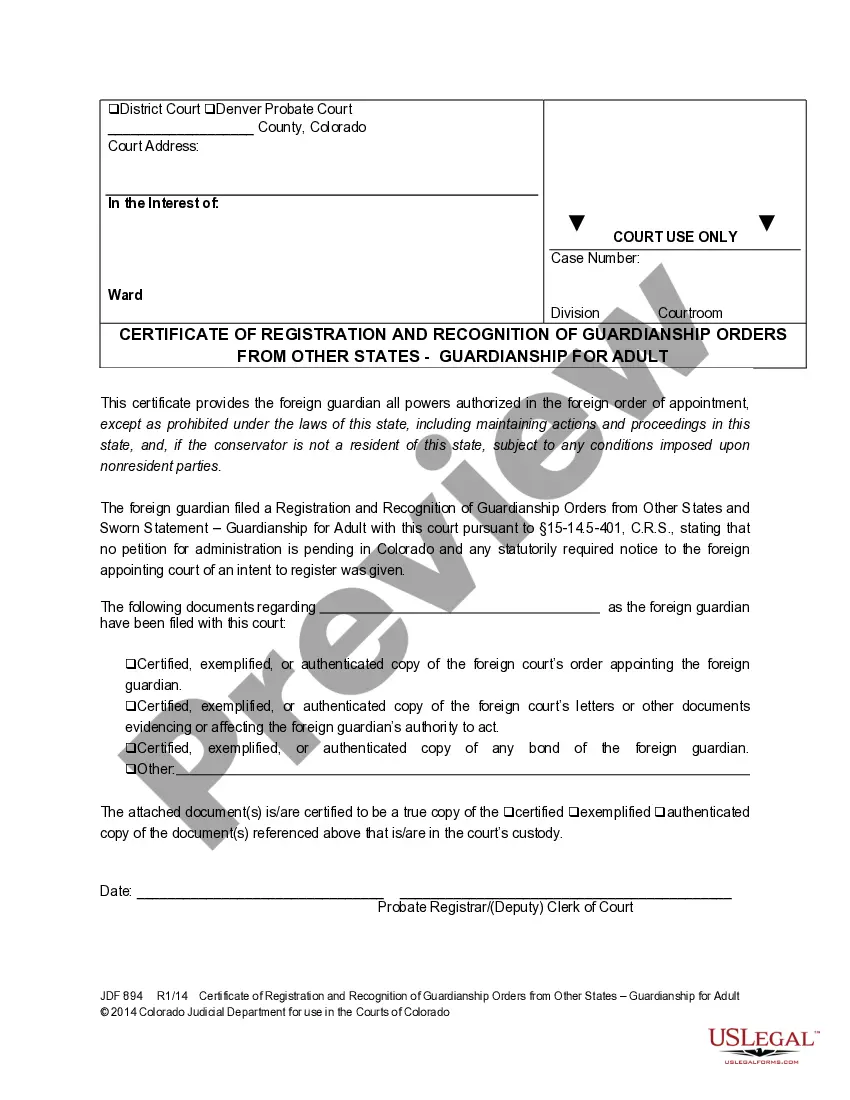
The Notice of Hearing is a legal document used in guardianship proceedings under the Uniform Guardianship and Protective Proceedings Act. This form serves to notify interested parties of a scheduled court hearing regarding the appointment of a guardian for an incapacitated person. Unlike other notices, this form specifically pertains to guardianship cases, ensuring proper legal protocol is observed in notifying all relevant parties.
Main sections of this form
- Case number: Uniquely identifies the guardianship proceeding.
- Names of parties involved: Includes the petitioner and incapacitated person.
- Date and time of hearing: Specifies when the court will consider the petition.
- Probate court information: Indicates the specific court managing the case.
- Certificate of service: Confirms that notification was provided to interested parties.
Situations where this form applies
This form should be used when a petitioner has filed a petition for guardianship of an incapacitated person and a hearing has been scheduled in probate court. You will need to notify family members or other interested parties of the hearing date to allow them the opportunity to participate or object, ensuring that the process is transparent and legally compliant.
Who needs this form
- Petitioners seeking guardianship of an incapacitated person.
- Family members of the incapacitated individual involved in the guardianship case.
- Legal representatives or advocates acting on behalf of the incapacitated person.
Steps to complete this form
- Identify the parties involved: Enter the names of the petitioner and the incapacitated person.
- Fill in the case number: Include the unique identifier for the guardianship case.
- Specify the date and time of the hearing: Clearly state when the hearing will occur.
- Complete the probate court information: Include the name of the county where the court is located.
- Sign and date the document: Ensure the Probate Judgeâs signature is obtained.
Does this form need to be notarized?
This form does not typically require notarization unless specified by local law. However, having the signature of the Probate Judge is necessary for it to be legally valid.
Get your form ready online
Our built-in tools help you complete, sign, share, and store your documents in one place.
Make edits, fill in missing information, and update formatting in US Legal Forms—just like you would in MS Word.
Download a copy, print it, send it by email, or mail it via USPS—whatever works best for your next step.
Sign and collect signatures with our SignNow integration. Send to multiple recipients, set reminders, and more. Go Premium to unlock E-Sign.
If this form requires notarization, complete it online through a secure video call—no need to meet a notary in person or wait for an appointment.
We protect your documents and personal data by following strict security and privacy standards.

Make edits, fill in missing information, and update formatting in US Legal Forms—just like you would in MS Word.

Download a copy, print it, send it by email, or mail it via USPS—whatever works best for your next step.

Sign and collect signatures with our SignNow integration. Send to multiple recipients, set reminders, and more. Go Premium to unlock E-Sign.

If this form requires notarization, complete it online through a secure video call—no need to meet a notary in person or wait for an appointment.

We protect your documents and personal data by following strict security and privacy standards.
Typical mistakes to avoid
- Failing to accurately list all interested parties who should receive the notice.
- Leaving out the case number, which can lead to confusion.
- Not providing a clear date and time for the hearing, risking improper notice.
- Neglecting to sign the certificate of service, which confirms delivery of the notice.
Benefits of completing this form online
- Convenient access to the form that can be downloaded anytime.
- Edit and customize the document as needed to fit your specific situation.
- Reliable templates created by licensed attorneys ensure compliance with the law.
- Access to legal support if questions arise while filling out the form.
Quick recap
- The Notice of Hearing is vital to inform relevant parties about court hearings in guardianship cases.
- Completing the form accurately is essential for legal compliance.
- This form must be filed with the appropriate probate court in Alabama.
Looking for another form?
Form popularity
FAQ
In Alabama, the estate executor is known as a "personal representative". Executors for Alabama estates are entitled to reasonable compensation of up to 2.5% of assets received, and 2.5% of disbursements.
Letters testamentary are the documentary evidence of an individual's appointment as the executor of an estate. They are issued by Alabama probate courts following appointment of an executor.
Generally, an executor has 12 months from the date of death to distribute the estate. This is known as 'the executor's year'. However, for various reasons the executor may have been delayed and has not distributed the estate within this time frame.
By law, the probate of an estate in Alabama will take at least six months. This period gives creditors and others with a claim on the estate time to receive notice that the estate is being probated and to submit a claim.
The length of time an executor has to distribute assets from a will varies by state, but generally falls between one and three years.
According to Alabama Probate Code, probate must be filed within five years after the death of the owner of the estate.
If you die without a will the State will not get your property unless you do not have any heirs at law. The Alabama Code sets out guidelines that that Probate Court must follow when someone dies without a Will. Those guidelines, which are referred to as the rules of intestate succession, list who gets the estate.