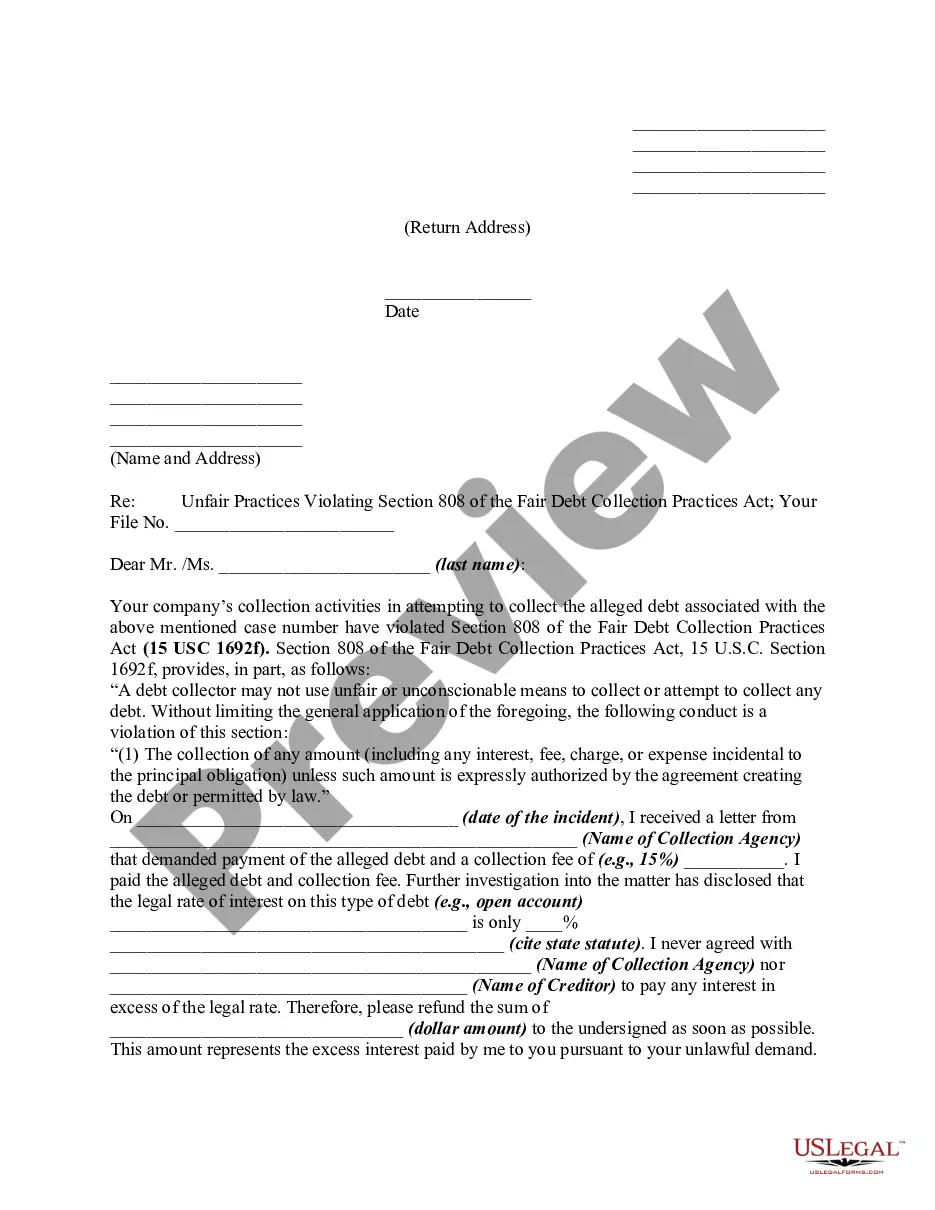
Alaska Letter Informing Debt Collector of Unfair Practices in Collection Activities - Collecting an Amount not Authorized by the Agreement Creating the Debt or by Law

State:
Multi-State
Control #:
US-DCPA-20.1BG
Format:
Word; 
Rich Text
Instant download

Description

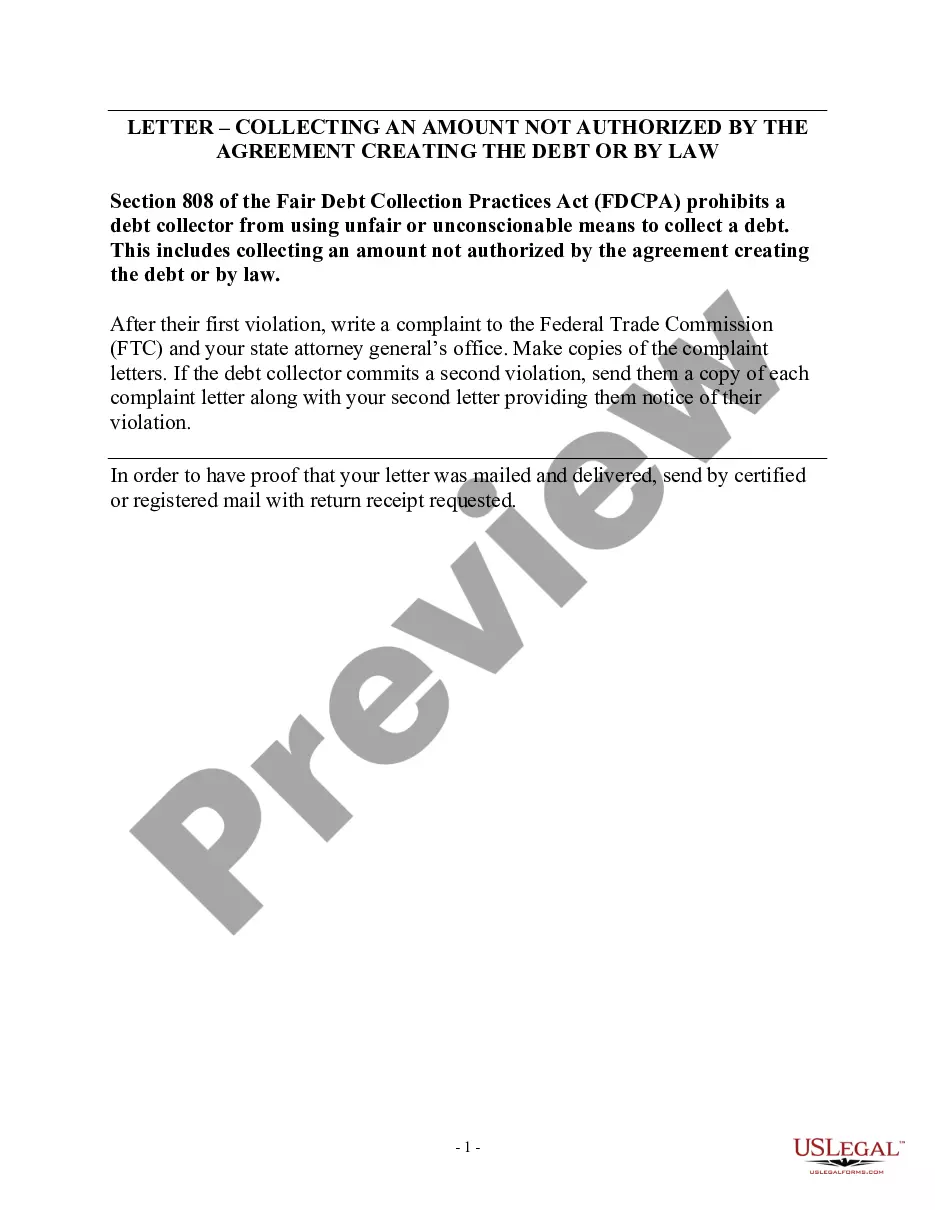
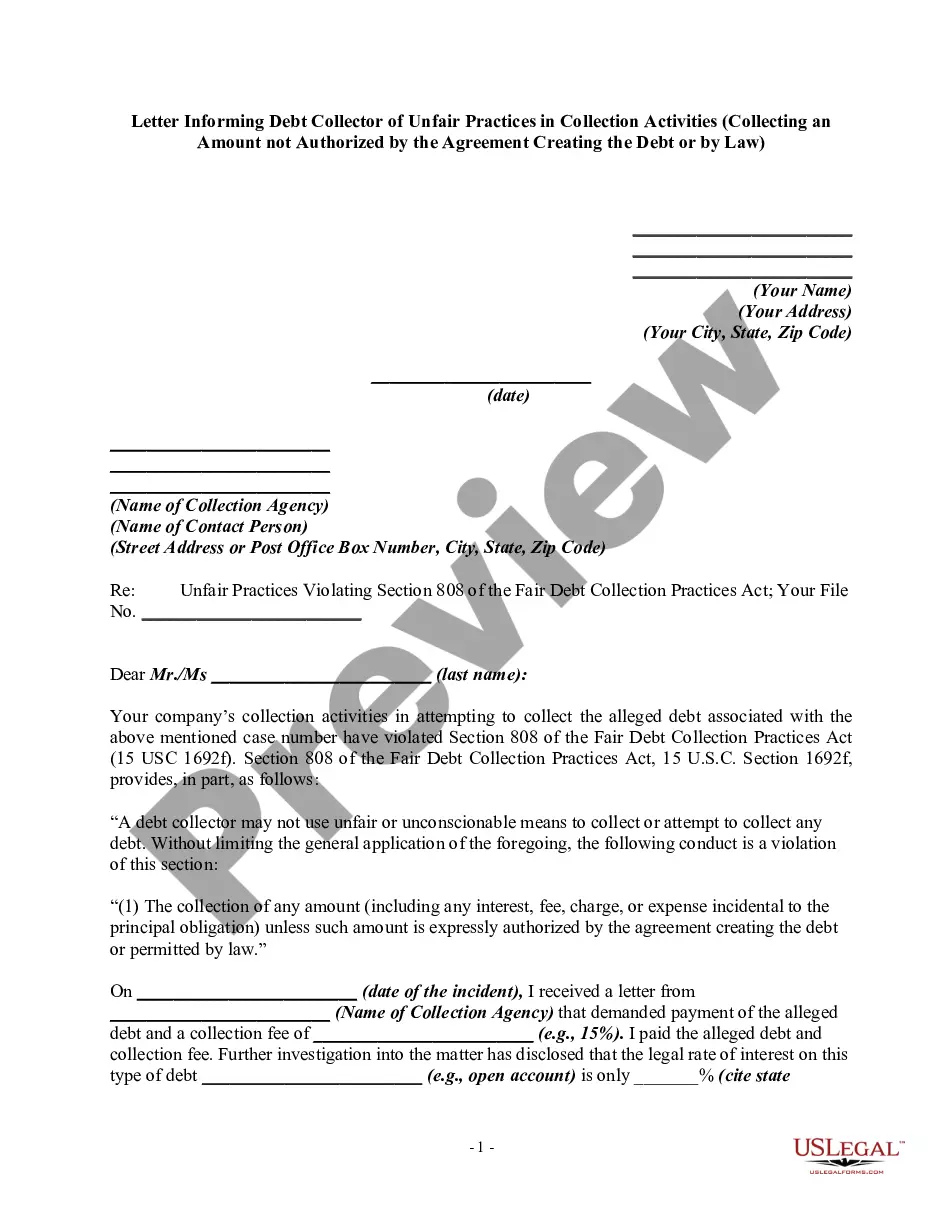
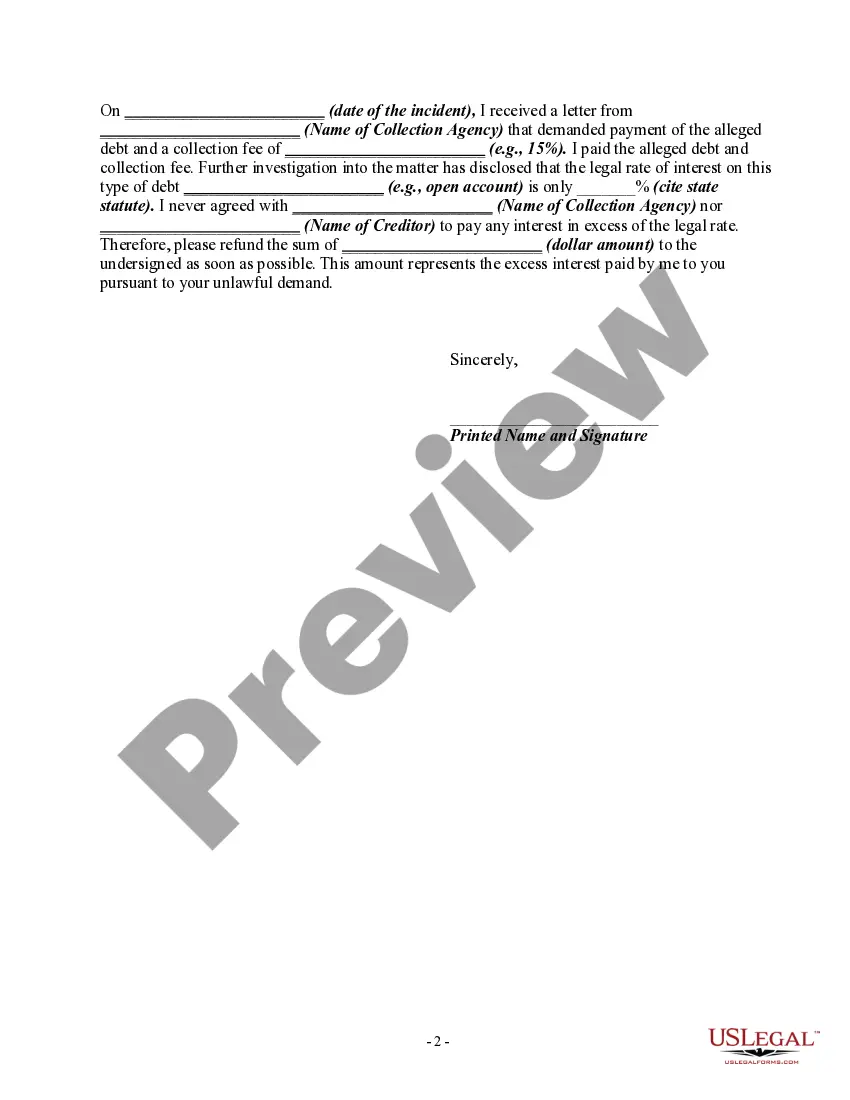
Section 808 of the Fair Debt Collection Practices Act, 15 U.S.C. Section 1692f, provides, in part, as follows:


"A debt collector may not use unfair or unconscionable means to collect or attempt to collect any debt. Without limiting the general application of the foregoing, the following conduct is a violation of this section:


"(1) The collection of any amount (including any interest, fee, charge, or expense incidental to the principal obligation) unless such amount is expressly authorized by the agreement creating the debt or permitted by law."
Free preview
  • Preview Letter Informing Debt Collector of Unfair Practices in Collection Activities - Collecting an Amount not Authorized by the Agreement Creating the Debt or by Law
  • Preview Letter Informing Debt Collector of Unfair Practices in Collection Activities - Collecting an Amount not Authorized by the Agreement Creating the Debt or by Law

Related forms

form-preview
Alaska Letter Informing Debt Collector of Unfair Practices in Collection Activities

Alaska Letter Informing Debt Collector of Unfair Practices in Collection Activities

View this form
form-preview
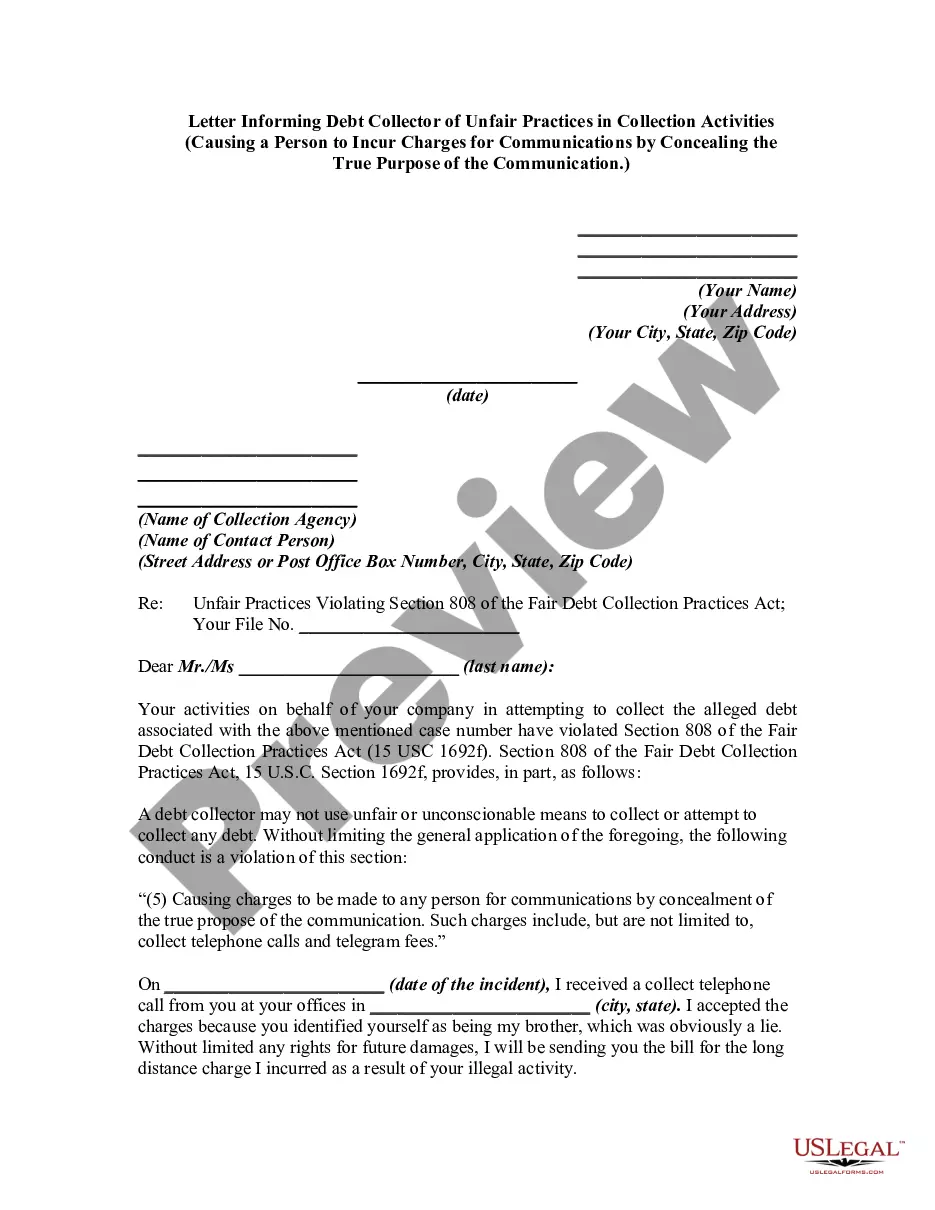
Alaska Letter Informing Debt Collector of Unfair Practices in Collection Activities - Causing a Person to Incur Charges for Communications by Concealing the True Purpose of the Communication

Alaska Letter Informing Debt Collector of Unfair Practices in Collection Activities - Causing a Person to Incur Charges for Communications by Concealing the True Purpose of the Communication

View this form
form-preview
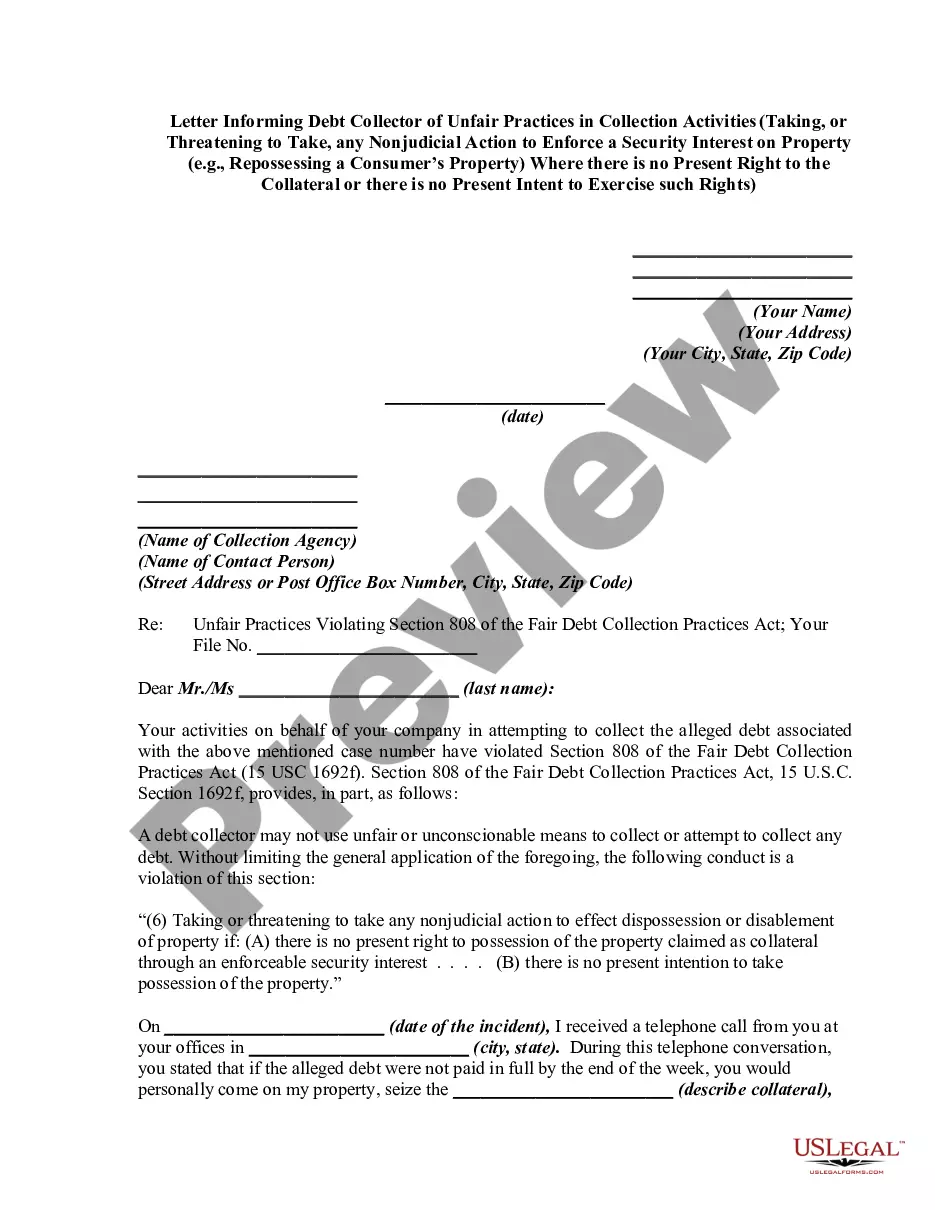
Alaska Letter Informing Debt Collector of Unfair Practices in Collection Activities - Taking, or Threatening to Take, any Nonjudicial Action Where there is no Present Right or Intent to Exercise such Rights

Alaska Letter Informing Debt Collector of Unfair Practices in Collection Activities - Taking, or Threatening to Take, any Nonjudicial Action Where there is no Present Right or Intent to Exercise such Rights

View this form
form-preview
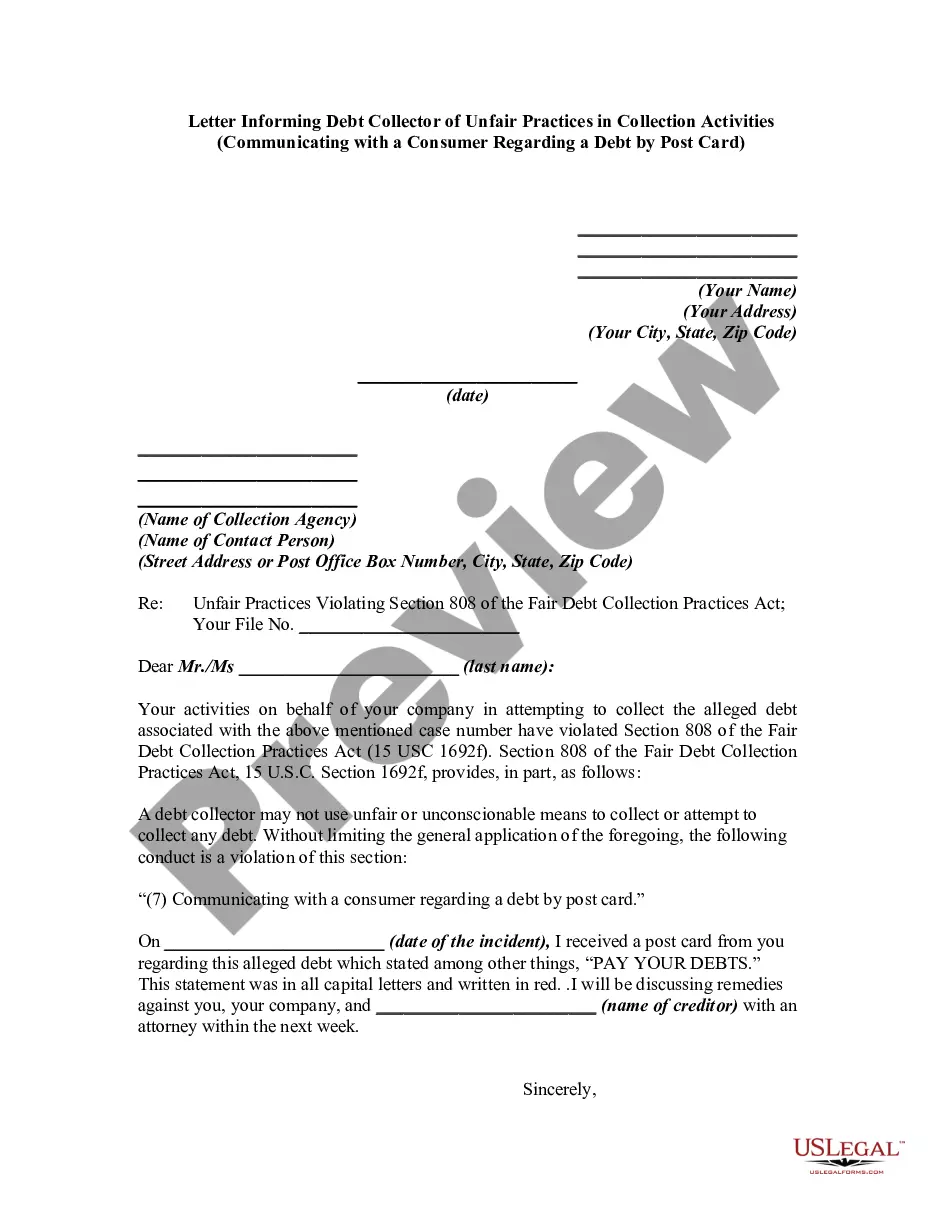
Alaska Letter Informing Debt Collector of Unfair Practices in Collection Activities - Communicating with a Consumer Regarding a Debt by Post Card

Alaska Letter Informing Debt Collector of Unfair Practices in Collection Activities - Communicating with a Consumer Regarding a Debt by Post Card

View this form
form-preview
Alaska Notice to Debt Collector - Collecting an Amount Not Authorized by Agreement or by Law

Alaska Notice to Debt Collector - Collecting an Amount Not Authorized by Agreement or by Law

View this form

How to fill out Letter Informing Debt Collector Of Unfair Practices In Collection Activities - Collecting An Amount Not Authorized By The Agreement Creating The Debt Or By Law?

Selecting the ideal legal document template can be a challenge.

Clearly, there are numerous designs accessible online, but how do you locate the specific legal form you require.

Utilize the US Legal Forms website. The service offers thousands of templates, such as the Alaska Letter Informing Debt Collector of Unfair Practices in Collection Activities - Collecting an Amount not Authorized by the Agreement Creating the Debt or by Law, that you can utilize for both business and personal purposes.

First, ensure you have selected the appropriate form for your specific city/region. You can review the form using the Preview button and examine the form description to confirm it fits your requirements.

  1. All forms are reviewed by professionals and comply with state and federal regulations.
  2. If you already have an account, Log In and then click the Download button to locate the Alaska Letter Informing Debt Collector of Unfair Practices in Collection Activities - Collecting an Amount not Authorized by the Agreement Creating the Debt or by Law.
  3. Use your account to browse the legal forms you have previously purchased.
  4. Go to the My documents tab in your account to obtain an additional copy of the document you need.
  5. If you are a new user of US Legal Forms, here are simple instructions you should follow.

Form popularity

FAQ

Debt collectors cannot harass or abuse you. They cannot swear, threaten to illegally harm you or your property, threaten you with illegal actions, or falsely threaten you with actions they do not intend to take. They also cannot make repeated calls over a short period to annoy or harass you.

Debts that may not be covered are those that are not incurred voluntarily, such as income taxes, parking and speeding tickets, and domestic support obligations like child support and alimony, or spousal support.

The Fair Debt Collection Practices Act (FDCPA) The FDCPA prohibits debt collection companies from using abusive, unfair or deceptive practices to collect debts from you.

Your credit card debt, auto loans, medical bills, student loans, mortgage, and other household debts are covered under the FDCPA.

The debt dispute letter should include your personal identifying information; verification of the amount of debt owed; the name of the creditor for the debt; and a request the debt not be reported to credit reporting agencies until the matter is resolved or have it removed from the report, if it already has been

Debt collectors must be truthful The Fair Debt Collection Practices Act states that debt collectors cannot use any false, deceptive or misleading representation to collect the debt. Along with other restrictions, debt collectors cannot misrepresent: The amount of the debt. Whether it's past the statute of limitations.

Among the insider tips, Ulzheimer shared with the audience was this: if you are being pursued by debt collectors, you can stop them from calling you ever again by telling them '11-word phrase'. This simple idea was later advertised as an '11-word phrase to stop debt collectors'.

The FDCPA broadly prohibits a debt collector from using 'any false, deceptive, or misleading representation or means in connection with the collection of any debt. ' 15 U.S.C. § 1692e. The statute enumerates several examples of such practices, 15 U.S.C.

If the FDCPA is violated, the debtor can sue the debt collection company as well as the individual debt collector for damages and attorney fees.

7 Most Common FDCPA ViolationsContinued attempts to collect debt not owed.Illegal or unethical communication tactics.Disclosure verification of debt.Taking or threatening illegal action.False statements or false representation.Improper contact or sharing of info.Excessive phone calls.

Trusted and secure by over 3 million people of the world’s leading companies

Alaska Letter Informing Debt Collector of Unfair Practices in Collection Activities - Collecting an Amount not Authorized by the Agreement Creating the Debt or by Law