Wisconsin Life Estate With Remainder
Description

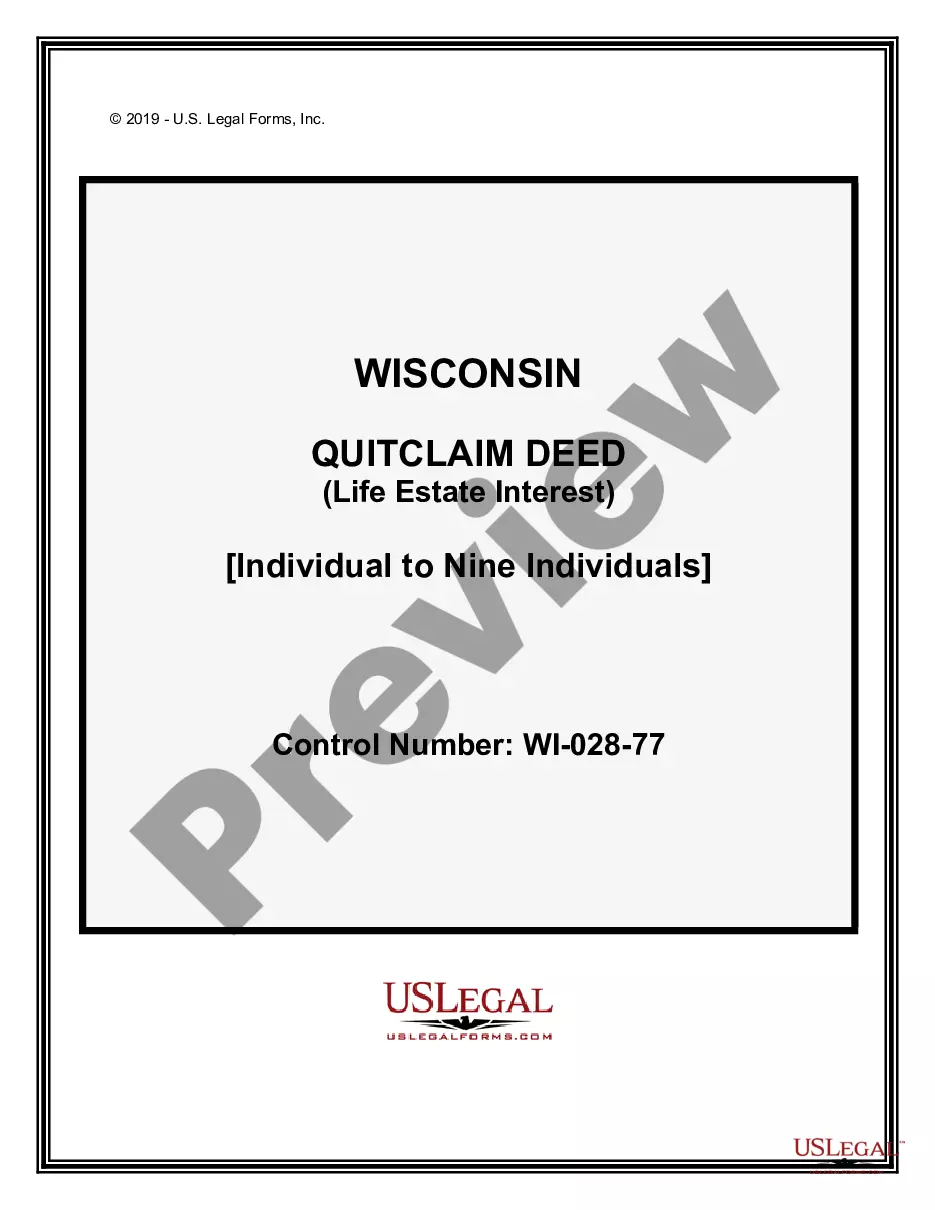
Get your form ready online
Our built-in tools help you complete, sign, share, and store your documents in one place.
Make edits, fill in missing information, and update formatting in US Legal Forms—just like you would in MS Word.
Download a copy, print it, send it by email, or mail it via USPS—whatever works best for your next step.
Sign and collect signatures with our SignNow integration. Send to multiple recipients, set reminders, and more. Go Premium to unlock E-Sign.
If this form requires notarization, complete it online through a secure video call—no need to meet a notary in person or wait for an appointment.
We protect your documents and personal data by following strict security and privacy standards.

Make edits, fill in missing information, and update formatting in US Legal Forms—just like you would in MS Word.

Download a copy, print it, send it by email, or mail it via USPS—whatever works best for your next step.

Sign and collect signatures with our SignNow integration. Send to multiple recipients, set reminders, and more. Go Premium to unlock E-Sign.

If this form requires notarization, complete it online through a secure video call—no need to meet a notary in person or wait for an appointment.

We protect your documents and personal data by following strict security and privacy standards.
Looking for another form?
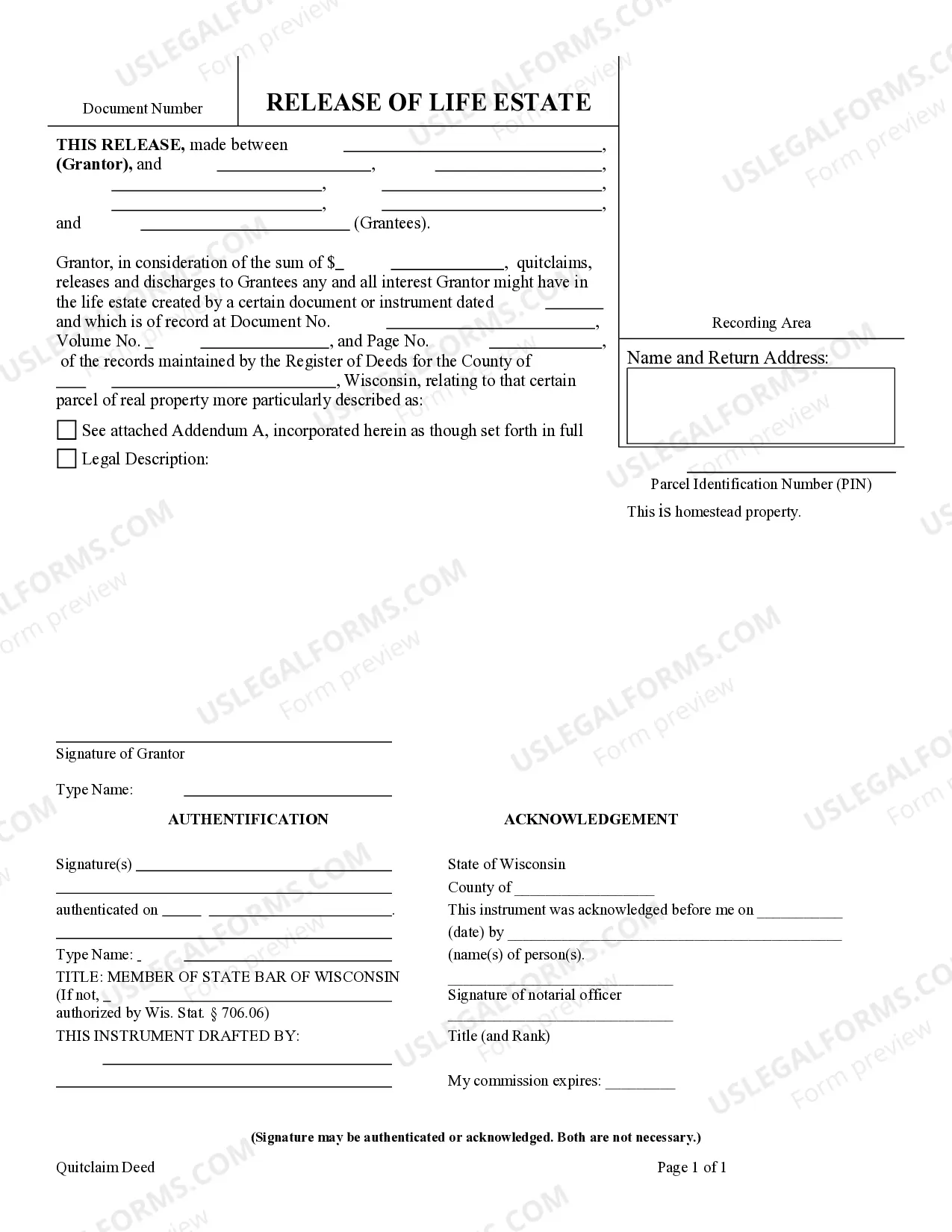
How to fill out Wisconsin Release Deed - Life Estate - Individual To Nine Individuals?
Managing legal documents can be daunting, even for the most experienced professionals.
When you seek a Wisconsin Life Estate With Remainder and lack the time to search for the accurate and current version, the process can be overwhelming.
Access legal and business documentation specific to your state or county. US Legal Forms meets any needs you might have, from personal to commercial paperwork, all in one convenient location.
Employ sophisticated tools to prepare and manage your Wisconsin Life Estate With Remainder.
Below are the steps to follow after accessing the required form: Validate that it is the correct document by previewing it and reading its description.
- Tap into a valuable resource library of articles, guides, and manuals relevant to your situation and requirements.
- Conserve time and energy searching for the documents you require, and utilize US Legal Forms' enhanced search and Review feature to locate and obtain Wisconsin Life Estate With Remainder.
- If you possess a subscription, Log In to your US Legal Forms account, locate the form, and retrieve it.
- Check the My documents tab to review the documents you've previously saved and manage your folders as you see fit.
- If this is your first time using US Legal Forms, create a complimentary account and gain unlimited access to all the platform's advantages.
- Utilize a comprehensive online form library that could revolutionize the way anyone addresses these scenarios successfully.
- US Legal Forms excels in providing online legal documents, featuring over 85,000 state-specific forms accessible at any moment.
- With US Legal Forms, you can.
Form popularity
FAQ
The FMV of the life estate is determined using the age of the life estate holder on the date that the life estate was created and the property's FMV on that date. Multiply the FMV by the life estate multiplier on the Life Estate and Remainder Interest Table (see Section 39.1 Life Estate and Remainder Interest). 10-02 Version of 17.10 Life Estates - Wisconsin.gov Wisconsin (.gov) ? history ? 1... Wisconsin (.gov) ? history ? 1...
For the life estate interest, multiply the figure in the life estate column for the individual's age by the equity value of the property. 3. For the remainder interest, multiply the figure in the remainder interest column for the individual's age by the equity value of the property. Life Estate and Remainder Interest Tables myflfamilies.com ? sites ? default ? files myflfamilies.com ? sites ? default ? files
A remainder is a future interest in land. It is the right to own and possess the land after the fixed interest of current holder expires. Thus, a remainder can follow a life estate or a term of years. It is created by the use of the phrase "then to" or similar language.
Almost all deeds creating a life estate will also name a remainderman?the person or persons who get the property when the life tenant dies. Life estates are often used to provide for another person's well-being, without granting ownership of the relevant property. What Is a Remainderman? Definition, How It Works, and Examples investopedia.com ? terms ? remainderman investopedia.com ? terms ? remainderman
For example, A grants her brother B the property deed for life, and upon B's death, the land deed to C, B's son, or C's offspring if he does not live. C holds a remainder, and his offspring will inherit a "contingent remainder" if C dies before the title passes. remainder (property law) | Wex | US Law | LII / Legal Information Institute cornell.edu ? wex ? remainder_(propert... cornell.edu ? wex ? remainder_(propert...