Legal Property Info For The Future
Description


Get your form ready online
Our built-in tools help you complete, sign, share, and store your documents in one place.
Make edits, fill in missing information, and update formatting in US Legal Forms—just like you would in MS Word.
Download a copy, print it, send it by email, or mail it via USPS—whatever works best for your next step.
Sign and collect signatures with our SignNow integration. Send to multiple recipients, set reminders, and more. Go Premium to unlock E-Sign.
If this form requires notarization, complete it online through a secure video call—no need to meet a notary in person or wait for an appointment.
We protect your documents and personal data by following strict security and privacy standards.

Make edits, fill in missing information, and update formatting in US Legal Forms—just like you would in MS Word.

Download a copy, print it, send it by email, or mail it via USPS—whatever works best for your next step.

Sign and collect signatures with our SignNow integration. Send to multiple recipients, set reminders, and more. Go Premium to unlock E-Sign.

If this form requires notarization, complete it online through a secure video call—no need to meet a notary in person or wait for an appointment.

We protect your documents and personal data by following strict security and privacy standards.
Looking for another form?


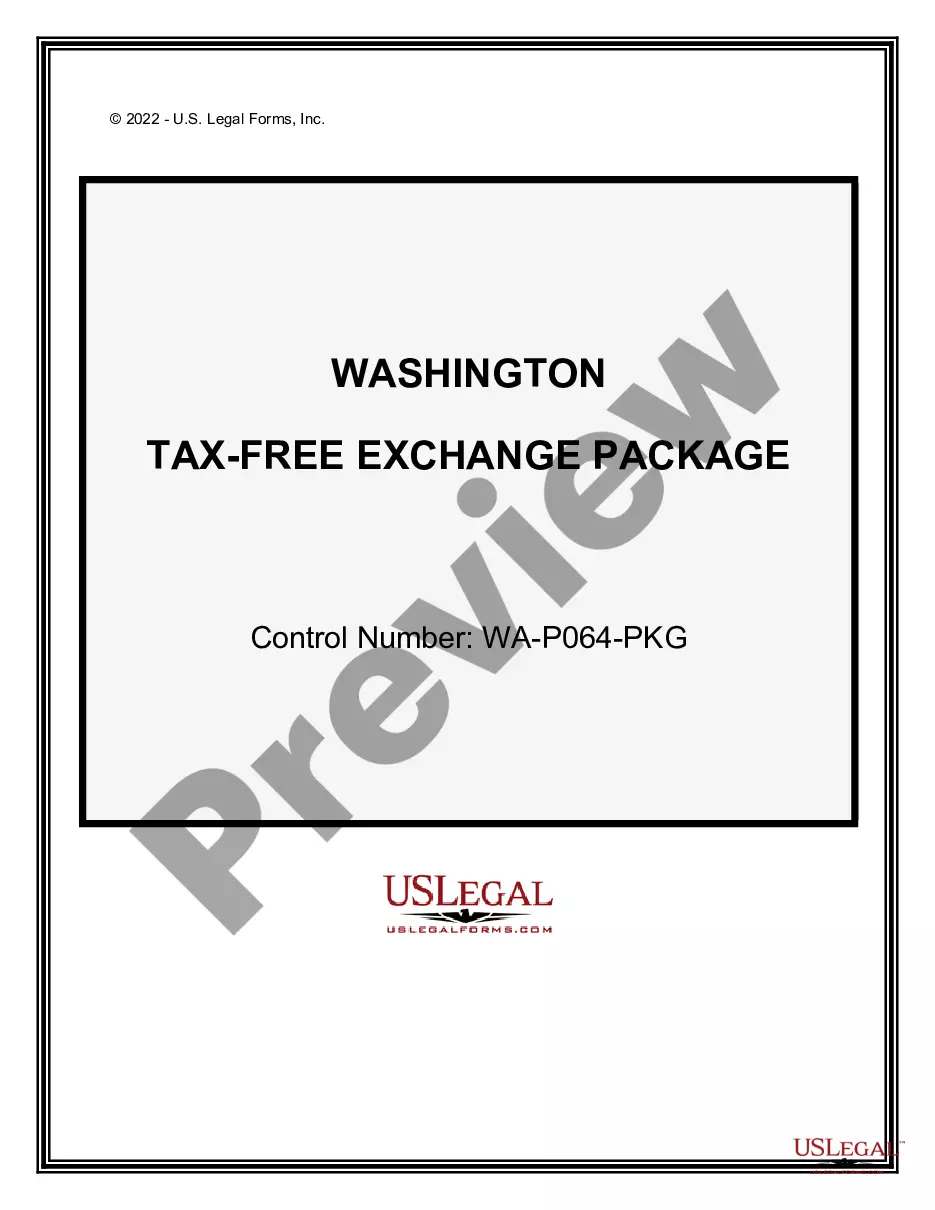
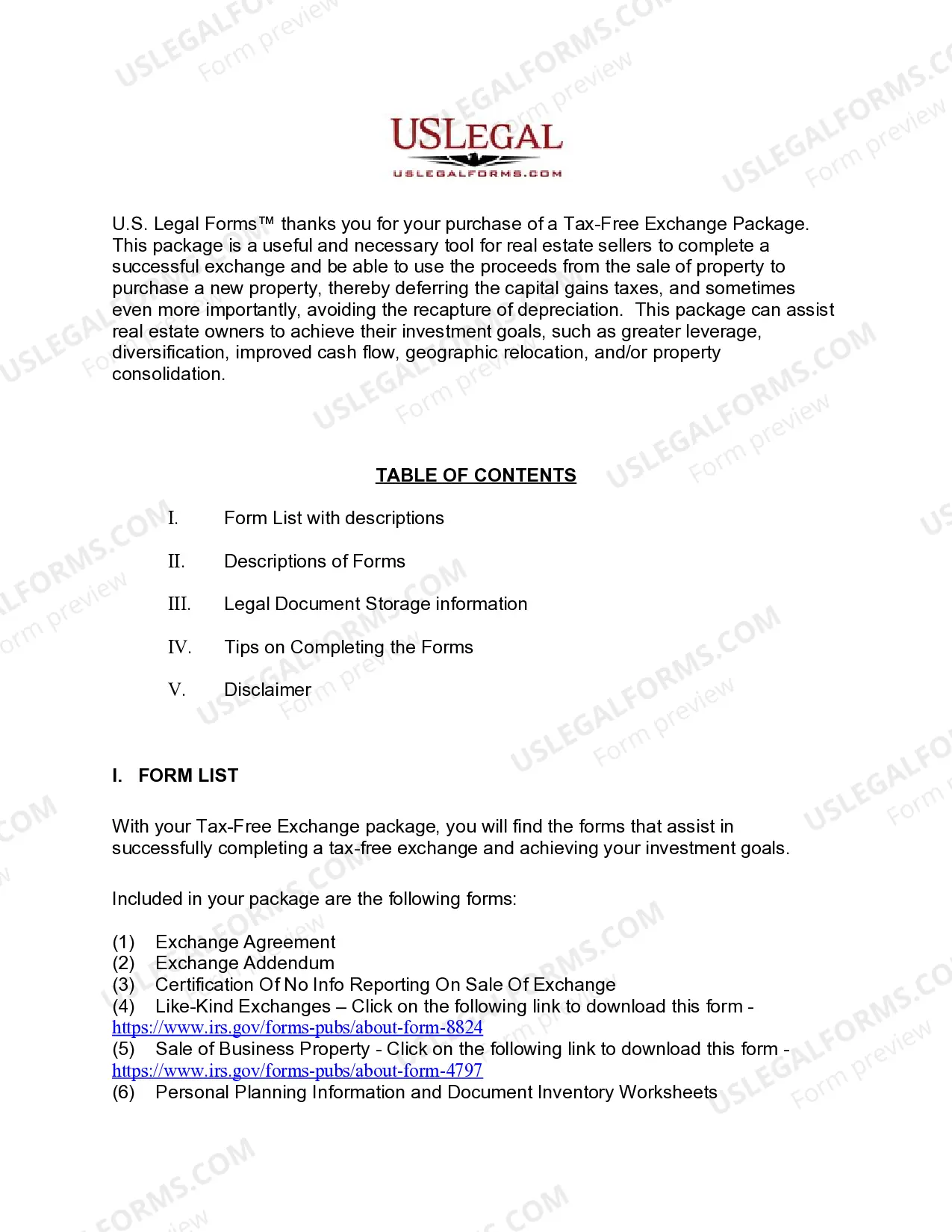
How to fill out Washington Tax Free Exchange Package?
- Log in to your account to access your previously purchased templates. Ensure your subscription is active to download the forms directly.
- If you're new to our service, start by examining the available forms. Use the Preview mode to verify that your selected template meets your specific requirements and complies with local laws.
- Search for alternative templates if the initial choice isn't perfect. Use the Search feature to locate other forms that suit your needs.
- Proceed to purchase the chosen document by clicking the Buy Now button. Select a subscription plan that best fits your needs and create an account for full access.
- Complete your transaction using your credit card or PayPal. This will grant you access to our expansive library of legal forms.
- Download the form to your device. This will enable you to fill out the template at your convenience, and you'll also find it in the My Forms section of your account for future reference.
By utilizing US Legal Forms, you can streamline your access to critical legal documents and receive the support of premium experts ensuring that your forms are accurate and legally sound.
Take control of your legal needs today by signing up for US Legal Forms and explore our extensive library to secure your legal property info for the future!
Form popularity
FAQ
The very best proof of property ownership remains the original deed, which is recorded legally with local authorities. A copy of the title insurance policy can also be substantial evidence, as it verifies your rights to the property. In summary, for straightforward legal property info for the future, maintain these documents diligently.
A legal document that proves ownership of a property is called a deed. This document contains vital information about the property and identifies the owner. For anyone looking for solid legal property info for the future, keeping the deed secure is essential.
The document that outlines how you will list your property is usually referred to as a listing agreement. This contract specifies the terms of the sale and the responsibilities of both the seller and the real estate agent. Having detailed legal property info for the future helps ensure all parties understand the listing process and their roles.
The best proof of property ownership is typically the original deed, as it provides a concrete record of transfer. In circumstances where the deed is not available, a title report or title insurance policy may also serve as reliable proof. With a focus on legal property info for the future, make sure these documents are securely stored for easy access.
To create a legal description of your property, you should define the boundaries and dimensions accurately, often referencing survey sketches or plat maps. This includes specifying the lot number, block, and subdivision, if applicable. Proper legal property info for the future ensures that your description is clear and can be easily understood in any legal context.
In real estate, both title and deed serve important roles, but they fulfill different purposes. The title is the legal concept of ownership, while the deed is the physical document that transfers property ownership. Understanding this distinction is crucial for anyone seeking legal property info for the future.
The best way to show proof of ownership is to provide a copy of your property deed, as it serves as the official record of your ownership. Additionally, you can use property tax records or title insurance documents for further verification. By having this legal property info for the future, you can clearly demonstrate your rightful ownership to any interested parties.
You can obtain the legal description of a property by requesting it from your local government office, such as the county clerk or recorder's office. Additionally, real estate platforms and services like uslegalforms can provide simplified access to legal property info for the future, including descriptions. By leveraging these resources, you can easily get the information you need.
To find the full legal description of a property, start by visiting your local county's tax assessor or recorder’s office. Many of these offices provide access to legal property info for the future in their public records. You can also search property databases online or consult a real estate agent for assistance.
A property legal description might read as follows: 'Lot 5, Block 2, Sunshine Estates, according to the plat recorded in the Clerk’s Office of County, State.' Such descriptions provide clear and specific legal property info for the future. It is important to use precise language so that there is no ambiguity in ownership and boundaries.