Vermont Failure Reasonable For Termination
Description


Get your form ready online
Our built-in tools help you complete, sign, share, and store your documents in one place.
Make edits, fill in missing information, and update formatting in US Legal Forms—just like you would in MS Word.
Download a copy, print it, send it by email, or mail it via USPS—whatever works best for your next step.
Sign and collect signatures with our SignNow integration. Send to multiple recipients, set reminders, and more. Go Premium to unlock E-Sign.
If this form requires notarization, complete it online through a secure video call—no need to meet a notary in person or wait for an appointment.
We protect your documents and personal data by following strict security and privacy standards.

Make edits, fill in missing information, and update formatting in US Legal Forms—just like you would in MS Word.

Download a copy, print it, send it by email, or mail it via USPS—whatever works best for your next step.

Sign and collect signatures with our SignNow integration. Send to multiple recipients, set reminders, and more. Go Premium to unlock E-Sign.

If this form requires notarization, complete it online through a secure video call—no need to meet a notary in person or wait for an appointment.

We protect your documents and personal data by following strict security and privacy standards.
Looking for another form?


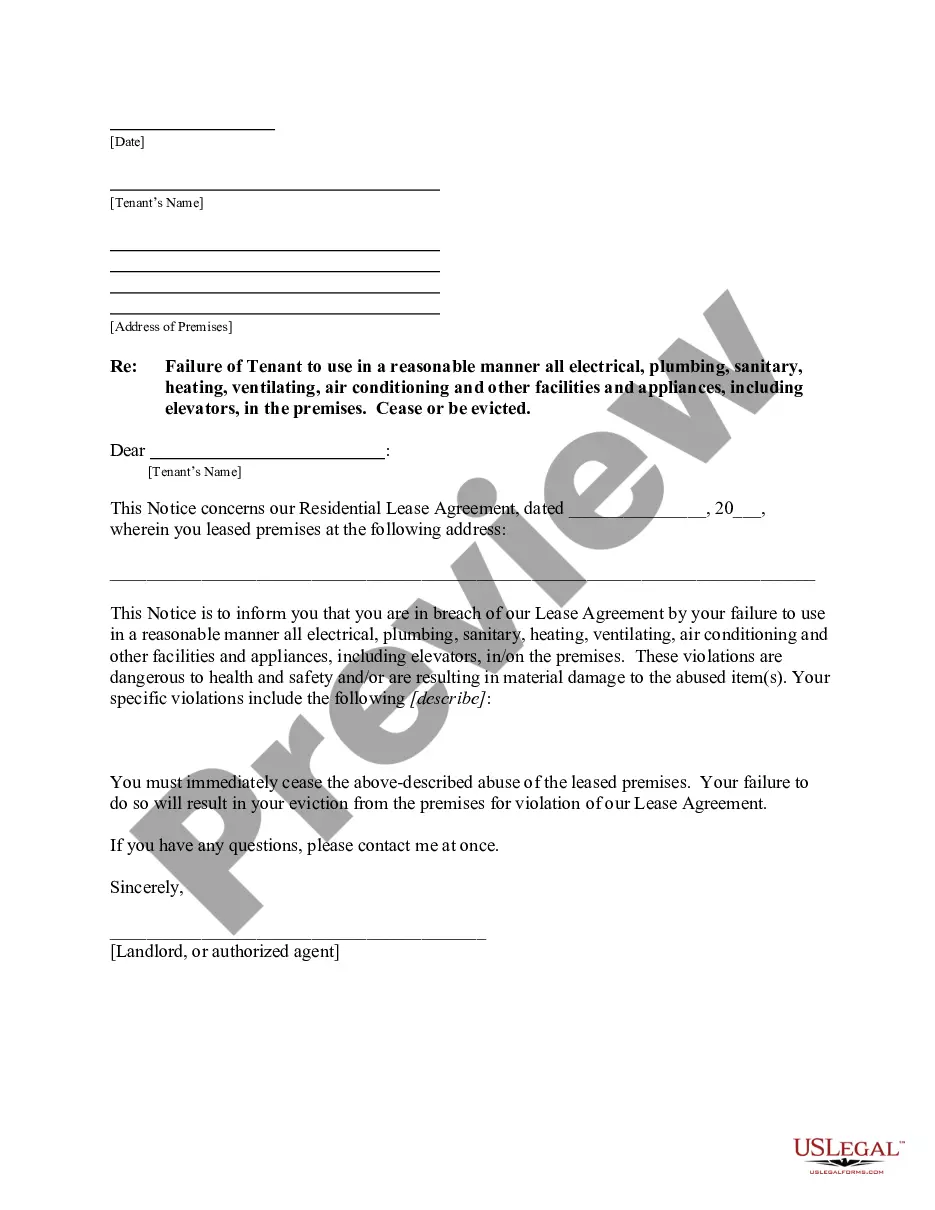
How to fill out Vermont Letter From Landlord To Tenant For Failure To Use Electrical, Plumbing, Sanitary, Heating, Ventilating, Air Conditioning And Other Facilities In A Reasonable Manner?
- Start by visiting the US Legal Forms website and log in to your account if you're an existing user. Ensure your subscription remains active to avoid interruptions.
- For first-time users, explore the preview mode and form descriptions thoroughly to ensure that you select the correct document that meets your state-specific requirements.
- If you don’t find what you need, utilize the search function to locate alternate templates that better fit your needs.
- Once you identify the right document, click 'Buy Now' to choose your preferred subscription plan. You'll need to create an account to gain full library access.
- Complete your purchase using a credit card or PayPal to confirm your subscription.
- Finally, download the form to your device, and access it anytime from the 'My Forms' section within your profile.
US Legal Forms empowers users with a robust collection of legal documents, boasting over 85,000 easily fillable templates. Their service not only simplifies legal processes but also provides access to expert assistance for document completion, ensuring legality and accuracy.
Don’t let legal complexities overwhelm you. Visit US Legal Forms and take advantage of their extensive resources today!
Form popularity
FAQ
Responding to an unfair termination involves several steps. First, clearly articulate your reasons for believing your termination was unjust and gather all supporting documentation. Next, consider contacting your employer to discuss the situation informally. If needed, US Legal Forms can assist you in drafting a formal letter or legal documents to express your concerns effectively.
To fight unfair termination, start by documenting everything related to your case. Gather evidence of your performance and any communications from your employer that may indicate an unjust firing. Consulting with an attorney familiar with Vermont labor laws can guide you through the complexities. Using US Legal Forms can also provide you access to the necessary documents and templates for your case.
Fighting against wrongful termination can be worth it, especially if you have a strong case. Not only can you receive compensation, but you may also enhance workplace policies against unfair practices. In Vermont, understanding the failure reasonable for termination can make a difference in your outcome. Assessing your situation with legal counsel can provide clarity on the potential benefits.
To prove wrongful termination in Vermont, you need to demonstrate that your employer did not have a valid reason to terminate your employment. Evidence such as emails, contracts, and any relevant correspondence can strengthen your case. If there is a pattern of behavior indicating discrimination or retaliation, that also supports your argument. US Legal Forms offers resources to assist you in collecting and presenting this information effectively.
Winning a wrongful termination case requires strong evidence that your firing was not justified. In Vermont, a failure reasonable for termination must be clearly established. You should gather documentation, such as performance reviews and witness statements, to support your claim. Utilizing a platform like US Legal Forms can help you navigate the process and find the necessary legal documents.
To write a statement for wrongful termination, first outline the events leading to your dismissal. Clearly mention the reasons provided by your employer for termination and explain why you believe those reasons do not constitute 'Vermont failure reasonable for termination.' Include any supporting evidence, such as emails or performance reviews. Lastly, be sure to express your feelings about the termination and your desired outcome, which could include reinstatement or compensation.
The 3 month termination clause is a provision that requires parties to provide a 3-month notice before terminating an agreement. This allows ample time for both sides to prepare for the change, minimizing disruption. Understanding Vermont failure reasonable for termination is vital when navigating this clause, as it outlines the protocol for ending a contract amicably. With the right guidance, such as from USLegalForms, you can craft effective agreements that align with your needs.
A typical termination clause specifies the conditions under which either party can end a contract. It usually includes notice periods, grounds for termination, and any required procedures. When discussing Vermont failure reasonable for termination, these clauses help safeguard the interests of both the employer and employee. Including a well-defined termination clause promotes transparency and reduces potential disputes.
A good reason termination clause outlines valid reasons for ending an employment contract. This ensures both parties have clear expectations and protections against sudden termination. When considering Vermont failure reasonable for termination, a good reason clause provides essential context for both employer and employee. By defining acceptable grounds, it reduces confusion and encourages fairness in employment practices.
Reasonable cause termination refers to dismissing an employee based on legitimate reasons, rather than arbitrary or discriminatory factors. In Vermont, this means that employers must have sufficient evidence or justifiable grounds before terminating an employee. Adhering to these standards can help organizations avoid wrongful termination claims and legal disputes.