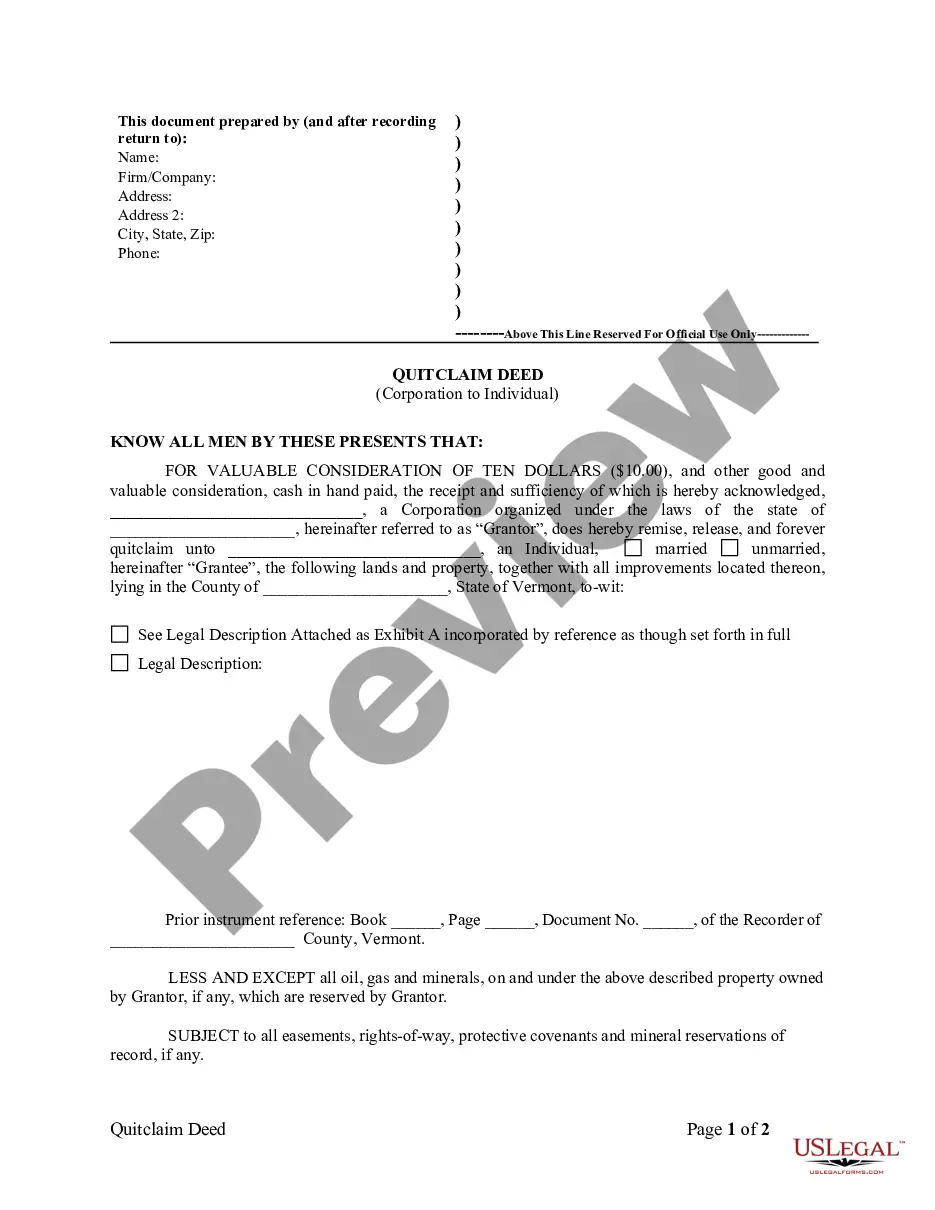
Quit Claim Deed Vermont With Multiple Grantees
Description

Get your form ready online
Our built-in tools help you complete, sign, share, and store your documents in one place.
Make edits, fill in missing information, and update formatting in US Legal Forms—just like you would in MS Word.
Download a copy, print it, send it by email, or mail it via USPS—whatever works best for your next step.
Sign and collect signatures with our SignNow integration. Send to multiple recipients, set reminders, and more. Go Premium to unlock E-Sign.
If this form requires notarization, complete it online through a secure video call—no need to meet a notary in person or wait for an appointment.
We protect your documents and personal data by following strict security and privacy standards.

Make edits, fill in missing information, and update formatting in US Legal Forms—just like you would in MS Word.

Download a copy, print it, send it by email, or mail it via USPS—whatever works best for your next step.

Sign and collect signatures with our SignNow integration. Send to multiple recipients, set reminders, and more. Go Premium to unlock E-Sign.

If this form requires notarization, complete it online through a secure video call—no need to meet a notary in person or wait for an appointment.

We protect your documents and personal data by following strict security and privacy standards.
Looking for another form?






How to fill out Vermont Quitclaim Deed From Corporation To Individual?
Individuals generally link legal documents with complexities that only an expert can manage.
In some respects, this is accurate, as creating a Quit Claim Deed Vermont With Multiple Grantees necessitates significant knowledge of the subject matter, encompassing state and local laws.
However, with US Legal Forms, everything has become simpler: pre-prepared legal documents for any life and business circumstance pertinent to state regulations are compiled in a single online collection and are now readily accessible for everyone.
Establish an account or sign in to move on to the payment page. Make payment for your subscription through PayPal or with a credit card. Decide the format for your sample and click Download. Print your document or upload it to an online editor for quicker completion. All templates in our library are reusable: once bought, they remain saved in your profile, accessible whenever needed via the My documents tab. Discover all the advantages of utilizing the US Legal Forms platform. Enroll today!
- US Legal Forms provides over 85,000 current forms categorized by state and area of application, allowing you to search for Quit Claim Deed Vermont With Multiple Grantees or any other specific template in just minutes.
- Users previously registered with a valid subscription must Log In to their account to click Download and access the form.
- New users to the platform will first need to create an account and subscribe prior to saving any documentation.
- Here’s a simple guide to procure the Quit Claim Deed Vermont With Multiple Grantees.
- Scrutinize the page content thoroughly to ensure it meets your requirements.
- Review the form description or view it through the Preview option.
- If the previous sample does not meet your needs, search for another template using the Search bar above.
- Once you locate the suitable Quit Claim Deed Vermont With Multiple Grantees, click Buy Now.
- Choose a pricing plan that aligns with your needs and budget.
Form popularity
FAQ
A warranty deed in Vermont is a document that provides a guarantee from the seller to the buyer about the title's ownership. This type of deed assures that there are no liens or encumbrances on the property. For individuals dealing with multiple grantees, a quit claim deed in Vermont presents a less complicated alternative compared to a warranty deed, making it easier to manage shared ownership.
A quitclaim deed in Vermont is a legal document that transfers ownership of property without guaranteeing the title. It is typically used among family members or in situations where trust exists between parties. Also, it is vital for dealing with multiple grantees, allowing for shared ownership effectively. By using a quit claim deed Vermont with multiple grantees, you simplify the property transfer process for everyone involved.
The most common type of warranty deed is the general warranty deed. This deed fully guarantees the property title against any future claims. All owners, including those utilizing quit claim deed Vermont with multiple grantees, can have confidence in the property’s ownership status under this deed. However, it is often more complex than a quitclaim option.
To do a quitclaim deed in Vermont, start by obtaining a quit claim deed form from a legal website or your local clerk’s office. Fill in the necessary information about the property and the parties involved, and then have it signed by the grantor in front of a notary public. Once complete, file the quitclaim deed with the local town clerk to make the transfer official. By choosing a quit claim deed Vermont with multiple grantees, you can seamlessly include all parties in the deed.
Individuals who want to transfer property without the need for a title search often benefit from a quitclaim deed. This option is typically advantageous for family members or close relations, as it offers a straightforward transfer without guarantee of ownership. In situations involving multiple grantees, a quit claim deed Vermont with multiple grantees allows all parties to gain clear ownership while avoiding costly processes.
To transfer a deed in Vermont, the current owner must complete a quit claim deed form. This document must include details about the property and the parties involved. It needs to be signed and notarized before filing with the local town clerk's office. Utilizing a quit claim deed Vermont with multiple grantees simplifies this process, allowing for clear transfers among several parties.
Filling out a Quit Claim Deed to add someone to your home title requires accurate information. Start with identifying the current owners and the new grantee's details, then describe the property clearly. After completing the form, sign it in front of a notary. Utilizing a Quit Claim Deed in Vermont with multiple grantees simplifies the process of transferring ownership, making it a practical solution for many homeowners.
To add your spouse to a deed in South Carolina, you will need to execute a Quit Claim Deed. This process involves drafting the deed with your names, the property description, and having it notarized. Once completed, file the deed with the local county recorder's office. Using a Quit Claim Deed in Vermont with multiple grantees ensures that both you and your spouse are recognized as owners of the property.
In Vermont, a valid deed must include the full names of the grantor and grantee, a legal description of the property, and the signature of the grantor. Additionally, the deed should be notarized for authenticity and must comply with local recording laws. Consider using US Legal Forms to access templates and ensure that your quit claim deed in Vermont with multiple grantees meets all necessary requirements.
To file a quitclaim deed in Vermont, first complete the deed form, ensuring you include the names of all parties involved. Next, have the document notarized to verify the signatures. Once completed, submit the quitclaim deed to the town clerk's office in the municipality where the property is located. By following these steps, you can smoothly execute a quit claim deed in Vermont with multiple grantees.
