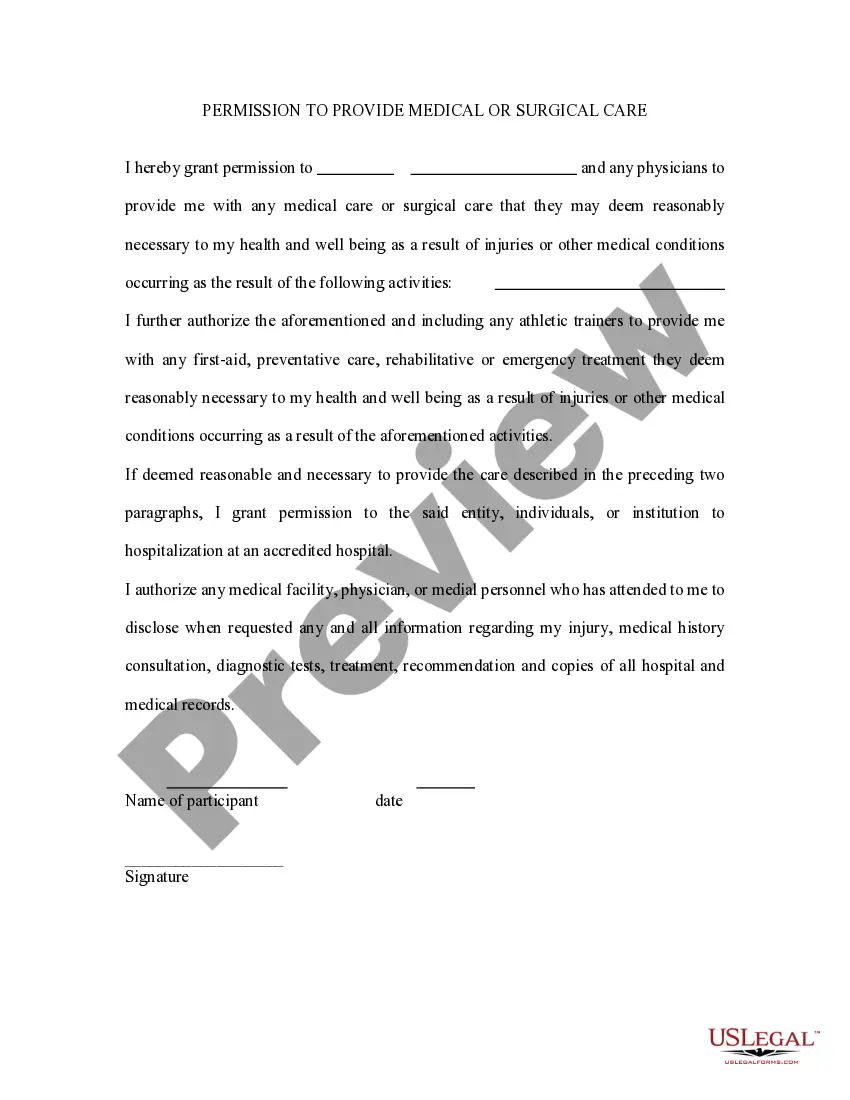
Medical Care Without Consent
Description
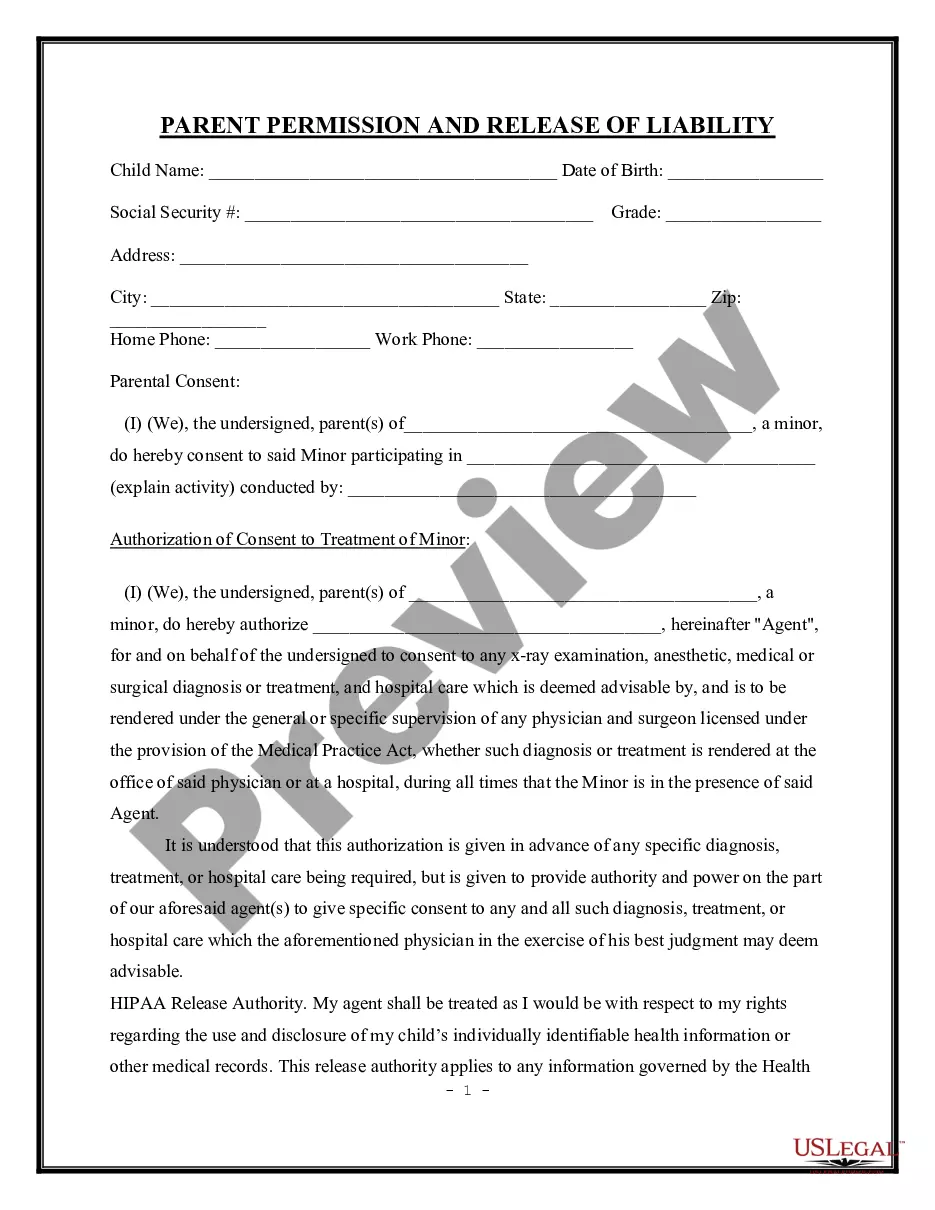
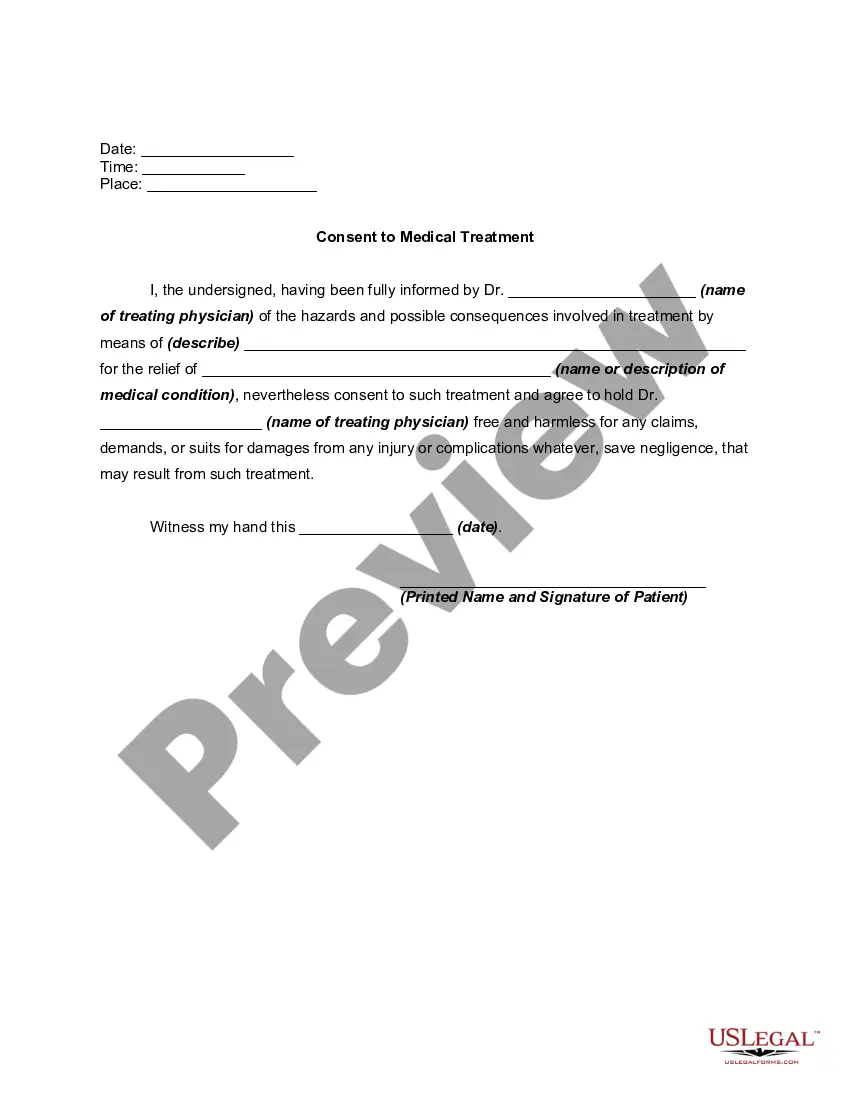



How to fill out Permission To Provide Medical Or Surgical Care?
Managing legal documents can be daunting, even for proficient professionals.
When searching for Medical Care Without Consent and lacking the time to invest in finding the appropriate and current version, the process can be taxing.
With US Legal Forms, you can.
Save time and energy searching for the required documents, and use US Legal Forms’ sophisticated search and Preview function to find Medical Care Without Consent and download it.
Leverage the US Legal Forms online catalog, backed by 25 years of expertise and trustworthiness. Transform your daily document management into a straightforward and user-friendly experience today.
- If you hold a subscription, Log In to your US Legal Forms account, search for the desired form, and download it.
- Visit the My documents section to review the documents you have previously saved and manage your folders as needed.
- If this is your first encounter with US Legal Forms, create an account for unlimited access to all platform benefits.
- After downloading the desired form, ensure it is the correct document by previewing it and reviewing its details.
- Confirm that the sample is recognized in your state or county.
- Click Buy Now when you are prepared.
- Select a monthly subscription plan.
- Choose your preferred format, and Download, complete, eSign, print, and submit your document.
- Utilize a robust online form directory that can transform the way you handle these circumstances positively.
- US Legal Forms is a frontrunner in the realm of online legal documents, boasting over 85,000 state-specific legal forms available at your convenience.
- Take advantage of a comprehensive library of articles, guides, and resources relevant to your situation and necessities.
Form popularity
FAQ
Valid consent requires that the individual is informed, voluntary, competent, and specific. The person must understand the risks and benefits of the medical care without consent being a factor. Each of these elements plays a vital role in ensuring that consent is meaningful and legally binding. For more information on consent forms and legal requirements, US Legal Forms offers resources that can assist you in this area.
In general, medical records cannot be released without consent. However, there are specific circumstances where this might occur, such as in emergencies or when required by law. Understanding your rights regarding medical care without consent is crucial. For guidance on navigating these situations, consider using US Legal Forms to access the necessary legal documents.
Treating a patient without consent can lead to serious legal repercussions for healthcare providers, including lawsuits for battery or malpractice. Additionally, it can damage the trust between patients and doctors, impacting future care. Understanding the implications of medical care without consent is vital for both patients and providers, and resources like uslegalforms can help clarify these legal issues.
There are several scenarios where a person may not legally provide consent, including being a minor, being incapacitated due to mental illness, being under the influence of drugs or alcohol, being unconscious, or being coerced. In these cases, medical care without consent may be necessary and legally justified. It's essential to know these situations to ensure that appropriate care is given.
Yes, you can receive certain types of medical treatment anonymously, particularly in cases involving mental health or reproductive health services. However, medical care without consent is generally not practiced in a way that allows for complete anonymity. Always discuss your privacy concerns with your healthcare provider to understand your options.
A doctor can treat a patient without consent in certain emergency situations, where the delay in treatment could lead to serious harm or death. This falls under the umbrella of medical care without consent, aimed at saving lives. However, in non-emergency cases, obtaining patient consent is a legal requirement and an ethical obligation.
Generally, a doctor cannot treat you without consent unless there is a compelling reason to do so, such as a medical emergency. In such cases, medical care without consent is allowed to protect the patient's health or life. It's important to understand your rights as a patient and to communicate openly with your healthcare provider regarding your treatment preferences.
Certain treatments may be administered without consent in specific circumstances, often dictated by law. For instance, emergency medical care can be provided if a patient is unable to give consent, such as in cases of unconsciousness. Additionally, medical care without consent may apply in situations involving minors or individuals with mental incapacities, where guardians may provide consent instead.
When a healthcare provider treats a patient without their consent, it is often referred to as 'medical care without consent.' This practice raises legal and ethical concerns, as patients have the right to make informed decisions about their own treatment. In some emergency situations, however, providers may act without consent to preserve life or prevent serious harm.
Yes, consent is a fundamental legal requirement in healthcare. Patients typically must provide informed consent before receiving medical care, ensuring they understand the risks and benefits of treatment. However, there are exceptional circumstances where medical care without consent may be permitted, such as in emergencies where a patient cannot give consent. Understanding these situations is crucial, and platforms like US Legal Forms can provide valuable resources and documents to help clarify the legal aspects of consent in healthcare.