Gross Up Clause In Commercial Lease
Description
Get your form ready online
Our built-in tools help you complete, sign, share, and store your documents in one place.
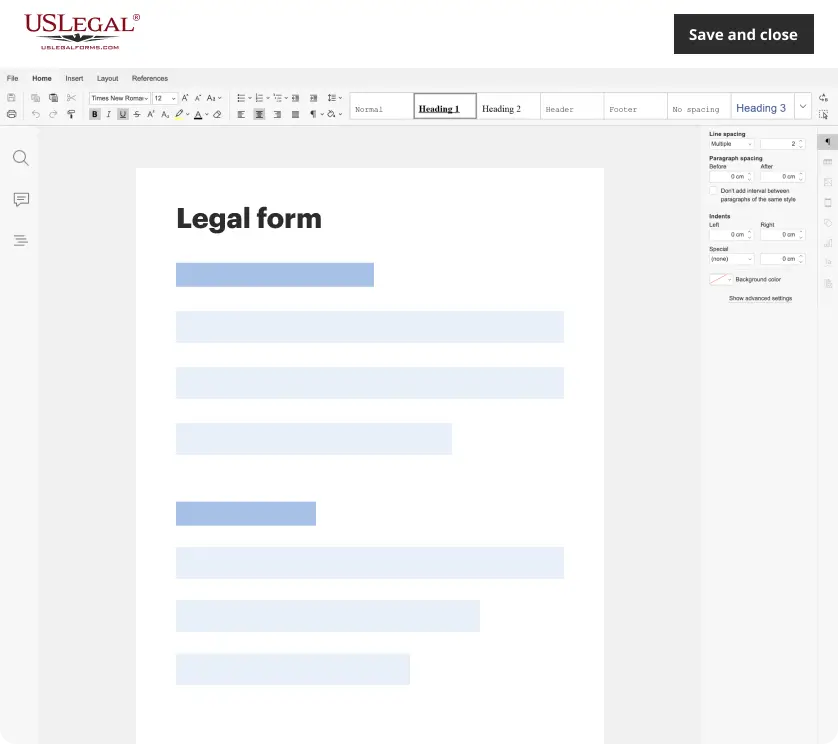
Make edits, fill in missing information, and update formatting in US Legal Forms—just like you would in MS Word.
Download a copy, print it, send it by email, or mail it via USPS—whatever works best for your next step.
Sign and collect signatures with our SignNow integration. Send to multiple recipients, set reminders, and more. Go Premium to unlock E-Sign.
If this form requires notarization, complete it online through a secure video call—no need to meet a notary in person or wait for an appointment.
We protect your documents and personal data by following strict security and privacy standards.
Make edits, fill in missing information, and update formatting in US Legal Forms—just like you would in MS Word.
Download a copy, print it, send it by email, or mail it via USPS—whatever works best for your next step.
Sign and collect signatures with our SignNow integration. Send to multiple recipients, set reminders, and more. Go Premium to unlock E-Sign.
If this form requires notarization, complete it online through a secure video call—no need to meet a notary in person or wait for an appointment.
We protect your documents and personal data by following strict security and privacy standards.
Looking for another form?
How to fill out Gross Up Clause That Should Be Used In A Base Year Lease?
When you need to finalize the Gross Up Clause in a Commercial Lease that adheres to your local state's statutes, there could be numerous options to choose from.
There's no need to examine each form to ensure it fulfills all the legal requirements if you are a subscriber to US Legal Forms.
It is a dependable service that can assist you in obtaining a reusable and current template on any topic.
Utilizing US Legal Forms simplifies obtaining well-prepared official documents. Additionally, Premium users can also take advantage of robust integrated features for online PDF editing and signing. Experience it today!
- US Legal Forms is the largest online repository with a compilation of over 85,000 ready-to-use documents for business and personal legal situations.
- All templates are confirmed to comply with the regulations of each state.
- Thus, when downloading the Gross Up Clause in a Commercial Lease from our site, you can be assured that you possess a valid and current document.
- Acquiring the required sample from our platform is remarkably straightforward.
- If you already hold an account, simply Log In to the system, ensure your subscription is active, and save the selected file.
- In the future, you can access the My documents tab in your profile and retrieve the Gross Up Clause in a Commercial Lease at any time.
- If this is your first interaction with our library, please adhere to the guidelines below.
- Review the suggested page and confirm it aligns with your needs.
Form popularity
FAQ
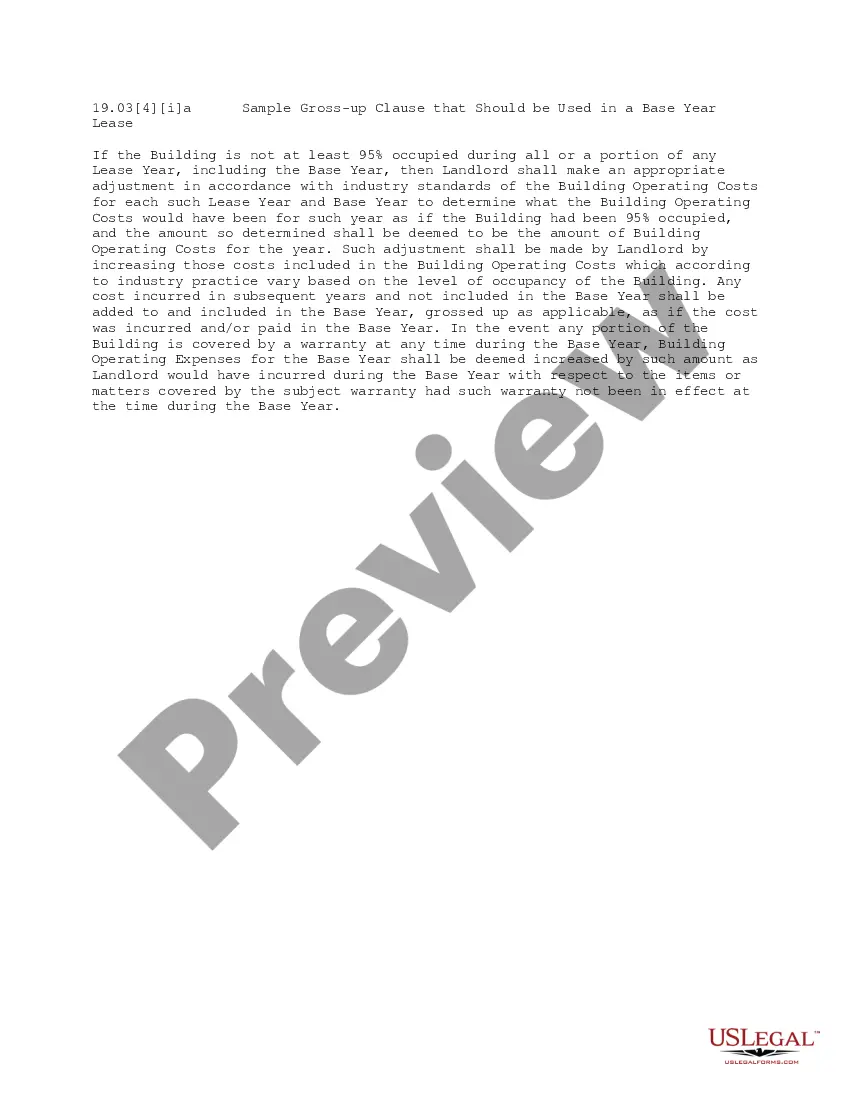
Many commercial leases, especially office leases, include a provision that allows landlords to gross up operating expenses. That is, if the building is not fully occupied, the landlord is empowered to gross up or overstate the expenses as if the building is fully occupied (or nearly full).
Gross-up is additional money an employer pays an employee to offset any additional income taxes (Social Security, Medicare, etc.) an employee would owe the IRS when that employee receives a company-provided cash benefit, such as relocation expenses. Gross-up is optional and is usually used for one-time payments.
How to Gross-Up a PaymentDetermine total tax rate by adding the federal and state tax percentages.Subtract the total tax percentage from 100 percent to get the net percentage.Divide desired net by the net tax percentage to get grossed up amount.More items...?
Correctly drafted, a gross up provision relates only to Operating Expenses that vary with occupancyso called variable expenses. Variable expenses are those expenses that will go up or down depending on the number of tenants in the Building, such as utilities, trash removal, management fees and janitorial services.
Simply stated, the concept of gross up provision stipulates that if a building has significant vacancy, the landlord can estimate what the variable operating expense would have been had the building been fully occupied, and charge the tenants their pro-rata share of that cost.