Jointly Owned Property And Inheritance Tax
Description
Get your form ready online
Our built-in tools help you complete, sign, share, and store your documents in one place.
Make edits, fill in missing information, and update formatting in US Legal Forms—just like you would in MS Word.
Download a copy, print it, send it by email, or mail it via USPS—whatever works best for your next step.
Sign and collect signatures with our SignNow integration. Send to multiple recipients, set reminders, and more. Go Premium to unlock E-Sign.
If this form requires notarization, complete it online through a secure video call—no need to meet a notary in person or wait for an appointment.
We protect your documents and personal data by following strict security and privacy standards.

Make edits, fill in missing information, and update formatting in US Legal Forms—just like you would in MS Word.

Download a copy, print it, send it by email, or mail it via USPS—whatever works best for your next step.

Sign and collect signatures with our SignNow integration. Send to multiple recipients, set reminders, and more. Go Premium to unlock E-Sign.

If this form requires notarization, complete it online through a secure video call—no need to meet a notary in person or wait for an appointment.

We protect your documents and personal data by following strict security and privacy standards.
Looking for another form?

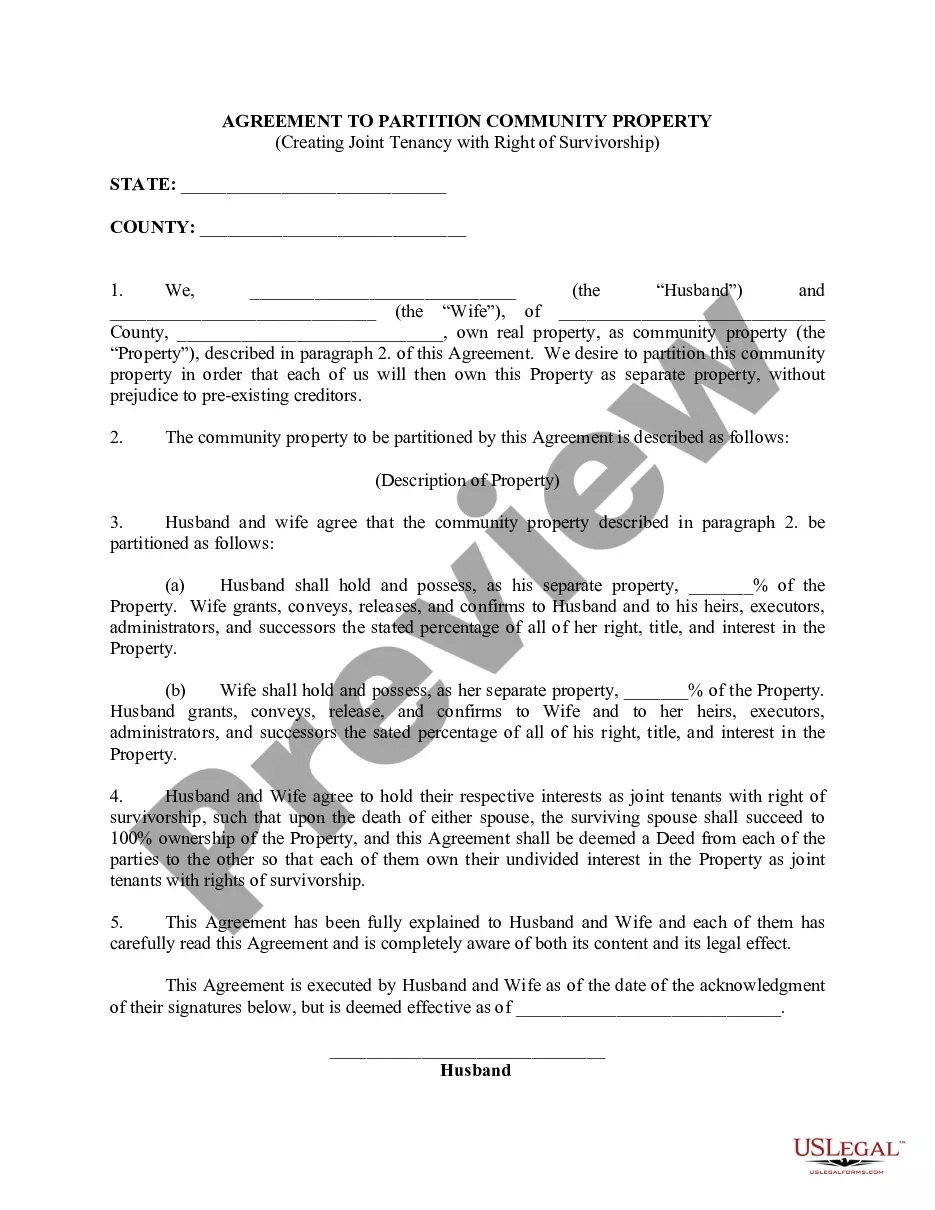
How to fill out Agreement To Partition Community Property Creating Joint Tenancy With Right Of Survivorship?
It’s clear that you cannot transform into a legal expert instantly, nor can you swiftly master how to prepare Jointly Owned Property And Inheritance Tax without possessing a specific skill set.
Generating legal documents is an extensive undertaking that demands a particular education and expertise. So why not entrust the creation of the Jointly Owned Property And Inheritance Tax to the specialists.
With US Legal Forms, which boasts one of the largest legal template collections, you can find everything from court documents to templates for internal communication. We recognize how crucial compliance and adherence to federal and state regulations are. That’s why, on our website, all templates are region-specific and current.
Click Buy now. Once the payment is completed, you can download the Jointly Owned Property And Inheritance Tax, fill it out, print it, and send or mail it to the relevant individuals or entities.
You can re-access your documents from the My documents section anytime. If you are a current client, you can simply Log In and find and download the template from the same section.
Regardless of the purpose of your documents—whether financial, legal, or personal—our platform has you covered. Experience US Legal Forms now!
- Initiate your experience with our platform and acquire the document you require in just minutes.
- Locate the document you seek using the search bar at the top of the webpage.
- Review it (if this feature is available) and examine the accompanying description to ascertain if Jointly Owned Property And Inheritance Tax is what you are looking for.
- Start your search anew if you require a different document.
- Sign up for a free account and select a subscription option to obtain the template.
Form popularity
FAQ
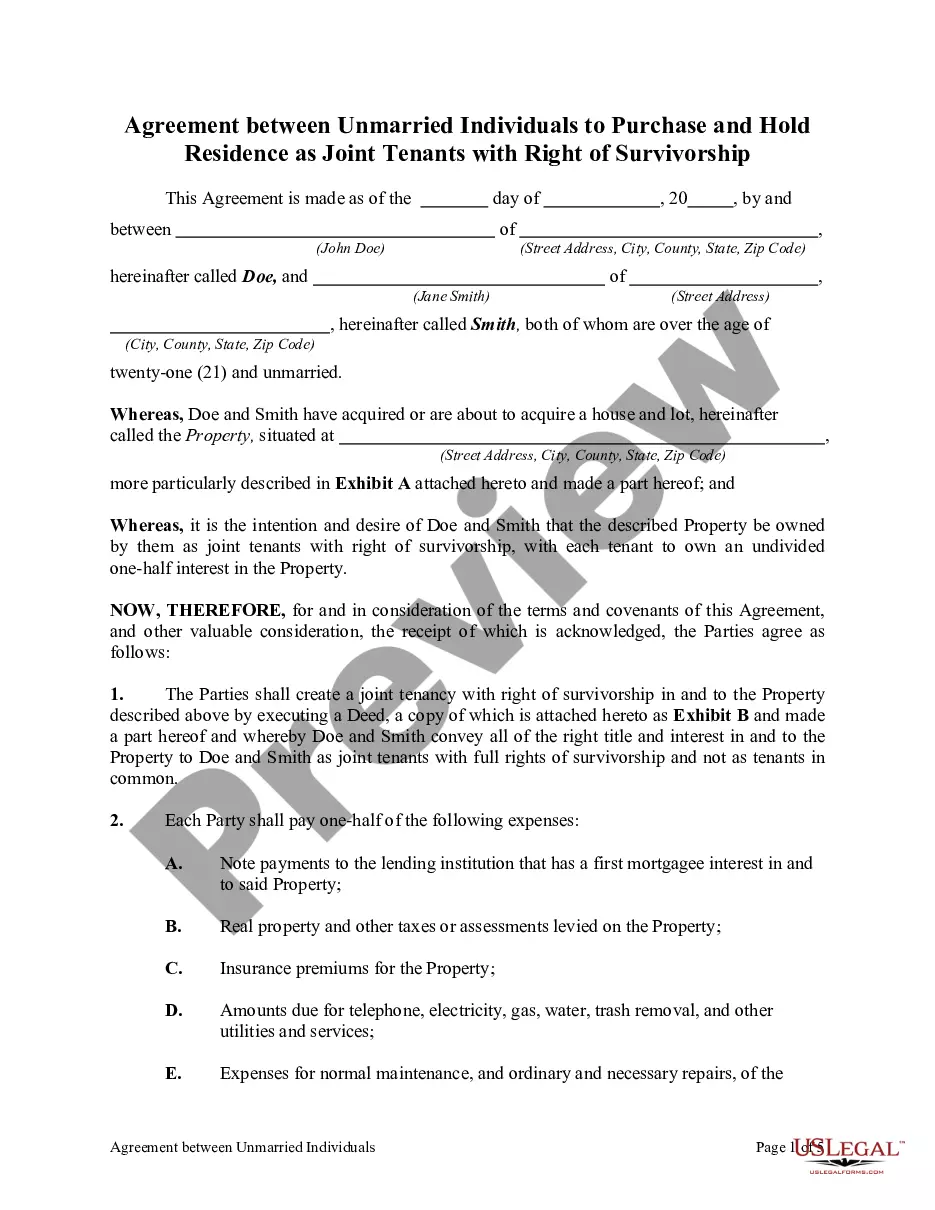
Co-ownership and joint ownership differ mainly in how the property is held and what happens upon an owner's death. In joint ownership, the surviving owners automatically inherit the deceased owner’s share, which can have implications for jointly owned property and inheritance tax. In co-ownership, each owner has a distinct share that may be passed to their heirs, allowing for more flexibility in estate management.
The entire value of jointly held property with the right of survivorship, including joint bank accounts and U.S. savings bonds registered in two names, is included in a decedent's gross estate except for the portion of the property for which the surviving joint tenant furnished consideration ( Code Sec. 2040).
Upon the death of one joint tenant, the title automatically passes to the survivor. Title insurance companies will require some formal procedure before recognizing the new owner. Two methods are followed: Filing an Affidavit of Death of Joint Tenant or obtaining a court decree of death of joint tenant.
For spouses: Assets in JTWROS accounts may get a step-up on cost basis when either spouse passes away. This can help reduce capital gains taxes when selling a property, but you can only step-up half of the full value of the asset. This 50% step-up represents the portion owned by the joint owner who died.
Step-Up in Basis for Joint Accounts This is common when married people own assets together. If a couple has a joint account and spouse A dies, half of the account deemed to belong to spouse A gets a step-up in basis.
Property owned jointly between husband and wife is exempt from inheritance tax, while property inherited from a spouse, or from a child aged 21 or younger by a parent, is taxed a rate of 0%. Inheritance tax returns are due nine calendar months after a person's death.