Payment Contract Schedule With Solids
Description

Get your form ready online
Our built-in tools help you complete, sign, share, and store your documents in one place.
Make edits, fill in missing information, and update formatting in US Legal Forms—just like you would in MS Word.
Download a copy, print it, send it by email, or mail it via USPS—whatever works best for your next step.
Sign and collect signatures with our SignNow integration. Send to multiple recipients, set reminders, and more. Go Premium to unlock E-Sign.
If this form requires notarization, complete it online through a secure video call—no need to meet a notary in person or wait for an appointment.
We protect your documents and personal data by following strict security and privacy standards.

Make edits, fill in missing information, and update formatting in US Legal Forms—just like you would in MS Word.

Download a copy, print it, send it by email, or mail it via USPS—whatever works best for your next step.

Sign and collect signatures with our SignNow integration. Send to multiple recipients, set reminders, and more. Go Premium to unlock E-Sign.

If this form requires notarization, complete it online through a secure video call—no need to meet a notary in person or wait for an appointment.

We protect your documents and personal data by following strict security and privacy standards.
Looking for another form?






How to fill out Self-Employed Independent Contractor Payment Schedule?
Whether for commercial reasons or for personal issues, everyone must confront legal circumstances at some point in their lives.
Completing legal documents requires meticulous focus, starting with choosing the correct form template.
Once downloaded, you have the option to fill out the form using editing software or print it and complete it by hand. With a comprehensive US Legal Forms archive available, you won’t need to waste time hunting for the correct template online. Take advantage of the library’s convenient navigation to find the right form for any circumstance.
- For example, if you select an incorrect version of a Payment Agreement Schedule With Solids, it will be rejected upon submission.
- Therefore, it's vital to have a trustworthy source for legal documents such as US Legal Forms.
- If you need to obtain a Payment Agreement Schedule With Solids template, follow these straightforward steps.
- Find the required template using the search bar or catalog browsing.
- Review the form’s details to ensure it aligns with your situation, state, and county.
- Click on the form’s preview to inspect it.
- If it is the incorrect document, return to the search feature to find the Payment Agreement Schedule With Solids sample you seek.
- Acquire the file once it satisfies your needs.
- If you own a US Legal Forms account, simply click Log in to access your previously saved documents in My documents.
- If you haven’t registered for an account yet, you can download the document by clicking Buy now.
- Choose the appropriate pricing option.
- Complete the account creation form.
- Select your payment method: a credit card or PayPal account.
- Choose the document format you prefer and download the Payment Agreement Schedule With Solids.
Form popularity
FAQ
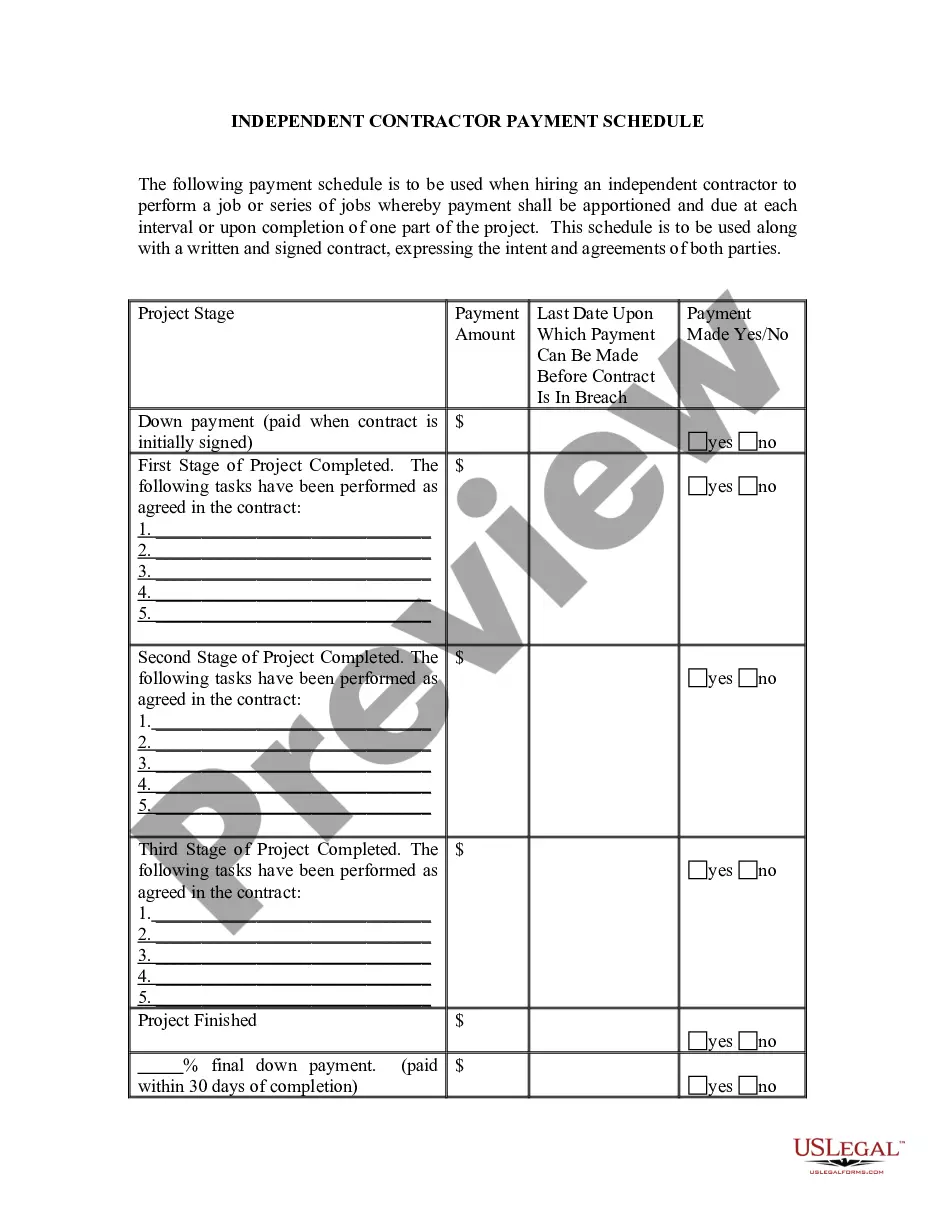
To make a scheduled payment, first, confirm that the project milestone has been achieved as per your agreement. Then, process the payment through the agreed method on the payment contract schedule with solids. This ensures transparency and keeps both parties aligned, fostering a trusting working relationship.
Creating a payment schedule starts by determining the overall budget and expected completion timeline. Next, outline specific payment milestones that align with project deliverables. Implementing a payment contract schedule with solids can simplify this process, ensuring you have a structured plan that meets all parties' needs.
Writing a payment schedule involves outlining the project scope, timelines, and payment amounts clearly. Each payment should be linked to specific deliverables to avoid confusion. Incorporating a payment contract schedule with solids ensures that both parties understand their responsibilities and that you have a legally binding agreement in place.
A typical payment schedule for a contractor often includes milestones based on project phases. These can include initial deposits, interim payments at completed stages, and a final payment upon project completion. Using a payment contract schedule with solids can clarify expectations and ensure timely payments, ultimately leading to a smoother project workflow.
Writing a contract for a payment plan involves detailing the payment terms clearly. Begin with the total amount owed, define the payment schedule, and state the consequences of late payments. It can be beneficial to use uslegalforms to create a payment contract schedule with solids that is both professional and legally sound, ensuring a mutually agreeable arrangement.
To write a payment schedule, begin by clearly defining the total payment amount and the timeline for payments. Next, outline each payment due date, the amount due, and any conditions for those payments. Using a structured template like those provided by uslegalforms can greatly simplify your payment contract schedule with solids. This clarity helps all parties understand their obligations.
The payment schedule outlines when payments are due from the client throughout the duration of the project. Generally speaking, these payments are made at pre-determined milestones such as after completion of certain phases or upon delivery of materials or other items necessary to complete the job.
The most common type of construction payment is a net payment, meaning the invoice is due a set amount of days from the issue date. For longer projects, it's typical to pay an upfront deposit and then to pay the contractor monthly until the job is finished.
A payment schedule must[2]: Identify the payment claim to which it relates; Indicate the amount of the payment that the respondent proposes to make; and. State the respondent's reasons for withholding payment.