Common Law Sample With Example
Description

Get your form ready online
Our built-in tools help you complete, sign, share, and store your documents in one place.
Make edits, fill in missing information, and update formatting in US Legal Forms—just like you would in MS Word.
Download a copy, print it, send it by email, or mail it via USPS—whatever works best for your next step.
Sign and collect signatures with our SignNow integration. Send to multiple recipients, set reminders, and more. Go Premium to unlock E-Sign.
If this form requires notarization, complete it online through a secure video call—no need to meet a notary in person or wait for an appointment.
We protect your documents and personal data by following strict security and privacy standards.

Make edits, fill in missing information, and update formatting in US Legal Forms—just like you would in MS Word.

Download a copy, print it, send it by email, or mail it via USPS—whatever works best for your next step.

Sign and collect signatures with our SignNow integration. Send to multiple recipients, set reminders, and more. Go Premium to unlock E-Sign.

If this form requires notarization, complete it online through a secure video call—no need to meet a notary in person or wait for an appointment.

We protect your documents and personal data by following strict security and privacy standards.
Looking for another form?
How to fill out USLegal Guide To Common Law Marriage?
Whether for commercial reasons or for personal matters, everyone must confront legal issues at some stage in their life.
Completing legal documents requires meticulous care, starting from selecting the correct form template.
Once it is saved, you can fill out the form using editing software or print it and complete it manually. With an extensive catalog from US Legal Forms, there's no need to waste time searching for the right template online. Utilize the library’s straightforward navigation to find the appropriate template for any circumstance.
- For instance, if you choose an incorrect version of a Common Law Sample With Example, it will be rejected once submitted.
- Thus, it is crucial to obtain a reliable source of legal documents like US Legal Forms.
- If you wish to acquire a Common Law Sample With Example template, follow these straightforward steps.
- Retrieve the template you require using the search feature or catalog navigation.
- Review the form’s details to ensure it is suitable for your circumstance, state, and locality.
- Click on the form’s preview to inspect it.
- If it is not the correct form, return to the search feature to locate the Common Law Sample With Example template you need.
- Obtain the template once it aligns with your specifications.
- If you have a US Legal Forms account, click Log in to access previously saved documents in My documents.
- If you don't possess an account yet, you can acquire the form by clicking Buy now.
- Select the appropriate pricing option.
- Complete the profile registration form.
- Choose your payment method: you can use a credit card or PayPal account.
- Select the desired file format and download the Common Law Sample With Example.
Form popularity
FAQ
IMM 5409 form tips First, ensure you meet the common-law criteria. Fill out the form, but don't sign or date it until you're in front of a public official. Do not leave any questions blank. Ensure all the details are correct. Use your complete legal names, exactly as they appear on your passports.
Property Deeds showing title to property held jointly by both parties in the common-law marriage. Bank statements and checks showing joint ownership of the accounts. Loan documents, leases, mortgages, and promissory notes that show joint financial obligations of the parties.
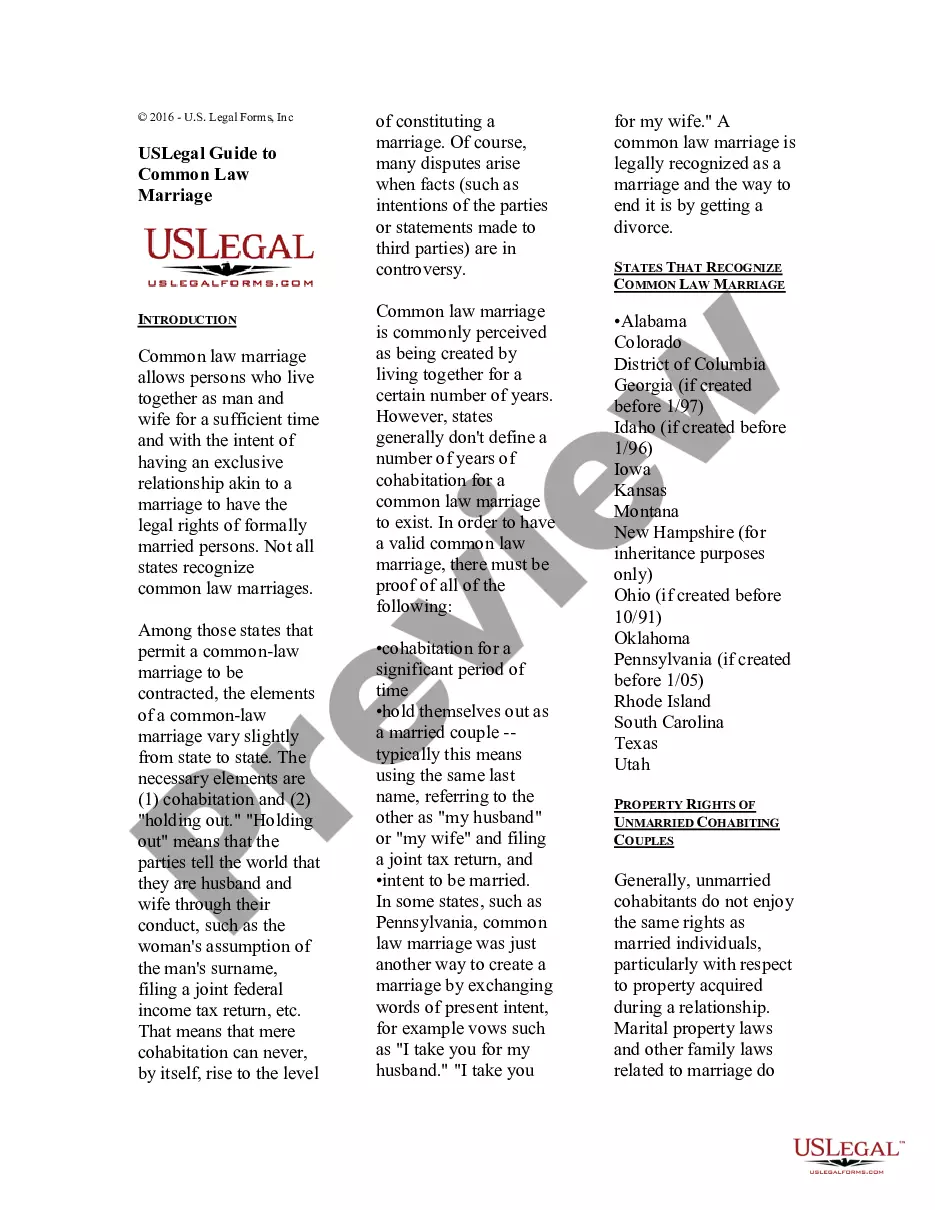
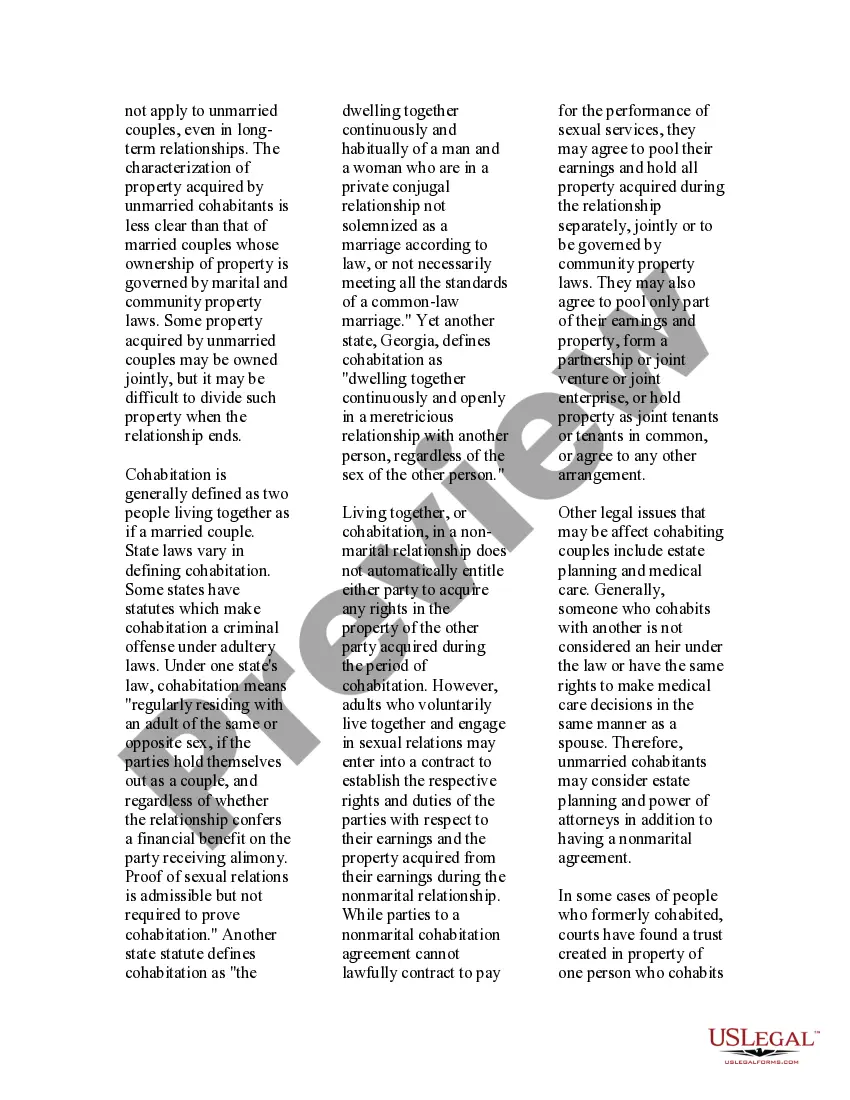
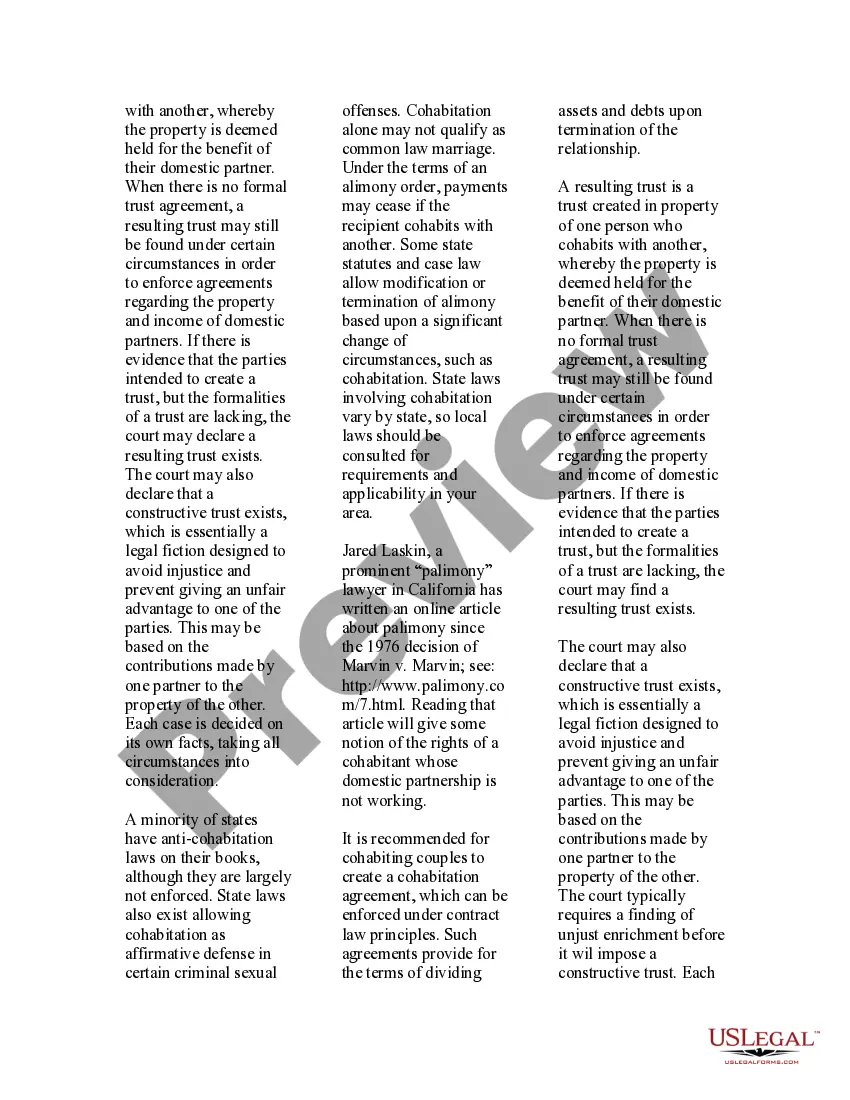
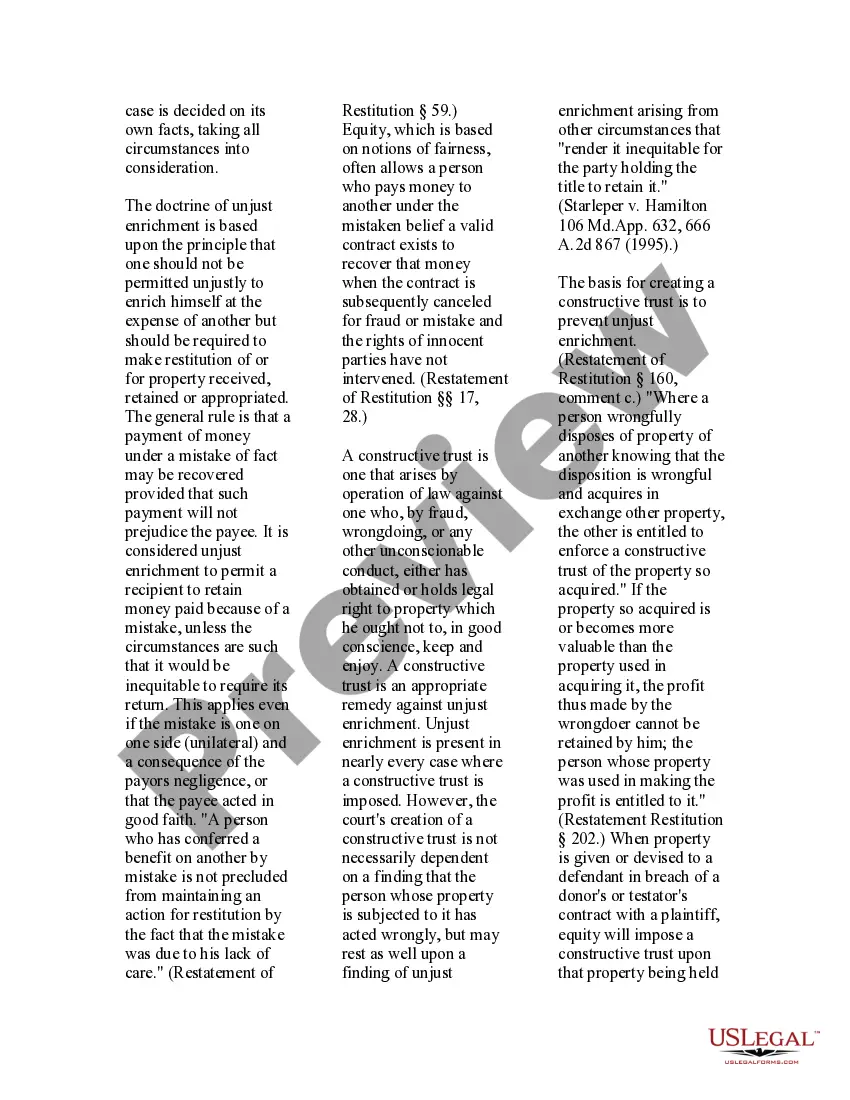
The term common-law marriage refers to a relationship between two people who decide to cohabitate and present themselves as a married couple without the benefit of a legal ceremony and marriage certificate.
Items that can be used as proof of a common-law relationship include: shared ownership of residential property. joint leases or rental agreements. bills for shared utility accounts, such as: gas. electricity. ... important documents for both of you showing the same address, such as: driver's licenses. ... identification documents.
A common law marriage usually consists of a couple that considers themselves married and exhibit the typical characteristics associate with a marriage ? cohabitation, joint finances and financial accounts, children, etc. However, they never went through an officiated ceremony or registered with the state of residence.