Transfer Between Mortgage With Bad Credit
Description

Get your form ready online
Our built-in tools help you complete, sign, share, and store your documents in one place.
Make edits, fill in missing information, and update formatting in US Legal Forms—just like you would in MS Word.
Download a copy, print it, send it by email, or mail it via USPS—whatever works best for your next step.
Sign and collect signatures with our SignNow integration. Send to multiple recipients, set reminders, and more. Go Premium to unlock E-Sign.
If this form requires notarization, complete it online through a secure video call—no need to meet a notary in person or wait for an appointment.
We protect your documents and personal data by following strict security and privacy standards.

Make edits, fill in missing information, and update formatting in US Legal Forms—just like you would in MS Word.

Download a copy, print it, send it by email, or mail it via USPS—whatever works best for your next step.

Sign and collect signatures with our SignNow integration. Send to multiple recipients, set reminders, and more. Go Premium to unlock E-Sign.

If this form requires notarization, complete it online through a secure video call—no need to meet a notary in person or wait for an appointment.

We protect your documents and personal data by following strict security and privacy standards.
Looking for another form?








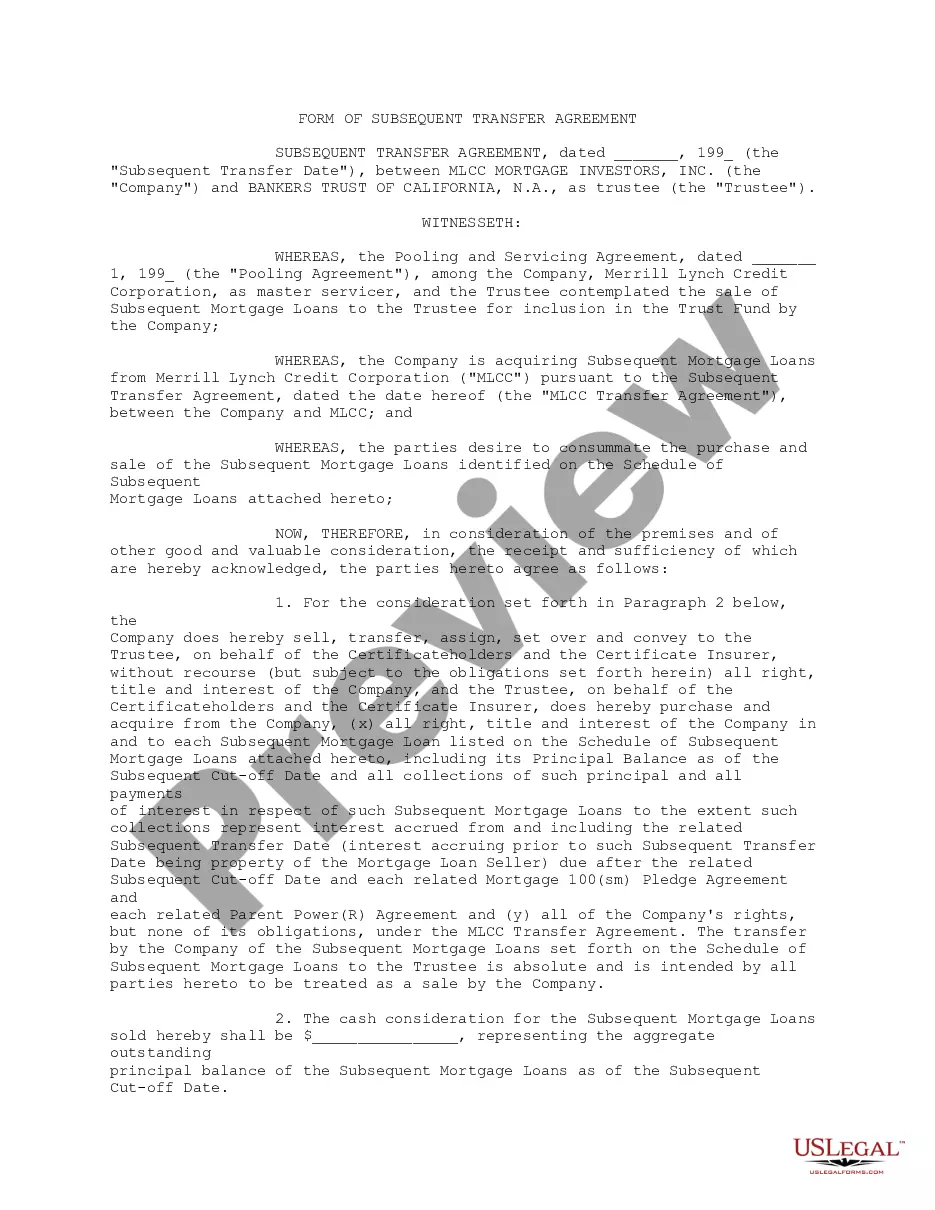
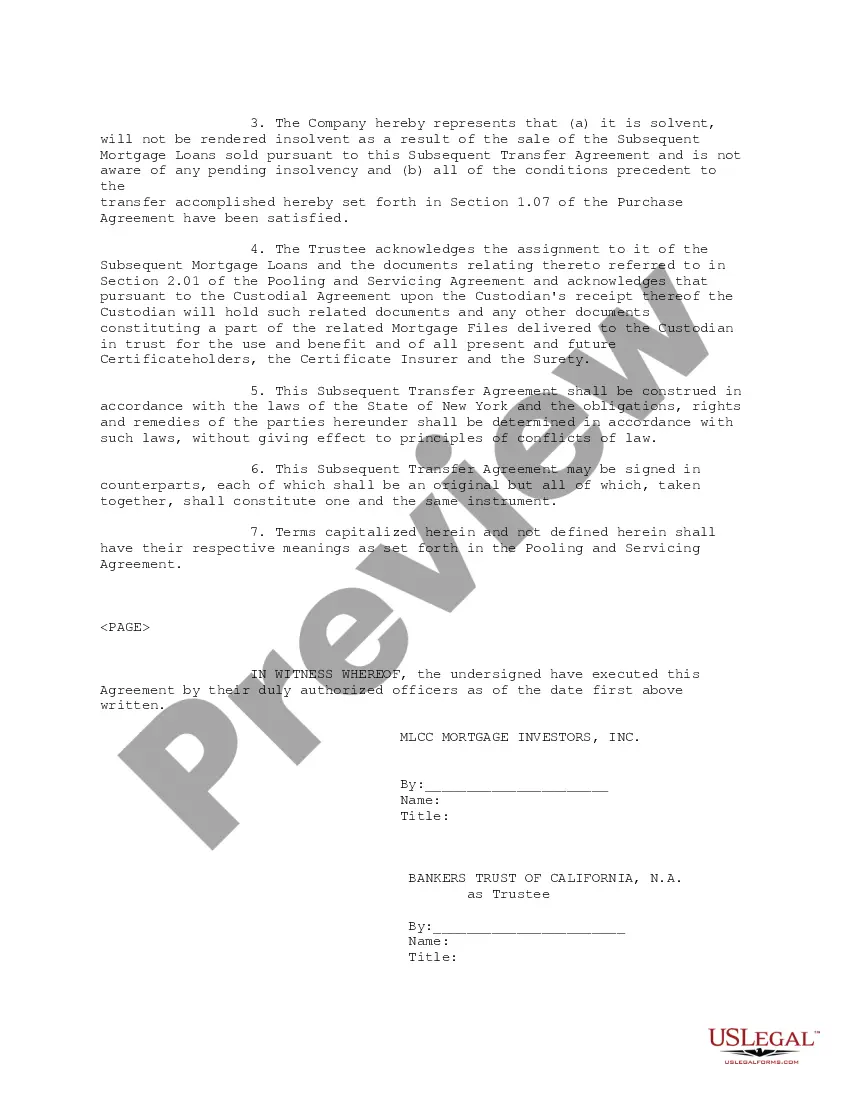
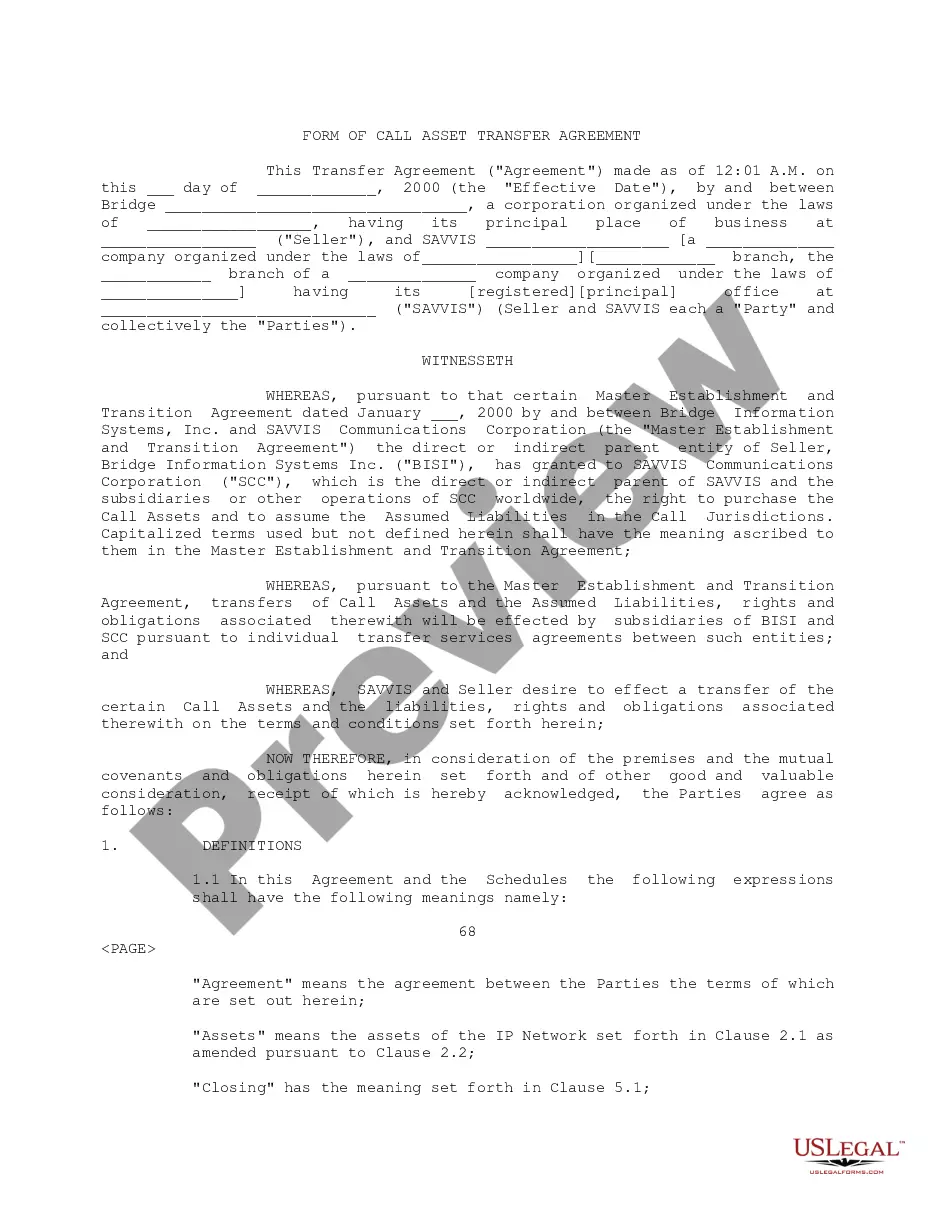
How to fill out Subsequent Transfer Agreement Between MLCC Mortgage Investors, Inc. And Bankers Trust Of CA, N.A. Regarding Consummation For Purchase And Sale Of Mortgage Loans?
The Transfer Between Mortgage With Poor Credit you find on this page is a reusable legal template crafted by experienced attorneys in accordance with federal and local regulations.
For over 25 years, US Legal Forms has offered individuals, businesses, and legal experts more than 85,000 verified, state-specific documents for any business and personal situation. It’s the fastest, simplest, and most dependable method to acquire the documentation you require, as the service ensures bank-level data security and anti-malware safeguards.
Subscribe to US Legal Forms to have verified legal templates for all of life's situations readily available.
- Examine the document you require and assess it. Review the file you searched and look through its preview or examine the form description to confirm it meets your needs. If it doesn't, utilize the search bar to locate the correct one. Click Buy Now once you have identified the template you wish to use.
- Choose and sign in. Select the pricing plan that fits you and set up an account. Use PayPal or a credit card for a swift payment. If you already possess an account, Log In and check your subscription to proceed.
- Obtain the editable template. Choose the format you prefer for your Transfer Between Mortgage With Poor Credit (PDF, Word, RTF) and download the sample to your device.
- Complete and sign the documents. Print the template to fill it out by hand. Alternatively, use an online multifunctional PDF editor to quickly and accurately complete and sign your form with a valid signature.
- Download your documents again. Reuse the same document whenever necessary. Access the My documents tab in your profile to redownload any previously downloaded forms.
Form popularity
FAQ
On a joint mortgage, all borrowers' credit scores matter. Lenders collect credit and financial information including credit history, current debt and income. Lenders determine what's called the "lower middle score" and usually look at each applicant's middle score.
It is certainly possible to remortgage with poor credit. Different bad credit situations will require different mortgage solutions. Don't worry if you have a bad credit score, it doesn't always mean you can't remortgage your property. There are likely to be options available to you.
As long as your new loan-to-value ratio is 90% or lower, you'll only need a 500 credit score to qualify for an FHA refinance. If it's higher than this, a 580 score is required. Keep in mind these are just the minimums set out by the Department of Housing and Urban Development.
You can only transfer your mortgage to another person if your mortgage lender allows it. If you have a conventional loan, you probably won't be able to transfer your mortgage unless you have an allowed exception, such as if you're going through a divorce.
Yes, you can remortgage even if one of you on the joint application has adverse credit. Most lenders will add your credit scores together, and you'll need to meet their minimum score to be considered. Some mortgage companies prefer to look at your scores individually.