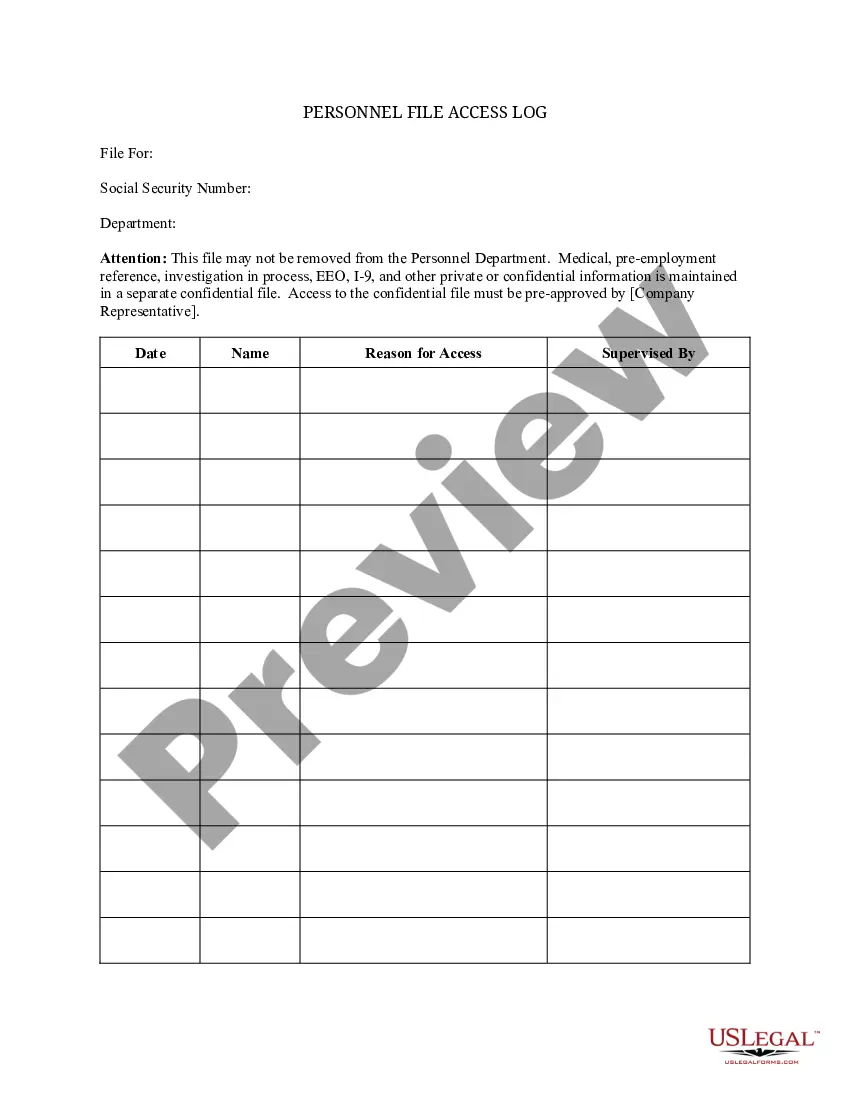
Personnel File Access With Your
Description
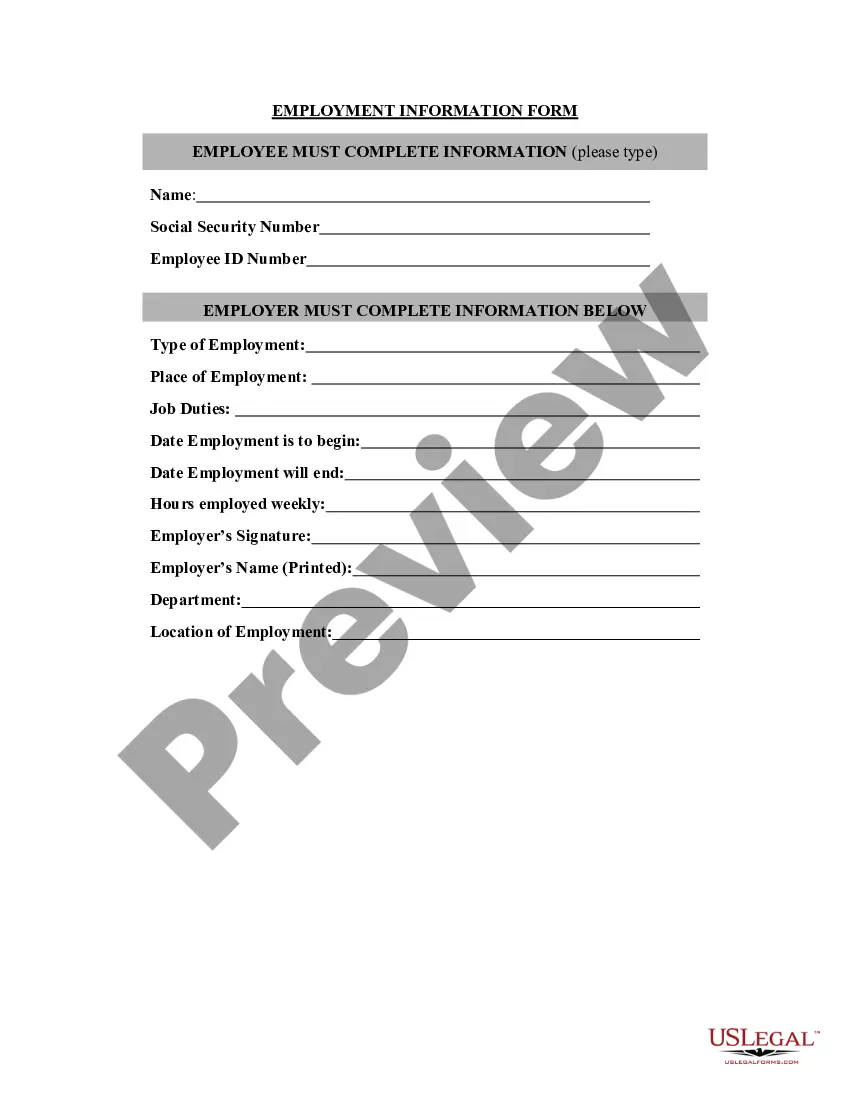
Get your form ready online
Our built-in tools help you complete, sign, share, and store your documents in one place.
Make edits, fill in missing information, and update formatting in US Legal Forms—just like you would in MS Word.
Download a copy, print it, send it by email, or mail it via USPS—whatever works best for your next step.
Sign and collect signatures with our SignNow integration. Send to multiple recipients, set reminders, and more. Go Premium to unlock E-Sign.
If this form requires notarization, complete it online through a secure video call—no need to meet a notary in person or wait for an appointment.
We protect your documents and personal data by following strict security and privacy standards.

Make edits, fill in missing information, and update formatting in US Legal Forms—just like you would in MS Word.

Download a copy, print it, send it by email, or mail it via USPS—whatever works best for your next step.

Sign and collect signatures with our SignNow integration. Send to multiple recipients, set reminders, and more. Go Premium to unlock E-Sign.

If this form requires notarization, complete it online through a secure video call—no need to meet a notary in person or wait for an appointment.

We protect your documents and personal data by following strict security and privacy standards.
Looking for another form?





How to fill out Personnel File Access Log?
Utilizing legal document examples that conform to federal and state regulations is crucial, and there are countless options available online.
However, what is the benefit of spending time searching for the properly drafted Personnel File Access With Your example online when the US Legal Forms digital library already has such templates gathered in a single location.
US Legal Forms is the largest online legal repository featuring over 85,000 fillable forms created by attorneys for various business and personal situations. They are easy to navigate with all documents organized by jurisdiction and purpose.
- Stay updated with legal developments to ensure your documents remain current and compliant when procuring a Personnel File Access With Your from our platform.
- Acquiring a Personnel File Access With Your is swift and straightforward for both existing and new users.
- If you possess an account with an active subscription, Log In and download the document sample you need in your desired format.
- For newcomers to our site, follow these steps.
- Review the template via the Preview option or through the outline to confirm it fits your needs.
Form popularity
FAQ
While there is no set deadline for when an executor must settle an estate in North Carolina, as previously stated it can take several years for this to happen, the executor is responsible for meeting several key deadlines throughout probate proceedings.
The most useful tool we use to avoid probate is a revocable ?living? trust. A trust is an entity that holds property for the use of individuals known as beneficiaries. The property in the trust is managed by a trustee, but the trustee does not get to use the property for their own benefit.
What is a ?Small Estate?? North Carolina considers ?small estates? to be any estate valued at less than $20,000.00 (or $30,000.00 if the only beneficiary is a surviving spouse). You do not have to count real property or certain retirement accounts and life insurance policies if they already include a named beneficiary.
Do All Estates Have to Go Through Probate in North Carolina? Smaller estates with probate-qualified assets valued at less than $20,000 can avoid the formal probate proceeding. If the surviving spouse inherits the whole estate, however, the estate's value can't exceed $30,000 if probate is to be avoided.
Such property may include life insurance policies, retirement accounts, joint bank accounts, and annuities. Land and houses generally are not administered through the probate estate unless the will provides otherwise or the sale of these assets is needed to pay estate debts.
This process applies to estates with personal property valued at $20,000, or $30,000 if the surviving spouse inherits everything under state law. North Carolina also has a simplified probate process called summary administration which applies if the surviving spouse is the sole heir.
This includes life insurance policies, bank accounts, and investment or retirement accounts that require you to name a beneficiary. The proceeds are paid out directly to your named beneficiary when you pass away without having to pass through probate.
A North Carolina small estate affidavit is a document that allows an individual to petition for all or a portion of a deceased person's estate. The petitioner, or affiant, can only use this affidavit if they have a lawful claim to the estate.