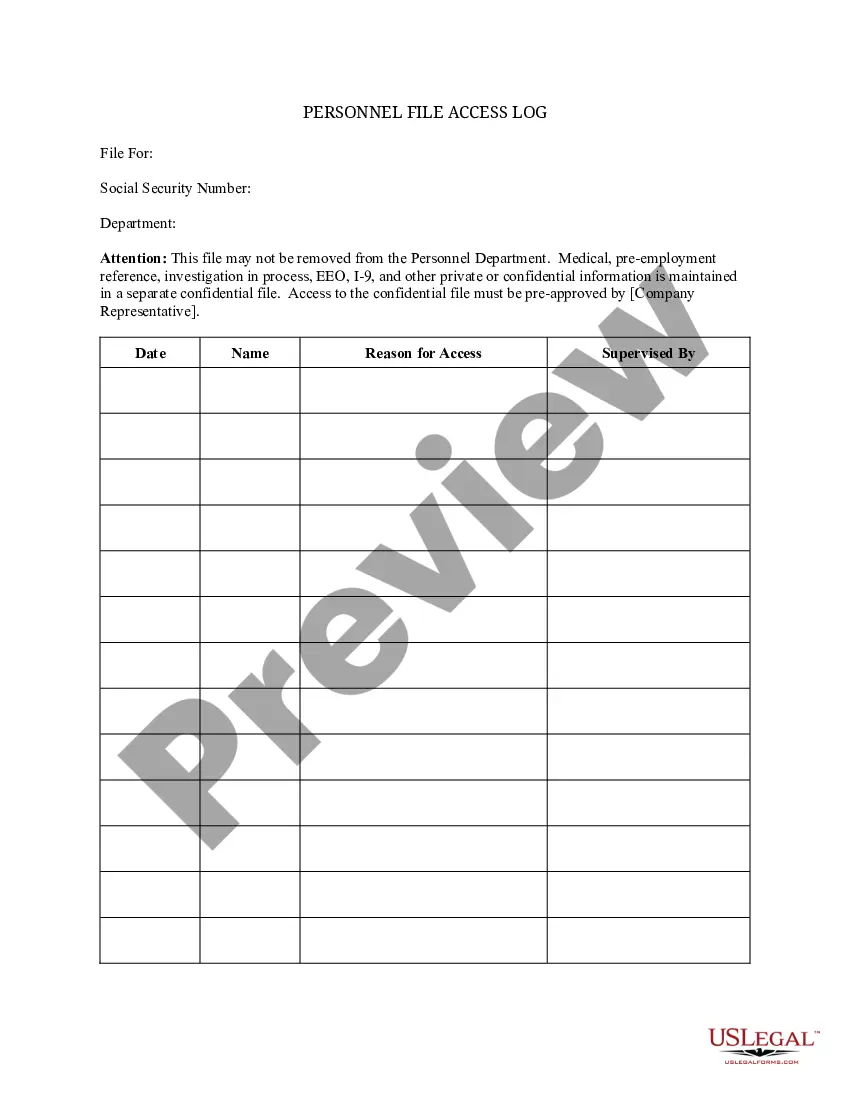
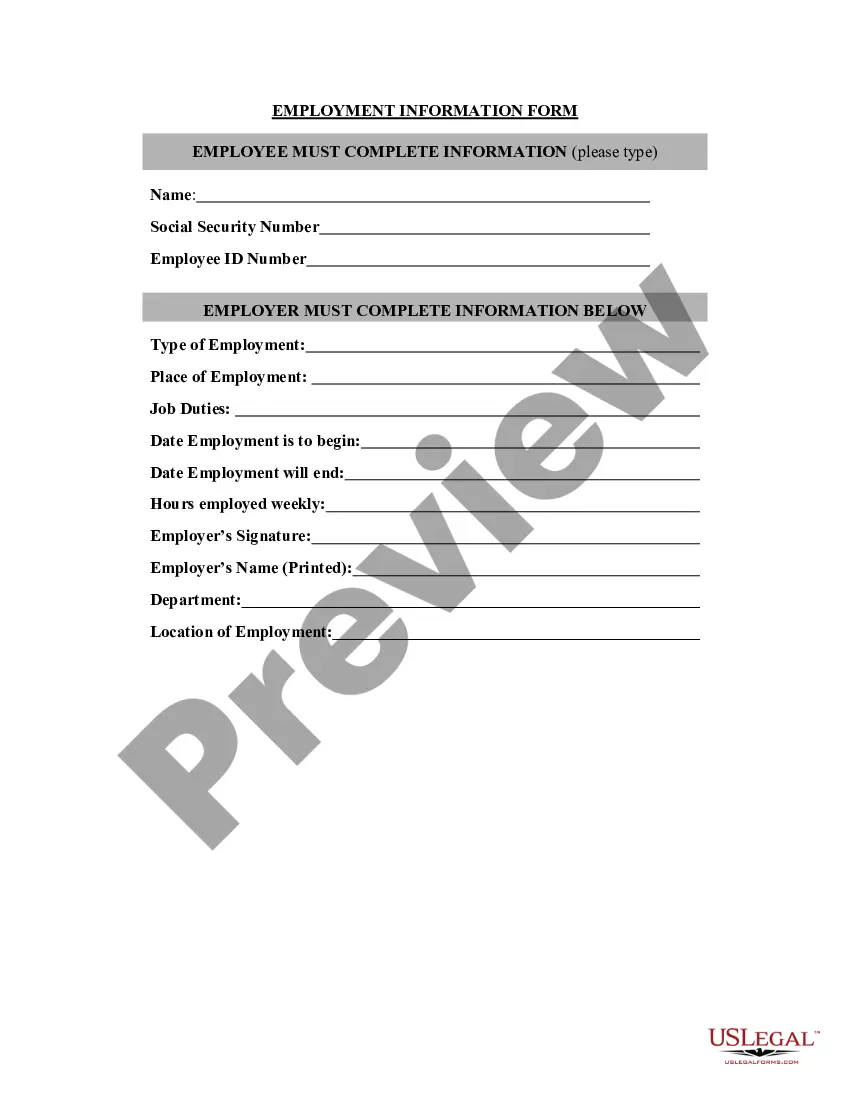
Personnel File Access By State
Description
Get your form ready online
Our built-in tools help you complete, sign, share, and store your documents in one place.
Make edits, fill in missing information, and update formatting in US Legal Forms—just like you would in MS Word.
Download a copy, print it, send it by email, or mail it via USPS—whatever works best for your next step.
Sign and collect signatures with our SignNow integration. Send to multiple recipients, set reminders, and more. Go Premium to unlock E-Sign.
If this form requires notarization, complete it online through a secure video call—no need to meet a notary in person or wait for an appointment.
We protect your documents and personal data by following strict security and privacy standards.

Make edits, fill in missing information, and update formatting in US Legal Forms—just like you would in MS Word.

Download a copy, print it, send it by email, or mail it via USPS—whatever works best for your next step.

Sign and collect signatures with our SignNow integration. Send to multiple recipients, set reminders, and more. Go Premium to unlock E-Sign.

If this form requires notarization, complete it online through a secure video call—no need to meet a notary in person or wait for an appointment.

We protect your documents and personal data by following strict security and privacy standards.
Looking for another form?







How to fill out Personnel File Access Log?
Whether for professional reasons or personal issues, everyone must confront legal matters at some stage in their lives.
Completing legal paperwork requires meticulous care, starting from selecting the appropriate form example.
With a vast US Legal Forms repository available, you will never need to waste time searching for the correct example online. Use the library’s straightforward navigation to find the appropriate form for any circumstance.
- Locate the form you need utilizing the search bar or catalog browsing.
- Review the form’s description to ensure it aligns with your situation, state, and county.
- Click on the form’s preview to examine it.
- If it is not the correct form, return to the search tool to find the Personnel File Access By State example you need.
- Obtain the template if it fits your requirements.
- If you have a US Legal Forms account, simply click Log in to access previously saved templates in My documents.
- If you don’t have an account yet, you can acquire the form by clicking Buy now.
- Choose the appropriate pricing option.
- Fill out the profile registration form.
- Select your payment method: you can pay using a credit card or a PayPal account.
- Choose the file format you prefer and download the Personnel File Access By State.
- Once saved, you can fill out the form using editing software or print it and complete it by hand.
Form popularity
FAQ
NCAOC offers online remote access to and data extract files of criminal and civil case information.
A consent order must be submitted to the appropriate court in North Carolina to get the judge's signature. Essentially, a consent order is similar to a court order in terms of its enforceability. A consent order is enforceable because it shows the consent of both parties and contains the signature of the judge.
Information about criminal cases in the North Carolina court system can be accessed by visiting a public, self-service terminal located at a clerk of court's office in any county. You can use the terminal to search for cases by defendant name, case number, or victim or witness name.
A consent order is a record of an agreement which has been reached. Once agreed, it is submitted to the court for approval. Once the order has been given court approval, the order has legal force. You are bound by the order in the same way as if you have had a decision imposed on you by the court.
A DVPO is not a criminal conviction and does not appear on the defendant's criminal record. However, all documents filed in the case are public record.
Think of a consent order as the midway point between the two. It's an agreement between two parents who have negotiated and drafted their own custody arrangement, like those in a separation agreement. Then the agreement is signed by both parties and submitted to the judge who reads it and signs it.
You'll need to pay the court clerk $150 to open your case. If you can't afford it, submit a Petition to Proceed as an Indigent to ask the court to waive the charges. When the clerk gives you a file number, write it on your forms from Step 1 (the originals as well as the copies) and hand them all to the clerk.
An emergency custody order, sometimes referred to as an ?ex parte order,? is an immediate, short-term custody order that a judge can grant under limited emergency circumstances, without hearing from the other party.