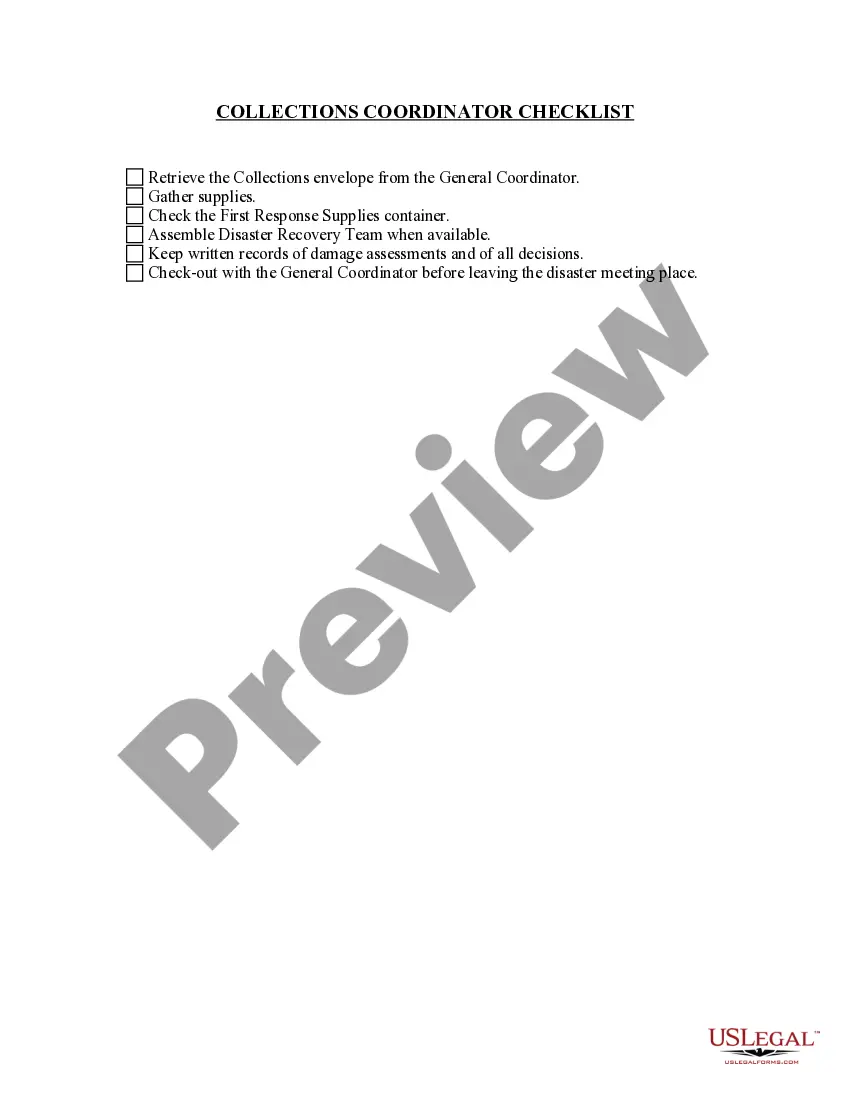
Collections Checklist With Type
Description
Get your form ready online
Our built-in tools help you complete, sign, share, and store your documents in one place.
Make edits, fill in missing information, and update formatting in US Legal Forms—just like you would in MS Word.
Download a copy, print it, send it by email, or mail it via USPS—whatever works best for your next step.
Sign and collect signatures with our SignNow integration. Send to multiple recipients, set reminders, and more. Go Premium to unlock E-Sign.
If this form requires notarization, complete it online through a secure video call—no need to meet a notary in person or wait for an appointment.
We protect your documents and personal data by following strict security and privacy standards.

Make edits, fill in missing information, and update formatting in US Legal Forms—just like you would in MS Word.

Download a copy, print it, send it by email, or mail it via USPS—whatever works best for your next step.

Sign and collect signatures with our SignNow integration. Send to multiple recipients, set reminders, and more. Go Premium to unlock E-Sign.

If this form requires notarization, complete it online through a secure video call—no need to meet a notary in person or wait for an appointment.

We protect your documents and personal data by following strict security and privacy standards.
Looking for another form?







How to fill out Collections Coordinator Checklist?
Creating legal documents from the beginning can frequently be daunting.
Certain situations may require extensive research and significant financial expenditure.
If you seek a more straightforward and economical method of drafting Collections Checklist With Type or any other paperwork without undue hassle, US Legal Forms is consistently accessible to you.
Our digital repository of over 85,000 current legal forms covers nearly every facet of your financial, legal, and personal matters.
However, before jumping straight into downloading Collections Checklist With Type, consider these recommendations: Check the document preview and descriptions to ensure you are on the right document you are looking for. Ensure the template you select adheres to the rules and regulations of your state and county. Choose the most appropriate subscription plan to obtain the Collections Checklist With Type. Download the file. Then complete, sign, and print it. US Legal Forms has established a solid reputation and over 25 years of experience. Join us now and make document completion an easy and efficient process!
- With just a few clicks, you can promptly obtain state- and county-compliant documents carefully assembled for you by our legal professionals.
- Utilize our website whenever you require a dependable and trustworthy service through which you can swiftly find and download the Collections Checklist With Type.
- If you’re a returning user and have previously created an account with us, just Log In to your account, find the form, and download it immediately or retrieve it anytime later from the My documents section.
- Not registered yet? No worries. It only takes a few minutes to sign up and browse the catalog.
Form popularity
FAQ
Yes, you can create a checklist in Microsoft Word efficiently. The application offers built-in features like checkboxes that you can insert into your document. Utilizing Word for your collections checklist with type allows for editing and formatting options that enhance clarity and organization. Once complete, you can easily save, print, or share your checklist as needed.
Typing a checklist is simple and can be done using word processing software or online platforms. Begin by opening your chosen application, then create a new document. You can easily insert checkboxes or bullet points to format your collections checklist with type. This not only helps with organization but also makes tracking your progress easier.
To write an effective checklist, begin by identifying the key tasks needed to achieve your goals. Be specific in your wording to eliminate ambiguity. When using your collections checklist with type, arrange items in the order they should be completed for an efficient workflow. Regularly review and update the checklist to ensure it remains relevant and useful.
Creating a checklist format is straightforward. Start with a clear title that reflects the purpose of your collections checklist with type. Next, list each item sequentially, ensuring each point is concise and easy to understand. You can also use bullet points or numbering to enhance organization and readability.
Types of checklist methods include linear checklists, categorized checklists, and prioritized checklists. These variations allow you to tailor your approach based on the complexity and urgency of the tasks at hand. Using a collections checklist with type can enhance your organization as you adapt these methods to fit specific scenarios.
A checklist is a systematic list used to verify that tasks or items are completed. Types of checklists include action checklists, knowledge checklists, and project checklists, each serving different purposes. By applying a collections checklist with type, you can benefit from various formats to suit different contexts effectively.
A checklist is a tool that helps you track tasks and ensure nothing is forgotten. Common examples include packing lists, project task lists, and safety inspections. Utilizing a collections checklist with type can provide you with examples that enhance clarity and ensure comprehensive coverage of tasks.
Checklist types vary widely and can include to-do lists, inspection checklists, and procedural checklists, among others. Each type is designed to address a specific need or task, enhancing organization and efficiency. By using a collections checklist with type, you can tailor your checklist to meet unique requirements.
The best format for a checklist is one that is clear and easy to use. Many users find that a bullet point format or a tabulated layout works well to organize tasks. Incorporating a collections checklist with type can significantly improve usability by allowing you to categorize items effectively.
A basic checklist serves as a simple tool that lists essential items or tasks to complete. Its primary purpose is to ensure that nothing important is overlooked during a process. Integrating a collections checklist with type can enhance the functionality of basic checklists, making them more suitable for various scenarios.