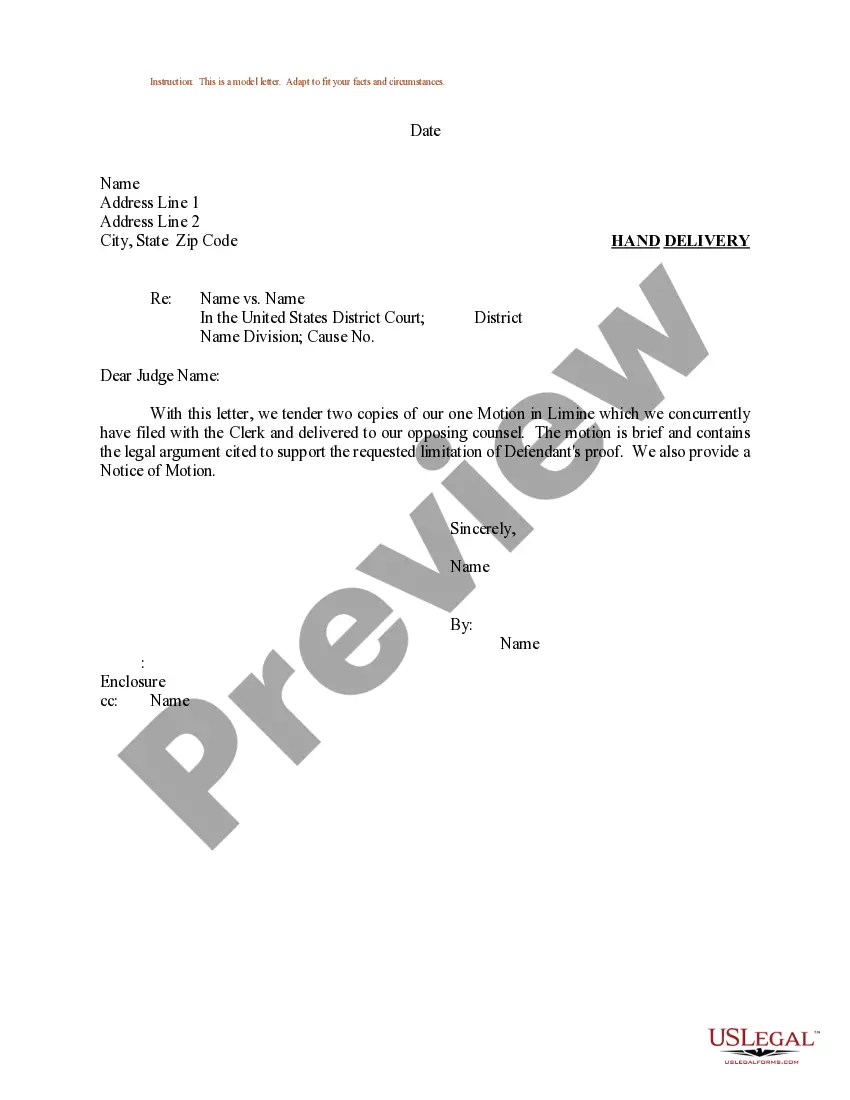
Motion In Limine To Exclude Hearsay Evidence
Description
Get your form ready online
Our built-in tools help you complete, sign, share, and store your documents in one place.
Make edits, fill in missing information, and update formatting in US Legal Forms—just like you would in MS Word.
Download a copy, print it, send it by email, or mail it via USPS—whatever works best for your next step.
Sign and collect signatures with our SignNow integration. Send to multiple recipients, set reminders, and more. Go Premium to unlock E-Sign.
If this form requires notarization, complete it online through a secure video call—no need to meet a notary in person or wait for an appointment.
We protect your documents and personal data by following strict security and privacy standards.

Make edits, fill in missing information, and update formatting in US Legal Forms—just like you would in MS Word.

Download a copy, print it, send it by email, or mail it via USPS—whatever works best for your next step.

Sign and collect signatures with our SignNow integration. Send to multiple recipients, set reminders, and more. Go Premium to unlock E-Sign.

If this form requires notarization, complete it online through a secure video call—no need to meet a notary in person or wait for an appointment.

We protect your documents and personal data by following strict security and privacy standards.
Looking for another form?
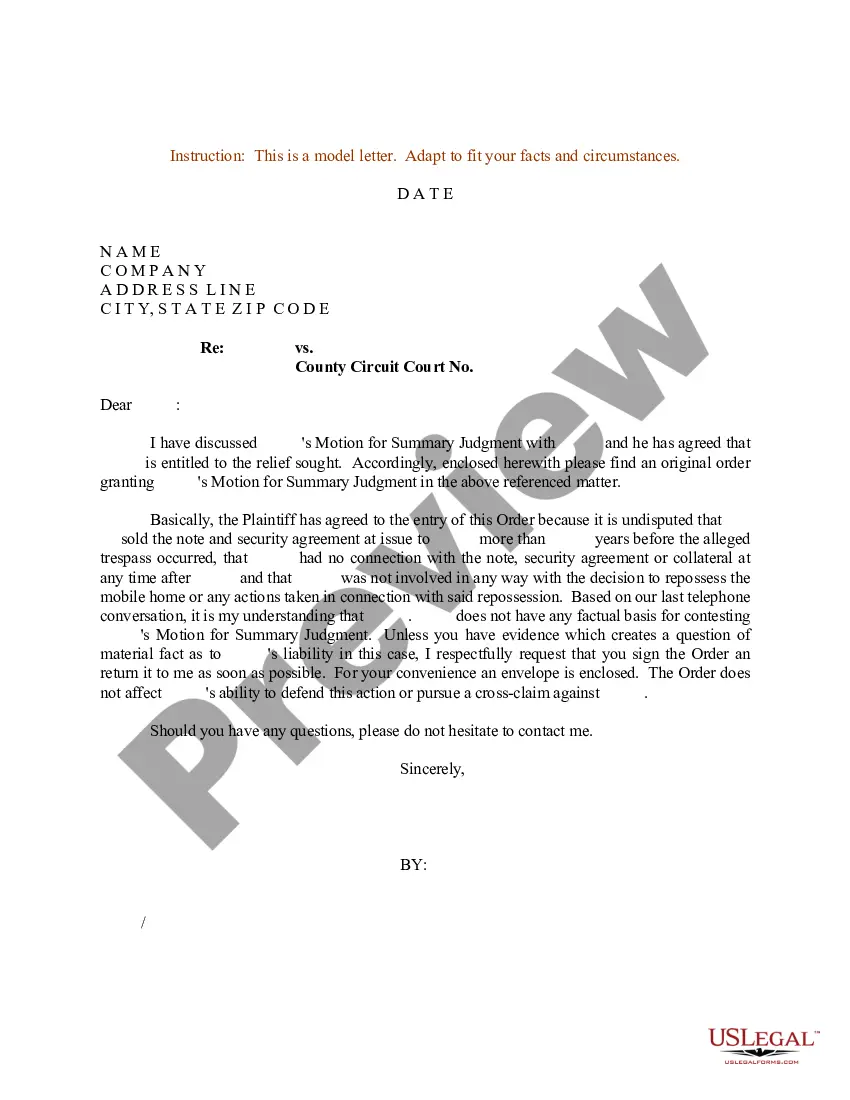
How to fill out Sample Letter For Motion In Limine - Notice Of Motion?
The Motion In Limine To Exclude Hearsay Evidence displayed on this page is a reusable official template crafted by experienced attorneys in compliance with federal and local statutes and regulations.
For over 25 years, US Legal Forms has offered individuals, enterprises, and legal practitioners more than 85,000 validated, state-specific documents for any business and personal event. It’s the quickest, most straightforward, and most dependable method to secure the forms you require, as the service assures optimal data security and anti-malware safeguards.
Download your documents once more. Use the same document again whenever necessary. Access the My documents tab in your profile to redownload any previously obtained forms. Sign up for US Legal Forms to have verified legal templates for all of life’s situations readily available.
- Search for the document required and evaluate it. Browse through the sample you sought and preview it or review the form description to confirm it meets your needs. If it does not, use the search feature to find the appropriate one.
- Click Purchase Now once you have identified the template you require.
- Register and sign in. Select the pricing option that best fits you and create an account. Use PayPal or a credit card for a swift payment. If you already possess an account, sign in and verify your subscription to move forward.
- Acquire the editable template. Choose the format you wish for your Motion In Limine To Exclude Hearsay Evidence (PDF, Word, RTF) and store the sample on your device.
- Complete and endorse the documents. Print the template to fill it out by hand. Alternatively, utilize an online multifunctional PDF editor to quickly and accurately complete and endorse your form with a legally-binding electronic signature.
Form popularity
FAQ
A range of evidence can be suppressed if it violates legal standards, including evidence obtained without a warrant or through unlawful interrogation. Additionally, hearsay evidence often falls under scrutiny for exclusion in legal proceedings, especially through a motion in limine to exclude hearsay evidence. Asserting the inadmissibility of certain evidence strengthens your case, protecting your rights. Utilizing reliable legal tools, such as those offered by US Legal Forms, can help in drafting and filing necessary motions effectively.
The preponderance of evidence is a legal standard used to determine if it is more likely than not that a claim is true. In the context of a motion to suppress, this means that the evidence must show it is more than 50% likely that the evidence in question was obtained unlawfully. Therefore, when you file a motion in limine to exclude hearsay evidence during this process, you should present arguments that clearly connect the unlawfulness to the hearsay claim. This clarity can greatly impact the court's ruling.
Generally, hearsay is not admissible in a suppression hearing, as the goal is to ensure that only valid and reliable evidence influences the court's decisions. A motion in limine to exclude hearsay evidence could be crucial in these contexts, reinforcing the principle that evidence must meet the standards of credibility. Courts often seek to avoid hearsay in order to uphold the rights of the defendant. When preparing for a hearing, it's important to know how to effectively challenge hearsay claims.
Hearsay is typically considered inadmissible because it relies on secondhand information rather than firsthand knowledge. In legal terms, a motion in limine to exclude hearsay evidence aims to keep unreliable statements out of court. The primary issue revolves around the lack of opportunity for cross-examination, which compromises the integrity of the testimony. If you want to ensure that only credible evidence is presented, focusing on this aspect in your legal strategy is essential.
Writing a motion to exclude evidence involves clearly stating the reasons for your request and citing relevant laws or precedents. Begin with a strong introductory statement, followed by the legal grounds for exclusion, and conclude with a request for the judge’s ruling. Ensure your motion identifies the specific evidence and articulates why it should not be permitted. Crafting a motion in limine to exclude hearsay evidence with clarity and precision will strengthen your legal argument.
A motion to exclude evidence generally refers to specific requests made during court proceedings to keep particular evidence from being presented. In contrast, a motion in limine is typically filed before trial to proactively deal with potentially inadmissible evidence, keeping it out of the courtroom from the start. Both legal tools serve to maintain a fair trial, but their timing and context differ. Effective use of a motion in limine to exclude hearsay evidence could prevent unnecessary complications during the trial.
Possible motions in limine can range from requests to exclude specific types of evidence to those seeking to clarify the admissibility of certain testimonies. These motions may target evidence that is deemed irrelevant, prejudicial, or potentially misleading. By carefully crafting your motion, you can set the stage for a favorable ruling. A well-prepared motion in limine to exclude hearsay evidence is particularly beneficial in maintaining the focus of your case.
The grounds for motions in limine may include the relevance of the evidence, potential prejudicial impact, and compliance with legal standards. Judges typically evaluate whether the evidence could unfairly sway the jury or confuse the issues. Underlying legal principles, such as hearsay rules, often underpin these motions. Preparing a motion in limine to exclude hearsay evidence can clarify your argument and bolster your position in court.
Yes, you can file a motion in limine to include evidence, especially if you believe that the evidence is crucial for your case's success. To do this effectively, you should ensure that your motion is well-supported with legal justifications and how the evidence contributes to your claims. Utilizing a motion in limine to exclude hearsay evidence can also strengthen your overall case strategy. Make sure to consult legal resources or professionals if needed.
A motion to suppress evidence typically focuses on evidence that was obtained unlawfully or that violates a defendant’s rights. In contrast, a motion in limine is generally used before a trial starts to preemptively keep certain evidence, such as hearsay, from being presented. Both motions aim to protect the integrity of the trial, but they apply in different circumstances. Knowing the distinction can help you better navigate legal procedures.