Drug Workplace Act Federal For 20
Description
Get your form ready online
Our built-in tools help you complete, sign, share, and store your documents in one place.
Make edits, fill in missing information, and update formatting in US Legal Forms—just like you would in MS Word.
Download a copy, print it, send it by email, or mail it via USPS—whatever works best for your next step.
Sign and collect signatures with our SignNow integration. Send to multiple recipients, set reminders, and more. Go Premium to unlock E-Sign.
If this form requires notarization, complete it online through a secure video call—no need to meet a notary in person or wait for an appointment.
We protect your documents and personal data by following strict security and privacy standards.

Make edits, fill in missing information, and update formatting in US Legal Forms—just like you would in MS Word.

Download a copy, print it, send it by email, or mail it via USPS—whatever works best for your next step.

Sign and collect signatures with our SignNow integration. Send to multiple recipients, set reminders, and more. Go Premium to unlock E-Sign.

If this form requires notarization, complete it online through a secure video call—no need to meet a notary in person or wait for an appointment.

We protect your documents and personal data by following strict security and privacy standards.
Looking for another form?





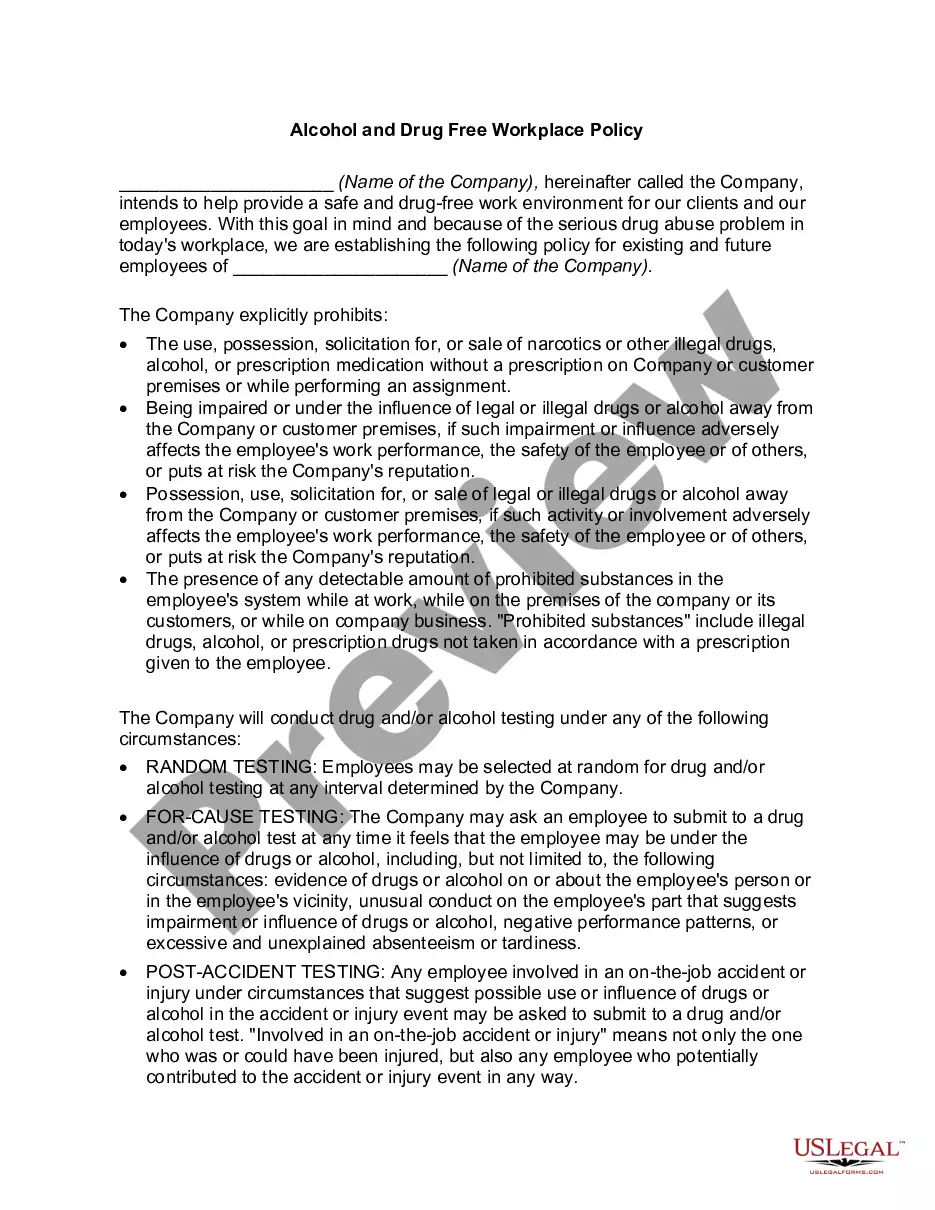
How to fill out Alcohol And Drug Free Workplace Policy?
- If you're an existing user, log in to your account and click the Download button to get your required form template. Check if your subscription is active; if not, renew your plan.
- For first-time users, start by browsing the preview and descriptions of available forms. Confirm you've selected the correct template pertinent to your needs.
- If you need a different form, utilize the search feature at the top to locate the appropriate document and proceed once you find it.
- Purchase the document by clicking the Buy Now button and selecting the subscription plan that best suits your needs. You'll need to create an account to access the full library.
- Complete your purchase by entering your payment details, either via credit card or PayPal.
- Finally, download the form to your device. Access your downloaded templates anytime through the My Forms section of your profile.
In conclusion, US Legal Forms simplifies the process of obtaining legal documents, boasting an extensive library with over 85,000 forms. It ensures not only access to a vast collection but also expert guidance to help you fill them out correctly.
Start streamlining your legal needs today by visiting US Legal Forms and discover how easy it can be!
Form popularity
FAQ
To determine if your position is a Test Designated Position (TDP), review your job description and the company’s drug testing policy under the Drug Workplace Act federal for 20. TDPs typically involve safety-sensitive functions where the risk of accidents may impact others. If you're unsure, consult your HR department for clarification. USLegalForms can also provide useful templates and information related to drug testing classifications and employer responsibilities.
Yes, federal contractors are required to drug test employees under the Drug Workplace Act federal for 20. This legislation aims to ensure a safe and productive work environment by regulating substance use among workers. Contractors should establish clear drug testing policies, conducted consistently to meet federal requirements. For more tailored guidance, consider using USLegalForms, which provides resources to help navigate federal regulations.
The federal drug policy is a comprehensive framework that governs how drug use and testing are managed for federal employees. It aims to prevent drug abuse in the workplace through rigorous testing and clear repercussions for violations. Understanding this policy is crucial for compliance with the drug workplace act federal for 20 and fosters a safer working environment.
Federal employees may undergo drug testing randomly, or as part of a routine or suspicion-based procedure. Typically, the frequency will depend on the specific agency's policy and the nature of the work involved. Adhering to the guidelines established by the drug workplace act federal for 20 promotes the health and safety of every workplace.
Acceptable reasons for deferral of a drug test include medical emergencies, the need for a reasonable accommodation, or a legitimate inability to provide a sample. Employers must evaluate requests on a case-by-case basis, ensuring compliance with the drug workplace act federal for 20. Documenting these reasons helps maintain transparency and fairness in the process.
Writing a drug policy requires clarity and specific guidelines tailored to your organization. Start by identifying the purpose of the policy, then establish testing procedures and consequences for violations. Utilizing resources like the uslegalforms platform can help you access templates and examples that align with the drug workplace act federal for 20.
A TDP, or testing designated position, refers to a job role that requires regular drug testing due to safety-sensitive responsibilities. Such positions are often found in industries like transportation, healthcare, and construction, where impairment can have serious consequences. Knowing about the Drug Workplace Act federal for 20 can be beneficial as it outlines the legal framework for drug testing in TDPs.
To find out if you passed your escreen drug test, contact the testing laboratory or your employer's HR department, as they handle the results. Normally, results are provided within a few days. Understanding the Drug Workplace Act federal for 20 can help clarify what your rights are regarding test results and re-testing opportunities.
If an employee in a testing designated position (TDP) fails a random drug test, the employer should follow established procedures as outlined in their drug testing policy. This may include suspension, mandatory counseling, or termination, depending on the severity of the violation and company policy. Adhering to the Drug Workplace Act federal for 20 ensures that employee rights are respected while maintaining workplace safety.
To determine if a job will require a drug test, review the company's employment policy, which often outlines drug testing procedures. Additionally, job postings may include a statement about testing for drugs as part of the hiring process. Understanding the Drug Workplace Act federal for 20 can also give you insights into what employers may legally require.