Sample Letter For Funeral
Description
Get your form ready online
Our built-in tools help you complete, sign, share, and store your documents in one place.
Make edits, fill in missing information, and update formatting in US Legal Forms—just like you would in MS Word.
Download a copy, print it, send it by email, or mail it via USPS—whatever works best for your next step.
Sign and collect signatures with our SignNow integration. Send to multiple recipients, set reminders, and more. Go Premium to unlock E-Sign.
If this form requires notarization, complete it online through a secure video call—no need to meet a notary in person or wait for an appointment.
We protect your documents and personal data by following strict security and privacy standards.

Make edits, fill in missing information, and update formatting in US Legal Forms—just like you would in MS Word.

Download a copy, print it, send it by email, or mail it via USPS—whatever works best for your next step.

Sign and collect signatures with our SignNow integration. Send to multiple recipients, set reminders, and more. Go Premium to unlock E-Sign.

If this form requires notarization, complete it online through a secure video call—no need to meet a notary in person or wait for an appointment.

We protect your documents and personal data by following strict security and privacy standards.
Looking for another form?
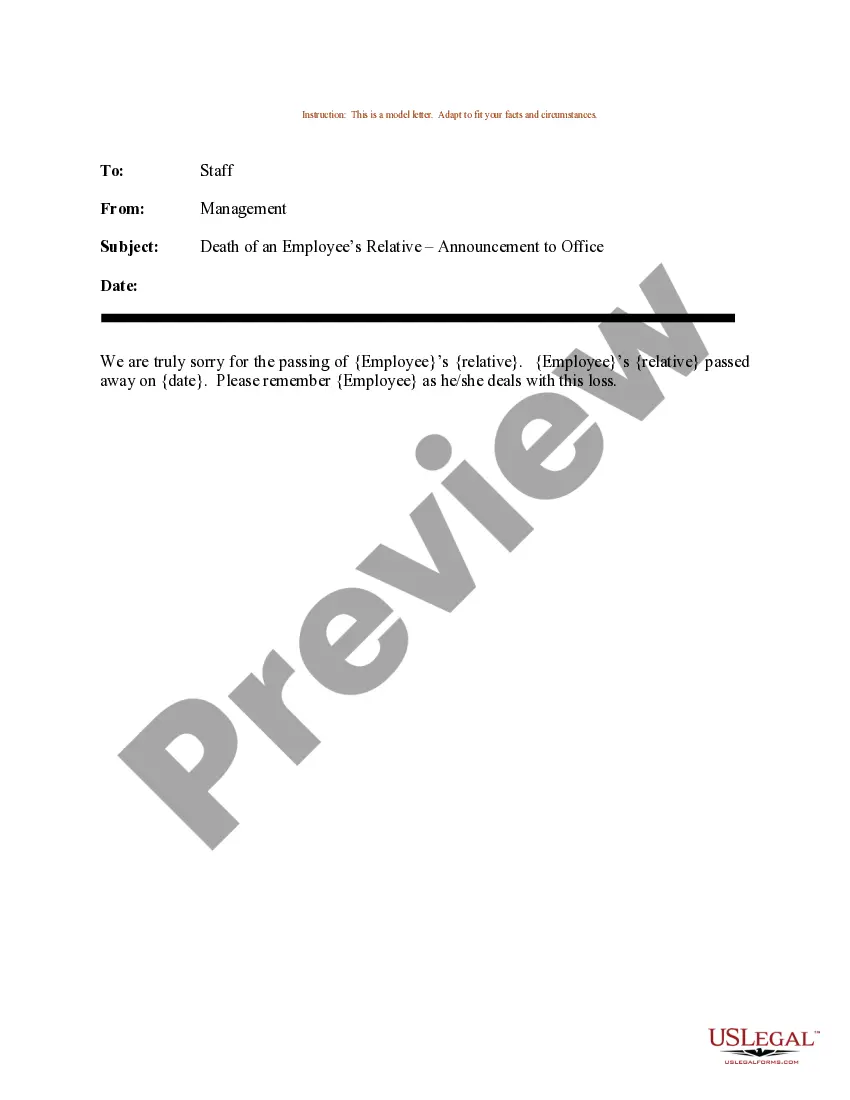
How to fill out Sample Letter For Death Of An Employee's Relative - Announcement To Office?
Regardless of whether it is for commercial purposes or personal reasons, everyone must handle legal circumstances at various points in their lives.
Filling out legal documents necessitates meticulous care, starting with selecting the appropriate form template.
With a comprehensive catalog from US Legal Forms available, you will never need to waste time searching for the suitable template online. Utilize the library’s straightforward navigation to find the appropriate template for any scenario.
- Locate the template you require by using the search bar or browsing through the catalog.
- Review the description of the form to confirm it aligns with your circumstances, state, and area.
- Click on the preview of the form to view it.
- If it is incorrect, go back to the search tool to find the Sample Letter For Funeral template you need.
- Download the template if it fulfills your requirements.
- If you already possess a US Legal Forms account, simply click Log in to access files you’ve previously saved in My documents.
- If you haven’t set up an account yet, you can acquire the form by clicking Buy now.
- Choose the appropriate pricing option.
- Complete the account registration form.
- Select your preferred payment method: either a credit card or PayPal account.
- Pick the document format you desire and download the Sample Letter For Funeral.
- Once it is saved, you can fill out the form using editing software or print it out to complete it manually.
Form popularity
FAQ
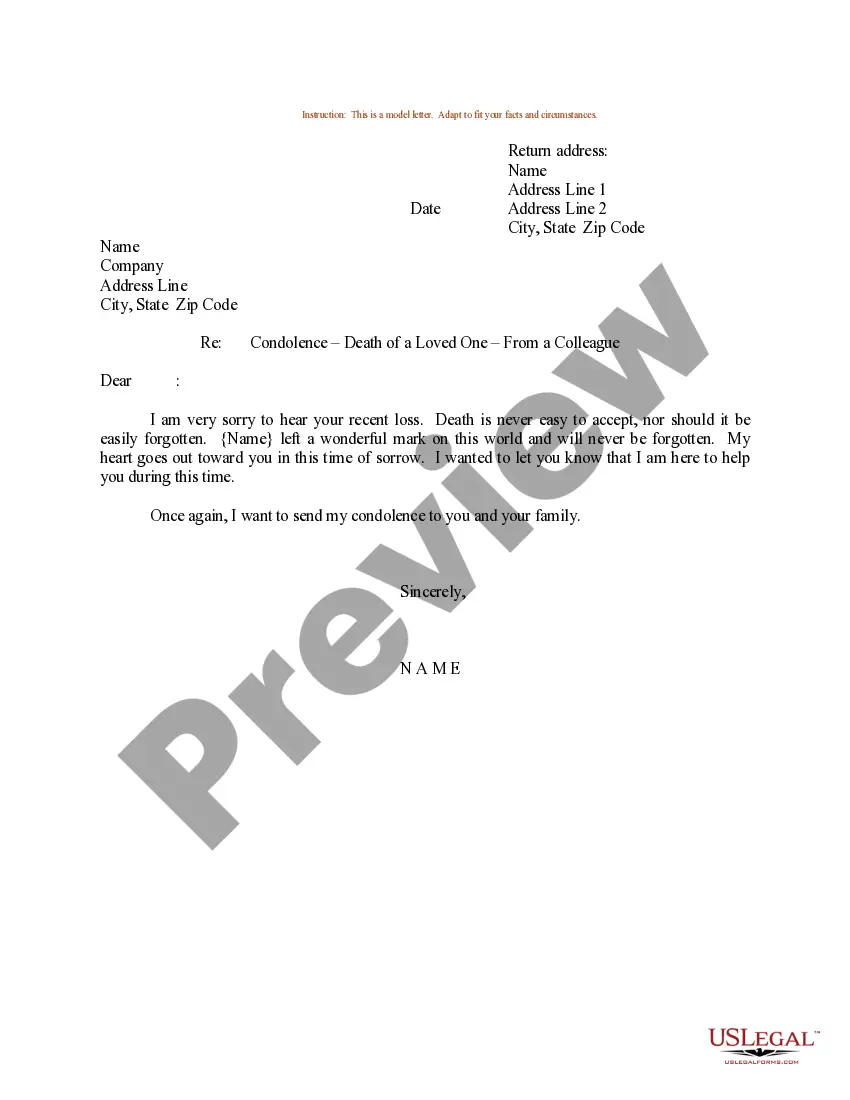
An example of a condolence letter includes elements like an opening statement of sympathy, a positive memory of the deceased, and an offer of support. Begin with a sincere expression of your feelings, then recount a moment that showcases the person's character. Finally, reassure the family of your availability during this difficult time. You can find various templates and a sample letter for funeral on platforms like US Legal Forms to assist you in writing.
To write a letter for the death of a family member, start by expressing your sorrow and offering condolences to the family. Share a personal story or memory that highlights the impact of the deceased on your life. This connection deepens their understanding of your support. If you prefer structure, a sample letter for funeral can provide a helpful framework for your own message.
A thoughtful message for a funeral should express condolences while honoring the deceased. Consider sharing a fond memory or a quality that you admired about them. This personal touch makes your message more meaningful. If you need guidance, refer to a sample letter for funeral to help you craft your thoughts.
Begin an introduction for a funeral by acknowledging the deep sadness surrounding the loss. You can express your heartfelt condolences immediately, setting the tone for the rest of your message. Using a sample letter for funeral can help you structure your thoughts and ensure your introduction resonates with empathy.
Funeral notices typically include essential information such as the date, time, and location of the service. They often mention details about the deceased and how friends and family can show their support. Reviewing a sample letter for funeral can provide you with inspiration on how to communicate important details effectively.
You can start a funeral letter by expressing your condolences right away. Use a compassionate tone and mention the recipient's loss to make your opening sincere. A well-phrased introduction sets the stage for a thoughtful message; consider using a sample letter for funeral as a reference.
A short funeral message should be heartfelt and focused. Aim for a clear expression of sympathy while referencing the deceased's impact on your life. A sample letter for funeral can serve as a template to help you formulate your thoughts simply and directly.
To write a letter for a funeral, start by addressing the recipient warmly, acknowledging their loss. Next, include a sample letter for funeral to provide structure, touching on shared memories or attributes of the deceased. Conclude with words of support and offer help if appropriate.
A bereavement letter often expresses sympathy and support to someone who has lost a loved one. You might include comforting words along with a sample letter for funeral to guide your own message. It can be brief or elaborate, but the key is to convey your condolences sincerely.