Sample Letter Request For Bank Account Details
Description
Get your form ready online
Our built-in tools help you complete, sign, share, and store your documents in one place.
Make edits, fill in missing information, and update formatting in US Legal Forms—just like you would in MS Word.
Download a copy, print it, send it by email, or mail it via USPS—whatever works best for your next step.
Sign and collect signatures with our SignNow integration. Send to multiple recipients, set reminders, and more. Go Premium to unlock E-Sign.
If this form requires notarization, complete it online through a secure video call—no need to meet a notary in person or wait for an appointment.
We protect your documents and personal data by following strict security and privacy standards.

Make edits, fill in missing information, and update formatting in US Legal Forms—just like you would in MS Word.

Download a copy, print it, send it by email, or mail it via USPS—whatever works best for your next step.

Sign and collect signatures with our SignNow integration. Send to multiple recipients, set reminders, and more. Go Premium to unlock E-Sign.

If this form requires notarization, complete it online through a secure video call—no need to meet a notary in person or wait for an appointment.

We protect your documents and personal data by following strict security and privacy standards.
Looking for another form?
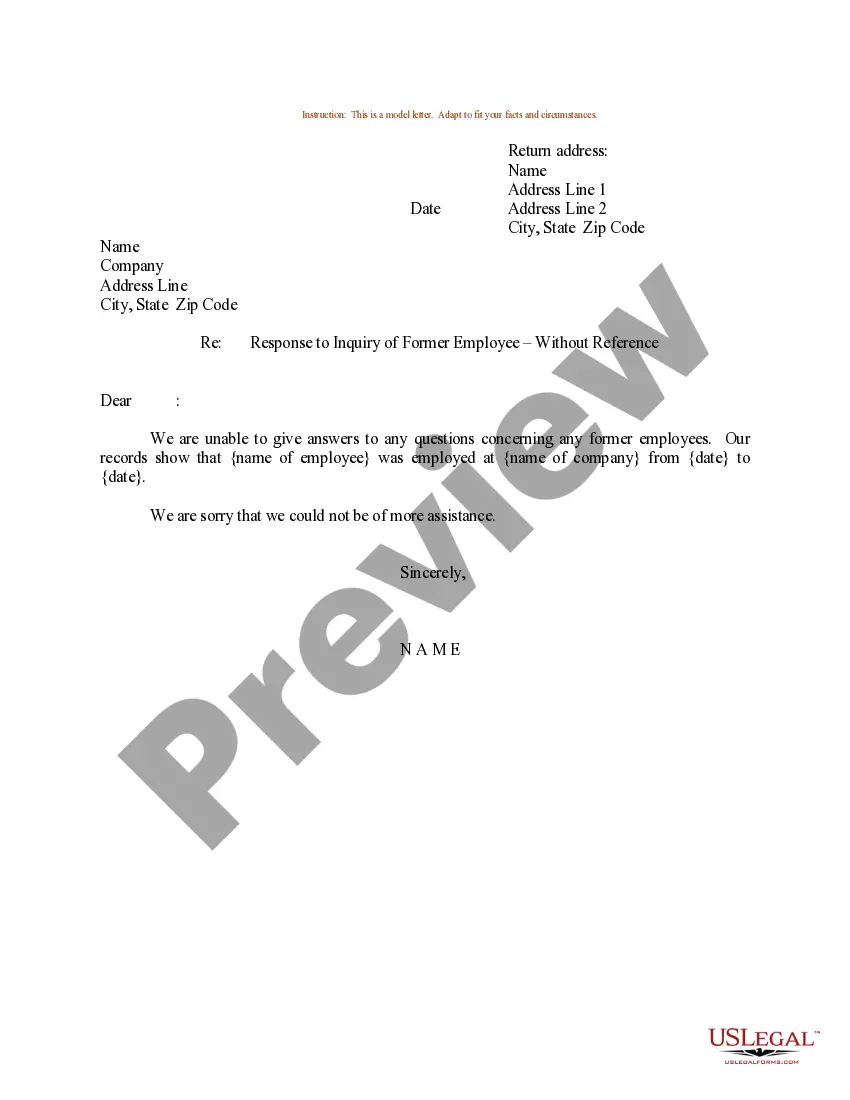
How to fill out Sample Letter For Response To Inquiry Of Former Employee - Without Reference?
It’s clear that you cannot transform into a legal specialist instantly, nor can you learn to efficiently draft Sample Letter Request For Bank Account Details without possessing a specific collection of expertise.
Assembling legal documents is a labor-intensive undertaking that necessitates certain training and expertise. So why not entrust the creation of the Sample Letter Request For Bank Account Details to the professionals.
With US Legal Forms, one of the most comprehensive libraries of legal documents, you can access everything from court forms to templates for internal business communication.
You can regain access to your documents from the My documents tab at any moment. If you’re a current client, you can just Log In, and find and download the template from the same section.
Regardless of the aim of your documents—be it financial and legal, or personal—our platform has you covered. Experiment with US Legal Forms today!
- Recognize the form you need by utilizing the search bar at the top of the site.
- Preview it (if this option is available) and review the accompanying description to see if Sample Letter Request For Bank Account Details meets your requirements.
- Restart your search if you require a different form.
- Establish a free account and select a subscription plan to purchase the template.
- Select Buy now. Once your payment is finalized, you can obtain the Sample Letter Request For Bank Account Details, fill it out, print it, and send or mail it to the relevant individuals or entities.
Form popularity
FAQ
How to Write a Release of Liability Form Fill in the information of both parties, including each person's name and address. Include the details of the event. ... Add if there is a payment required by the releasee. ... Write a section for signatures, which will contain the names and dates of both parties.
To build a waiver of liability: Choose a waiver template. Determine the type of activity or service. State the purpose of the waiver. Identify the risks. Include a title. Include customer information. Include waiver terms. Include a statement of understanding.
A release of liability or waiver is a legal document that a person signs to acknowledge the risks involved in a particular activity and to not hold the organization or individual for any harm that might arise.
How Do You Write a Release Form? The first step in writing is identifying all parties involved, including the releaser and the release. Specify the activity or event in detail, such as a photo shoot, a video production, or a performance. Clearly specify what is being released, whether liability, claims, or damages.
As tempting as it may be, you should never write your own liability waiver. Unless you're a fully qualified lawyer with experience in this area, it's likely that you'll omit critical language that puts your business at risk for lawsuits.
A release of liability, also known as a liability waiver or a hold harmless agreement, is a contract in which one party agrees not to hold another party liable for damages or injury. These contracts are common in fields that involve some risk to property, finances, or health.
To build a waiver of liability: Choose a waiver template. Determine the type of activity or service. State the purpose of the waiver. Identify the risks. Include a title. Include customer information. Include waiver terms. Include a statement of understanding.
The liability release form, also known as the waiver form, contains a legally binding agreement between two parties, stating that one of them (the releasor) promises not to sue the other side (the releasee) for past, current, or future damages, losses, or injuries.