Agreement Consent Property For Unmarried Couples
Description
Get your form ready online
Our built-in tools help you complete, sign, share, and store your documents in one place.
Make edits, fill in missing information, and update formatting in US Legal Forms—just like you would in MS Word.
Download a copy, print it, send it by email, or mail it via USPS—whatever works best for your next step.
Sign and collect signatures with our SignNow integration. Send to multiple recipients, set reminders, and more. Go Premium to unlock E-Sign.
If this form requires notarization, complete it online through a secure video call—no need to meet a notary in person or wait for an appointment.
We protect your documents and personal data by following strict security and privacy standards.

Make edits, fill in missing information, and update formatting in US Legal Forms—just like you would in MS Word.

Download a copy, print it, send it by email, or mail it via USPS—whatever works best for your next step.

Sign and collect signatures with our SignNow integration. Send to multiple recipients, set reminders, and more. Go Premium to unlock E-Sign.

If this form requires notarization, complete it online through a secure video call—no need to meet a notary in person or wait for an appointment.

We protect your documents and personal data by following strict security and privacy standards.
Looking for another form?

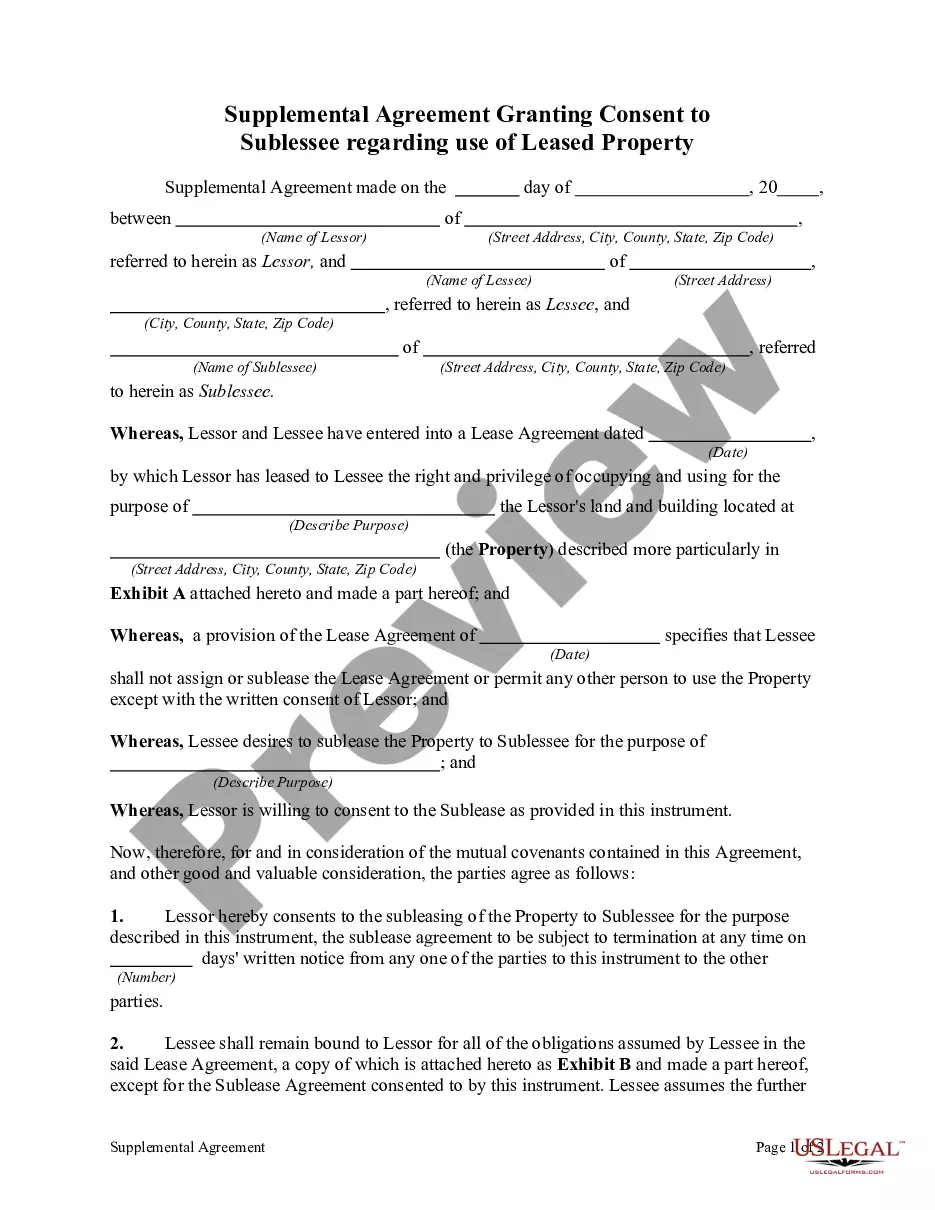
How to fill out Supplemental Agreement Granting Consent To Sublessee Regarding Use Of Leased Property?
Individuals frequently link legal documents with something complex that only an expert can manage.
In a certain sense, this is accurate, as formulating Agreement Consent Property For Unmarried Couples requires considerable expertise in topic specifics, including state and local laws.
Nevertheless, with US Legal Forms, the process has become simpler: pre-prepared legal documents for any personal and business circumstance tailored to state regulations are compiled in one online repository and are now accessible to all.
Establish an account or Log In to move to the payment section. Complete your purchase via PayPal or your credit card. Choose the format for your document and click Download. Print your document or upload it to an online editor for quicker completion. All templates in our collection are reusable: once acquired, they remain stored in your profile. You can access them anytime needed via the My documents tab. Discover all the benefits of utilizing the US Legal Forms platform. Subscribe now!
- US Legal Forms provides over 85,000 current documents categorized by state and area of use, allowing you to find Agreement Consent Property For Unmarried Couples or another specific template within minutes.
- Previous users with a valid subscription need to Log In to their account and click Download to obtain the form.
- New users will need to register for an account and subscribe before they can download any documents.
- Here is a step-by-step guide on how to obtain the Agreement Consent Property For Unmarried Couples.
- Review the page content carefully to ensure it meets your requirements.
- Examine the form description or view it using the Preview feature.
- Search for another template using the Search bar above if the previous one does not meet your preferences.
- Click Buy Now when you locate the appropriate Agreement Consent Property For Unmarried Couples.
- Select a pricing plan that aligns with your needs and budget.
Form popularity
FAQ
To truly protect yourself legally, you can put together a cohabitation agreement, which is sort of like a prenup. "Cohabitation agreements usually include how property will be divided in the event of a separation," said attorney David Reischer, CEO of LegalAdvice.com.
Yes. You can find a lender that will allow you to apply for a home loan with your partner. However, you'll run into different challenges than married couples based on the current legal framework. Take the time to determine whether you and your partner should apply for a loan together.
Unmarried couples who are living together have the option of creating a number of legal documents (often called cohabitation agreements) that can help protect their rights as a couple, while at the same time safeguarding their individual interests and assets.
Unmarried couples who are living together have the option of creating a number of legal documents (often called cohabitation agreements) that can help protect their rights as a couple, while at the same time safeguarding their individual interests and assets.
Each state has its own laws, but generally, property is distributed to the deceased person's spouse and children. If the person is not married, the property will be divided among parents, siblings, aunts and uncles, nieces and nephews, and then to more distant relatives.