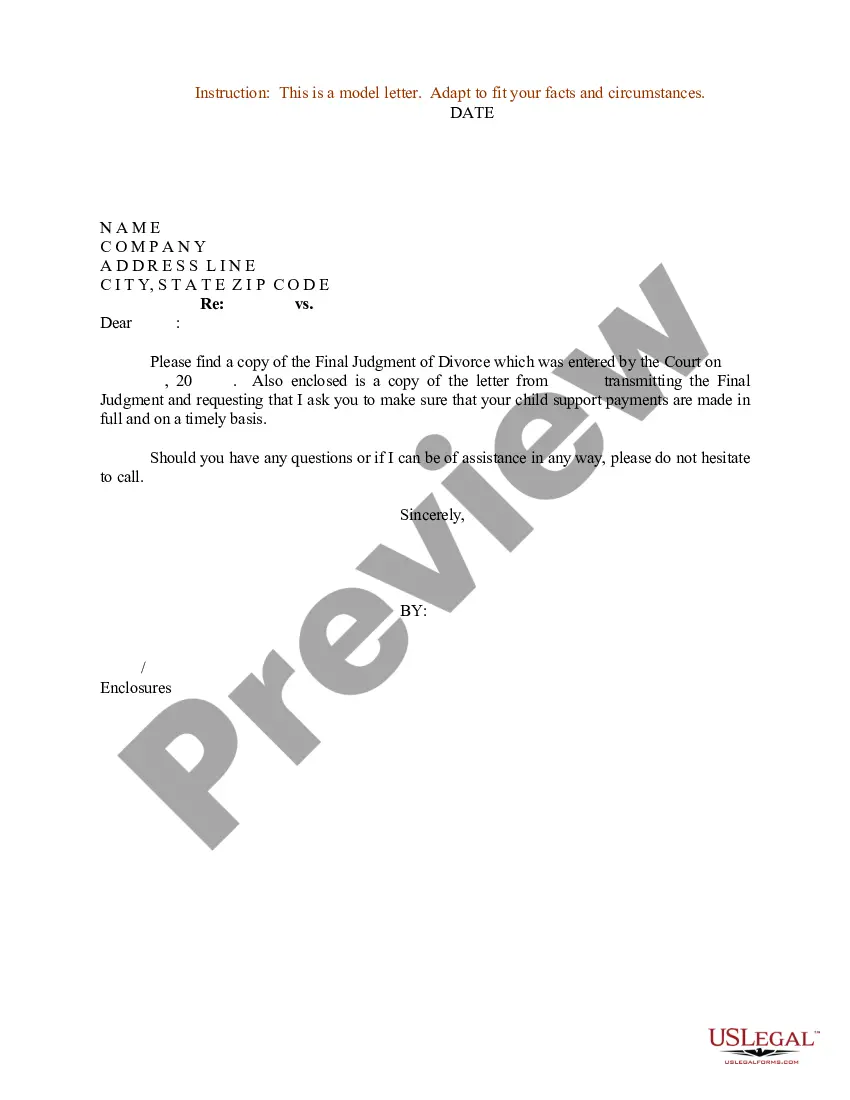
Final Judgement For Divorce
Description


Get your form ready online
Our built-in tools help you complete, sign, share, and store your documents in one place.
Make edits, fill in missing information, and update formatting in US Legal Forms—just like you would in MS Word.
Download a copy, print it, send it by email, or mail it via USPS—whatever works best for your next step.
Sign and collect signatures with our SignNow integration. Send to multiple recipients, set reminders, and more. Go Premium to unlock E-Sign.
If this form requires notarization, complete it online through a secure video call—no need to meet a notary in person or wait for an appointment.
We protect your documents and personal data by following strict security and privacy standards.

Make edits, fill in missing information, and update formatting in US Legal Forms—just like you would in MS Word.

Download a copy, print it, send it by email, or mail it via USPS—whatever works best for your next step.

Sign and collect signatures with our SignNow integration. Send to multiple recipients, set reminders, and more. Go Premium to unlock E-Sign.

If this form requires notarization, complete it online through a secure video call—no need to meet a notary in person or wait for an appointment.

We protect your documents and personal data by following strict security and privacy standards.
Looking for another form?
How to fill out Sample Letter Regarding Final Judgment Of Divorce?
Identifying a reliable location to obtain the latest and pertinent legal documents is part of the challenge of managing bureaucracy.
Acquiring the correct legal forms demands precision and carefulness, which is why it is essential to gather samples of Final Judgement For Divorce exclusively from trustworthy sources, such as US Legal Forms. An incorrect template will squander your time and prolong the situation you face. With US Legal Forms, you have minimal concerns.
Eliminate the hassle that comes with your legal documentation. Explore the extensive US Legal Forms library where you can locate legal samples, verify their applicability to your circumstances, and download them instantly.
- Use the library navigation or search field to find your document.
- Open the form details to ensure it meets the standards of your state and county.
- View the form preview if available, to confirm it is the form you are looking for.
- Continue the search and locate the correct document if the Final Judgement For Divorce does not fit your needs.
- If you are certain about the form's suitability, download it.
- When you are a registered user, click Log in to verify and access your selected templates in My documents.
- If you do not have an account yet, click Buy now to purchase the form.
- Choose the pricing plan that suits your requirements.
- Proceed to the registration to complete your transaction.
- Finalise your purchase by selecting a payment option (credit card or PayPal).
- Choose the file format to download Final Judgement For Divorce.
- Once you possess the form on your device, you can modify it with the editor or print it out and complete it manually.
Form popularity
FAQ
Regulatory Scheme: Connecticut Rule of Professional Conduct 7.4A permits attorneys to state or imply that they are certified specialists where certification is granted "by a board or other entity which is approved by the Rules Committee of the Superior Court." [Rule 7.4A].
Unprofessional Behavior Failing to show up for meetings. Using foul or crass language. Making important decisions about your case without your input. Missing deadlines. Filing paperwork incorrectly. Failing to disclose conflicts of interest. Continuing to work on your case when there is a known conflict of interest.
Rule 4.2 of the Rules of Professional Conduct provides that ?[i]n representing a client, a lawyer shall not communicate about the subject of the representation with a party the lawyer knows to be represented by another lawyer in the matter, unless the lawyer has the consent of the other lawyer or is authorized by law ...
Rule 7.1. A lawyer shall not make a false or misleading communication about the lawyer or the lawyer's services.
Rule 4.2 of the Rules of Professional Conduct provides that ?[i]n representing a client, a lawyer shall not communicate about the subject of the representation with a party the lawyer knows to be represented by another lawyer in the matter, unless the lawyer has the consent of the other lawyer or is authorized by law ...
Rule 8.4(7) defines ?professional misconduct? by a Connecticut attorney as including speech that the lawyer knows or reasonably should know ?is harassment or discrimination on the basis of? any of 15 listed characteristics?among them race, sex, religion, disability, sexual orientation, and gender identity.
Rule 1.10 - Imputation of Conflicts of Interest: General Rule (a) While lawyers are associated in a firm, none of them shall knowingly represent a client when any one of them practicing alone would be prohibited from doing so by Rules 1.7, 1.8(c), or 1.9, unless the prohibition is based on a personal interest of the ...
Rule 7.1. A communication is false or misleading if it contains a material misrepresentation of fact or law, or omits a fact necessary to make the statement considered as a whole not materially misleading.