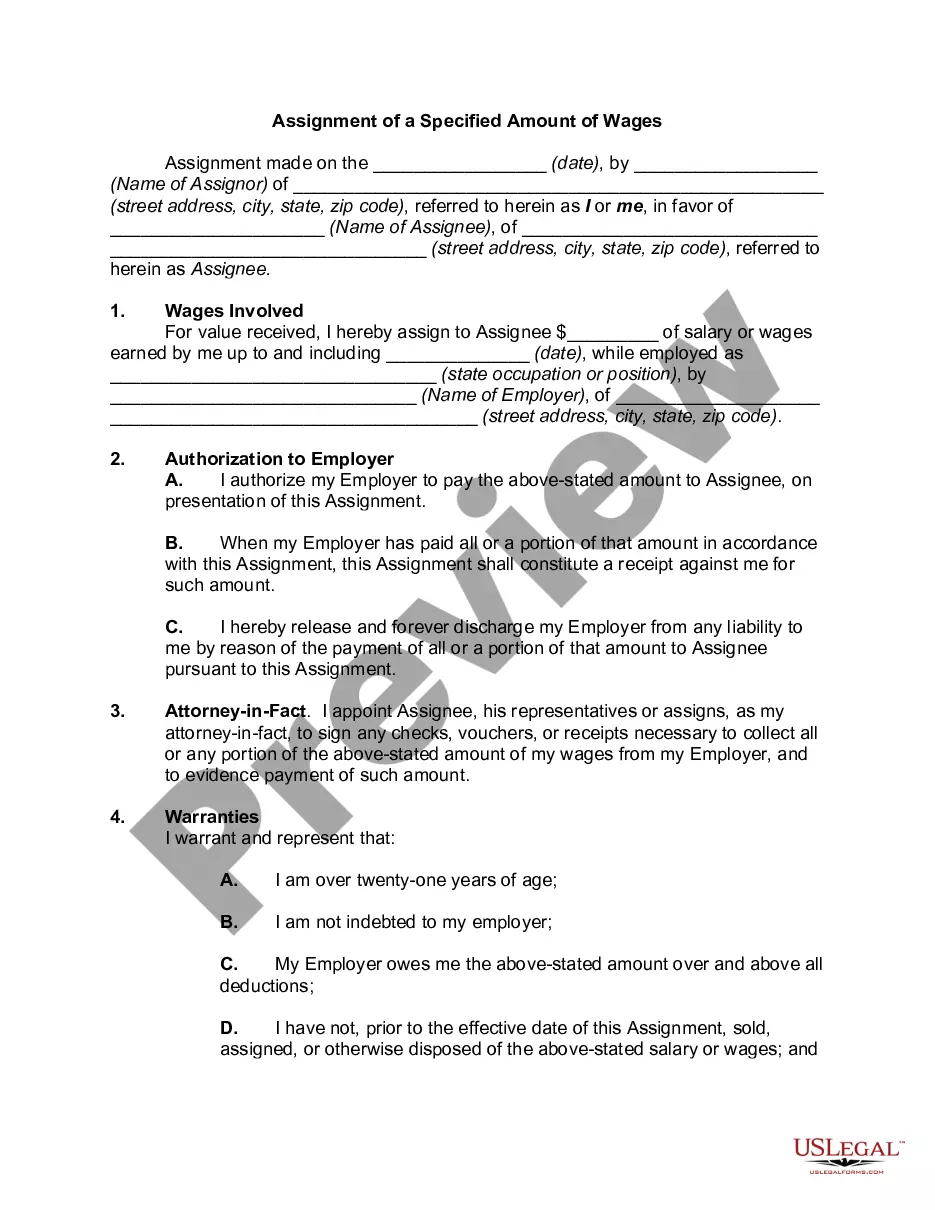
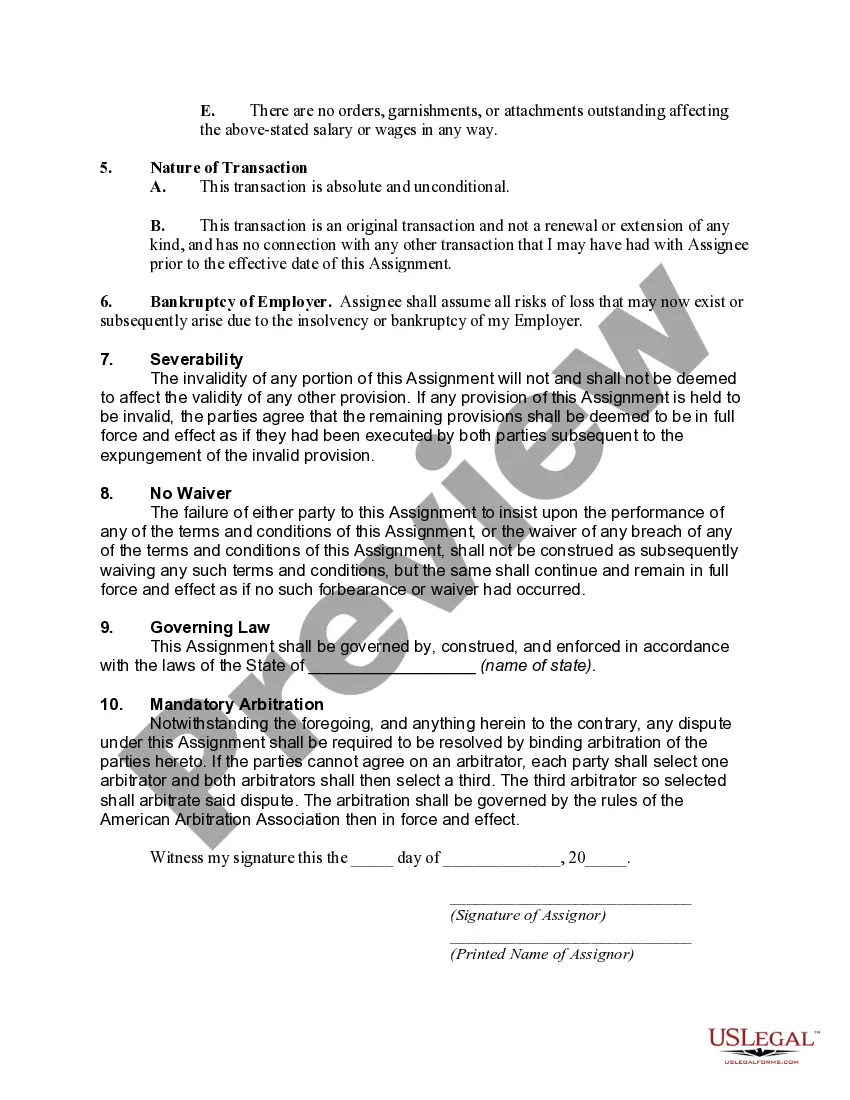
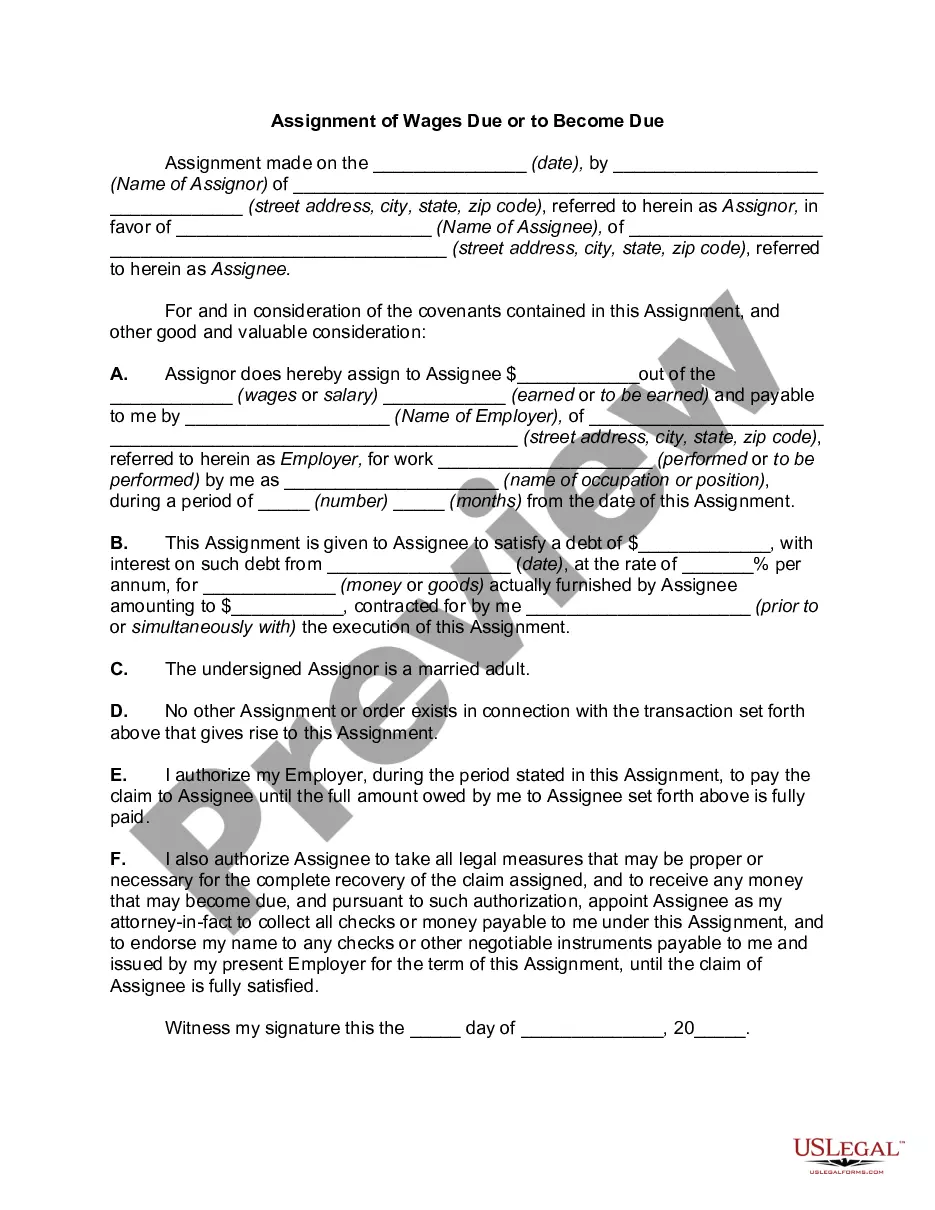
Wage Assignment Example With Parameters
Description
Get your form ready online
Our built-in tools help you complete, sign, share, and store your documents in one place.
Make edits, fill in missing information, and update formatting in US Legal Forms—just like you would in MS Word.
Download a copy, print it, send it by email, or mail it via USPS—whatever works best for your next step.
Sign and collect signatures with our SignNow integration. Send to multiple recipients, set reminders, and more. Go Premium to unlock E-Sign.
If this form requires notarization, complete it online through a secure video call—no need to meet a notary in person or wait for an appointment.
We protect your documents and personal data by following strict security and privacy standards.

Make edits, fill in missing information, and update formatting in US Legal Forms—just like you would in MS Word.

Download a copy, print it, send it by email, or mail it via USPS—whatever works best for your next step.

Sign and collect signatures with our SignNow integration. Send to multiple recipients, set reminders, and more. Go Premium to unlock E-Sign.

If this form requires notarization, complete it online through a secure video call—no need to meet a notary in person or wait for an appointment.

We protect your documents and personal data by following strict security and privacy standards.
Looking for another form?
How to fill out Assignment Of A Specified Amount Of Wages?
Securing a reliable source for accessing the most up-to-date and pertinent legal templates is a significant part of navigating bureaucracy. Locating the suitable legal documents requires precision and careful consideration, which is why it is essential to obtain Wage Assignment Example With Parameters solely from trustworthy providers, such as US Legal Forms. An incorrect template can squander your time and delay your current situation. With US Legal Forms, you can have peace of mind.
You can find and review all the details concerning the document’s applicability and significance for your case and within your jurisdiction.
Eliminate the complications associated with your legal paperwork. Explore the vast library of US Legal Forms where you can discover legal templates, assess their relevance to your particular situation, and download them right away.
- Use the library navigation or search function to find your template.
- Review the form’s details to confirm it meets the criteria of your state and locality.
- If available, check the form preview to ensure it is indeed the document you need.
- Return to the search and locate the appropriate document if the Wage Assignment Example With Parameters does not fulfill your criteria.
- Once you are confident in the form’s applicability, download it.
- If you are a registered user, click Log in to verify and access your selected templates in My documents.
- If you do not have an account yet, click Buy now to purchase the template.
- Choose the pricing option that suits your needs.
- Proceed to register to complete your purchase.
- Finalize your purchase by selecting a payment method (credit card or PayPal).
- Select the document format for downloading the Wage Assignment Example With Parameters.
- Once you have the template on your device, you can edit it using the editor or print it to fill it out manually.
Form popularity
FAQ
To categorize a wage garnishment in QuickBooks, start by creating a liability account specifically for the garnished wages. Next, record the garnishment as a transaction under that liability account to keep track of the amounts owed. QuickBooks can help you manage and document these transactions effectively, making it simpler to maintain accurate financial records while adhering to wage assignment examples with parameters.
A wage garnishment example occurs when a court orders an employer to withhold a portion of an employee's earnings to satisfy a debt, such as child support or a tax obligation. For instance, if an employee owes back taxes, the Internal Revenue Service (IRS) may issue a garnishment order to take 15% of their wages. Knowing the difference between wage garnishment and wage assignment examples with parameters is important for anyone dealing with debt issues.
A wage is typically the compensation an employee receives in exchange for their work. For example, if a worker earns $20 per hour and works 40 hours a week, their weekly wage would be $800 before taxes and other deductions. When it comes to wage assignment examples with parameters, understanding how wages are calculated is crucial for determining how much can be assigned.
To figure out wage garnishment, start by reviewing your financial obligations and any court judgments against you. A wage assignment example with parameters can clarify how much of your paycheck might be withheld. Typically, the court or creditor will provide details about the percentage of your wages subject to garnishment. Utilizing reliable resources, such as US Legal Forms, can help you understand your rights and how to navigate the garnishment process effectively.
Lenders get a wage garnishment by taking the borrower to court. Wage assignments do not go through the courts. Instead, the lender just sends the borrower a notice & begins taking a portion of their wages.
A wage assignment is a voluntary or involuntary transfer of earned wages to pay debt, pay back taxes or even pay off student loan debt. Wage assignments may also be used to pay child or spousal support payments.
At a minimum, your written objection to the garnishment should include the following information: the case number and case caption (ex: "XYZ Bank vs. John Doe") the date of your objection. your name and current contact information. the reasons (or "grounds") for your objection, and. your signature.
In a voluntary wage assignment, a worker asks their employer to withhold a portion of their paycheck and send it to a creditor to pay off a debt. Loan agreements may sometimes include in their terms a voluntary wage assignment clause should the borrower default on their loan.
A wage assignment is a voluntary agreement between the employee and creditor where an amount is withheld from the employee's paycheck to satisfy a debt owed to a third-party recipient, whereas under a wage garnishment, the amount withheld from the employee's check is typically obtained through a court order initiated ...