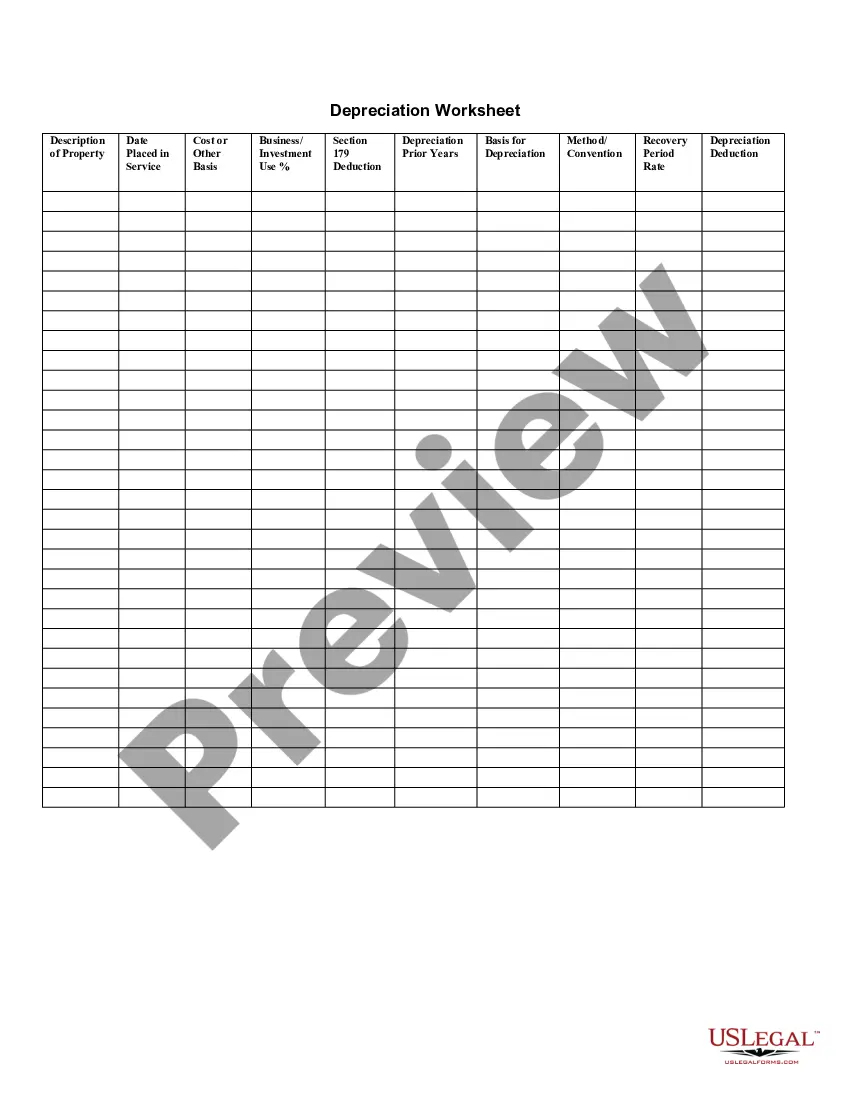
Federal Tax Depreciation Methods
Description
Get your form ready online
Our built-in tools help you complete, sign, share, and store your documents in one place.
Make edits, fill in missing information, and update formatting in US Legal Forms—just like you would in MS Word.
Download a copy, print it, send it by email, or mail it via USPS—whatever works best for your next step.
Sign and collect signatures with our SignNow integration. Send to multiple recipients, set reminders, and more. Go Premium to unlock E-Sign.
If this form requires notarization, complete it online through a secure video call—no need to meet a notary in person or wait for an appointment.
We protect your documents and personal data by following strict security and privacy standards.

Make edits, fill in missing information, and update formatting in US Legal Forms—just like you would in MS Word.

Download a copy, print it, send it by email, or mail it via USPS—whatever works best for your next step.

Sign and collect signatures with our SignNow integration. Send to multiple recipients, set reminders, and more. Go Premium to unlock E-Sign.

If this form requires notarization, complete it online through a secure video call—no need to meet a notary in person or wait for an appointment.

We protect your documents and personal data by following strict security and privacy standards.
Looking for another form?
How to fill out Depreciation Worksheet?
Securing a reliable source for obtaining the most up-to-date and suitable legal documents is part of the challenge of navigating bureaucracy.
Selecting the appropriate legal forms requires precision and meticulousness, which highlights the necessity of obtaining samples of Federal Tax Depreciation Methods solely from credible sources, such as US Legal Forms. An incorrect template can squander your time and postpone your current situation. With US Legal Forms, there is minimal concern. You can access and verify all the details regarding the document’s applicability and relevance for your circumstances and in your state or county.
Once you have the form on your device, you can edit it using the editor or print it and fill it out manually. Eliminate the hassle associated with your legal documentation. Browse the extensive US Legal Forms catalog to discover legal templates, assess their relevance to your situation, and download them immediately.
- Utilize the catalog navigation or search bar to find your template.
- Review the form’s description to ensure it meets the criteria of your state and county.
- View the form preview, if available, to confirm that the template is the one you need.
- Continue the search and look for the suitable document if the Federal Tax Depreciation Methods does not meet your requirements.
- If you are confident about the form’s relevance, download it.
- As a registered user, click Log in to verify and access your selected templates in My documents.
- If you don’t have an account yet, click Buy now to acquire the template.
- Choose the pricing option that matches your needs.
- Proceed to registration to finalize your purchase.
- Complete your transaction by selecting a payment method (credit card or PayPal).
- Select the document format for downloading Federal Tax Depreciation Methods.
Form popularity
FAQ
The four primary federal tax depreciation methods include Straight-Line, Declining Balance, Sum-of-the-Years' Digits, and Units of Production. Each method serves a unique purpose and can affect your tax liability differently. Straight-Line provides equal deductions over an asset's life, while Declining Balance offers larger deductions in the early years. Understanding these methods and how they apply to your assets can simplify your financial strategy, and US Legal Forms can assist you in choosing the right approach.
Choosing the right federal tax depreciation methods depends on your specific situation and the type of asset you are depreciating. You should consider factors like the asset's useful life, your business's financial goals, and how you want to manage your tax liabilities. It's often beneficial to consult with a tax professional who can guide you through the options available to you. Additionally, platforms like US Legal Forms can provide resources to help you understand these methods better.
IRS Form 4562 walkthrough (Depreciation and Amortization) YouTube Start of suggested clip End of suggested clip And you choose to list expense. It under 179. You need to complete part five and then Circle back toMoreAnd you choose to list expense. It under 179. You need to complete part five and then Circle back to part one. So we'll just fast forward. And for use of this we'll just assume that our taxpayer.
Generally, if you're depreciating property you placed in service before 1987, you must use the Accelerated Cost Recovery System (ACRS) or the same method you used in the past. For property placed in service after 1986, you generally must use the Modified Accelerated Cost Recovery System (MACRS).
What do you need to fill out Form 4562 The price of the asset you're depreciating. A receipt for the asset you're depreciating. The date the asset was put into use (when you started using it for your business) The total income you're reporting for the year in question.
The straight-line method of depreciation is one of the most effective methods of allocating the cost of capital assets. With the straight-line method, assets' values are reduced uniformly in every period until it reaches the salvage value, or the end of an asset's useful life.
The straight-line method is the simplest and most commonly used way to calculate depreciation under generally accepted accounting principles. Subtract the salvage value from the asset's purchase price, then divide that figure by the projected useful life of the asset.