Partnership By Estoppel With Examples
Description
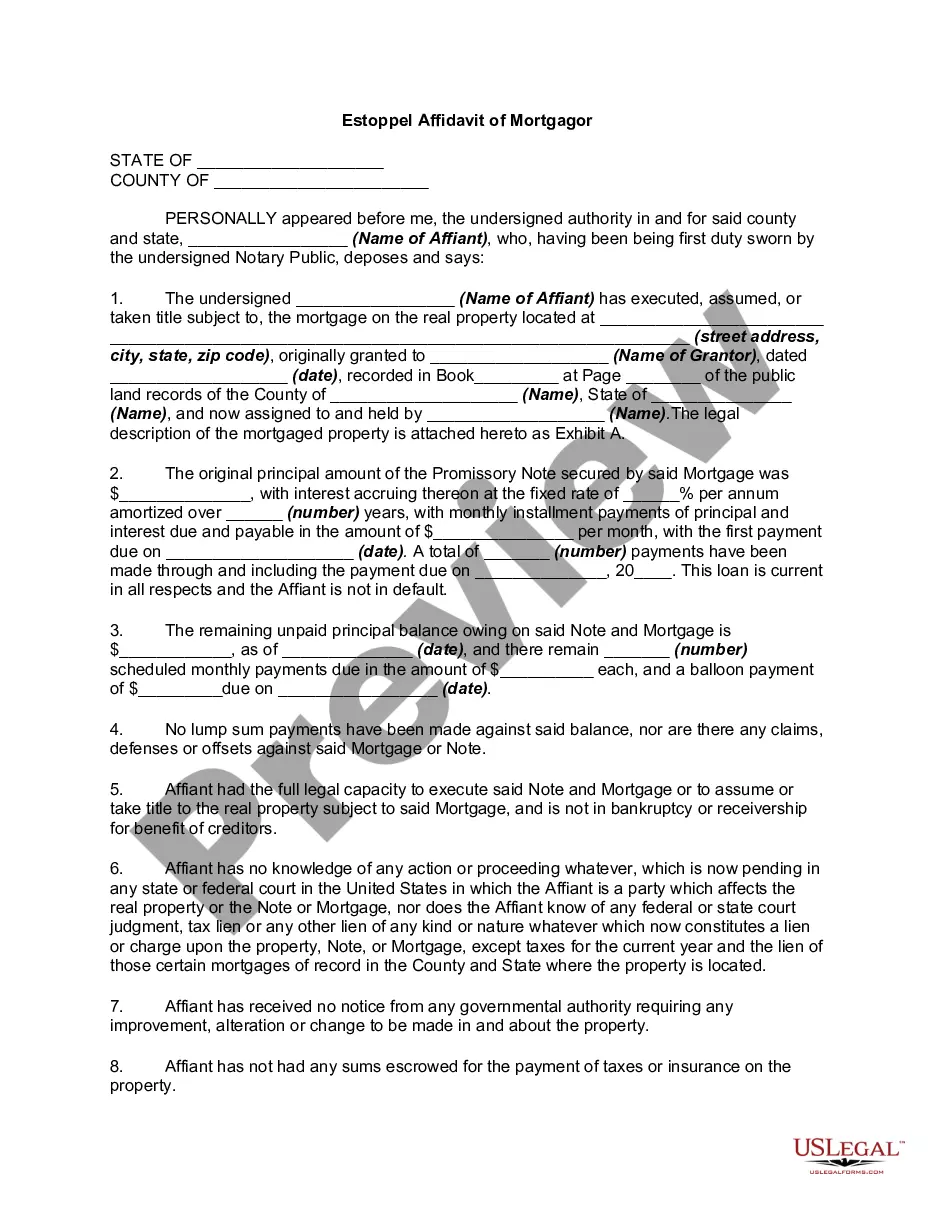



How to fill out Estoppel Affidavit Of Mortgagor?
Securing a reliable source to obtain the latest and pertinent legal templates is a significant part of navigating bureaucracy.
Identifying the appropriate legal documents requires accuracy and meticulousness, which is why it is crucial to source Partnership By Estoppel With Examples exclusively from trustworthy providers, such as US Legal Forms. An incorrect template can squander your time and prolong your situation.
Once you have the form on your device, you can edit it using the editor or print it and complete it by hand. Eliminate the stress associated with your legal documentation. Explore the extensive US Legal Forms library to find legal templates, verify their suitability for your needs, and download them immediately.
- Utilize the catalog navigation or search function to find your template.
- Examine the form’s details to ensure it aligns with the requirements of your state and locality.
- Check the form preview, if available, to confirm the template matches what you need.
- If the Partnership By Estoppel With Examples does not suit your needs, return to the search to find the correct template.
- When you are confident about the form’s suitability, download it.
- If you are a registered user, click Log in to validate your identity and access your chosen forms in My documents.
- If you haven’t created a profile yet, click Buy now to acquire the form.
- Select the pricing plan that meets your needs.
- Proceed to registration to complete your transaction.
- Finalize your purchase by choosing a payment method (credit card or PayPal).
- Select the file type for downloading Partnership By Estoppel With Examples.
Form popularity
FAQ
Liabilities in a partnership agreement generally include shared financial responsibility for debts and obligations undertaken by the partnership. Each partner may be liable for the actions of others if they act within the scope of the partnership’s business. This can lead to unexpected financial exposure, especially without clear terms. It is vital to grasp the nuances of partnership by estoppel with examples to navigate these liabilities effectively.
The main characteristics of partnership by estoppel include the absence of a formal partnership agreement, the reliance of third parties on representations made by the alleged partner, and the resulting legal obligations created by those representations. Typically, the individual causes others to believe they are a partner, leading to a situation where they cannot deny their relationship with the business. These traits enrich understanding and analysis of partnership by estoppel with examples that reflect its practical implications.
A partner by estoppel is an individual that is legally recognized as a partner due to the belief created by their actions or representations, despite not having formal agreement or authority. Essentially, this status arises when others rely on representations that lead them to assume the person is part of a partnership. Therefore, they can be held liable for partnership debts under certain circumstances. For clarity, examining partnership by estoppel with examples illustrates how this recognition occurs.
The liability in a partnership by estoppel can be significant since the courts may hold the alleged partner accountable for debts and obligations of the partnership, despite their passive role. This legal framework protects third parties who rely on the perceived partnership, allowing them to seek recourse from the so-called partner. Essentially, individuals risk being held liable when their actions have misled others regarding their involvement in the business. This underscores the importance of understanding partnership by estoppel with examples to avoid unintended consequences.
A common example of a partner by estoppel is when a business owner allows a friend to use their business address for banking purposes without any formal agreement. The friend may not actively participate in the business but their lack of participation does not prevent others from considering them a partner. This situation causes third parties to believe both individuals are in partnership, leading to potential liabilities. Exploring partnership by estoppel with examples like this helps in recognizing real-world implications.
Partnership by estoppel occurs when a person is treated as a partner due to their conduct, which causes others to reasonably believe they are part of the partnership, even if they do not have actual authority. In contrast, partnership by holding out specifically refers to situations where a person presents themselves as a partner to third parties, intentionally leading them to form a certain belief. Thus, the distinction lies in the intent behind the actions of the individual and the perception that others have based on those actions. Understanding partnership by estoppel with examples helps clarify these concepts.
Filling out a partnership agreement requires careful consideration of key details. First, include the names and addresses of all partners, outlining each person's contribution, roles, and responsibilities within the business. Next, outline how profits and losses will be shared among partners and procedures for resolving disputes. You can simplify this process by using platforms like US Legal Forms, which provide templates and guidance for creating a robust partnership agreement.
A partner by estoppel refers to a situation where an individual is considered a partner in a business, even if they did not officially enter into a partnership agreement. This typically occurs when others reasonably rely on the individual's representation as a partner. For instance, if someone allows their name to be used in business dealings, they may be held liable for debts incurred by the partnership. Understanding partnership by estoppel with examples can clarify your legal responsibilities.
Partnership by holding out occurs when a person represents themselves as a partner, causing others to believe in their partnership status. In contrast, partnership by estoppel emphasizes the reliance of third parties on this perceived status, even if one party did not officially intend to form a partnership. Understanding these distinctions is crucial, especially when navigating legal rights and responsibilities. USLegalForms provides valuable resources to clarify these concepts further.
Consider a scenario where a landlord accepts rent from a tenant without a formal lease for several months. If the landlord then attempts to evict the tenant on the grounds that no valid lease exists, the tenant can argue estoppel. This example shows how estoppel protects parties from sudden legal changes based on established conduct.