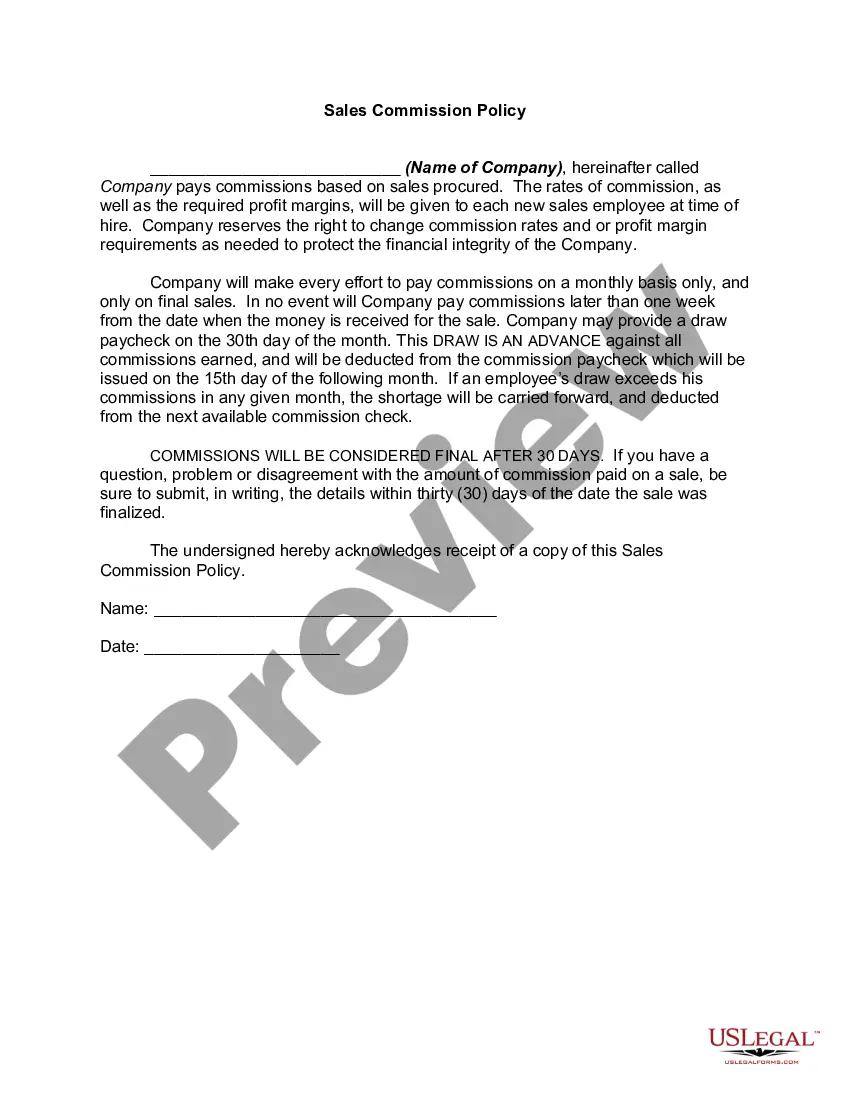
Commission Payment Policy
Description
Get your form ready online
Our built-in tools help you complete, sign, share, and store your documents in one place.
Make edits, fill in missing information, and update formatting in US Legal Forms—just like you would in MS Word.
Download a copy, print it, send it by email, or mail it via USPS—whatever works best for your next step.
Sign and collect signatures with our SignNow integration. Send to multiple recipients, set reminders, and more. Go Premium to unlock E-Sign.
If this form requires notarization, complete it online through a secure video call—no need to meet a notary in person or wait for an appointment.
We protect your documents and personal data by following strict security and privacy standards.

Make edits, fill in missing information, and update formatting in US Legal Forms—just like you would in MS Word.

Download a copy, print it, send it by email, or mail it via USPS—whatever works best for your next step.

Sign and collect signatures with our SignNow integration. Send to multiple recipients, set reminders, and more. Go Premium to unlock E-Sign.

If this form requires notarization, complete it online through a secure video call—no need to meet a notary in person or wait for an appointment.

We protect your documents and personal data by following strict security and privacy standards.
Looking for another form?


How to fill out Sales Commission Policy?
Managing legal documents and activities can be a lengthy addition to your day.
Commission Payment Guidelines and similar forms frequently necessitate searching for them and figuring out how to complete them efficiently.
Thus, if you are addressing financial, legal, or personal affairs, utilizing a comprehensive and practical online directory of forms readily available will be immensely beneficial.
US Legal Forms represents the foremost online platform for legal templates, boasting over 85,000 state-specific forms along with various resources to facilitate the completion of your documents effortlessly.
Simply Log In to your account, locate Commission Payment Guidelines, and download it directly from the My documents section. You can also access previously downloaded documents.
- Explore the collection of pertinent documents accessible to you with just a single click.
- US Legal Forms offers you state- and county-specific forms available for download at any time.
- Protect your document management processes with top-notch support that allows you to prepare any form within minutes without additional or hidden fees.
Form popularity
FAQ
To record commission payable, start by documenting the commission agreements and any earned amounts that remain unpaid. Use accounting software or ledgers to create a liability entry that reflects the commission payable amount. Following the commission payment policy will help you maintain accurate records and ensure timely and precise payments, enhancing your financial management.
To file commission income correctly, you first need to gather all your commission statements and relevant income documentation. After this, you can report this income on Schedule C if you are self-employed or on Form 1040 if you're an employee. It’s crucial to follow the commission payment policy guidelines to ensure accurate reporting and compliance with tax regulations.
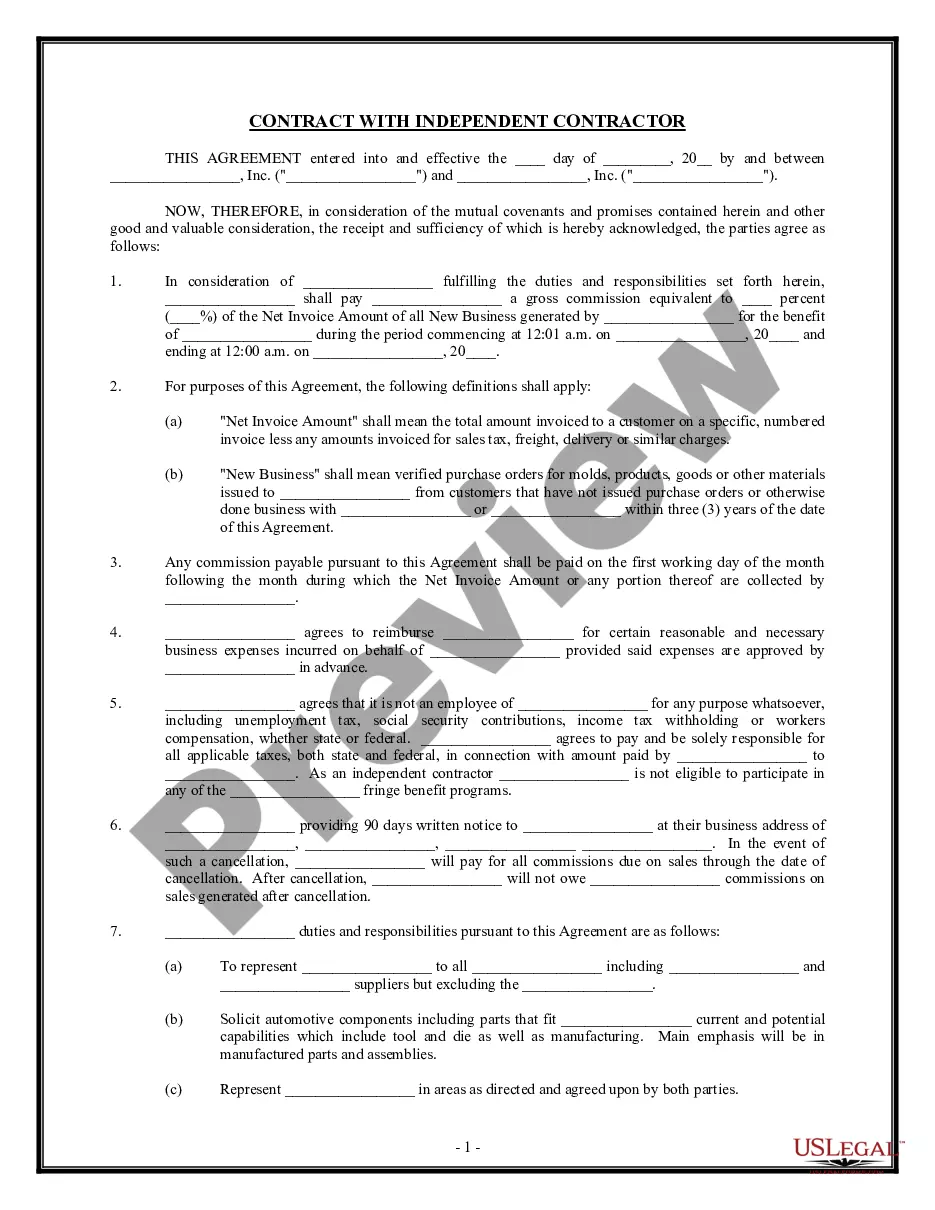
A sales commission clause is a specific section in a contract that outlines how commissions will be awarded. For example, it might state that salespersons earn a 7% commission on all new business generated. This precise language ensures that all parties understand the terms of payment. Including a well-written clause in the commission payment policy can protect both the employee's and employer's interests.
A 5% commission on $10,000 would amount to $500. This calculation is straightforward: you multiply the total sales value by the commission rate to find the commission due. Understanding this calculation is essential for both employers and employees when discussing compensation. When drafting a commission payment policy, clear examples like this can enhance understanding across the team.
Commission payments typically work by calculating a percentage of the sales generated by an employee. This amount can vary based on factors such as the product sold and sales targets achieved. By tying employee earnings directly to their performance, companies encourage higher productivity. A solid commission payment policy can clarify expectations for everyone involved.
A sales commission is a payment made to salespeople based on the sales they generate. For instance, if a salesperson sells a software package for $2,000 and earns a 10% commission, they would receive $200 as their commission. This type of payment structure incentivizes employees to increase sales. Understanding various examples can help you create an effective commission payment policy.
An example of a commission policy could detail various compensation structures based on the type of sale. For instance, the policy might specify a 10% commission for new client acquisitions while offering a reduced 5% for renewals. This strategy emphasizes rewarding new business while maintaining value in existing relationships, showcasing how effective commission payment policies can guide sales strategies.
A sales commission policy typically outlines the structure of how commissions are distributed based on sales performance. For example, a policy might state that sales representatives earn 5% on all sales and an additional 2% for achieving sales targets above a certain threshold. This clarity helps motivate employees to maximize their efforts, reinforcing the importance of a well-designed commission payment policy.
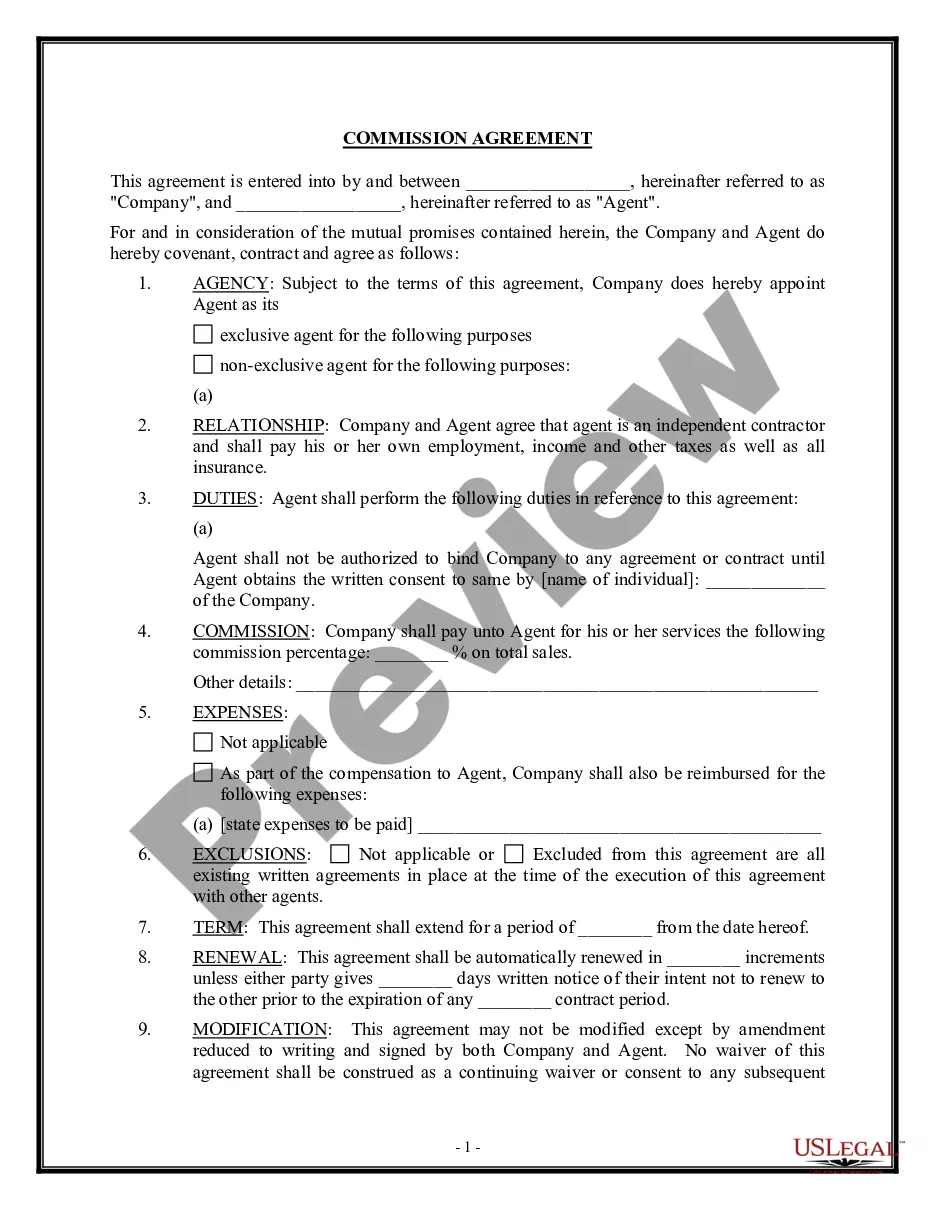
Filling out a commission agreement involves several key steps. First, clearly state the terms of the commission payment policy, including commission rates, payment schedule, and criteria for earning commissions. Both parties should review the document for accuracy and completeness. Once confirmed, both parties can sign, and the agreement becomes legally binding, ensuring clarity in expectations.
A good commission plan aligns with your business goals and motivates employees. Consider offering a competitive commission rate that rewards high performance while ensuring sustainable profit margins. A commission payment policy that includes tiers or bonuses for exceeding targets can effectively encourage your sales team. Ultimately, balance is key—set goals that are achievable yet challenging.