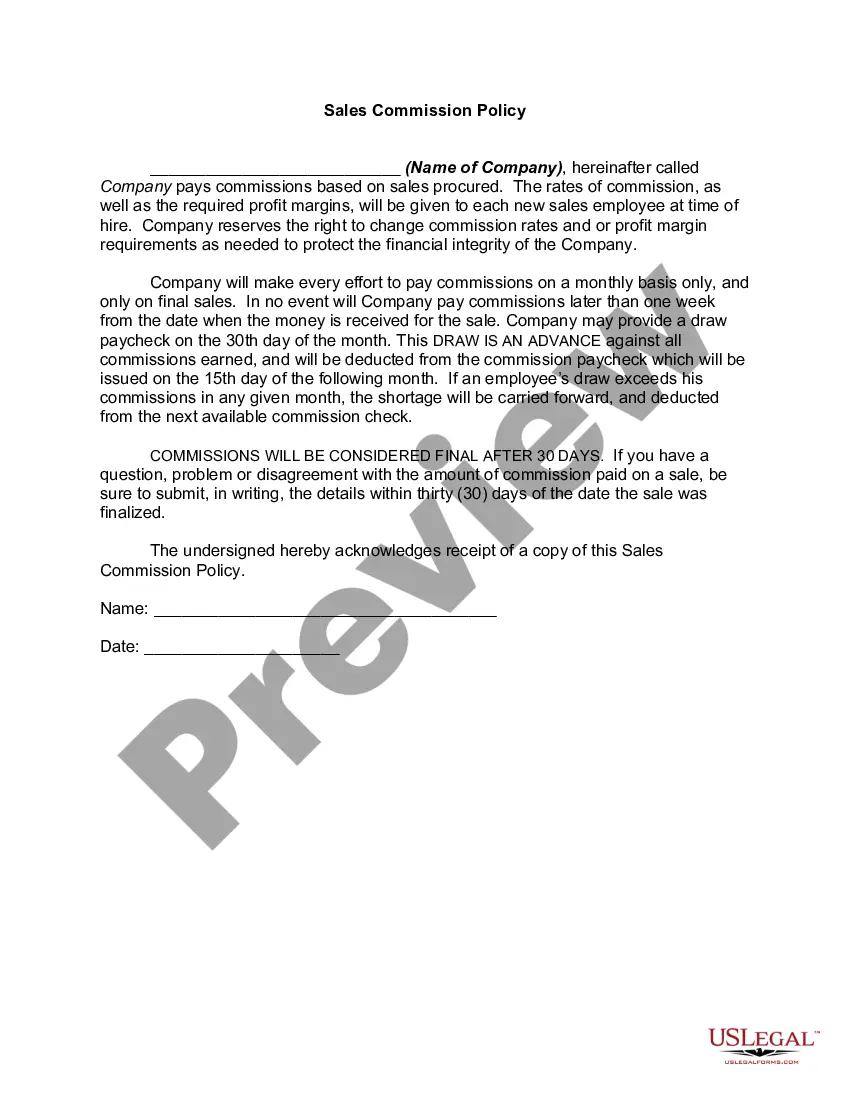
Commission For Examples
Description
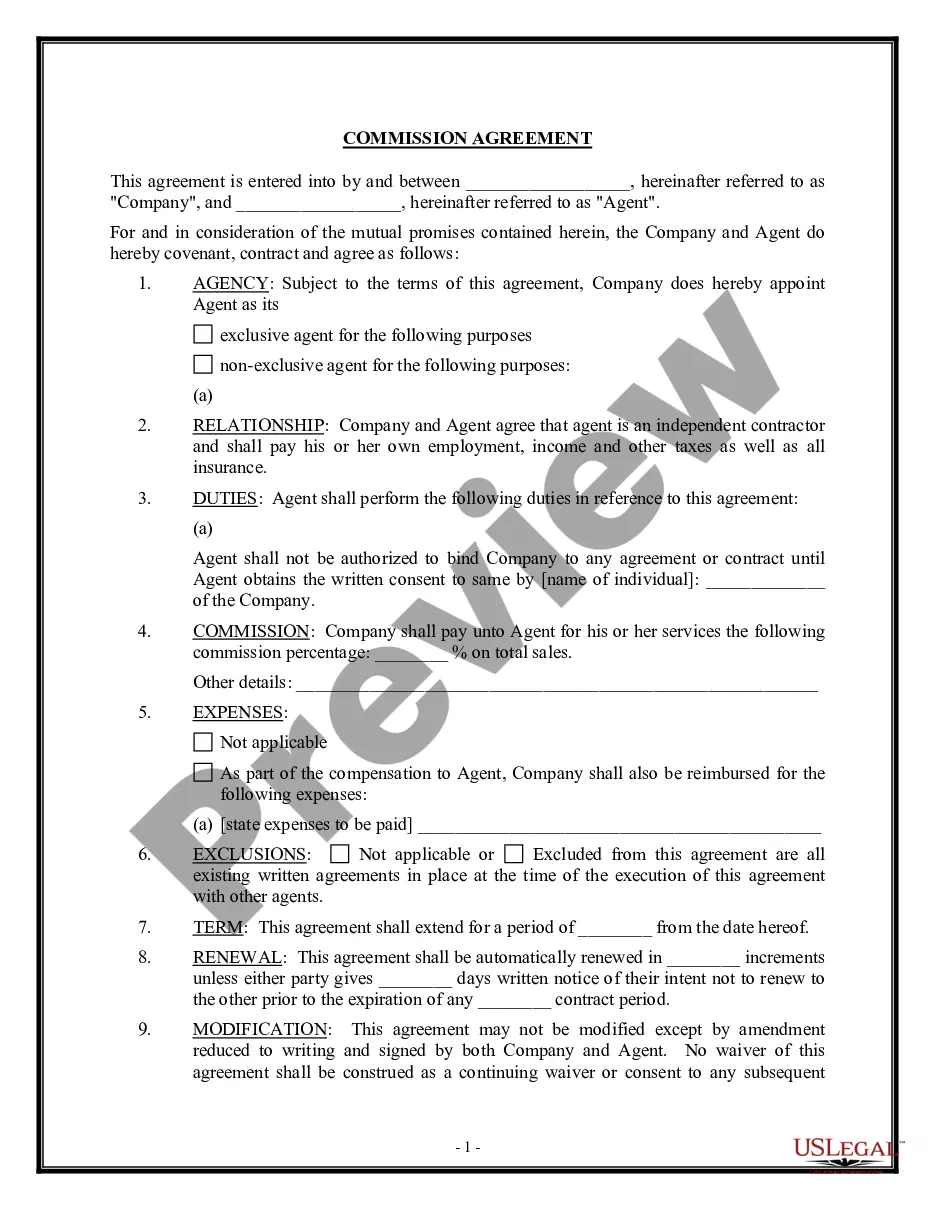
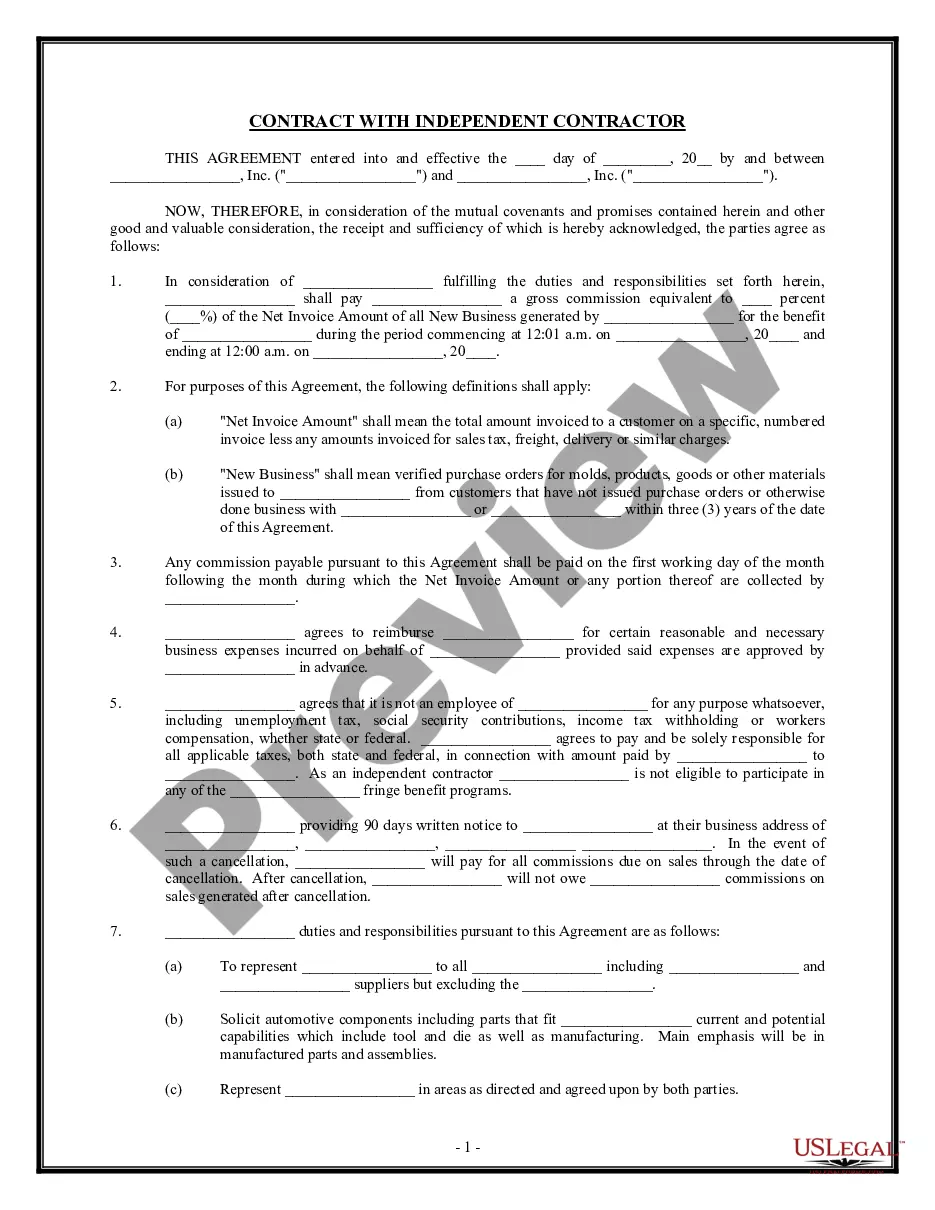
Get your form ready online
Our built-in tools help you complete, sign, share, and store your documents in one place.
Make edits, fill in missing information, and update formatting in US Legal Forms—just like you would in MS Word.
Download a copy, print it, send it by email, or mail it via USPS—whatever works best for your next step.
Sign and collect signatures with our SignNow integration. Send to multiple recipients, set reminders, and more. Go Premium to unlock E-Sign.
If this form requires notarization, complete it online through a secure video call—no need to meet a notary in person or wait for an appointment.
We protect your documents and personal data by following strict security and privacy standards.

Make edits, fill in missing information, and update formatting in US Legal Forms—just like you would in MS Word.

Download a copy, print it, send it by email, or mail it via USPS—whatever works best for your next step.

Sign and collect signatures with our SignNow integration. Send to multiple recipients, set reminders, and more. Go Premium to unlock E-Sign.

If this form requires notarization, complete it online through a secure video call—no need to meet a notary in person or wait for an appointment.

We protect your documents and personal data by following strict security and privacy standards.
Looking for another form?

How to fill out Sales Commission Policy?
It's well known that you cannot transform into a legal expert instantly, nor can you determine how to swiftly prepare Commission For Examples without possessing a distinct set of expertise.
Compiling legal documents is an extensive process necessitating specific education and competencies. So why not entrust the preparation of the Commission For Examples to the professionals.
With US Legal Forms, one of the largest legal template collections, you can gain access to anything from court documents to templates for in-office communication.
You can relog into your forms from the My documents section at any time. If you are an existing client, you can simply Log In, and find and download the template from the same section.
Regardless of the purpose of your forms—whether it be financial and legal, or personal—our platform has got you covered. Try US Legal Forms today!
- Locate the form you require by utilizing the search bar at the top of the page.
- View it (if this option is available) and read the supporting description to ascertain whether Commission For Examples is what you are seeking.
- Initiate your search again if you require a different form.
- Establish a free account and select a subscription plan to purchase the form.
- Click Buy now. Once the transaction is completed, you can download the Commission For Examples, fill it out, print it, and send or mail it to the designated recipients or organizations.
Form popularity
FAQ
To calculate commission on sales, identify the total sale amount and the commission rate. For example, if the sale amount is $400,000 and the commission rate is 7%, you multiply $400,000 by 0.07 to find the commission of $28,000. This simple calculation illustrates how commission for examples can directly impact your revenue.
To find the 6% commission on a $300,000 sale, multiply $300,000 by 0.06. This calculation yields a commission of $18,000. Understanding these figures allows you to evaluate potential earnings accurately, crucial for making informed decisions in your business.
If you have a sale of $250,000, the 5% commission would be calculated by multiplying $250,000 by 0.05. This results in a commission of $12,500. Knowing this can help you anticipate earnings from large transactions, making it essential for planning your finances effectively.
To calculate a 5% commission, multiply the total sale amount by 0.05. This straightforward method gives you the commission amount earned from the sale. For example, if the sale is $200, the commission would be $10. Utilizing this calculation helps in understanding how commission for examples impacts your earnings.
To calculate sales commission, use the formula: Commission = Sales Amount x Commission Rate. First, determine the total sales amount generated by the salesperson. Then, multiply this amount by the agreed-upon commission rate to find the total commission owed. Using examples from USLegalForms, you can see various commission structures that clarify how to apply this formula effectively.
To fill out a commission agreement, start by clearly identifying the parties involved and their roles. Next, outline the terms of the commission, including the percentage, payment schedule, and any specific conditions. You can use USLegalForms to find templates that guide you step-by-step in this process, ensuring accuracy and compliance with legal standards. This structured approach helps protect both parties and clarifies expectations.
Different types of commissions include flat rate commissions, percentage-based commissions, performance-based commissions, and tiered commissions. Each type serves distinct purposes and suits various business models. For instance, tiered commissions can motivate sales teams to exceed sales goals. Understanding these types can help you choose the right commission structure, and platforms like USLegalForms offer resources to guide you.
The most common type of commission is the sales commission, usually based on the percentage of a sale. Sales representatives often earn commissions as an incentive to boost sales and improve performance. This structure benefits both the business and the sales team, encouraging a results-driven approach. Therefore, businesses frequently adopt this model to align goals.
Yes, you must report commission as income on your tax returns. Regardless of whether you receive it as a 1099 or W-2, all commission income is taxable. It's essential to track your earnings throughout the year, ensuring you comply with tax laws regarding commission reporting.
Whether commission income is reported on a 1099 or W-2 form depends on your employment status. If you are an independent contractor, you typically receive a 1099 form for commissions earned. If you are an employee, then your commissions will be reported on a W-2. Understanding this distinction helps you manage your income reporting effectively.