Final Account Estate Form For Probate
Description
Get your form ready online
Our built-in tools help you complete, sign, share, and store your documents in one place.
Make edits, fill in missing information, and update formatting in US Legal Forms—just like you would in MS Word.
Download a copy, print it, send it by email, or mail it via USPS—whatever works best for your next step.
Sign and collect signatures with our SignNow integration. Send to multiple recipients, set reminders, and more. Go Premium to unlock E-Sign.
If this form requires notarization, complete it online through a secure video call—no need to meet a notary in person or wait for an appointment.
We protect your documents and personal data by following strict security and privacy standards.

Make edits, fill in missing information, and update formatting in US Legal Forms—just like you would in MS Word.

Download a copy, print it, send it by email, or mail it via USPS—whatever works best for your next step.

Sign and collect signatures with our SignNow integration. Send to multiple recipients, set reminders, and more. Go Premium to unlock E-Sign.

If this form requires notarization, complete it online through a secure video call—no need to meet a notary in person or wait for an appointment.

We protect your documents and personal data by following strict security and privacy standards.
Looking for another form?









How to fill out Contest Of Final Account And Proposed Distributions In A Probate Estate?
It’s widely recognized that you cannot instantly become a legal expert, nor can you rapidly learn how to efficiently draft the Final Account Estate Form For Probate without possessing a specific educational background.
Developing legal documents is a labor-intensive process that demands particular knowledge and abilities. So why not entrust the creation of the Final Account Estate Form For Probate to the specialists.
With US Legal Forms, one of the largest collections of legal templates, you can obtain anything from judicial documents to templates for internal business correspondence. We appreciate how crucial compliance with federal and state regulations is. That’s why, on our platform, all forms are geographically tailored and current.
Select Buy now. Once the payment is completed, you can download the Final Account Estate Form For Probate, complete it, print it, and forward it by mail to the relevant persons or entities.
You can revisit your forms from the My documents section at any moment. If you’re a current client, you can easily Log In, and locate and download the template from the same section. Regardless of your document's intent—whether financial, legal, or personal—our platform is at your service. Experience US Legal Forms today!
- Initiate your journey with our platform and acquire the document you need in just a few minutes.
- Locate the document you require with the search bar at the top of the webpage.
- Review it (if this choice is offered) and examine the accompanying description to determine if the Final Account Estate Form For Probate is suitable for your needs.
- Restart your search if you require an alternative template.
- Sign up for a free account and choose a subscription option to buy the form.
Form popularity
FAQ
All beneficiaries do not need to formally approve estate accounts; however, it is best practice for the Executor(s) and main beneficiaries to sign the estate accounts to show a legal agreement across all parties. Nevertheless, the beneficiaries are entitled to receive a copy of them and review the information.
Every state sets the priority ing to which claims must be paid. The estate's beneficiaries only get paid once all the creditor claims have been satisfied. Usually, estate administration fees, funeral expenses, support payments, and taxes have priority over other claims.
An informal accounting for an estate is a document that outlines the financial activities of the estate. This type of accounting is often used to prepare financial statements of affairs. It includes details about assets and liabilities, income and expenses, donations or transfers from the estate, and tax information.
By way of example, in a relatively simple estate an informal accounting can consist of copies of all of the estate account statements and a copy of the fiduciaries check register. If there was real property sold by the fiduciary a copy of the closing statement should be provided to the beneficiaries.
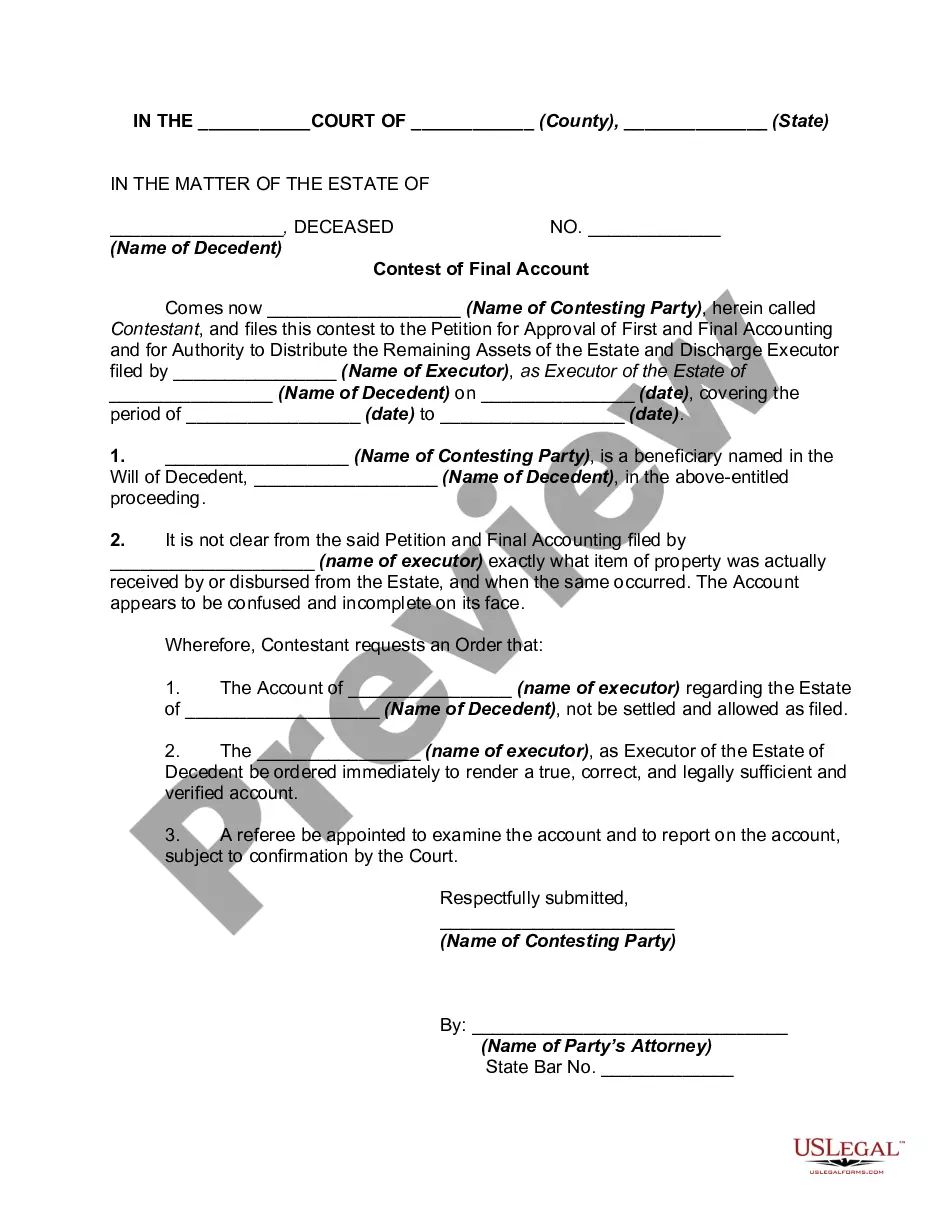
A Final Account is a complete record detailing the assets, receipts, and disbursements made during a probate administration.