Memorandum Trust With Employees
Description
Get your form ready online
Our built-in tools help you complete, sign, share, and store your documents in one place.
Make edits, fill in missing information, and update formatting in US Legal Forms—just like you would in MS Word.
Download a copy, print it, send it by email, or mail it via USPS—whatever works best for your next step.
Sign and collect signatures with our SignNow integration. Send to multiple recipients, set reminders, and more. Go Premium to unlock E-Sign.
If this form requires notarization, complete it online through a secure video call—no need to meet a notary in person or wait for an appointment.
We protect your documents and personal data by following strict security and privacy standards.

Make edits, fill in missing information, and update formatting in US Legal Forms—just like you would in MS Word.

Download a copy, print it, send it by email, or mail it via USPS—whatever works best for your next step.

Sign and collect signatures with our SignNow integration. Send to multiple recipients, set reminders, and more. Go Premium to unlock E-Sign.

If this form requires notarization, complete it online through a secure video call—no need to meet a notary in person or wait for an appointment.

We protect your documents and personal data by following strict security and privacy standards.
Looking for another form?







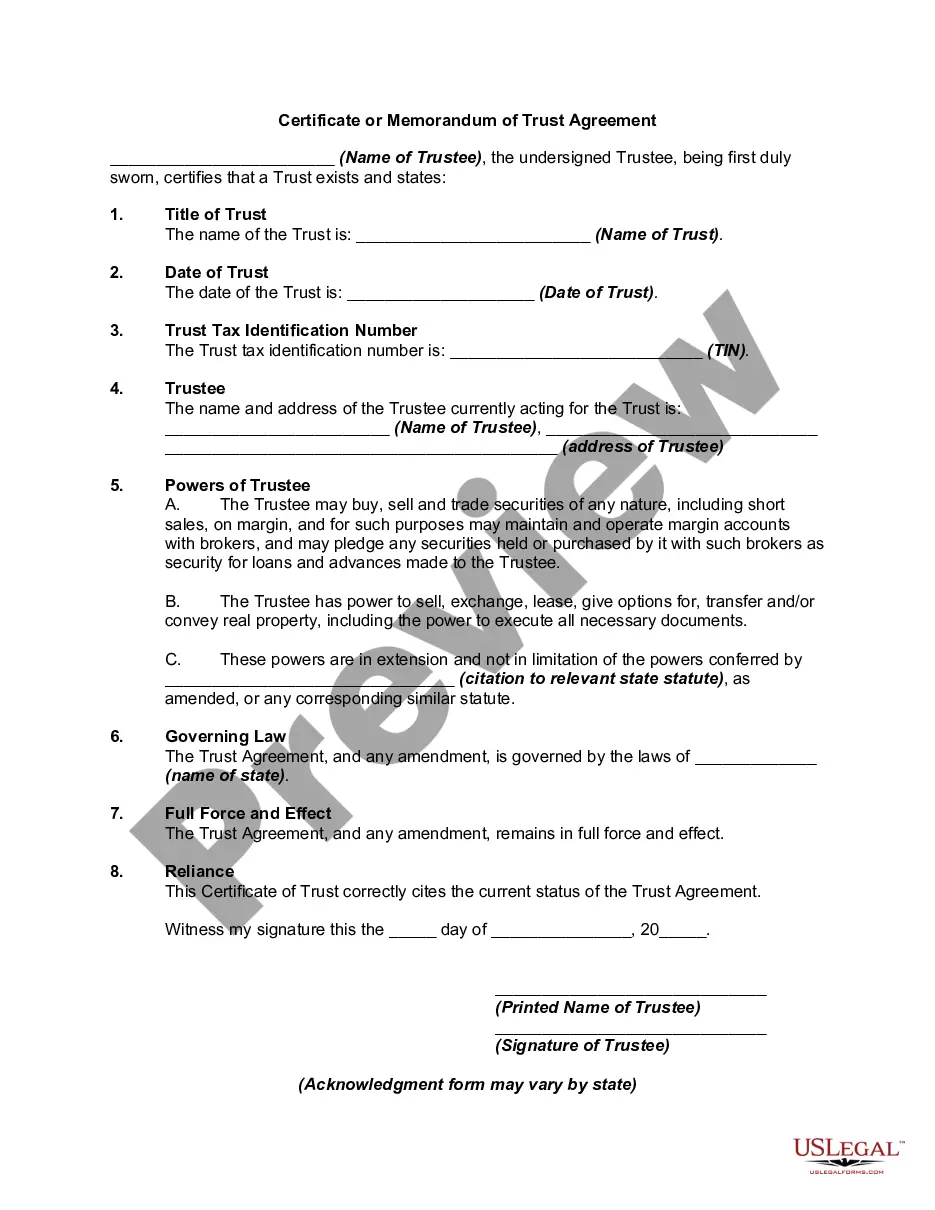
How to fill out Certificate Or Memorandum Of Trust Agreement?
Regardless of whether it's for professional reasons or personal affairs, everyone must handle legal issues at some stage in their life.
Filling out legal documents requires meticulous care, starting with the selection of the appropriate form template.
With an extensive catalog from US Legal Forms available, you can save time searching for the suitable template online. Utilize the library's intuitive navigation to locate the perfect template for any circumstance.
- Obtain the required sample by utilizing the search bar or browsing the catalog.
- Review the specifics of the form to verify it suits your circumstances, state, and locality.
- Click on the preview of the form to examine it.
- If it is not the right document, return to the search feature to locate the required Memorandum Trust With Employees sample.
- Download the document if it satisfies your requirements.
- If you possess a US Legal Forms account, simply click Log in to retrieve previously saved documents in My documents.
- If you haven't created an account yet, you can download the form by clicking Buy now.
- Choose the correct payment option.
- Fill out the account registration form.
- Select your payment method: utilize a credit card or PayPal account.
- Choose the file format you desire and download the Memorandum Trust With Employees.
- Once downloaded, you can fill out the form using editing applications or print it and complete it by hand.
Form popularity
FAQ
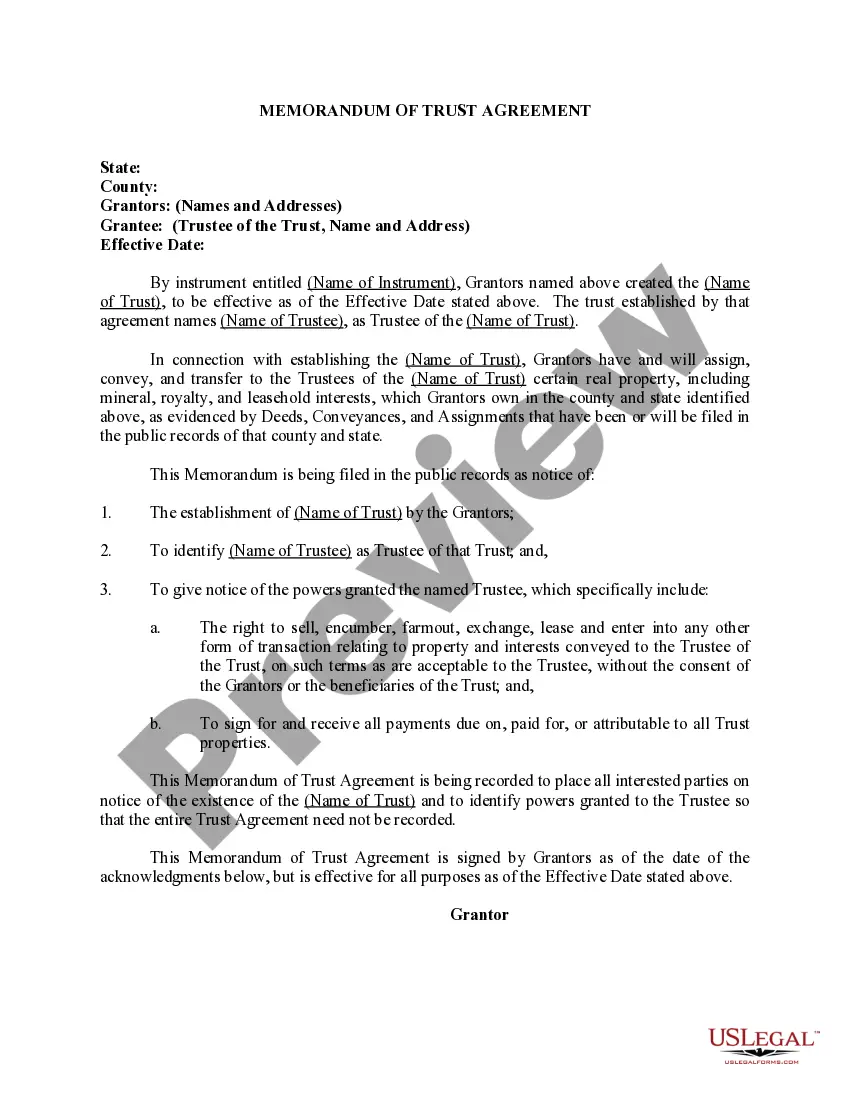
The purpose of the memorandum of trust is to provide a clear and concise outline of the trust's framework and intentions. It serves as a guide for trustees and beneficiaries, detailing how the trust will be managed and distributed. Using a memorandum trust with employees can enhance clarity in operations and reinforce the trust's integrity.
Yes, a trust can employ individuals, depending on its structure and purpose. If the trust is set up to manage a business or generate income, it may hire employees to fulfill its objectives. Therefore, understanding how a memorandum trust with employees operates can help you navigate the complexities of employment within a trust.
The Memorandum of trust is a legal document that outlines the terms and conditions of a trust agreement. It clarifies the roles of the trustee and beneficiaries, ensuring everyone involved understands their rights and obligations. By utilizing a memorandum trust with employees, you can promote transparency and trust within your organization.
A memorandum serves as a written record that outlines important information or decisions within an organization. It helps communicate essential details clearly and efficiently among employees. When discussing a memorandum trust with employees, it ensures that all parties understand their roles and responsibilities.
When writing a memo to an employee, focus on clarity and purpose. Begin with a direct subject line, followed by a respectful salutation. Clearly outline the message, addressing specific points relevant to the employee's role, and finish with any necessary follow-up actions. Such communication fosters a memorandum trust with employees, enhancing workplace relationships.
To write a memo professionally, start with a formal greeting and a clear subject. Use straightforward language, maintain a polite tone, and organize the content logically. Avoid jargon or overly complex sentences, as clarity is key in building a memorandum trust with employees, ensuring your message is both received and understood.
The proper format for a memorandum includes a header with the date, to, from, and subject lines, followed by an introduction, body, and conclusion. Each section should be clearly defined, and the content should be concise. This structured approach enhances readability, supporting a memorandum trust with employees by ensuring they can easily understand and refer back to your message.
Filling out a memorandum involves entering specific information in designated sections. Start with the date, followed by the names of the recipient and sender, and include a clear subject line. Next, write the message in a structured format, ensuring each point is concise and relevant, which builds a memorandum trust with employees as they receive organized information.
An example of a memo could be a company-wide announcement regarding a policy change or an update on project deadlines. Memos typically include sections for the date, the recipient, the sender, and the subject, followed by the main message. This format helps maintain professional communication and promotes a memorandum trust with employees, fostering transparency.
To write an effective memo to employees, start with a clear subject line that reflects the main topic. Begin with a brief introduction stating the purpose of the memo, followed by the main content organized into sections. Use bullet points for clarity and finish with a summary or a call-to-action. Utilizing a memorandum trust with employees ensures your message is understood and retained.