Towing Vehicles Form With Insurance
Description
Get your form ready online
Our built-in tools help you complete, sign, share, and store your documents in one place.
Make edits, fill in missing information, and update formatting in US Legal Forms—just like you would in MS Word.
Download a copy, print it, send it by email, or mail it via USPS—whatever works best for your next step.
Sign and collect signatures with our SignNow integration. Send to multiple recipients, set reminders, and more. Go Premium to unlock E-Sign.
If this form requires notarization, complete it online through a secure video call—no need to meet a notary in person or wait for an appointment.
We protect your documents and personal data by following strict security and privacy standards.

Make edits, fill in missing information, and update formatting in US Legal Forms—just like you would in MS Word.

Download a copy, print it, send it by email, or mail it via USPS—whatever works best for your next step.

Sign and collect signatures with our SignNow integration. Send to multiple recipients, set reminders, and more. Go Premium to unlock E-Sign.

If this form requires notarization, complete it online through a secure video call—no need to meet a notary in person or wait for an appointment.

We protect your documents and personal data by following strict security and privacy standards.
Looking for another form?






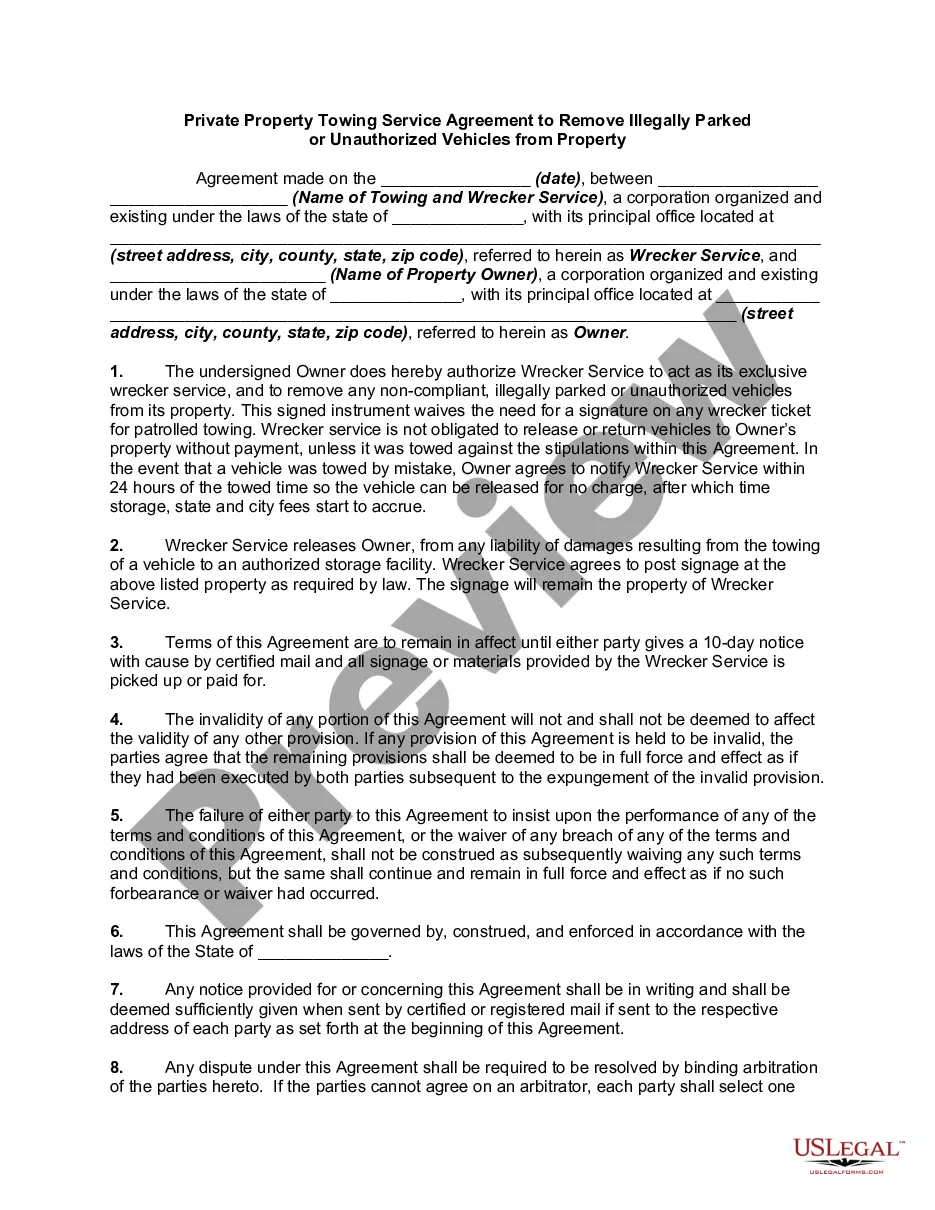
How to fill out Private Property Truck Towing Service Agreement To Remove Illegally Parked Or Unauthorized Vehicles From Property?
Whether for commercial objectives or for personal matters, everyone encounters legal issues at some point in their life.
Filling out legal documents necessitates meticulous consideration, beginning with choosing the correct form template.
With an extensive US Legal Forms collection available, you won't waste time searching for the correct template online. Use the library's straightforward navigation to find the right template for any scenario.
- Locate the template you require by using the search bar or browsing the catalog.
- Review the details of the form to ensure it aligns with your circumstances, state, and county.
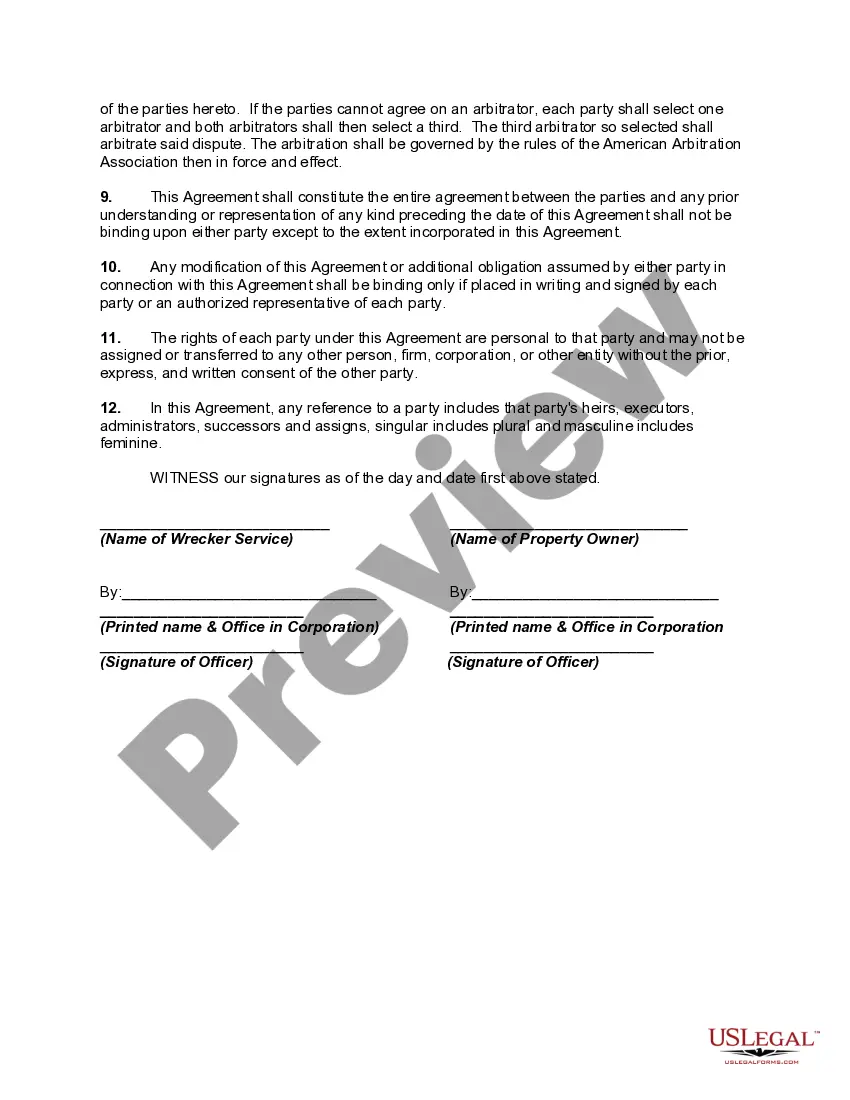
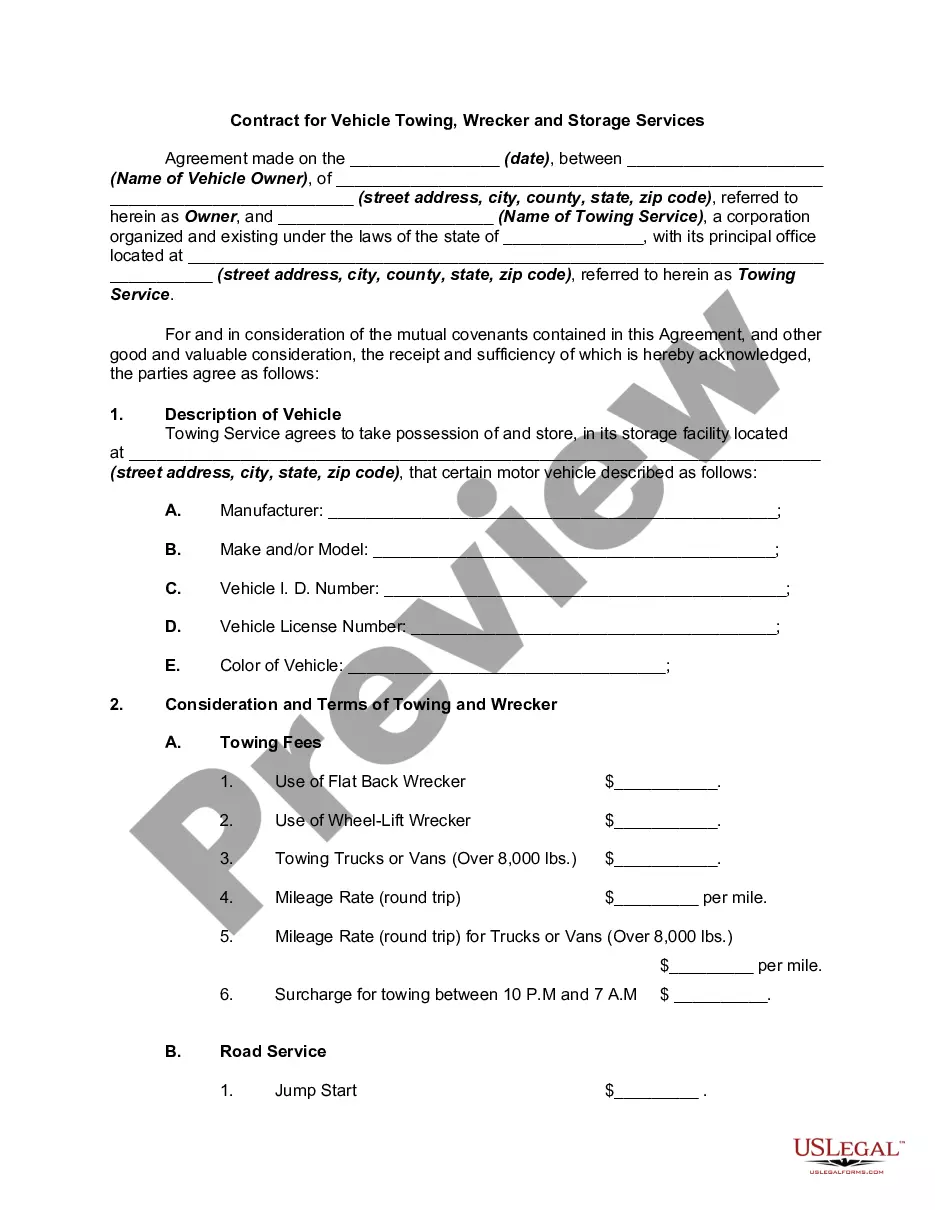
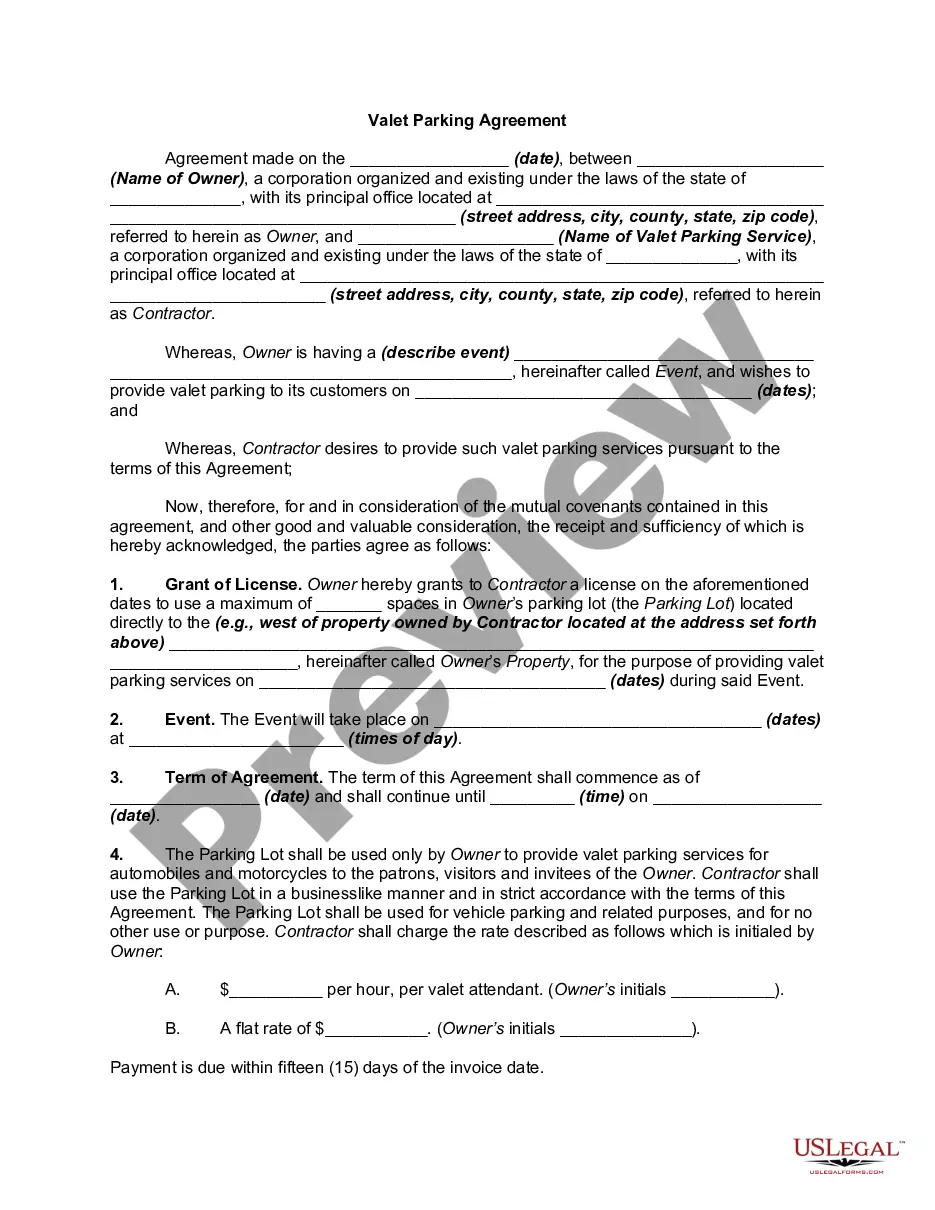
- Click on the form's preview to examine it.
- If it is the wrong form, return to the search feature to find the Towing Vehicles Form With Insurance example you need.
- Download the document if it meets your specifications.
- If you already have a US Legal Forms account, simply click Log in to access previously saved documents in My documents.
- If you haven't registered yet, you can acquire the form by clicking Buy now.
- Select the suitable pricing option.
- Fill out the profile registration form.
- Choose your payment method: you can utilize a credit card or PayPal account.
- Select the file format you prefer and download the Towing Vehicles Form With Insurance.
- Once downloaded, you can complete the form using editing software or print it out and finish manually.
Form popularity
FAQ
In most cases, you will need valid insurance to retrieve your vehicle from a tow yard. The towing company often requires proof of insurance to verify that you can cover any associated costs. By using a towing vehicles form with insurance, you document your coverage, which may expedite the release of your vehicle.
Who Gets the Family Home in a Missouri Divorce? Even though Missouri judges will consider whether the custodial parent should stay in the marital home, the law doesn't say that either spouse must get to keep the family home after divorce.
During a Missouri divorce, the wife is entitled to a fair share of marital property. This commonly includes the marital home, car, savings, retirement account, business interests, and valuable household items.
Missouri is an equitable distribution state, which means that property will be divided by the court in a manner that is fair to both parties but not necessarily equally. Missouri is also a dual-property state, which means that property can be defined as either marital or nonmarital.
Divorce decrees can be obtained from the Circuit Clerk in the county where the divorce was granted. If someone wants to access public court records, they can access all public records held in local and state governments, including county courts. Under Mo. Rev.
These forms usually include an 'Income and Expense Statement,' a 'Statement of Property and Debt,' a 'Parenting Plan' if children are involved, a 'Filing Information Sheet,' a 'Certificate of Dissolution,' and a proposed 'Judgment of Dissolution of Marriage. ' These forms are available for download from this site.
Is Missouri a fifty-fifty state during a divorce? No, Missouri is not a 50/50 state during the divorce process. Missouri is an ?equitable distribution? state, where a judge will decide how to divide marital property if the two parties cannot reach an amicable settlement.
In a Missouri divorce, all marital property is subject to equitable distribution. The judge will attempt to divide marital assets as fairly as possible. This does not necessarily mean that property will be evenly split.
There is no requirement for an attorney to get a uncontested divorce in Missouri; however, you may consult with one prior to separation to know what you're entitled to. Additionally, Missouri courts require you to attend an online class if you're representing yourself in court, including in an uncontested divorce.