The Miller Trust For Texas
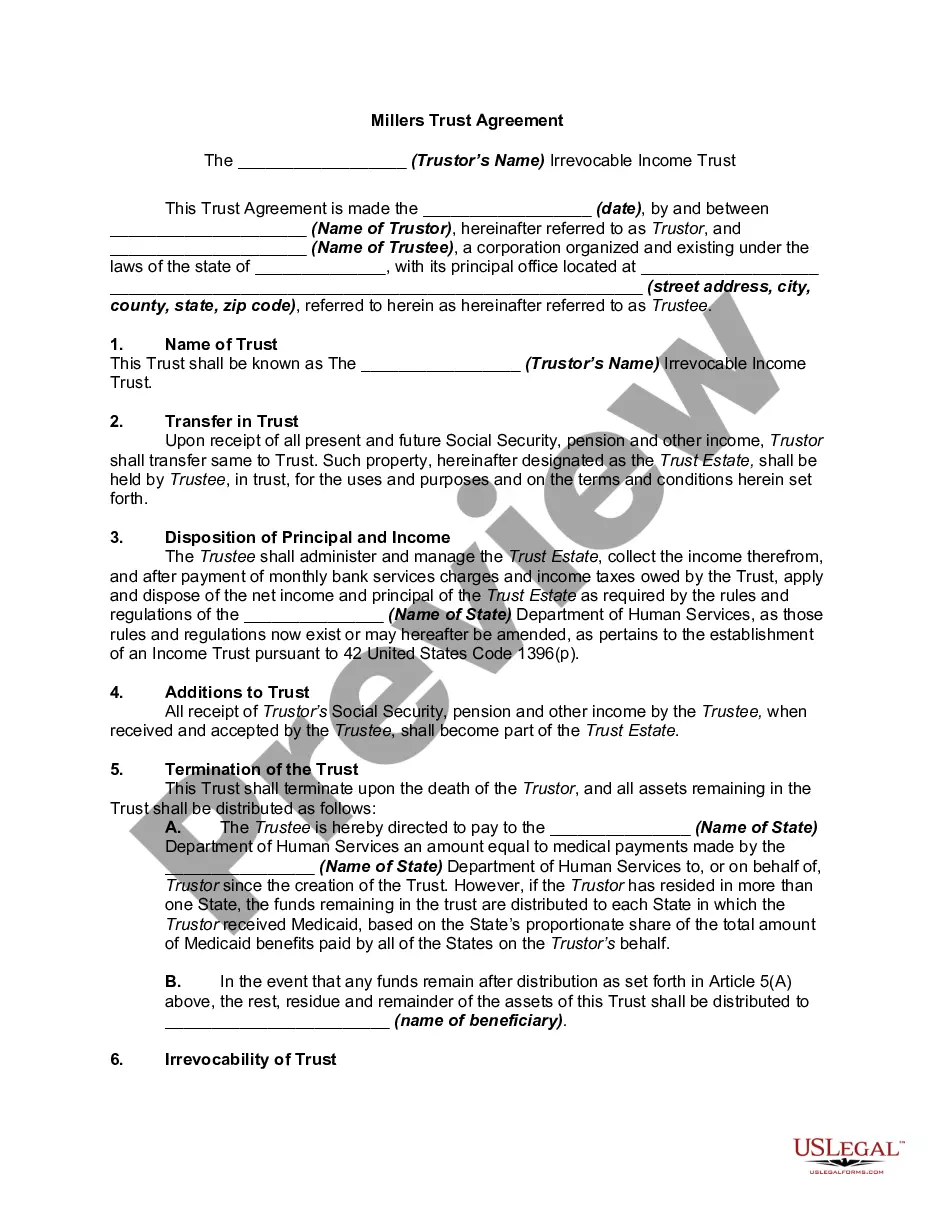
Description

Get your form ready online
Our built-in tools help you complete, sign, share, and store your documents in one place.
Make edits, fill in missing information, and update formatting in US Legal Forms—just like you would in MS Word.
Download a copy, print it, send it by email, or mail it via USPS—whatever works best for your next step.
Sign and collect signatures with our SignNow integration. Send to multiple recipients, set reminders, and more. Go Premium to unlock E-Sign.
If this form requires notarization, complete it online through a secure video call—no need to meet a notary in person or wait for an appointment.
We protect your documents and personal data by following strict security and privacy standards.

Make edits, fill in missing information, and update formatting in US Legal Forms—just like you would in MS Word.

Download a copy, print it, send it by email, or mail it via USPS—whatever works best for your next step.

Sign and collect signatures with our SignNow integration. Send to multiple recipients, set reminders, and more. Go Premium to unlock E-Sign.

If this form requires notarization, complete it online through a secure video call—no need to meet a notary in person or wait for an appointment.

We protect your documents and personal data by following strict security and privacy standards.
Looking for another form?








How to fill out Qualified Income Miller Trust?
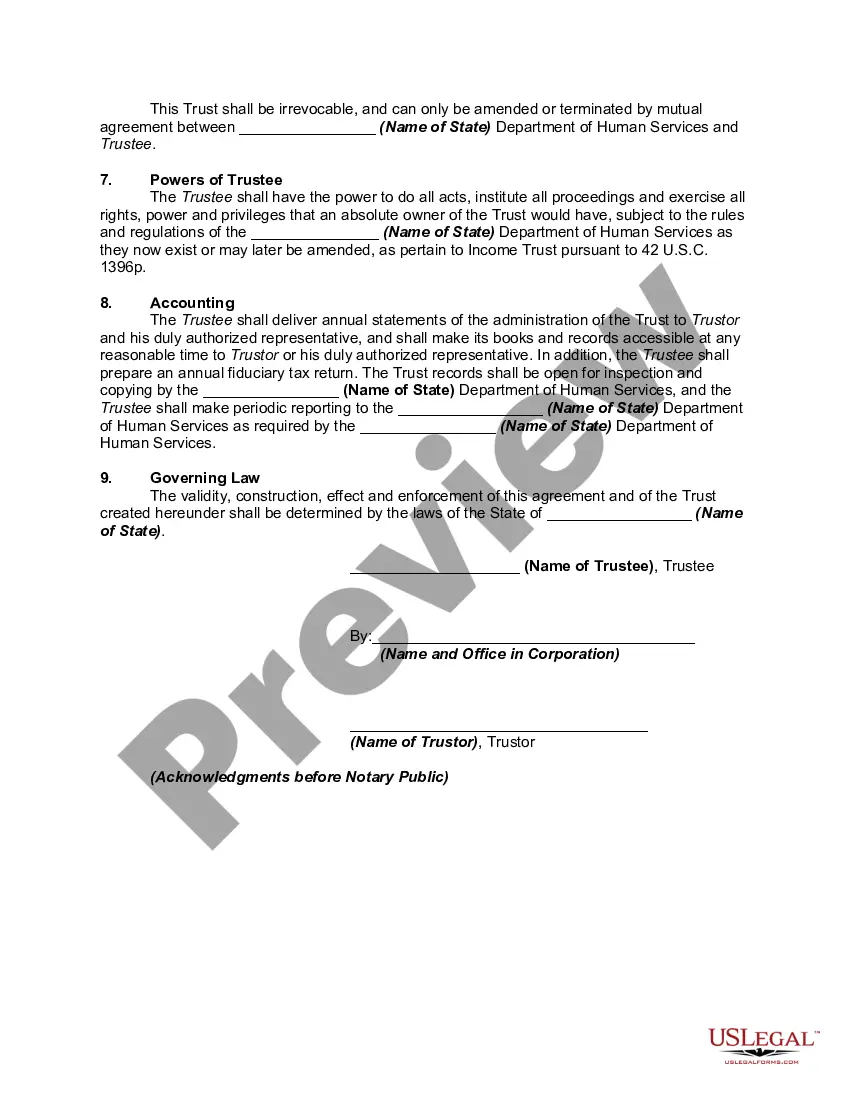
The Miller Trust For Texas that you observe on this page is a versatile official template crafted by experienced attorneys in accordance with federal and state regulations.
For over 25 years, US Legal Forms has supplied individuals, enterprises, and lawyers with more than 85,000 validated, state-specific forms for any professional and personal circumstance. It’s the fastest, easiest, and most reliable way to acquire the documents you require, as the service ensures bank-level data protection and anti-malware safeguards.
Register for US Legal Forms to have confirmed legal templates for all of life’s situations at your fingertips.
- Explore the document you need and examine it.
- Sign up and Log In.
- Obtain the editable template.
- Fill out and endorse the documents.
- Re-download your files as needed.
Form popularity
FAQ
How do I set up a Qualified Income Trust? A lawyer creates the trust documents, which are then signed and notarized by both the settlor (beneficiary) or the settlor's (beneficiary's) agent under a power of attorney, and the trustee.
A Qualifying Income Trust (QIT) also referred to as Miller Trust, is a trust that allows the beneficiary to control the amount of income that is used to determine Medicaid eligibility. A qualified income trust in Texas helps people qualify for Medicaid but it doesn't shelter income.
Income deposits into the trust may also provide funds to a spouse if the patient is married. In Texas, Miller Trust funds can also be used to pay for health insurance and Medicare premiums. Medical costs not covered by Medicare and Medicaid can also be paid from the trust.
The state in which the Medicaid recipient will be receiving long-term care benefits must be named as the beneficiary, and upon the death of the individual, the state will receive any funds it paid into the Miller Trust that were unused. The trust is irrevocable, which means that it cannot be altered or cancelled.
Further, under Texas law, a Miller Trust must require the trustee to make the following distributions: A monthly personal needs allowance to the beneficiary; Any court-ordered guardianship fees; A sum sufficient to give the beneficiary's spouse a minimum monthly maintenance needs allowance; and.