Qualified Trust Caps Statement With Text
Description

Get your form ready online
Our built-in tools help you complete, sign, share, and store your documents in one place.
Make edits, fill in missing information, and update formatting in US Legal Forms—just like you would in MS Word.
Download a copy, print it, send it by email, or mail it via USPS—whatever works best for your next step.
Sign and collect signatures with our SignNow integration. Send to multiple recipients, set reminders, and more. Go Premium to unlock E-Sign.
If this form requires notarization, complete it online through a secure video call—no need to meet a notary in person or wait for an appointment.
We protect your documents and personal data by following strict security and privacy standards.

Make edits, fill in missing information, and update formatting in US Legal Forms—just like you would in MS Word.

Download a copy, print it, send it by email, or mail it via USPS—whatever works best for your next step.

Sign and collect signatures with our SignNow integration. Send to multiple recipients, set reminders, and more. Go Premium to unlock E-Sign.

If this form requires notarization, complete it online through a secure video call—no need to meet a notary in person or wait for an appointment.

We protect your documents and personal data by following strict security and privacy standards.
Looking for another form?






How to fill out Qualified Income Miller Trust?
- If you have previously signed up with US Legal Forms, log in to your account and download the form you need by clicking the Download button, ensuring your subscription is active.
- For first-time users, begin by reviewing the Preview mode and the form description to confirm it aligns with your requirements and complies with your local regulations.
- If the form doesn’t meet your needs, utilize the Search tab above to locate a more suitable template before proceeding.
- Select the document you want. Click the Buy Now button, choose the subscription plan that fits you, and create an account to access the library.
- Complete your transaction by entering your credit card information or using your PayPal account for payment.
- Download and save the form on your device to access it later in the My Forms section of your profile.
Upon following these steps, you'll find that US Legal Forms not only enhances your ability to manage legal documents but also ensures that you receive tailored support throughout the process. This service stands out with its robust collection of forms and expert assistance that guarantees precision and legality in your documentation.
Start leveraging the convenience of US Legal Forms today and simplify your legal document needs!
Form popularity
FAQ
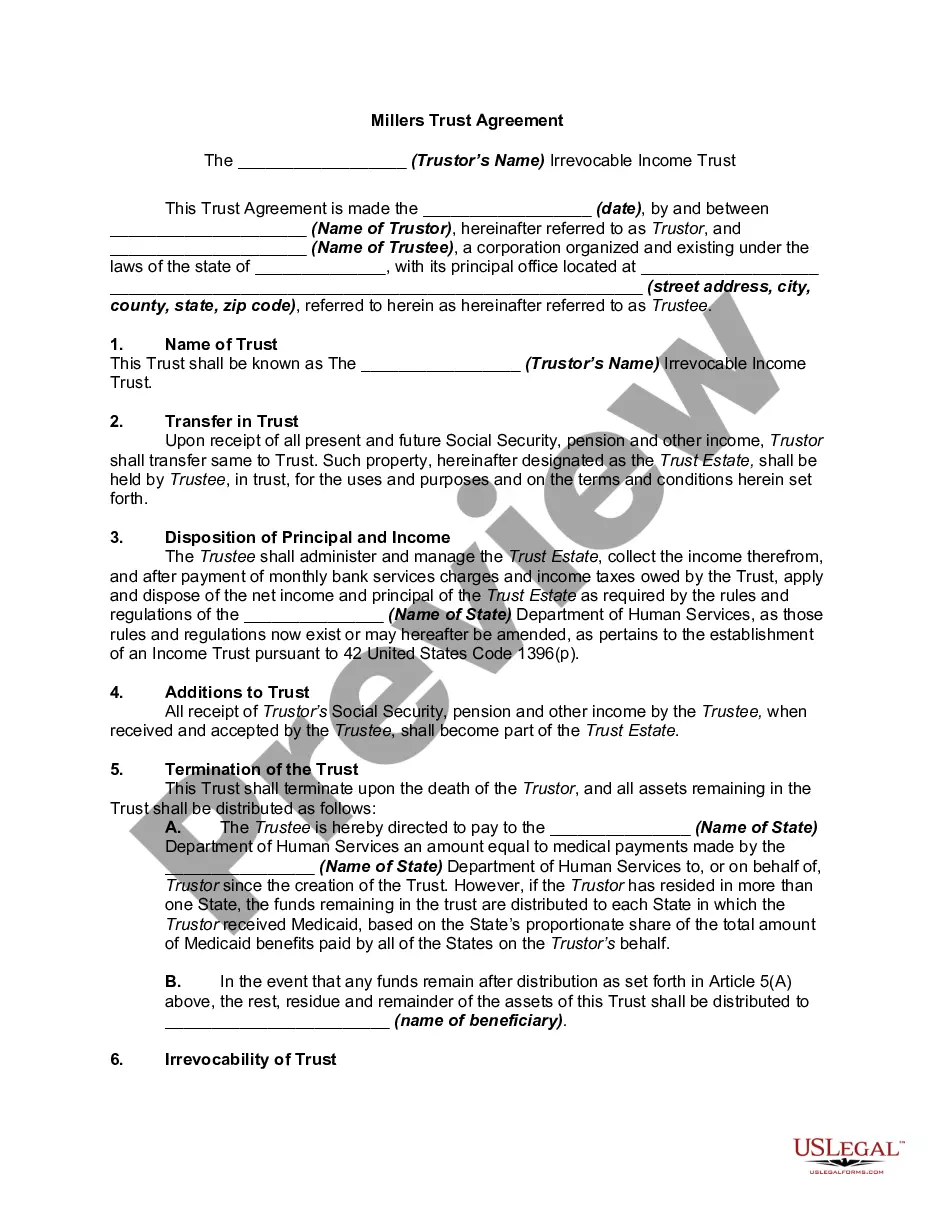
Acquiring a qualified income trust requires careful planning and knowledge of state laws. Begin by seeking assistance from a professional familiar with Medicaid trusts. They can help you create an appropriate trust document that aligns with the qualified trust caps statement with text, ensuring your investment is well-protected and compliant.
To set up a trust for income, begin by defining your goals and the beneficiaries involved. Consulting with a financial planner or attorney will help you create a trust document tailored to your needs, ensuring it qualifies under state regulations. Following these guidelines will maintain your income distribution within the qualified trust caps statement with text.
Setting up a QIT account in Georgia involves several steps, including gathering necessary documentation and working with a legal expert. You will need to create a trust document that adheres to Georgia's legal standards, and then follow specific state guidelines for account management. Ensuring compliance with the qualified trust caps statement with text is vital for Medicaid eligibility.
To get a qualified income trust, start by consulting with a legal professional who specializes in trusts and Medicaid planning. They will guide you in drafting the necessary documents, ensuring that your trust meets state requirements. This process ultimately safeguards your eligibility under the qualified trust caps statement with text.
To establish a qualified trust, certain conditions must be met. First, the trust must be irrevocable and set up specifically for the benefit of one or more individuals, typically regarding Medicaid or other income eligibility programs. Additionally, the trust must comply with state-specific laws to ensure it adheres to the qualified trust caps statement with text.
A trust can reduce taxes by taking advantage of allowable deductions and credits. By properly categorizing and managing income, expenses, and distributions according to a Qualified trust caps statement with text, trustees can potentially lower the overall taxable amount. Working with tax professionals or using legal services, like those offered by uslegalforms, can further streamline this process.
Yes, you can file Form 1041 electronically using approved e-filing software. This option offers convenience and can lead to faster processing times. Incorporating a Qualified trust caps statement with text into your e-filing process ensures that all necessary information is included, enhancing the accuracy of your submission.
To report income from a trust, you typically use IRS Form 1041, detailing the income earned during the year. The income reported flows through to beneficiaries in the form of Schedule K-1, allowing them to report it on their individual returns. Following the guidelines in a Qualified trust caps statement with text can simplify this reporting process and ensure accuracy.
Yes, a trustee can claim legitimate expenses incurred while managing the trust. This includes costs related to administering the trust, legal fees, and any necessary professional services. By understanding the rules outlined in a Qualified trust caps statement with text, trustees can effectively maximize deductions and ensure compliance.
Yes, a Qualified Subchapter S Trust (QSST) must file Form 1041, the U.S. Income Tax Return for Estates and Trusts. This form reports the income generated by the trust, which is crucial for tax compliance. When a trust operates under the guidelines of a Qualified trust caps statement with text, it ensures clarity in reporting its taxable income.